Functional Medicine Marketing: The Complete 2026 Guide
Every marketing channel that works for functional and integrative medicine practices, in the order you should build them, with the compliance realities of healthcare advertising built in.
By Salem Sidi, founder of Wellness Practice Marketing · Updated July 2026 · ~48 min read
What this guide covers
Most functional medicine practitioners are excellent clinicians and reluctant marketers. You spent years learning root-cause medicine, then discovered that the patients who need you most cannot find you, and the ones who find you often choose the conventional clinic down the road because it showed up first on Google.
This guide fixes that. It covers every marketing channel that works for functional and integrative medicine practices, in the order you should build them, with the compliance realities of healthcare advertising baked in. Bookmark it, work through it in stages, and use the checklists in Part 22 to keep yourself accountable.
Part 1
Introduction
Why Marketing Is Different for Functional Medicine Clinics
Functional medicine is not an impulse purchase. Your patients are typically making a considered, high-value decision, often after years of unresolved symptoms and disappointing conventional care. Three things follow from that:
Longer decision cycles. A patient might read your content for weeks or months before booking. Marketing that only asks for the appointment, without building trust first, leaves most of your future patients behind.
Higher transaction values. Initial consultations of 300 to 600 dollars and programs of 2,000 to 10,000 dollars are common. That changes the math: you can profitably spend far more to acquire a patient than a conventional GP can, which makes channels like Google Ads viable even in competitive markets.
Compliance constraints. You cannot promise cures or outcomes. Advertising platforms restrict health claims and personalized-health targeting. Everything in this guide assumes you market education and process, never guaranteed results.
Why Great Practitioners Still Struggle to Get Patients
Clinical skill does not generate demand. The most common pattern we see: a brilliant practitioner relying entirely on word of mouth and an outdated website, watching a less qualified competitor fill their calendar because that competitor ranks in Google Maps, runs search ads, and answers the exact questions patients type into Google at 11pm.
Patients cannot evaluate clinical quality before they meet you. They evaluate signals: reviews, website clarity, content depth, professionalism of your online presence. Marketing is how you make your competence visible.
The Biggest Marketing Mistakes Clinics Make
Treating the website as a brochure instead of a conversion tool
Ignoring Google Business Profile, the single highest-ROI asset in local healthcare
Sending paid traffic to the homepage instead of dedicated landing pages
Posting on Instagram daily while having zero search visibility
Targeting "everyone with health problems" instead of a defined patient
Making outcome claims that create legal and platform-policy risk
Not tracking cost per lead, so every channel decision is a guess
Understanding the Functional Medicine Patient Journey
The typical journey looks like this:
Symptom frustration. Years of fatigue, gut issues, hormonal symptoms, or autoimmune flares. Conventional labs come back "normal."
Research phase. Late-night Google searches: "why am I always tired even with normal thyroid labs," "functional medicine doctor near me," "root cause of Hashimoto's."
Evaluation phase. They compare 2 to 4 practitioners. They read reviews, check credentials, watch videos, and look for evidence you treat their specific condition.
Decision trigger. A new symptom, a dismissive doctor visit, or a piece of your content that finally explains what they are experiencing.
Booking. Usually via online scheduling or a discovery call.
Your marketing needs an asset for every stage: content for research, condition pages and reviews for evaluation, and a frictionless booking path for decision.
How Patients Find Functional Medicine Doctors Today
In order of volume for most clinics: Google Search (organic and paid), Google Maps, referrals from other patients and practitioners, AI assistants like ChatGPT and Perplexity (a fast-growing source, covered in the SEO section), social media, and directories like IFM's Find a Practitioner. Notice that search dominates. That is why Parts 4, 5, and 6 are the core of this guide.
The Difference Between Marketing and Patient Acquisition
Marketing builds awareness and trust. Patient acquisition is the measurable system that turns strangers into booked appointments: traffic source, landing page, offer, follow-up, booking. You need both, but if your calendar is empty, start with acquisition (local SEO and Google Ads) and layer brand-building on top.
The WPM system
The WPM Functional Medicine Patient Acquisition Framework
This is the basic acquisition model we use when thinking about functional and integrative medicine marketing. The goal is not simply to generate clicks. Each step should reduce uncertainty and move a prospective patient closer to a confident decision.
Search Intent
→
Google Ads + SEO + Google Maps
→
Condition-Specific Landing Page
→
Trust + Education
→
Consultation / Booking
→
Follow-Up + Nurture
→
Long-Term Patient Relationship
Channels work together here. Search creates the opportunity, a focused page earns attention, proof and education build trust, and follow-up prevents good enquiries from being lost after the first visit.
Part 2
Building a Marketing Foundation
Define Your Ideal Patient
Write a one-page profile: age range, condition, how long they have struggled, what they have already tried, what they fear, what they want their life to look like, and what they can afford. Every headline, ad, and page you create should speak to this person. A clinic that markets to "women 35 to 55 with unresolved thyroid and hormonal symptoms who have been told their labs are normal" will outperform a clinic that markets to "anyone seeking optimal wellness" in every channel.
Choose Your Niche: Generalist vs Specialist
Specialists win in marketing for three reasons: keywords are cheaper and less competitive ("functional medicine for Hashimoto's" vs "functional medicine"), conversion rates are higher because the patient feels understood, and referral partners know exactly who to send you. You can still treat other conditions. Your marketing should lead with one or two.
If you are unsure, look at your last 20 patients. The conditions you get the best results with, enjoy treating, and that carry high lifetime value are your niche candidates. Gut health, thyroid, women's hormones, and autoimmunity are proven niches with strong search demand.
Create a Clear Value Proposition
A value proposition answers three questions in one or two sentences: who you help, what problem you solve, and how your approach differs. Formula: "We help [ideal patient] resolve [condition/problem] by [differentiated approach], without [common frustration]."
Example: "We help women with stubborn thyroid and hormone symptoms find and treat the root cause with advanced testing and personalized protocols, instead of being told their labs are fine."
Position Your Clinic Against Conventional Medicine
Never attack conventional medicine directly. Your patients still see conventional doctors, and hostility reads as unprofessional. Instead, position around the gaps: appointment length (60 to 90 minutes vs 8), depth of testing, root-cause investigation vs symptom management, and partnership vs prescription. "We work alongside your existing care" is both compliant and reassuring.
Build a Brand Patients Trust
Trust signals for a healthcare brand: real photography of you and your clinic (not stock), credentials displayed clearly, consistent visual identity, professional email address on your own domain, a warm but expert tone of voice, and visible proof (reviews, testimonials, media mentions, professional affiliations like IFM certification).
Develop Consistent Messaging
Document your core messages once: value proposition, three key differentiators, how you describe your process (name it, e.g. "The Root Cause Method"), and the three to five phrases you use to describe patient outcomes in compliant language ("many of our patients report," "our goal is to help you," never "we will cure"). Use this document for every page, ad, and post. Inconsistency erodes trust; repetition builds it.
Understanding Patient Pain Points
The pains that drive functional medicine bookings are rarely just physical. They are: being dismissed ("it's just stress"), normal labs despite obvious symptoms, medication side effects, fear of a lifetime on prescriptions, and the exhaustion of managing their own care. Marketing copy that names these pains specifically converts dramatically better than copy about "holistic wellness." The patient should read your page and think "finally, someone gets it."
For clinics with a self-pay model, read our guide to cash-pay medical practice marketing for a practical approach to service positioning, transparent fees and respectful follow-up without relying on discounts.
Building an Irresistible Offer
The gap between "Book an appointment (450 dollars)" and a stranger on your website is too big. Bridge it with a low-friction entry offer:
Free 15-minute discovery call. The standard, and it works. Frame it as "find out if we're the right fit," not a sales call.
Paid case review (97 to 197 dollars). Filters for seriousness, positions your time as valuable, and converts well to full programs.
Free guide or masterclass for patients earlier in the journey (see lead magnets, Part 10).
Whatever you choose, make it the single primary call to action across your website and ads.
Part 3
Your Website
Why Your Website Is Your Most Important Marketing Asset
Every channel ends at your website. Referrals check it before calling. Ad clicks land on it. Google ranks it. A weak website taxes every euro and hour you spend elsewhere. Before you scale any traffic channel, make sure the destination converts.
Essential Pages Every Clinic Needs
Homepage, About the Practitioner, one page per core service, one page per core condition, New Patients (process, pricing philosophy, FAQs), Contact with booking, Reviews/Testimonials, Blog, Privacy Policy, and medical disclaimer. That is roughly 12 to 20 pages for a solid foundation.
Homepage Best Practices
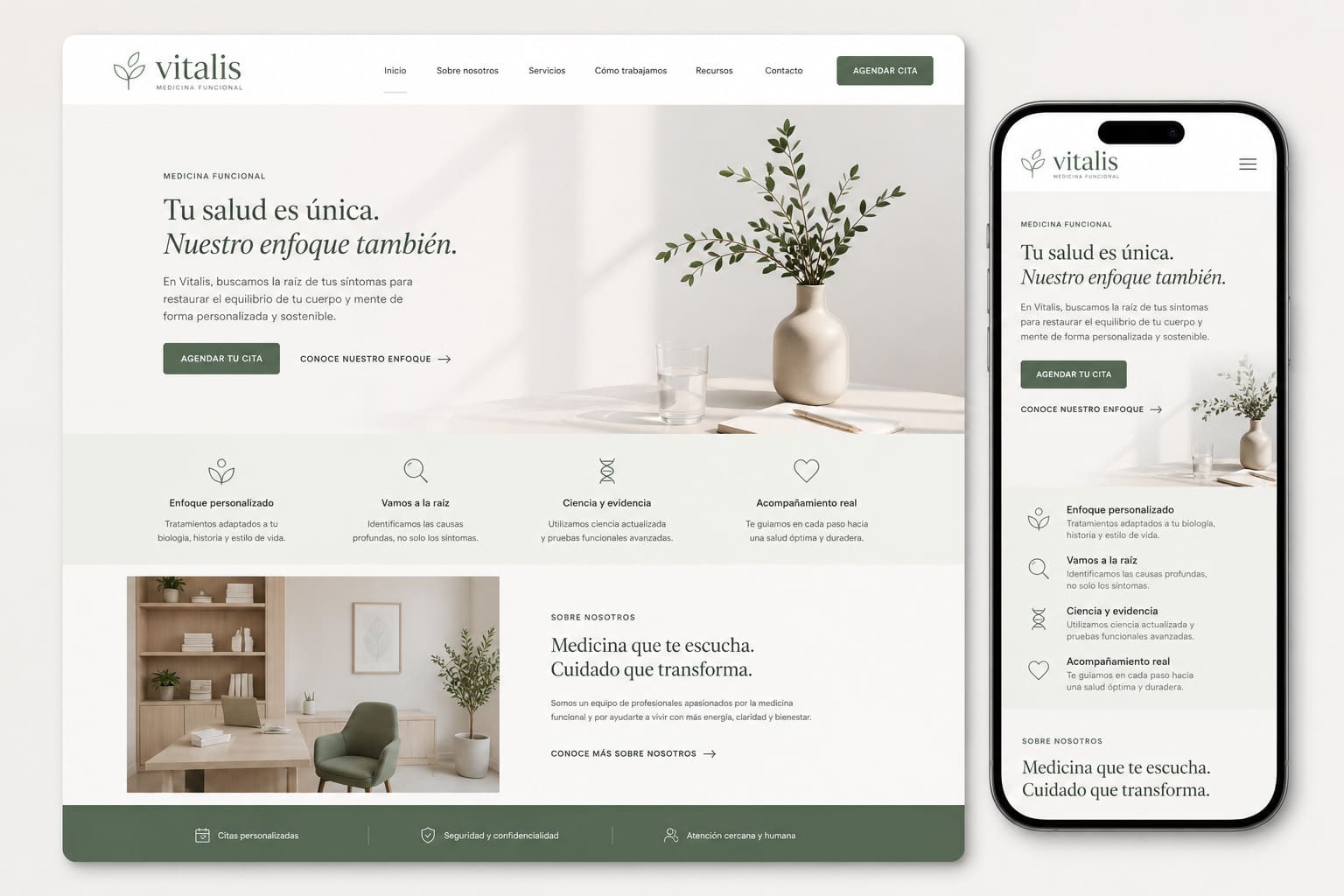
Above the fold: a headline stating who you help and with what, a subheadline with your differentiator, one primary call to action, and a trust bar (review stars, credentials, years in practice). Below the fold: the patient's problem in their words, your process in three steps, conditions you treat (linking to condition pages), practitioner introduction, testimonials, and a final CTA. One goal per page: get the discovery call booked.
Service Pages That Convert
One page per service (functional medicine consultations, advanced lab testing, nutrition therapy, IV therapy, and so on). Structure: what it is, who it is for, what is included, what to expect at the first visit, pricing or pricing range, FAQs, and a CTA. Service pages target commercial-intent keywords like "functional medicine consultation [city]."
Condition Pages
The highest-converting pages on most clinic websites, and the most neglected. One page per condition: Hashimoto's, IBS/SIBO, PCOS, perimenopause, chronic fatigue, and so on. Structure each page:
The patient's experience of the condition, in their language
Why conventional approaches often fall short (respectfully)
How your functional approach investigates root causes
Testing you may use
What treatment involves (process, not promised outcomes)
A relevant testimonial
FAQs
CTA to book a discovery call
Condition pages capture searches like "functional medicine for SIBO" and "natural approach to Hashimoto's," which are the searches your best-fit patients actually make.
About the Practitioner Page
Usually the second most visited page on a clinic site. Lead with the patient, not your CV: why you practice this way, often including your own health story. Then credentials, training, and philosophy. A professional photo and a short video introduction meaningfully increase booking rates from this page.
Testimonials and Social Proof
Collect testimonials that follow a before/journey/after arc, focused on experience and quality of life, not clinical claims. Check your jurisdiction's rules: some regions restrict patient testimonials in healthcare advertising, and HIPAA requires written authorization to use any patient story in the US. Video testimonials outperform text roughly three to one.
Calls to Action That Generate Appointments
Use one primary CTA sitewide ("Book a Free Discovery Call"), placed after every major section, in the header, and as a mobile sticky button. Specific beats generic: "Book Your Free 15-Minute Discovery Call" outperforms "Contact Us" because it tells the patient exactly what happens next and removes fear of commitment.
Mobile Optimization
60 to 75 percent of clinic traffic is mobile. Test your site on a real phone: tap targets large enough, phone number clickable, booking flow completable in under a minute, no horizontal scrolling, forms short. Google indexes the mobile version of your site, so mobile problems are SEO problems.
Website Speed
Aim for a Largest Contentful Paint under 2.5 seconds. The usual culprits are uncompressed images and bloated page builders. Compress images to WebP, lazy-load below-the-fold media, and keep the tech stack lean. Fast sites convert better and rank better.
Online Booking
Every barrier between "I want help" and a booked slot costs you patients. Offer online scheduling for discovery calls (Calendly, Acuity, or your EHR's booking module), embedded on the site, not just linked. Patients research at night; your booking system should work when your front desk does not.
FAQs
An FAQ section on every key page does triple duty: it overcomes objections (cost, insurance, "is this legitimate"), it captures long-tail search queries, and it can earn FAQ rich results in Google when marked up with FAQPage schema. Answer the questions patients actually ask on discovery calls, including the uncomfortable ones about price.
HIPAA and Privacy Considerations
If you serve US patients: no standard analytics or ad pixels on pages where health information is entered, use HIPAA-compliant form and scheduling tools with a signed BAA, encrypt everything, and publish a clear privacy policy. In the EU/UK, GDPR requires a compliant cookie consent setup (Consent Mode v2 if you run Google Ads) and lawful basis for processing health data. Get this right before scaling paid traffic.
Related: everything in this section, clean code, fast loading, condition pages built to convert, is what we build into every site. See our functional medicine web design service for the full breakdown.
Part 4
Local Marketing
Google Business Profile Optimization
Your Google Business Profile (GBP) is the highest-leverage free asset in local healthcare marketing. Optimization checklist:
Primary category: the most specific accurate option (e.g. "Naturopathic practitioner," "Medical clinic," or "Doctor" depending on your credentials)
Complete every field: services, hours, description with your niche keywords written naturally
15 or more real photos: exterior, interior, team, and you with patients (with consent)
Weekly Google Posts with educational content and offers
Q&A section seeded with your top 10 patient questions, answered by you
Booking link connected
Every review responded to within 48 hours
Local SEO Fundamentals
Local SEO means ranking for "[service/condition] + [city]" searches and in the Google Maps pack. The three ranking pillars are relevance (your GBP categories and website content), proximity (your physical location, which you cannot change), and prominence (reviews, citations, links, and overall web presence). You control two of the three. Most clinics barely work either.
Ranking in Google Maps
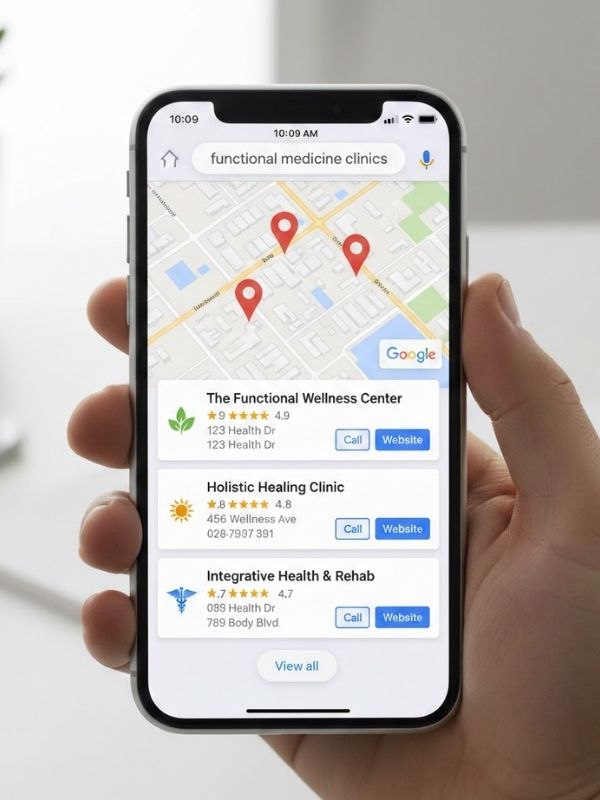
The Maps three-pack gets the majority of clicks for "functional medicine doctor near me." To climb it: nail your primary GBP category, build review velocity (steady new reviews beat a burst of old ones), embed a Google Map on your contact page, ensure your website's city and service pages support your GBP relevance, and earn a handful of local links (chamber of commerce, local news, community organizations).
Local Citations
Citations are mentions of your clinic's name, address, and phone number on directories: Healthgrades, Yelp, Bing Places, Apple Maps, IFM's directory, and local business listings. Build the top 20 to 30 once, accurately, and move on. Citations are foundational, not a growth lever.
NAP Consistency
Your Name, Address, and Phone number must be identical everywhere, character for character. Inconsistencies (Suite 200 vs #200, old phone numbers) erode Google's confidence in your listing. Audit annually or after any move or rebrand.
Reviews and Reputation Management
Reviews are the strongest local ranking factor you can influence and the strongest conversion factor patients see. Build a system, not a hope: ask at the moment of expressed satisfaction (end of a great visit, a positive message), send a direct review link by SMS or email the same day, and make it a front-desk workflow. Target a steady 4 to 10 new reviews per month. Never incentivize reviews, and never gate them (only asking happy patients through a filter tool violates Google's policies).
Community Partnerships
Partner with the businesses your ideal patients already trust: high-end gyms, yoga and Pilates studios, organic grocers, med spas. Offer their communities a free talk or workshop, provide a genuinely useful guide they can share, and set up simple cross-referral agreements. One good partnership can outproduce months of social posting.
Local Events and Workshops
A monthly in-clinic or partner-hosted workshop ("Understanding Your Thyroid Labs," "The Gut-Hormone Connection") does three things: fills your pipeline with warm prospects, generates content (record it), and builds local authority. Charge a small fee or keep it free with registration so you capture emails. Convert with a workshop-only discovery call offer at the end.
Speaking Engagements
Rotary clubs, corporate lunch-and-learns, professional associations, and local conferences all need health speakers. One 30-minute talk to 40 local professionals is worth more than a thousand Instagram impressions. Have one signature talk polished and ready, and mention it on your website so organizers can find you.
Networking with Other Healthcare Providers
Therapists, chiropractors, dietitians, personal trainers, midwives, and even conventional GPs who are frustrated with what they cannot offer their patients: these are your referral network. The approach that works is giving first. Refer to them, invite them for coffee to learn their practice, and make referring to you effortless (a simple one-page referral sheet with your niche, process, and contact). Part 11 covers building this into a system.
Related: we wrote a complete, dedicated breakdown of everything in this section. See our full guide to functional medicine local SEO for Google Business Profile, citations, reviews, and technical local SEO in depth.
Part 5
Search Engine Optimization (SEO)
Why SEO Works for Functional Medicine
Your future patients are searching right now with high intent and specific language: symptoms, conditions, tests, and "functional medicine doctor near me." SEO puts you in front of them at the exact moment of need, compounds over time (a page you publish once can generate patients for years), and costs nothing per click. It is slower than ads, which is why the two work best together (see Part 21).
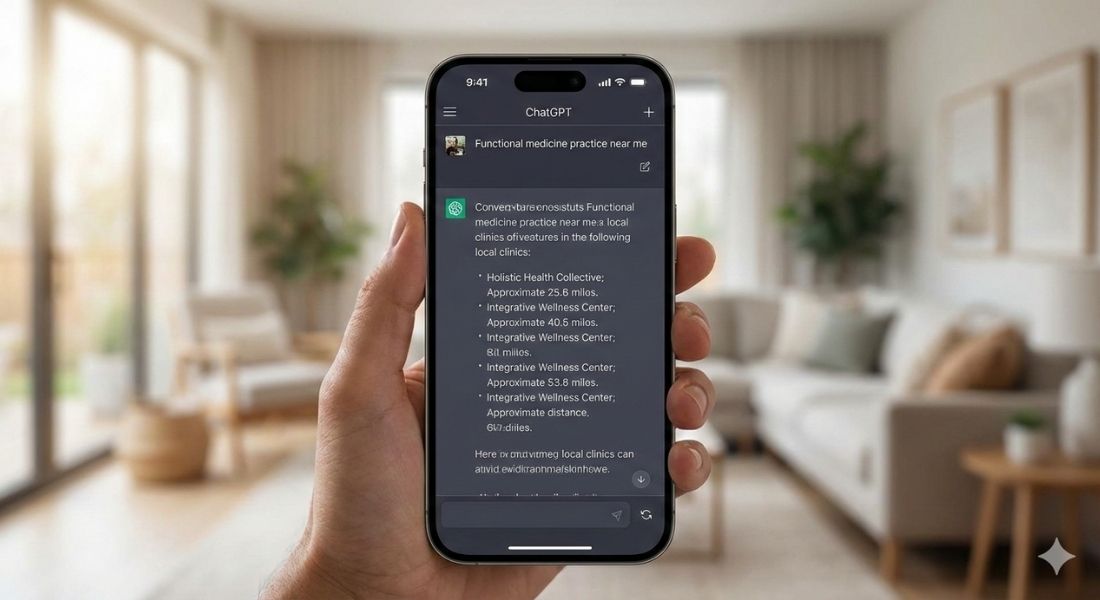
One addition for 2026: GEO, or Generative Engine Optimization. A growing share of patients now ask ChatGPT, Perplexity, and Google's AI Overviews "who is the best functional medicine doctor for thyroid issues in [city]." These systems draw from the same signals as classic SEO, with extra weight on clear entity information (who you are, where you are, what you treat), structured data, reviews, and being cited across the web. Everything in this section improves both.
Keyword Research
Map keywords to the patient journey:
Symptom keywords (research stage): "always tired normal blood tests," "bloating after every meal." High volume, lower intent. Blog content.
Condition + approach keywords (evaluation stage): "functional medicine for Hashimoto's," "root cause of PCOS," "natural treatment for SIBO." Medium volume, high intent. Condition pages.
Service + location keywords (decision stage): "functional medicine doctor [city]," "hormone specialist near me." Lower volume, highest intent. Service and location pages.
Use Google's autocomplete, People Also Ask, and a tool like Ahrefs or the free Google Keyword Planner. Prioritize decision and evaluation keywords first; they book patients fastest.
Service-Based SEO
Each service page targets one primary keyword ("functional medicine consultation [city]") in the title tag, H1, first paragraph, and URL. Support it with related terms naturally (initial visit, lab testing, what to expect, cost). One page, one keyword family. Never split one service across multiple thin pages.
Condition-Based SEO
Condition pages are your SEO goldmine because competition is low and intent is high. A clinic with well-built pages for Hashimoto's, SIBO, PCOS, perimenopause, and chronic fatigue can dominate its local market for those terms within months. Follow the condition page structure in Part 3, target "[condition] functional medicine" and "[condition] treatment [city]" variants, and interlink each condition page with related blog content.
Local SEO
Covered in depth in Part 4. The website side: include your city naturally in title tags and key pages, embed a map, publish a page for each location if you have several, and add LocalBusiness or MedicalClinic schema markup with your NAP, hours, and geo coordinates.
Content Clusters
Organize content in clusters: one comprehensive pillar page per topic (like this guide), supported by 8 to 15 specific articles that link back to it. Example cluster for thyroid: pillar "Functional Medicine Approach to Thyroid Health," supported by articles on reverse T3, Hashimoto's diet, thyroid labs explained, thyroid and perimenopause, and so on. Clusters signal topical authority to Google and to AI systems, which increasingly answer from sources that cover a topic completely.
Internal Linking
Every article should link to its pillar page, its condition page, and at least two related articles, using descriptive anchor text ("functional medicine testing for SIBO," not "click here"). Internal links pass authority to your money pages and keep readers moving toward booking. Audit quarterly: no orphan pages, and your most important pages should have the most internal links pointing at them.
On-Page SEO
The checklist for every page: one keyword-focused title tag under 60 characters, a meta description that earns the click, one H1, logical H2/H3 structure, the primary keyword in the first 100 words, descriptive image alt text, a clean URL (short, keyword, no dates), and schema markup where relevant (MedicalClinic, Physician, FAQPage, Article).
Technical SEO
For a clinic site, technical SEO is mostly hygiene: HTTPS, fast load times, mobile rendering, an XML sitemap submitted in Search Console, no broken links, canonical tags on any duplicate content, and crawlable navigation. Check Google Search Console monthly for coverage errors. If your site is small and clean, technical SEO is a one-time setup plus quarterly checks, not an ongoing project.
Backlink Building
Links remain a core ranking signal. Realistic sources for a clinic: local press (offer expert commentary on health stories), podcast guest appearances (most include a link), professional directories, partner websites (the gyms and studios from Part 4), guest articles for complementary practitioners, and your alma mater or certification bodies. Ten relevant, real links beat a hundred directory spam links. Never buy links.
Measuring SEO Success
Track monthly in Google Search Console and GA4: organic traffic to money pages (not just blog traffic), rankings for your 20 priority keywords, Google Maps actions (calls, direction requests, website clicks from GBP), and, most importantly, discovery calls booked from organic. SEO that grows traffic but not bookings is a content hobby, not a channel.
Part 6
Google Ads
Why Google Ads Is Often the Fastest Way to Get Patients
SEO takes months. Google Ads puts you at the top of the results for "functional medicine doctor [city]" this week. For a practice with capacity to fill, it is usually the fastest lever available, and with consultation values of 300 to 600 dollars and program values in the thousands, the math works: even a 150-dollar cost per booked call is profitable if you convert one in three calls to a program.
Search Campaigns
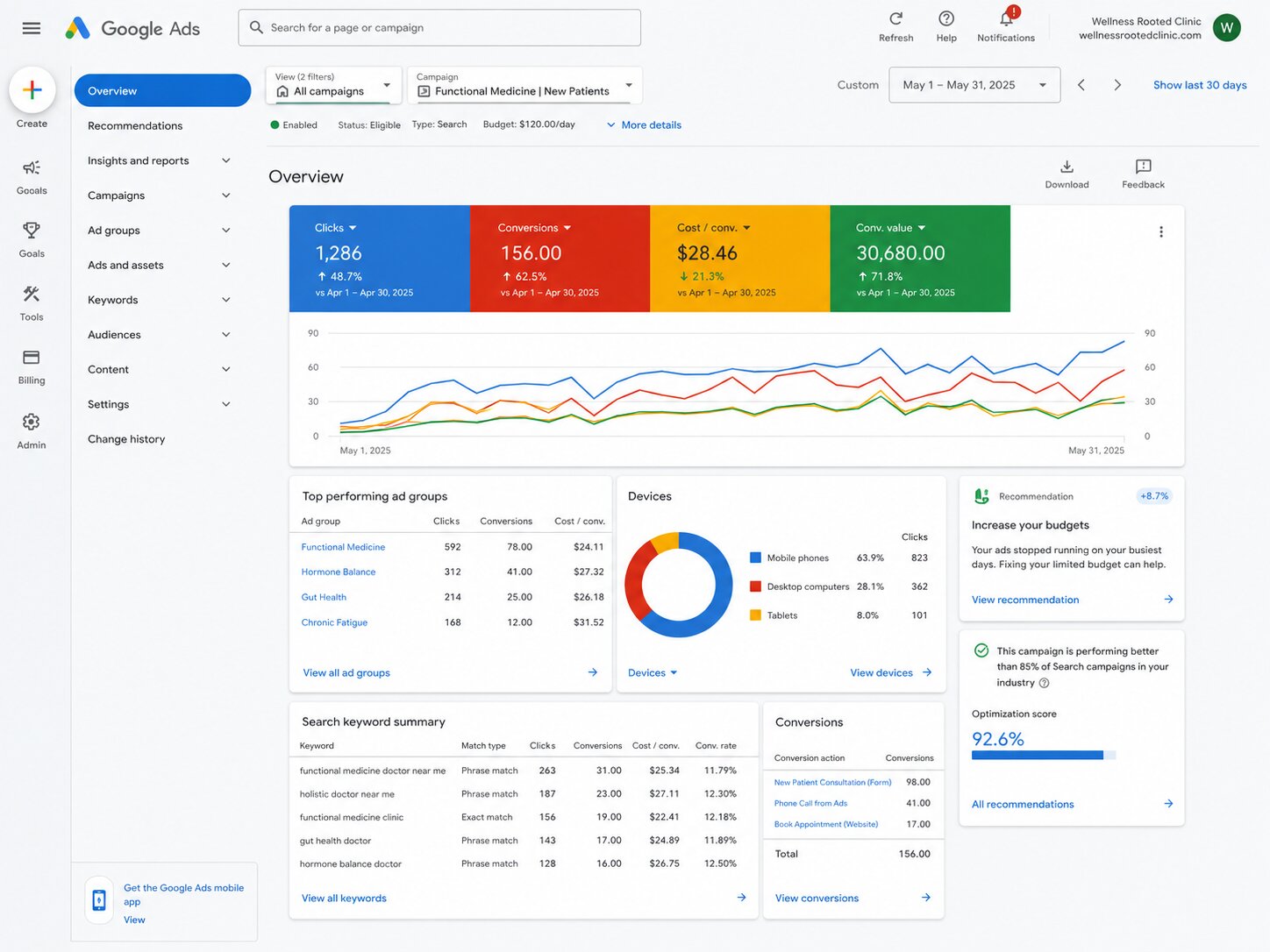
Start with search only. Skip Display, skip Performance Max, skip anything that spends your budget on low-intent placements. One campaign per theme: brand (your clinic name, cheap insurance), core service ("functional medicine doctor [city]"), and one or two conditions ("hormone doctor [city]," "SIBO treatment"). Tight ad groups of 5 to 15 closely related keywords each.
Keyword Research for Ads
Bid on decision-stage keywords only: service + location, condition + treatment + location, and "near me" variants. Use phrase and exact match; broad match with limited data will drain your budget. Build a negative keyword list from day one: free, jobs, salary, course, training, insurance-only terms, and conditions you do not treat. Review the search terms report weekly for the first two months.
Budget Planning
Minimum viable budget: enough for 10 clicks a day in your market. In most US cities that means 1,000 to 2,500 dollars per month in ad spend; in smaller markets or Spain, often less. Expect a learning phase of four to six weeks. Plan for three months before judging the channel, and judge it on cost per booked discovery call, not clicks.
Writing Effective Ads
Compliant, specific, benefit-led. Structure: headline 1 names the search ("Functional Medicine Doctor in Austin"), headline 2 the differentiator ("90-Minute Root Cause Consultations"), headline 3 the CTA or proof ("Book a Free Discovery Call" / "200+ Five-Star Reviews"). Descriptions address the pain: "Told your labs are normal but you still feel unwell? We investigate the root cause with advanced testing and personalized care." No cure claims, no guaranteed outcomes, no before/after implications.
Landing Pages
Never send ads to your homepage. Build one landing page per campaign theme that mirrors the search: same headline language as the ad, one CTA, trust signals, practitioner photo, short explanation of the process, FAQs, and no navigation menu to leak clicks. A matched landing page typically doubles conversion rate versus a homepage, which halves your cost per patient.
Conversion Tracking
Track what matters: discovery call bookings (scheduling tool confirmation page or event), form submissions, and phone calls (call tracking number or Google call reporting). Import these as conversions in Google Ads. In the EU/UK, implement Consent Mode v2 or your conversion data legally cannot be collected from users who decline cookies. Without conversion tracking you are flying blind and Smart Bidding cannot work.
Google Ads Policies for Functional Medicine
Google restricts healthcare advertising. Practical rules: no personalized health targeting (you cannot remarket based on health conditions), no prescription drug terms without certification, no misleading or cure claims, and some treatments (certain IV therapies, stem cells, some hormone claims) face extra restrictions or disapprovals. Write ads about the service and the process, not the patient's condition status ("Get support for thyroid health" is safer than "Do you have Hashimoto's?"). Expect occasional disapprovals; appeal with adjusted language rather than fighting the policy.
Scaling Successful Campaigns
When cost per booked call is profitable for four consecutive weeks: raise budget 20 percent at a time (bigger jumps reset learning), expand to adjacent condition keywords, add a second location radius if relevant, and only then test Performance Max or Meta retargeting (Part 13). Scale the offer too: if discovery calls fill, test the paid case review to raise lead quality.
Functional medicine patients research heavily before booking. Content is how they audition you: it demonstrates depth, communicates your philosophy, and answers the questions they are afraid to ask. It also feeds every other channel: SEO rankings, email newsletters, social posts, and the "prominence" signals that AI search engines use.
Blogging Strategy
Publish two to four articles per month, every one mapped to a keyword and a cluster (Part 5). Quality over volume: one 2,000-word article that genuinely answers "why am I tired all the time despite normal labs" outperforms eight thin posts. Every article ends with a contextual CTA to the relevant condition page or discovery call.
Educational Articles
The workhorse format. Best-performing angles for functional medicine: "what your doctor's labs miss" (optimal vs normal ranges), symptom explainers, testing explainers (GI-MAP, DUTCH, comprehensive thyroid panels), nutrition deep-dives, and myth-busting. Write at the level of an intelligent patient, cite research, and always close the loop to how your clinic investigates the topic.
Patient Success Stories
The most persuasive content you can publish, and the most regulated. Get written consent (HIPAA authorization in the US), focus on the journey and quality-of-life improvements rather than clinical claims, anonymize where required, and add a disclaimer that results vary. Structure: where they started, what they had tried, what the process was like, where they are now.
FAQs as Content
Turn every question from discovery calls into content: a site FAQ entry, a short video, a blog section. "How much does functional medicine cost," "does insurance cover it," and "is functional medicine legitimate" are high-volume searches where honest answers win enormous trust.
Pillar Pages and Content Clusters
Covered in Part 5. From a content-production standpoint: write the pillar first, outline its 10 to 15 supporting articles at the same time, and publish supports at a steady cadence, interlinking as you go. This guide is itself a pillar page; your version might be "The Complete Guide to Thyroid Health" for your niche.
Evergreen Content
Prioritize content that stays relevant: condition explainers, testing guides, process explanations. Refresh top performers annually (update stats, add sections, re-promote) rather than always chasing new topics. A refreshed article often regains rankings within weeks.
Repurposing Content
One pillar article becomes: five social posts, a newsletter, a YouTube video script, three short-form videos, a workshop outline, and a lead magnet chapter. Create once, distribute everywhere. This is how a solo practitioner sustains a multi-channel presence without a content team.
Part 8
Social Media Marketing
Should Functional Medicine Clinics Be on Social Media?
Yes, but with correct expectations. Social media rarely generates patients directly for local clinics. Its jobs are: staying visible to warm audiences (past patients, referral partners, email list), humanizing the practitioner, and providing proof-of-life when prospects check you out during the evaluation stage. Search fills the calendar; social supports the decision. Budget your time accordingly: search first, social second.
Choosing the Right Platforms
Pick one primary platform where your ideal patient spends time, and one secondary. Do those consistently rather than five platforms badly. For most functional medicine clinics targeting women 35 to 60: Instagram primary, Facebook or YouTube secondary. For practitioner-to-practitioner authority or corporate wellness: LinkedIn.
LinkedIn
Underrated for functional medicine. Use it to build referral relationships with other providers, attract corporate wellness contracts, and establish authority (long-form posts about your clinical approach perform well). If your model includes B2B or physician referrals, LinkedIn deserves 30 minutes a week.
Instagram
The default platform for wellness. What works: practitioner-on-camera Reels explaining one concept simply, lab-interpretation carousels, myth vs fact posts, day-in-the-clinic stories, and patient-journey highlights (with consent). Link in bio to your discovery call. Expect Instagram to nurture, not to prospect.
Facebook
Still valuable for local reach and the 45+ demographic. An active business page supports local SEO trust, local community groups allow genuine participation (answer health questions helpfully, never pitch), and Facebook remains the backbone for Meta retargeting ads (Part 13).
YouTube
The highest-ROI social platform for functional medicine because it is also a search engine. Videos like "Thyroid labs explained: why 'normal' isn't optimal" rank for years and pre-sell your expertise better than any other format. Covered fully in Part 9.
TikTok
Worth it only if short-form video comes naturally to you and your demographic skews under 45. Health content faces moderation sensitivity, so keep claims educational and conservative. Repurpose your Reels rather than creating natively.
Pinterest
A quiet performer for recipe, hormone, and gut-health content targeting women. Pins drive blog traffic for years. Low effort if you create pin graphics from existing articles; skip it if bandwidth is tight.
Posting Frequency
Sustainable beats impressive: three to four posts per week on your primary platform, one to two on secondary. Consistency for twelve months outperforms daily posting for six weeks followed by silence, which is the pattern most clinics fall into.
Content Ideas
Rotate five buckets: educate (one concept, simply), humanize (you, the team, the clinic), prove (testimonials, reviews, milestones), engage (questions, polls, common myths), and invite (workshop announcements, discovery call CTA, lead magnet). Roughly 80 percent value, 20 percent invitation.
Community Building
Respond to every comment and DM within a day. A private Facebook group or a simple email community for patients and warm leads deepens retention and referrals far more than chasing new followers. Small and engaged beats large and cold.
Part 9
Video Marketing
Why Video Converts Better Than Text
Patients are choosing a person, not a service. Video transmits warmth, competence, and bedside manner in a way text cannot, which collapses the trust-building timeline. Clinics that add practitioner video to landing pages routinely see booking rates rise 20 to 40 percent.
Educational Videos
Your core format: five to ten minutes, one topic, structured as problem, why it happens, how you investigate it, what patients can do. Map topics to your condition pages and embed each video on the matching page, which improves both conversion and time-on-page signals.
Patient FAQ Videos
Sixty-second answers to real questions: cost, insurance, first-visit expectations, how you differ from their GP. Batch-record ten in one session. Use them on the FAQ page, in email sequences, and as social clips.
Meet the Practitioner Videos
A two-minute video on your About page and homepage: why you practice functional medicine, who you help, what patients can expect. This single asset outperforms almost anything else you can add to your website.
Clinic Tours
A 60-second walkthrough reduces first-visit anxiety, which is a real booking barrier in healthcare. Post it on your GBP, website, and social profiles.
YouTube SEO
Treat YouTube like Google: keyword in the title ("Hashimoto's and Fatigue: What Your Labs Might Be Missing"), a genuine description of 150+ words with your clinic link, custom thumbnail with readable text, chapters, and end screens pointing to a related video and your website. Rank for evaluation-stage searches and let each video work for years.
Short-Form Video
Reels, Shorts, and TikToks: one idea, hook in the first two seconds ("Your thyroid labs are normal. So why are you exhausted?"), 30 to 60 seconds, caption overlay, end with where to learn more. Cut these from your long-form videos to keep production sustainable.
Live Q&A Sessions
A monthly live on Instagram or YouTube ("Ask a Functional Medicine Doctor") generates trust, content, and direct bookings. Collect questions in advance, answer generally (education, not diagnosis, state this clearly), and end with your discovery call invitation. Save and repurpose every session.
Part 10
Email Marketing
Building an Email List
Email is the only audience you own. Build the list from every touchpoint: lead magnet downloads, workshop registrations, discovery call bookings (with consent), and a simple newsletter opt-in on every blog post. A local clinic list of 2,000 engaged subscribers is a patient-generating machine.
Lead Magnets
Offer something your ideal patient urgently wants in exchange for an email. Proven formats: "The Thyroid Lab Guide: 10 Markers Your Doctor Should Test (and Optimal Ranges)," symptom checklists, a 7-day gut-reset food guide, or a recorded masterclass. Specific beats general: a Hashimoto's guide converts better than a "wellness ebook" every time.
Welcome Sequences
Five to seven automated emails over two weeks for every new subscriber: deliver the lead magnet, tell your story, explain your approach, share a patient journey, answer top objections (cost, legitimacy, time), and invite the discovery call twice. The welcome sequence converts more leads than any other email you will ever send, so write it once and write it well.
Educational Newsletters
Weekly or biweekly, one useful idea per email, written like a letter from the practitioner, not a corporate bulletin. Repurpose blog and video content. Every email includes one soft CTA. Open rates of 35 to 50 percent are normal for clinic lists; if yours are lower, fix your subject lines and sender name (use your personal name).
Patient Follow-Up
Post-visit email flows improve outcomes and retention: visit recaps, preparation instructions for testing, program milestone check-ins. Keep clinical specifics inside your patient portal for privacy compliance; email handles logistics and encouragement.
Re-Engagement Campaigns
Two automated flows pay for your email tool by themselves: leads who never booked (a three-email sequence 30, 60, 90 days later with new proof and a fresh invitation) and past patients inactive for six months (a check-in plus a relevant new service or seasonal program).
Appointment Reminders
Automated email plus SMS reminders at booking, 48 hours, and 2 hours before appointments cut no-shows dramatically. For discovery calls, add a short "what to expect" email that pre-frames the conversation and increases show-up rates.
Automation
The minimum viable stack: welcome sequence, lead-nurture sequence, booking reminders, and re-engagement flows. Set up once, review quarterly. Tools like MailerLite, ConvertKit, or your CRM's built-in email cover everything a clinic needs.
Part 11
Referral Marketing
Building a Referral System
Referrals are most clinics' best patients: pre-sold, better fit, higher retention. But "we get referrals sometimes" is not a system. A system means defined partners, a defined process for referring, materials that make it easy, and a rhythm of nurture. Build it like a channel, because it is one.
Physician Referrals
Conventional doctors refer when they trust you and when you solve their problem: the patient they cannot help in eight minutes. Approach: introduce yourself as complementary, not competitive, send excellent care summaries when you share patients, refer appropriately in both directions, and provide a one-page sheet describing exactly which patients you help. One aligned GP or endocrinologist can send you a patient a week.
Nutritionist Partnerships
Nutritionists and dietitians hit walls when clients need testing or medical oversight. You are their escalation path, and they are your maintenance and implementation partner. Formalize the loop: you refer nutrition implementation to them, they refer complex cases to you.
Chiropractor Partnerships
Chiropractors see high patient volume and think holistically already. Their patients with fatigue, gut, and hormonal complaints are your ideal referrals. Offer to be their answer for "the stuff adjustments can't fix."
Therapist Partnerships
The mind-body overlap is enormous: patients with anxiety, depression, and burnout frequently have thyroid, hormonal, or nutritional contributors. Therapists appreciate a trusted medical partner who takes their clients seriously. This is one of the most underused referral channels in functional medicine.
Fitness Professionals
Personal trainers and gym owners hear about plateaus, fatigue, and hormone issues daily. Equip them: a talk for their members, a co-branded guide, a simple referral card. Their recommendation carries real weight with exactly your demographic.
Existing Patient Referrals
Make it easy and expected: mention it at moments of expressed gratitude ("the best compliment is sending someone you care about"), include a line in your newsletter, and give patients something shareable (a guide, a workshop invite) rather than asking them to pitch you. Check your jurisdiction's rules before offering referral rewards; in much of healthcare, incentivized referrals are restricted, so lead with gratitude, not gift cards.
Community Referral Networks
Join or build a local practitioner circle: monthly breakfast with a therapist, chiropractor, dietitian, trainer, and you. Cross-referrals flow naturally from relationships, and the group compounds: every member's marketing becomes partially yours.
Part 12
Reputation Marketing
Getting More Google Reviews
Covered operationally in Part 4. The strategic point: reviews are marketing assets, so treat generation as a weekly workflow with an owner (usually front desk), a tool (direct link via SMS), and a target. Guide happy patients toward mentioning specifics ("what condition brought you in, what was different about the experience"), because detailed reviews convert readers and reinforce your keyword relevance.
Managing Negative Reviews
Respond within 24 hours, publicly and calmly: thank them, acknowledge without confirming they were a patient (privacy law prohibits confirming patient status), and move the conversation offline. Never argue, never reveal health information, never ignore. A gracious response to a bad review often builds more trust with readers than another five-star review would. Flag only genuinely fake reviews for removal; do not try to remove honest criticism.
Building Online Trust
Audit yourself as a skeptical patient would: Google your name and clinic. What appears on page one? Fill gaps with profiles you control: GBP, Healthgrades, LinkedIn, professional directories, press mentions. Consistent, complete, credentialed presence across the web is trust infrastructure, and it is exactly what AI search engines summarize when someone asks about you.
Testimonials
Collect continuously with a simple consent-based process: a post-program feedback form with a checkbox authorizing marketing use (formal HIPAA authorization in the US). Rotate fresh testimonials onto your website quarterly. Match testimonials to pages: a thyroid story on the thyroid condition page, not buried on a generic reviews page.
Video Testimonials
Ask your best-fit patients at the moment of a milestone win. Keep it easy: three questions, filmed on a phone or recorded on Zoom, two minutes maximum. One authentic video testimonial per core condition transforms your landing pages.
Before-and-After Stories, Within Compliance
Focus on function and quality of life, not clinical measurements or implied guarantees: "I have energy for my kids again" rather than "my antibodies dropped 80 percent." Include a visible disclaimer that experiences vary and results are not guaranteed. When in doubt, have your compliance advisor review the format once, then reuse the approved format.
Part 13
Paid Advertising Beyond Google
Meta Ads
Facebook and Instagram ads work differently than Google: you are interrupting, not answering. Cold Meta traffic converts poorly straight to bookings for high-ticket care. What works: promoting lead magnets and workshops to build the list, and retargeting warm audiences. Note Meta's health advertising restrictions: no targeting by health condition and no copy implying knowledge of the viewer's health status ("struggling with Hashimoto's?" will get rejected; "we help patients investigate thyroid health" is safer).
YouTube Ads
In-stream ads targeting viewers of health content in your area can work for established clinics with strong video assets and budgets above 2,000 dollars monthly. For most practices, organic YouTube first; ads only after search is maxed.
LinkedIn Ads
Expensive per click, so reserve them for B2B plays: corporate wellness programs, executive health packages, or practitioner-facing offers. For standard patient acquisition, skip them.
Display Advertising
Cold display is where clinic budgets go to die. The only display worth running is retargeting.
Retargeting Campaigns
The highest-ROI paid tactic after Google Search. People who visited your condition pages but did not book see your ads for the next 30 days: a testimonial, a practitioner video, a lead magnet, a gentle reminder. Small budgets (10 to 20 dollars a day) cover most local audiences. Compliance note: retargeting rules for health websites are strict (no lists built from condition-specific pages in some jurisdictions, and HIPAA implications in the US), so retarget from general pages and get proper consent banners in place.
When Paid Social Makes Sense
After Google Search is profitable and your organic foundation exists. The sequence for a growing clinic: Google Ads, then retargeting, then Meta lead magnet campaigns, then everything else. Clinics that start with Meta because "that's where everyone is" usually burn three months of budget learning this order the hard way.
Part 14
Community Marketing
Educational Workshops
The in-person workshop remains the highest-converting marketing activity in local healthcare: 60 to 90 minutes, one specific topic, genuine teaching, and a soft offer at the end (a workshop-attendee discovery call). Conversion rates of 10 to 30 percent of attendees to consultations are common. Monthly cadence, alternating topics by niche.
Webinars
The scalable version: same structure, delivered online, recorded for evergreen use. Promote through email, social, partners, and modest Meta ads. The recording becomes a lead magnet and the registration list feeds your welcome sequence.
Local Health Talks
Say yes to every reasonable invitation for your first two years: libraries, community centers, church groups, parent associations. Every talk seeds referrals and reviews, and your signature talk gets sharper each time.
Corporate Wellness Programs
Companies pay for lunch-and-learns, executive health screenings, and wellness workshops. Beyond the direct revenue, every session puts you in front of 20 to 100 potential patients with disposable income. Package one offering ("The Energy and Focus Workshop for Teams") and pitch HR departments and office managers directly on LinkedIn.
Health Fairs
Lower yield, but useful for new clinics building local awareness. Make the booth interactive (a symptom self-assessment, a spin on "what your fatigue might mean") and capture emails with a prize draw or free guide rather than hoping people keep a flyer.
Podcasts
Guesting on podcasts is the highest-leverage authority play available: an hour of your time yields a permanent asset, a backlink, an audience of pre-interested listeners, and content to repurpose. Pitch health, wellness, parenting, and local-interest shows with two or three specific episode ideas. Starting your own podcast is optional; guesting is not.
Guest Speaking Opportunities
Professional conferences, practitioner trainings, summit events: each one builds the peer authority that drives professional referrals and positions you for the "best in the region" reputation that AI search engines increasingly reflect back to patients.
Part 15
Strategic Partnerships
Cross-Referrals
The principle across all partnerships: give first, make referring effortless, and formalize the loop. Effortless means partners have your one-page referral sheet, know your exact niche, and can hand a patient a card or link that gets them a warm welcome.
Complementary Healthcare Providers
Beyond the referral relationships in Part 11, consider deeper integration: shared workshops, guest articles on each other's blogs (backlinks plus audience), bundled programs (your protocol plus their implementation), and co-located open evenings.
Functional Nutritionists
Your most natural deep partnership. Consider a formal arrangement: they implement your protocols, you provide their escalation path, and you co-market a signature program. This raises patient outcomes, retention, and both practices' capacity.
Gyms
Boutique and high-end gyms, CrossFit boxes, and studios attract health-invested locals. Offer member perks (a lab-review workshop, a discounted assessment window), train their coaches on when to refer, and sponsor one community event a year.
Yoga Studios
Ideal demographic overlap for hormone, stress, and gut niches. A quarterly "wellness evening" co-hosted at the studio consistently outperforms most digital campaigns for warm lead generation.
Wellness Centers
Med spas, float centers, and recovery studios share your clientele without competing clinically. Cross-promotion is easy and low-cost: reciprocal guides at reception, shared email features, bundled introductory offers.
Pharmacies
Compounding pharmacies especially: they already serve functional and integrative patients, they talk to them daily, and they need prescriber relationships. Introduce yourself to every compounding pharmacy within 30 minutes of your clinic.
Health Coaches
Coaches generate exactly the clients who eventually need testing and medical depth. Build a small stable of coaches who trust you; in return, refer implementation and accountability work to them. This is the referral network with the lowest effort-to-yield ratio in the industry.
Part 16
Conversion Optimization
Why Traffic Alone Doesn't Grow Your Clinic
Doubling conversion rate has the same effect as doubling traffic, and it is usually cheaper and faster. A clinic with 1,000 monthly visitors converting at 1 percent books 10 calls; fix the website to 3 percent and the same traffic books 30. Before you buy more traffic, make sure you are not wasting the traffic you have.
Improving Website Conversion Rates
The levers in order of impact: clarity of the above-the-fold headline, strength and specificity of the offer, visible trust signals (reviews, credentials, faces), page speed, and friction in the booking path. Audit with fresh eyes or a screen recording tool: where do visitors hesitate, scroll past, or leave?
Optimizing Contact Forms
Every field you remove increases completions. Name, email, phone, and one optional message field is enough for a discovery call request. Put the form high on the page, repeat it at the bottom, confirm submissions with a clear "what happens next," and respond within one business hour during office hours (speed-to-lead is the single biggest hidden conversion lever in clinics).
Increasing Phone Calls
Many patients over 45 prefer to call. Clickable phone number in the header on mobile, a human or warm voicemail answering (never a dead line), and front-desk training to convert inquiries into booked discovery calls with a simple script: acknowledge, empathize, explain the next step, offer two time slots.
Improving Appointment Booking Rates
From discovery call to consultation: send a pre-call email that sets expectations, run the call as a structured conversation (their story, whether you can help, what working together looks like, investment, next step), and always end with a concrete invitation. Track your call-to-consult rate; below 30 percent usually means a lead-quality problem or a call-structure problem.
A/B Testing Landing Pages
For most clinics, formal A/B testing needs more traffic than you have. Instead run sequential tests: change one element (headline, offer, hero image) for two to four weeks and compare booking rates. Test big swings, not button colors.
Reducing Patient Friction
Walk your own funnel monthly as a stranger: Google your niche, click your ad or listing, read the page, book a call. Every point of confusion, delay, or doubt you feel, your patients feel more. Fix the funnel before you feed it.
Related: this entire part, in practice, applied to your specific landing pages. See our landing page optimization service for the full system.
Part 17
Marketing Metrics
The Numbers That Matter
Track these monthly on one simple dashboard:
Metric
What it tells you
Cost per lead (CPL)
Total channel spend divided by leads (calls, forms, bookings). Direction matters more than the number.
Cost per appointment
Spend divided by booked discovery calls. The first number that reflects real business impact.
Cost per patient (CPA/CAC)
Spend divided by new patients who start care. The true cost of growth.
Patient lifetime value (LTV)
Average total revenue per patient. Often 2,000 to 8,000+ dollars in functional medicine. Determines how much you can afford to spend per patient.
Return on marketing investment
Revenue attributable to marketing divided by marketing cost. Healthy programs run 3x to 8x.
Website conversion rate
Bookings divided by visitors. 2 to 5 percent is a solid range for clinic sites.
Organic traffic
To money pages specifically (service and condition pages), not vanity blog totals.
Paid traffic
With cost, conversion rate, and cost per booking by campaign.
Referral sources
Ask every new patient how they found you and record it. One question, asked consistently, beats most dashboards.
Part 18
What Stage Is Your Clinic In?
The right marketing priority depends on the foundation you already have. Use this diagnostic to identify the next bottleneck rather than adding another disconnected channel.
Stage 1
Word-of-mouth dependent
Typical situation
Most new patients come from referrals
Google visibility is inconsistent
No reliable acquisition system
Priority
Website
Google Business Profile
Basic SEO
Tracking
Stage 2
Growing but inconsistent
Typical situation
Some Google traffic
Some paid leads
Results vary month to month
Priority
Google Ads
Landing pages
Conversion tracking
Stronger Local SEO
Stage 3
Established and ready to scale
Typical situation
Strong existing reputation
Multiple services and existing traffic
Acquisition is not properly measured
Priority
Conversion optimization and attribution
SEO expansion
Campaign segmentation
Retention and nurture
Marketing for a Multi-Practitioner Clinic
Brand the clinic's method, not just the founders, so the practice is not hostage to one person's face. Build practitioner bio pages with individual schema and reviews, market by specialty per practitioner, and centralize lead handling so speed-to-lead does not depend on whoever is least busy.
Marketing for Telehealth Practices
You trade proximity for reach: local SEO matters less, condition-based SEO and content matter more, and your market is anyone in the states or regions where you are licensed. Clarify licensing coverage prominently, invest heavily in video (trust must be built entirely remotely), and expect longer nurture cycles, which makes email and webinars your core channels.
Marketing for High-End Concierge Practices
Fewer patients at far higher values changes everything: personal brand and reputation dominate, referrals and strategic partnerships outproduce ads, exclusivity beats availability in messaging, and content should signal depth and discretion rather than volume. A waitlist, published membership pricing, and a rigorous application process are marketing assets in themselves.
Part 19
Marketing by Specialty
The playbook adapts by niche. For each specialty: build a dedicated condition page, a content cluster, a specific lead magnet, and matched ad campaigns.
Gut health: enormous search demand (SIBO, IBS, bloating, GI-MAP). Content and SEO dominate. Lead magnet: gut symptom assessment or food guide.
Hormone health: high commercial intent, strong Google Ads performance ("hormone specialist [city]"). Compliance care needed around HRT claims.
Women's health: broad umbrella; niche down to a life stage or condition for marketing purposes.
Men's health: underserved and growing. Men respond to performance and data framing (energy, focus, testosterone, metrics) more than wellness language. LinkedIn and podcast channels overperform.
Autoimmune conditions: patients are highly educated researchers. Deep, evidence-referenced content wins. Facebook communities are unusually active.
Thyroid health: the classic functional medicine niche; "normal labs but symptomatic" is your core message and a proven content angle.
PCOS: young, online demographic. Instagram, TikTok, and Pinterest genuinely work here, alongside strong search volume.
Menopause: surging search demand and cultural moment. Empathetic, dismissal-focused messaging ("you're not imagining it") converts strongly.
Chronic fatigue: desperate, skeptical audience burned by past promises. Proof, patience, and process-focused messaging matter more than anywhere else.
Weight management: highest competition and strictest ad policies (weight-loss claims face heavy restrictions, GLP-1 era has changed the conversation). Differentiate on metabolic health investigation, not pounds promised.
Longevity medicine: affluent, data-driven patients. Position around testing depth, biomarkers, and optimization. Concierge economics apply.
Preventive health: hard to sell directly (nobody searches for prevention); package it inside executive health, longevity, or annual deep-dive assessments.
Metabolic health: rising search category (insulin resistance, prediabetes, CGMs). Strong content opportunity with a data-forward audience.
Part 20
Common Marketing Mistakes
Relying only on social media. Followers are not patients; search intent is where bookings live.
Ignoring local SEO. The Maps pack takes the clicks while you perfect your Instagram grid.
Sending paid traffic to the homepage. Halves your conversion rate and doubles your cost per patient.
Trying every channel at once. Two channels done excellently beat six done poorly, every time.
Targeting everyone. The generalist message converts no one deeply.
Weak positioning. If patients cannot say why you over the clinic down the road, price becomes the deciding factor.
Inconsistent branding. Different messages, visuals, and offers across channels quietly erode trust.
Not measuring results. Without cost per patient by channel, budget decisions are folklore.
Part 21
Frequently Asked Questions
What is the best marketing strategy for a functional medicine clinic?
A conversion-ready website with condition pages, an optimized Google Business Profile with steady reviews, and Google Ads on decision-stage keywords, in that order. This foundation produces patients within 90 days; content, email, and partnerships then compound on top of it.
How much should I spend on marketing?
Growing practices typically invest 5 to 10 percent of target revenue. A practical floor for a clinic serious about growth: 1,500 to 3,000 dollars monthly across ad spend and marketing support, justified by patient lifetime values in the thousands.
Is SEO better than Google Ads?
They answer different timelines. Google Ads produces patients in weeks and stops when you stop paying. SEO takes three to nine months and compounds for years. Run ads for immediate flow, build SEO for durable flow, and let ads data inform which keywords deserve SEO investment.
Should I hire a marketing agency?
Hire when your time is worth more in the clinic than in the ad account, and hire specialists: an agency that works only with healthcare or wellness practices will know the compliance landscape, the patient psychology, and the benchmarks that generalists learn at your expense. Ask any agency for niche-specific results before signing.
How long does SEO take?
Local SEO and Maps improvements: often 1 to 3 months. Competitive condition and service keywords: 3 to 9 months. Content clusters and authority: 6 to 12 months to full effect. Anyone promising page one in weeks is selling something other than SEO.
Which social media platform works best?
For most clinics: Instagram for nurture, YouTube for search-driven authority, LinkedIn for professional referrals and corporate wellness. Pick based on where your ideal patient actually spends time, and commit to one platform consistently before adding a second.
How can I get more patient reviews?
Ask at the moment of expressed satisfaction, send a direct Google review link by SMS the same day, and make it a named weekly workflow with a monthly target. Consistency beats campaigns: 4 to 10 new reviews per month, every month.
How many new patients should I expect each month?
Depends on budget, market, and capacity, but as a working model: a 2,000-dollar monthly ad budget at a 150-dollar cost per booked call yields around 13 discovery calls; at a 33 percent conversion rate, that is 4 to 5 new patients monthly from ads alone, before SEO, referrals, and reviews contribute. Track your own numbers from month one; your funnel data beats any benchmark.
Part 22
Resources
The 90-Day Marketing Action Plan
Days 1 to 30: Foundation. Define your ideal patient and niche. Rewrite your homepage around your value proposition. Build or fix three condition pages. Fully optimize your Google Business Profile. Launch your review-generation workflow. Install conversion tracking.
Days 31 to 60: Acquisition. Launch Google Ads search campaigns with dedicated landing pages. Publish your first lead magnet and welcome sequence. Book two referral-partner conversations. Publish four cornerstone articles for your niche cluster.
Days 61 to 90: Momentum. Review ad data and cut what is not booking calls. Host your first workshop or webinar. Add practitioner video to your key pages. Pitch three podcasts. Build your monthly metrics dashboard and hold a monthly marketing review with yourself or your team.
Checklists
Use these as recurring audits:
Website checklist: essential pages, one CTA sitewide, mobile experience, speed under 2.5s LCP, schema markup, privacy compliance
Local SEO checklist: GBP complete, categories correct, NAP consistent across top 30 citations, map embedded, local links growing
Google Business Profile checklist: weekly post, new photos monthly, Q&A maintained, all reviews answered within 48 hours
Google Ads checklist: search-only campaigns, negative keywords reviewed weekly, dedicated landing pages, conversion tracking verified, cost per booked call trending down
Content checklist: every article mapped to a keyword and cluster, internal links added, CTA present, top performers refreshed annually
Monthly marketing audit: review the nine metrics in Part 17, one improvement action per channel, kill or fix anything below benchmark for two consecutive months
Recommended Tool Categories
Scheduling (Calendly, Acuity, or EHR-native), email (MailerLite, ConvertKit), SEO (Google Search Console, Ahrefs or Semrush), reviews (direct GBP links or a reputation tool), call tracking (CallRail or similar), analytics (GA4 with consent-compliant setup), and design (Canva for social and lead magnets).
Final Word
You do not need every tactic in this guide. You need the right five, executed consistently: a website that converts, a Google Business Profile that ranks, a review system that never stops, one paid channel that profitably books calls, and one relationship channel that compounds. Start there, measure honestly, and add channels only when the foundation is full.
This guide is for educational purposes and does not constitute medical, legal, or compliance advice. Verify advertising and privacy requirements for your jurisdiction and credentials.
You can implement this yourself, or we can build it with you.
The strategy in this guide reflects the same core principles we use when working with functional and integrative medicine practices.