
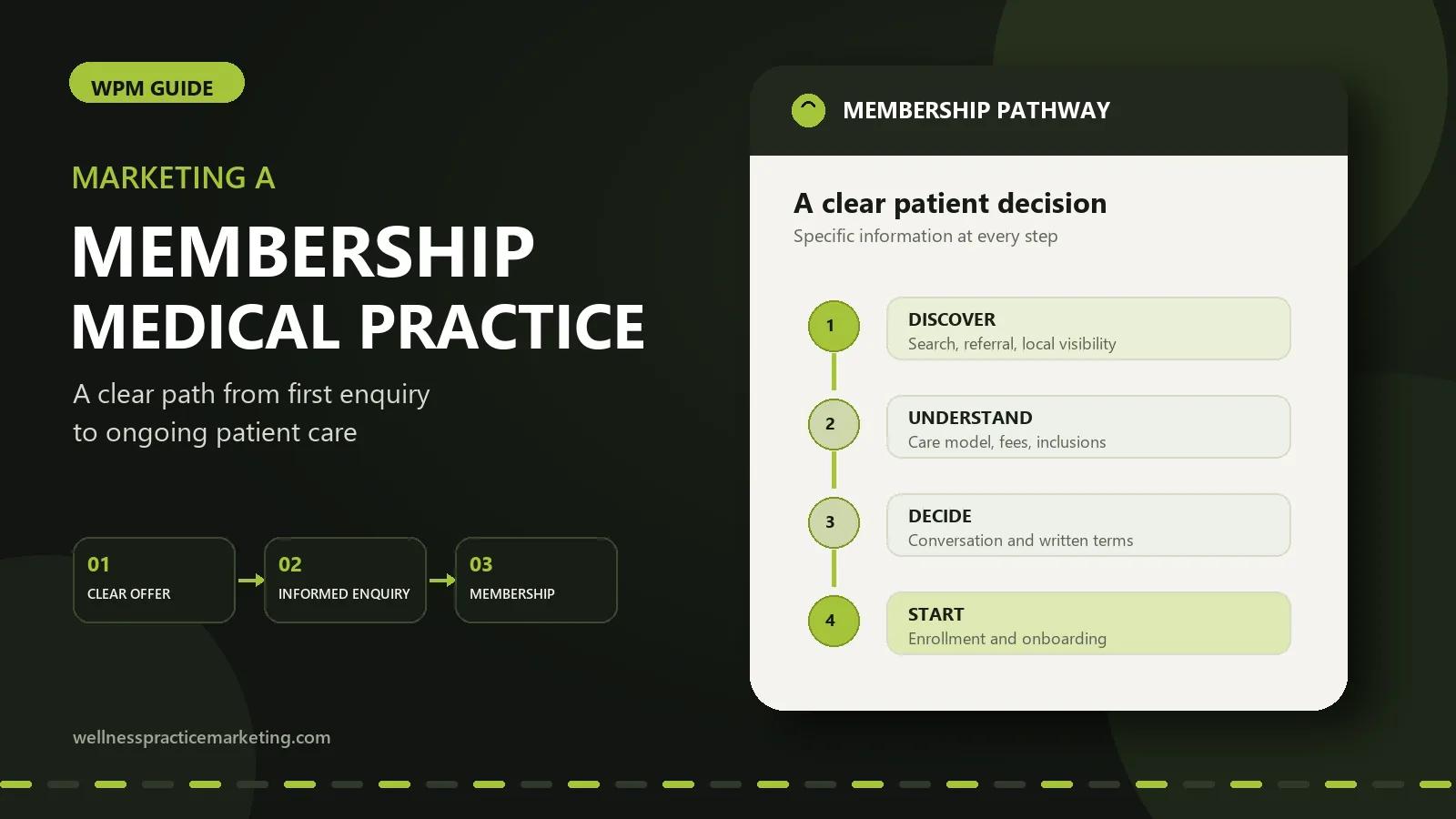
Short answer: market a membership or concierge medical practice by making the recurring relationship concrete. Explain who the practice is for, what the fee includes, what remains separate, how access works, who provides care and what happens before someone enrolls. Then promote that clear offer through professional referrals, local visibility and high-intent search.
The biggest marketing mistake is trying to sell the label. Most prospective patients are not looking for a "premium healthcare experience." They are deciding whether a particular clinical relationship, level of access and financial commitment make sense for them. If the website cannot explain that decision plainly, more traffic will create more confused enquiries.
This guide is intentionally narrower than our broader article on marketing a cash-pay medical practice. It focuses on the recurring membership decision, including panel capacity, enrollment, transitions, retention signals and the additional trust required when a patient is considering an ongoing fee.
Scope note: "membership," "concierge," "retainer" and "direct primary care" can describe different arrangements. This is marketing guidance, not legal, medical, billing or insurance advice. Have qualified advisers review the actual agreement, patient transition, claims, privacy and local rules.
1. Define the Model Before You Promote It
Start with the contract and care model, not a campaign. A recurring fee can pay for a defined group of primary care services, enhanced access, non-medical amenities, ongoing wellness support or a combination of elements. Those are not interchangeable. The marketing must reflect what the clinic truly provides.
The American Academy of Family Physicians describes direct primary care as a model that typically charges a monthly, quarterly or annual fee covering all or most primary care services. It also distinguishes DPC from concierge care, which may continue to bill insurance for covered services.[1] Do not call a specialty wellness membership "DPC" simply because it charges monthly.
Create an internal model sheet with answers to these questions:
- Clinical scope: Which visits, services and communications are included?
- Access: What appointment availability or communication channels are offered, and during which hours?
- Additional costs: Which labs, imaging, medications, procedures, outside services or visits are billed separately?
- Insurance relationship: Does the practice bill any payer for covered services, provide documentation or operate fully outside insurance?
- Term: Is billing monthly or annual? What are the renewal, pause and cancellation arrangements?
- Eligibility: Are there age, location, licensing or administrative criteria?
- Boundaries: What is not covered, including emergencies and care outside the practice?
Give the completed sheet to clinical, billing, legal and front-desk stakeholders. If they describe the membership differently, advertising is premature. The patient should hear the same explanation on the website, during the first call and in the written agreement.
The AMA Code of Medical Ethics says physicians entering retainer contracts should present the terms clearly, including known implications for existing insurance, and should not imply that the arrangement provides more or better medical services.[2] That is a useful marketing discipline even where a different professional code applies: sell the real arrangement, not a suggestion of superior care.
2. Set the Panel and Capacity Target First
A membership campaign needs a capacity target. "More members" is not specific enough. The practice must know how many additional relationships it can support while delivering the access and continuity described in its offer.
Work backward from operating capacity:
Available membership capacity = safe panel target minus active members.
Required consultations = desired new members divided by the practice's observed consultation-to-enrollment rate.
Required enquiries = required consultations divided by the observed qualified-enquiry-to-consultation rate.
Use the clinic's own data. If it has none, label early figures as planning assumptions and replace them quickly. Do not borrow an industry conversion rate to make the forecast look certain.
Capacity is more than appointment slots. Consider secure messages, care coordination, renewals, urgent requests, clinician leave and follow-up work. A practice that advertises unusually responsive access must protect the staffing and boundaries needed to deliver it. Otherwise, acquisition success erodes the reason patients joined.
Define a stop or waitlist point before launch. When the available panel is nearly full, change the call to action from immediate enrollment to a transparent waitlist or consultation schedule. Manufactured scarcity is unnecessary. Real capacity is a legitimate operational limit when explained honestly.
3. Position the Membership Around a Care Relationship
Weak concierge positioning relies on status words: elite, VIP, exclusive, luxury or white-glove. That language may attract attention, but it rarely explains the healthcare decision. It can also create an uncomfortable implication that paying the retainer buys better medical judgment.
Build the message around four concrete elements:
- The person: the type of patient or situation the model is designed to serve.
- The relationship: how ongoing care is organized, including the first clinical step and follow-up rhythm.
- The practitioner: credentials, scope, location and why this clinician is relevant.
- The terms: recurring fee, included services, separate costs and how to leave the arrangement.
A useful homepage statement might say: "Ongoing physician-led primary care for adults in [location], with scheduled preventive visits, same-week appointment access where available and secure communication during published office hours. Membership terms and fees are shown below." Every phrase must match the actual practice.
Avoid positioning against conventional or insured care. Saying other doctors "do not listen" or "only treat symptoms" is not evidence of your value. Describe your visit structure, coordination process and communication model. Prospective patients can decide whether those differences matter to them.
Choose a priority member profile, not a vulnerable fear
A target profile can be administratively useful without exploiting health anxiety. Define location, service need, care preference, availability and payment fit. Do not create ads that imply the viewer is personally known to have a diagnosis, or that delaying membership will place their health at risk.
For an established practice, examine which current patient groups use the model well and which expectations create friction. Interview staff about repeated pre-enrollment questions. Review anonymized enquiry themes. The best positioning often comes from clarifying what appropriate prospects already ask, not inventing a dramatic brand promise.
4. Build a Membership Page That Answers the Decision
Do not send membership traffic to a general homepage. Create one dedicated page that a careful person can read without scheduling a sales call just to learn the basics. This is both a conversion asset and a qualification tool.
A complete membership page should contain:
Fit
Who the membership is designed for, where care is available and any administrative eligibility requirements.
Care structure
The first appointment, included follow-ups, routine communication and how ongoing needs are handled.
Clear terms
Fee, billing frequency, inclusions, exclusions, separate charges, renewal and cancellation information.
Trust
Practitioner credentials, real photographs, location, professional role and a restrained explanation of the approach.
Boundaries
Emergency instructions, response expectations, insurance relationship and services outside the agreement.
Next step
A direct enrollment route only when appropriate, or a short administrative conversation with a clear purpose.
Publish the price. If there are tiers, make the differences understandable without forcing a visitor to compare a dense feature table. If the exact amount varies, explain why, show the meaningful range if appropriate and state when the written amount will be provided.
Do not hide material exclusions in tiny text. Put likely additional costs near the fee. Make it clear whether insurance may still be billed, whether the membership replaces insurance, and what patients should do for urgent or emergency care. The public page is not the contract, but it should not contradict or obscure it.
Use the practitioner page to deepen trust rather than repeat sales copy. Show full credentials, relevant experience, licensure where useful, professional interests and the actual care locations. Our functional medicine website design guide explains how service, practitioner and concern pages should work together.
5. Design a Low-Friction Enrollment Path
A recurring commitment often needs more explanation than a single appointment. That does not justify a long funnel with a webinar, application, discovery call and sales consultation for everyone. Use the shortest path that allows an informed decision and appropriate administrative checks.
A practical pathway is:
- Page visit: the prospect understands the model, fee and key exclusions.
- Administrative enquiry or consultation: staff confirm location, service fit, availability and payment structure without diagnosing.
- Clinical first step: when required, the person meets the appropriate clinician before any care plan is assumed.
- Written terms: the prospective member receives the agreement and enough time to review it.
- Enrollment and onboarding: payment, records, communication instructions and first appointments are handled securely.
Test this path on a phone. Count screens, required fields and handoffs. If the website says "join now" but the scheduler only offers an unexplained discovery call, the experience feels inconsistent. If staff cannot answer what the fee includes, the page has not solved the operational problem.
Keep public marketing forms short. Ask for contact details, preferred communication and the minimum administrative routing information. Do not invite a detailed medical history into an ordinary lead form. In the United States, HHS says HIPAA rules apply when regulated entities collect or disclose protected health information through tracking technologies, and it explains that a business associate agreement may be required in relevant vendor relationships.[5] The bulletin also notes a 2024 court order that vacated part of earlier guidance, so clinic-specific review matters.
Separate marketing communication from clinical onboarding. A person requesting membership information has not necessarily consented to newsletters or advertising audiences. Use appropriately reviewed systems for records, intake and patient communication.
6. Choose Channels That Match Enrollment Intent
Professional and patient referrals
Membership models can be unfamiliar, so trusted introductions are valuable. Give referral partners a one-page explanation with the patient profile, real service scope, location, first step and link to complete terms. Do not offer clinical claims or ask partners to promise access the practice cannot guarantee.
Existing patients may also refer, but the request should be neutral and privacy-conscious. Provide a public page they can share. Do not ask them to reveal diagnoses or sell the model to friends. A clear explanation travels better than a promotional script.
Local SEO and Google Business Profile
People may search for a membership doctor, concierge physician, direct primary care practice, functional medicine membership or a service-specific clinician. These searches do not all mean the same thing. Create content only where the actual model and search intent differ.
Use accurate categories, services, hours, location and appointment links on an eligible Google Business Profile. Connect the membership page to a detailed practitioner profile and relevant service pages. Our integrative medicine SEO guide covers the wider site and local search structure.
Avoid thin location pages and invented offices. If telehealth is available, state the jurisdictions the practitioner can actually serve. Do not use a national page to imply nationwide care when licensing is narrower.
Google Search Ads
Paid search can reach people already comparing a provider or care model. Start with tightly grouped themes such as concierge doctor plus location, membership primary care plus location, and the real service or practitioner type. Keep DPC terms separate if the clinic is not a direct primary care practice.
Send every ad to the membership page, not the homepage. Review search terms for jobs, software, definitions, training, unrelated insurance and locations outside the service area. Use ads to communicate the real model, not to force urgency.
Google restricts some healthcare content, prescription drug services, drug terms and treatments, with rules that vary by location and may require certification.[4] Google also treats health as a sensitive interest category and does not allow advertiser-curated audiences such as Customer Match and data segments for sensitive health promotion.[3] A search campaign still requires a current policy review of ads, keywords, landing pages, services and target locations.
For campaign structure, read our guide to Google Ads for functional medicine. For measurement, use the distinction between actions and patient outcomes in our clinic conversion tracking guide.
Educational email
Email can help someone who understands the model but is not ready to decide. Build a short sequence around practical questions: how membership works, who provides care, fees and exclusions, the first appointment, communication boundaries and how to ask questions. Do not turn uncertainty into a pressure campaign.
Stop the sequence when the person enrolls, declines or opts out. Appointment and patient communication should not depend on optional marketing consent. Use a process appropriate for the privacy and communications rules in the relevant market.
7. Handle an Existing-Patient Transition Carefully
Moving an established practice toward a retainer model is not an ordinary product launch. Current patients may be worried about continuity, affordability or whether they will lose access to a trusted clinician. Marketing language should not minimize those concerns.
Coordinate the transition with legal, billing and professional advisers before announcing it. Prepare a plain-language notice that covers the date, options, fees, insurance implications where known, record access, continuity arrangements and a route for individual questions. Train staff before messages go out.
The AMA ethics guidance says participation should be voluntary and that physicians should facilitate transfer of care for patients who choose not to participate.[2] The exact duties depend on profession and jurisdiction, but the communication principle is broadly sound: explain choices without implying abandonment or inferior treatment for declining.
Do not use a countdown timer against current patients. Do not present a reduced panel as proof of better outcomes. If enrollment is limited by genuine capacity, provide the date and process accurately. Document how questions and complaints are handled.
For a new practice without an existing panel, use the same clarity from the beginning. Our guide to getting the first 50 functional medicine patients provides a launch-stage framework for referrals, local visibility, search and intake.
8. Measure Enrollment and Early Member Experience
Membership marketing should not be judged by lead volume alone. A low-cost form submission may be irrelevant. A smaller number of informed consultations can be more useful if the practice understands what happens next.
| Stage | Working definition | Why it matters |
|---|---|---|
| Genuine enquiry | A deduplicated contact asking about the practice or membership | Removes spam and repeated contacts |
| Administratively qualified | Matches service, location, availability and payment criteria | Separates relevant demand from broad interest |
| Consultation scheduled | A confirmed first conversation or clinical step | Shows whether the offer leads to action |
| Consultation attended | The scheduled step took place | Reveals reminders and no-show friction |
| Member enrolled | Agreement completed and initial payment processed | Measures the actual acquisition outcome |
| Activated | Onboarding and first promised step completed | Tests whether enrollment becomes usable care |
| Cancellation reason | A consistently coded, voluntarily supplied reason | Identifies expectation, fit or delivery problems |
Review results by source, keyword theme and landing page. Record why suitable prospects do not enroll: unclear scope, timing, fee, insurance expectations, no available appointment, location, practitioner mismatch or no response. Do not label every loss as price resistance.
Track early cancellations and onboarding failures separately from acquisition. If people join and quickly leave because access or inclusions differed from their expectations, the problem may be message accuracy or service delivery. More advertising will make it worse.
Calculate acquisition economics using real contribution and retention data, not gross membership revenue. Include advertising, management, sales or intake time, onboarding and any promotion. Avoid assigning a lifetime value until the practice has enough mature cohorts to support the assumption.
9. Adapt the Message for the United States, United Kingdom and Canada
The strategic principles can travel, but medical advertising, professional rules, privacy, contracts, insurance and recurring billing requirements do not transfer unchanged between countries, states, provinces or professions.
In the United States, the FTC says advertising must be truthful and not misleading, and advertisers need adequate substantiation before making objective health-related claims.[6] Do not treat a disclaimer as permission to publish an unsupported treatment or outcome claim.
In the United Kingdom, CAP identifies Section 12 of its Code as the section covering marketing communications for medicines, medical devices, health-related products and beauty products, with additional guidance for therapies and substantiation.[7] Review the actual service, practitioner status, claims and media before launch.
In Canada, Health Canada states that health product advertisements must not be false, misleading or deceptive, and that only authorized health products may be advertised, with specific requirements for prescription drug advertising to consumers.[8] Provincial professional requirements and privacy rules may add further obligations.
Use separate market reviews when a practice serves more than one country. Change claims, terminology, locations and calls to action where needed. A US page should not be copied into a UK or Canadian campaign simply because the language is English.
10. A Practical 90-Day Marketing Plan
Days 1 to 30: make the model clear
- Complete the internal model sheet and resolve contradictions.
- Confirm the safe panel target and available capacity.
- Review the agreement, transition, claims, privacy and billing with appropriate advisers.
- Write the membership page, practitioner page and first-contact explanation.
- Test every form, phone link, scheduler and mobile screen.
- Create stage definitions for enquiry through activation.
Days 31 to 60: launch controlled acquisition
- Brief a small group of relevant professional referral partners.
- Update eligible local profiles and connect them to the correct page.
- Publish one useful educational article based on a repeated patient question.
- Launch a focused search campaign only after policy and landing-page review.
- Listen to real enquiries and update confusing language weekly.
Days 61 to 90: improve the whole path
- Compare sources by attended consultation, enrollment and activation.
- Review search terms and remove irrelevant intent without blocking useful questions.
- Audit response time, follow-up, scheduling and staff explanations.
- Review early member expectations and cancellation themes.
- Adjust spend to the remaining capacity and pause enrollment when necessary.
The goal of the first 90 days is not maximum reach. It is a reliable path from an appropriate prospect to an informed membership decision. Once the page, team and reporting tell the same story, the practice can expand promotion with far less waste.
Frequently Asked Questions
What is the best marketing channel for a concierge medical practice?
The best first channel depends on the practice, but high-intent local search and professional referrals are often sensible starting points. Both reach people who are already looking for care or have received a trusted recommendation. The website must explain the membership before you purchase more traffic.
Should a membership medical practice publish its fees?
Usually, yes. Publish the recurring fee, billing frequency, what is included, what may cost extra, cancellation terms and whether insurance may still be billed. If fees vary, explain the variables and when a prospective patient receives the exact terms.
How should a concierge clinic explain the value of membership?
Describe the actual care structure, access arrangements, visit process, communication boundaries and included services. Avoid vague claims about premium care or better outcomes. Patients should understand what they are paying for and what remains outside the membership.
Can a concierge medical practice run Google Ads?
Many practices can advertise eligible services, but the campaign, landing page, targeting and location must follow current Google healthcare and personalized advertising policies as well as local law. Restricted services or drug-related terms may require certification or may not be eligible.
What should a membership practice measure?
Track genuine enquiries, administratively qualified enquiries, scheduled consultations, attended consultations, enrollments, first-month activation and cancellations. Measure each source by completed enrollment and appropriate retention signals rather than clicks or form submissions alone.
Make the Membership Easier to Understand
A strong membership campaign does not pressure everyone to join. It helps the right people understand a recurring relationship, compare it with their needs and take a clear next step. That requires accurate terms, credible practitioner information, a focused page, careful promotion and reporting tied to enrollment and experience.
If your clinic has a membership model but enquiries stall before enrollment, book a strategy call with Salem. WPM can review the offer, website, search opportunity, landing page, intake path and measurement before recommending where to invest.
Sources
- [1] American Academy of Family Physicians: Direct primary care model for family physicians
- [2] AMA Code of Medical Ethics: Retainer Practices
- [3] Google Ads: Health in personalized advertising
- [4] Google Ads: Healthcare and medicines policy
- [5] HHS: Use of Online Tracking Technologies by HIPAA Covered Entities and Business Associates
- [6] FTC: Health Products Compliance Guidance
- [7] ASA/CAP: Healthcare Overview
- [8] Health Canada: Regulatory Requirements for Advertising
This article is marketing education, not medical, legal, billing, privacy or regulatory advice. Verify the requirements that apply to the practice, profession, service and location.