
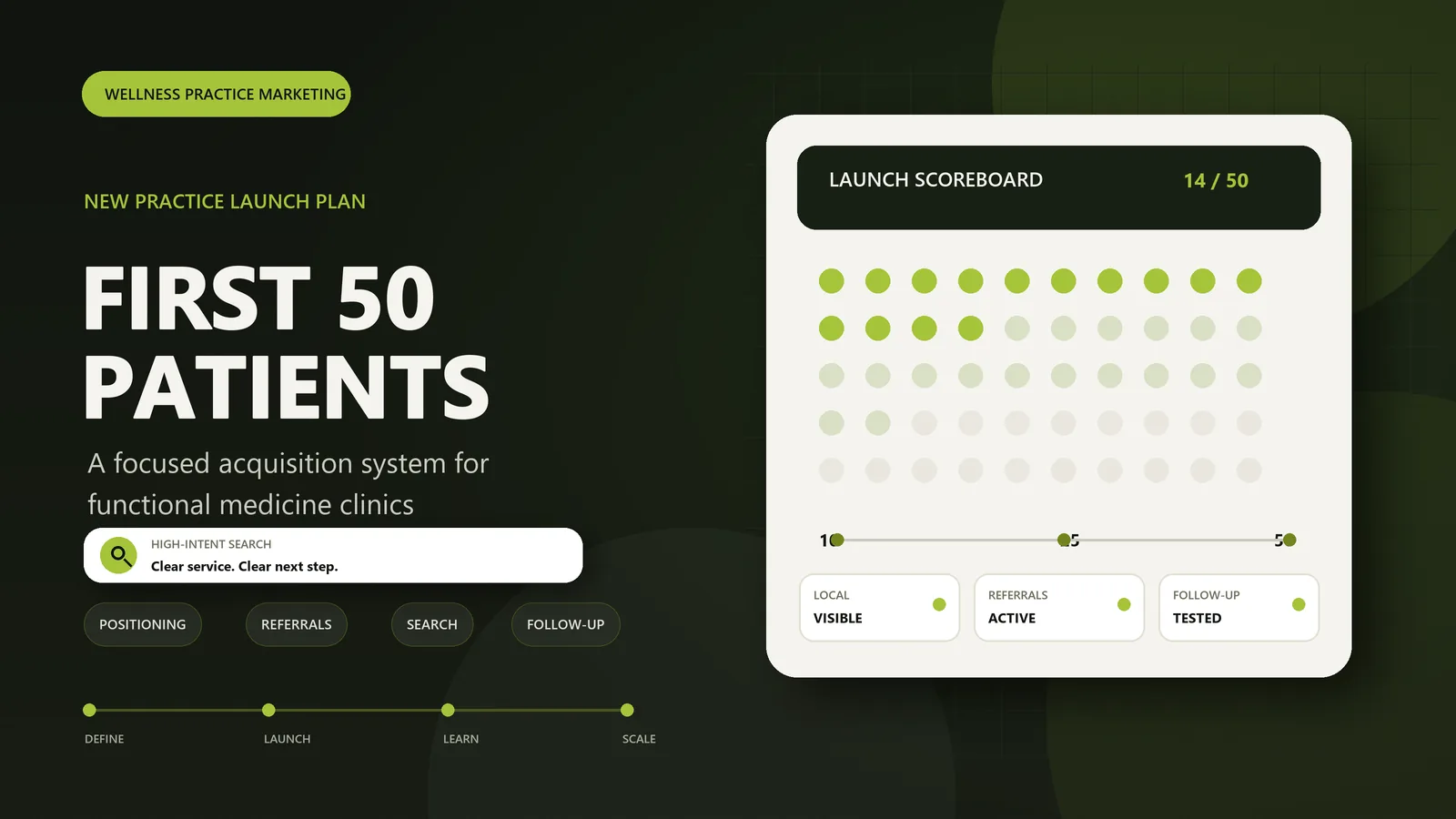
Short answer: get the first 50 patients by choosing one clear patient group, making one service easy to understand and book, starting with the people and professionals who already have a reason to trust you, and then adding local search or paid search when the booking path is ready.
Do not begin with a seven-channel marketing plan. A new functional medicine practice has limited time, limited proof and limited data. It needs a short feedback loop. Your first objective is to learn which patients are a good fit, what questions they ask before booking, why some enquiries stall and which sources produce completed first visits.
Count a patient when a real person completes the first paid clinical visit or the equivalent first step in your care model. A form submission is not a patient. A discovery call is not a patient. A booked consultation that does not happen is not a patient. This definition keeps the launch target honest.
Positioning note: WPM already has a broad guide to functional medicine marketing. This article is narrower. It covers the launch-stage sequence from zero to 50 completed new-patient visits.
Define the First 50 Before You Market
A clinic that markets to "anyone who wants to feel better" gives prospective patients very little to recognise. It also gives referral partners nothing memorable to repeat. Start with a specific launch offer, even if your long-term practice will treat a wider range of people.
Write a one-page launch brief before spending money. It should answer:
- Who is the initial patient group? Describe the problem, life stage, location and type of care they are already seeking.
- What is the first clinical step? Use the real service name, duration, price or price range, and what happens afterward.
- Why this practitioner? State relevant credentials, clinical focus and care philosophy without inflated claims.
- Where can care be delivered? List the physical service area and any telehealth jurisdictions where the practitioner is properly licensed.
- How many people can the clinic serve? Count available new-patient appointments, not theoretical treatment-room capacity.
- What makes an enquiry suitable? Define administrative fit without trying to make a clinical decision through a marketing form.
This prevents a common launch problem: a website promotes five programs, three modalities and a long list of conditions, while the owner cannot say which appointment a new visitor should book. You can broaden later. The first version should be easy to explain in one conversation.
Build the Minimum Credible Booking Path
Your first website does not need dozens of pages. It does need enough information for a careful prospective patient to decide whether contacting you is sensible. Functional medicine is a high-trust purchase. People may compare practitioners, read credentials, discuss cost with a partner and return to the site more than once.
The minimum credible path includes:
- A focused homepage or service page. Name the patient group, the service, the location and the next step near the top.
- A useful practitioner page. Show qualifications, licensing, relevant experience, a real photograph and a plain-English explanation of how the practitioner works.
- A transparent process. Explain the first appointment, expected preparation, follow-up structure and what is not included.
- Clear cost information. Publish the fee or explain exactly when and how the patient will receive it. Hidden pricing creates avoidable calls and drop-off.
- One primary call to action. Use a direct booking action when the service is self-selecting, or a short enquiry process when the clinic must check administrative fit first.
- A tested mobile path. Submit the form, tap the phone number and complete the booking flow on a real phone before sending traffic.
Our guide to functional medicine website design covers the wider site architecture. At launch, clarity is more valuable than decorative complexity.
Be deliberate about analytics and forms. HHS says HIPAA-regulated entities must consider whether tracking technologies transmit protected health information and take steps consistent with the HIPAA Rules. Its current bulletin also notes the 2024 court decision that vacated part of earlier guidance, so this is an area to review with qualified privacy counsel rather than solve with a generic cookie banner.[3] Collect the minimum information needed for initial contact and keep sensitive clinical details out of ordinary marketing forms unless the workflow has been properly assessed.
Use Four Phases Instead of One Big Campaign
The first 50 patients are not one homogeneous group. What works before the clinic has any market feedback is different from what should happen after 25 completed visits. Use each phase to earn the evidence needed for the next one.
Patients 1 to 10
Start with direct introductions, professional contacts, a clear launch message and founder-led conversations. Record every question and objection.
Patients 11 to 25
Fix the website, intake and offer using real feedback. Build a consistent referral routine and begin requesting honest feedback appropriately.
Patients 26 to 40
Add or expand one measurable search channel. Match each campaign or page to the service that has shown real demand and fit.
Patients 41 to 50
Cut weak activity, document the intake process and decide which channel can support the next capacity target without harming patient experience.
Phase 1: earn the first ten conversations
Prepare two launch messages. One is for people who know you personally and may know someone looking for this kind of care. The other is for professionals who serve an overlapping population. Neither message should pressure anyone or reveal patient information.
A professional message can be simple: who you serve, the first service you offer, where you practise, what types of referrals are appropriate and how to contact you. Send it individually to people with a genuine connection. Avoid buying a list of clinicians and blasting a generic introduction.
Build a referral map with categories such as primary care, therapy, nutrition, physical therapy, pelvic health, dentistry, fitness, community organisations and employers. The relevant categories depend on your service. A perimenopause practice needs a different map from a paediatric neurodevelopment clinic.
Your goal in this phase is not reach. It is accurate language. After each enquiry, write down what prompted the person to contact you, which words they used, what nearly stopped them and what they expected the first visit to include. Those notes become better copy, FAQs and referral materials.
Phase 2: turn early feedback into trust assets
After several completed visits, patterns become easier to see. Patients may be confused about lab costs, whether you replace primary care, how telehealth works or why the first appointment is longer. Fix those points on the site instead of answering the same question privately every week.
Ask for honest reviews only through a process that respects privacy, professional rules and platform terms. Do not ask only the people you expect to be positive. Do not write the review for the patient. Do not make a gift conditional on a favourable rating. FTC guidance warns against selective positive-review requests and incentives conditioned on positive sentiment, and it tells businesses to check the rules of each review platform.[7]
Google says complete and accurate Business Profile information makes a business more likely to appear in relevant local results. It also identifies relevance, distance and prominence as the main local ranking factors, and notes that reviews and positive ratings can contribute to prominence.[6] Complete the clinic name, address where applicable, category, hours, phone, appointment link, services and photographs. Keep those details consistent with the website.
A new clinic should not pretend it has years of history. Real practitioner credentials, a clear process, accurate photographs and responsive communication are enough to build an honest first layer of trust.
Phase 3: add one high-intent search channel
Once the offer and booking path are working, choose between paid search and organic search based on urgency, budget and existing visibility.
Google Ads can create visibility while the domain is still new. Start with one service and a tight geographic area. Separate searches for the practitioner type, the service and high-intent condition-related consultations where advertising is appropriate. Send each theme to a page that directly answers that search.
Healthcare campaigns require a policy check before launch. Google restricts some healthcare content, prescription drug services, restricted drug terms and certain treatments, with rules that vary by location.[1] Health is also a sensitive-interest category under Google's personalised advertising policy, which limits the use of advertiser-curated audiences such as Customer Match and data segments for sensitive health promotion.[2] Search intent is useful, but it does not remove the need for compliant ads, landing pages and targeting.
Local SEO and service-page SEO take longer, but they create an asset the clinic owns. Build the strongest page for the priority service first. Then add supporting pages only where the patient intent is meaningfully different. A new site with ten thin condition pages is not stronger than a smaller site that answers the right questions well.
Read our functional medicine local SEO guide for the profile, citation and local page work. If paid search is the better launch bridge, use the campaign structure in our Google Ads for functional medicine guide.
Phase 4: keep what produced completed visits
At 40 patients, the practice has enough lived experience to stop treating all activity as equally useful. Review the entire path by source. One channel may create many enquiries but few suitable patients. A small referral source may create fewer conversations but more completed visits. The comparison only works if the clinic records outcomes consistently.
Document who responds to new enquiries, how missed calls are handled, when follow-up happens, which administrative questions are asked and where the final outcome is recorded. This turns founder memory into an operating process that another team member can follow.
Do not scale simply because the calendar looked full for one week. Check new-patient capacity, follow-up capacity, practitioner energy and cash timing. Reaching 50 patients should produce a stable base, not a queue the clinic cannot serve well.
Track a 50-Patient Scoreboard
A launch dashboard can be a spreadsheet. It does not need advanced attribution software. Each row should represent one genuine enquiry, with access restricted appropriately.
| Field | What to record | Question it answers |
|---|---|---|
| First-touch source | Referral partner, Google Maps, organic search, ad, event, direct | Where did awareness begin? |
| Service requested | The actual consultation or program discussed | Which offer attracts demand? |
| Administrative fit | Location, availability, payment model and service match | Was this a relevant enquiry? |
| Booked | Yes, no and booking date | Did intake turn interest into an appointment? |
| Attended | Show, cancelled or no-show | Did the appointment happen? |
| New patient | Completed the defined first paid clinical visit | Did the launch gain a patient? |
| Reason lost | Price, timing, service mismatch, location, unreachable or unknown | Where is the real constraint? |
Work backward from 50 completed first visits.
Required enquiries = 50 divided by your qualified-enquiry-to-patient rate.
Do not borrow a conversion rate from another clinic. Begin with a clearly labelled planning assumption, then replace it with your own booking, show and patient conversion data every week.
A weekly review should take less than an hour. Count new enquiries, suitable enquiries, bookings, attended first visits and new patients. Read the lost reasons. Then choose one change for the next week. Changing the website, ads, intake script and pricing at the same time makes it difficult to learn what helped.
A Practical 12-Week Launch Rhythm
Twelve weeks is a working cadence, not a promise that every clinic will reach 50 patients within that period. The milestone may arrive sooner or much later. The point is to give each week a job.
Before opening
- Finalize the launch brief, first service, price and capacity.
- Publish the minimum credible booking path and test it on mobile.
- Set up the enquiry scoreboard and define what counts as a patient.
- Prepare personal and professional launch messages.
- Claim or prepare the Business Profile as appropriate for the real operating location.
Weeks 1 to 4
- Contact a small number of relevant people personally each day.
- Schedule short introductions with appropriate referral professionals.
- Record the exact questions asked by every prospect.
- Test response times, missed-call handling and booking confirmation.
- Update the service page weekly based on repeated confusion.
Weeks 5 to 8
- Publish one genuinely useful FAQ or supporting page based on real patient research.
- Request honest feedback through a consistent, privacy-conscious process.
- Complete local listings and check contact information for consistency.
- Choose one search channel and prepare the landing page, tracking and policy review.
- Review which referral categories are producing suitable introductions.
Weeks 9 to 12
- Run or expand the chosen search channel only if intake and capacity are ready.
- Compare sources by completed visits, not just leads.
- Pause activity that consumes time without producing useful conversations.
- Document the intake and follow-up process.
- Set the next capacity target based on what the clinic can serve well.
Adjust the Plan for the United States, United Kingdom and Canada
The acquisition sequence can be similar across English-speaking markets, but the copy and advertising rules are not interchangeable. Practitioner licensing, scope, telehealth, testimonials, privacy and health-product promotion can differ by country, state, province and profession. Use qualified local advice before launch.
In the United States, the FTC says health-related advertising must be truthful, not misleading and adequately substantiated before publication.[4] In the United Kingdom, the CAP Code applies a high level of scrutiny to marketing communications for medicines, medical devices, treatments and health-related products.[8] In Canada, Health Canada says health-product advertisements must not be false, misleading or deceptive, and it notes specific requirements for prescription-drug advertising to consumers.[9]
That means a US landing page should not simply be copied into a UK or Canadian campaign. Review the actual service, claims, practitioner status, products mentioned, target location and platform policy for each market.
Seven Launch Mistakes That Slow the First 50
- Marketing every service at once. The message becomes vague and the budget is divided before any offer has earned attention.
- Buying traffic before testing the booking path. Ads amplify a confusing page and a slow response process.
- Counting leads as patients. This hides booking, show and suitability problems.
- Waiting for a perfect brand. A clear service, credible practitioner and reliable contact path matter more than endless logo revisions.
- Using aggressive clinical claims. Outcome promises create trust, compliance and platform risk.
- Automating before understanding the conversation. The owner should hear early objections before turning them into templates and workflows.
- Scaling beyond capacity. More enquiries do not help when calls go unanswered or suitable patients cannot get an appointment.
The budget should follow the stage of the practice. Our functional medicine marketing budget guide explains how to separate foundational work from later growth spending.
Frequently Asked Questions
How can a new functional medicine practice get its first patients?
Start with one clearly defined patient group and service. Build a credible page that explains the practitioner, cost and booking process. Contact appropriate personal and professional networks, complete the local search presence, and track every enquiry through to a completed first visit.
Should a new functional medicine practice run Google Ads immediately?
Google Ads can help when the practice has a clear service, suitable landing page, reliable intake, compliant messaging, conversion tracking and capacity. If those basics are missing, fix them before paying for traffic.
How many leads are needed to get 50 patients?
There is no universal number. Use your qualified-enquiry, booking, show and patient conversion rates. Work backward from 50 completed first visits and replace assumptions with real data as the launch progresses.
Can a new clinic ask its first patients for Google reviews?
A clinic can request honest feedback, but should not review-gate, write reviews for patients or make incentives conditional on positive sentiment. Protect patient privacy and follow platform rules and the laws in your market.
How long should it take to reach 50 patients?
No responsible marketer can promise a fixed timeline. The pace depends on the service, location, price, practitioner network, search demand, capacity, booking process and follow-up. Use a target date for planning, not as a guarantee.
What is the best first marketing channel?
The best first channel reaches suitable patients, can be measured and fits the clinic's capacity. Many new practices begin with professional referrals and local visibility, then add high-intent search advertising or SEO once the offer and booking path are ready.
Build a System, Not a Burst of Attention
The first 50 patients should leave the practice with more than revenue. They should produce clearer positioning, a tested booking path, a useful referral network, better patient questions, real conversion data and an intake process the team can repeat.
Keep the launch focused. One audience. One primary service. One clear next step. One scoreboard. Add channels only when you know what the previous stage taught you.
If you want help deciding which parts of the system to build first, book a strategy call with Salem. We will review the offer, website, local visibility, search opportunity, tracking and capacity before recommending a scope.
Sources
- [1] Google Ads: Healthcare and medicines policy
- [2] Google Ads: Health in personalized advertising
- [3] HHS: Use of Online Tracking Technologies by HIPAA Covered Entities and Business Associates
- [4] FTC: Health Products Compliance Guidance
- [6] Google Business Profile: Tips to improve your local ranking
- [7] FTC: Soliciting and Paying for Online Reviews
- [8] UK CAP Non-broadcast Code
- [9] Health Canada: Regulatory Requirements for Advertising
This article is marketing education, not medical, legal, privacy or regulatory advice. Verify the rules that apply to your profession, service and location.