A functional medicine website has a demanding job. It must explain an approach that may be unfamiliar, earn trust in a high-stakes health decision, show who provides care, answer practical questions about access and cost, and make the next step feel safe. It also has to work quickly on a phone, support local discovery, and handle patient information with care.
That is why functional medicine website design is not a styling exercise. A modern color palette cannot compensate for vague positioning, thin practitioner profiles, hidden fees, or a confusing booking path. The useful question is not, “Does this site look premium?” It is, “Can the right patient understand the clinic, evaluate fit, and take an appropriate next step without friction?”
This guide shows how to build that system. It combines patient journey planning, site architecture, conversion design, accessibility, search visibility, privacy awareness, measurement, and a practical 60 to 90 day plan. The recommendations are marketing and design guidance, not legal or medical advice.
What functional medicine website design must accomplish
A strong site turns uncertainty into informed action. A prospective patient may arrive with a symptom question, a referral, a provider name, or a search for care nearby. The website needs to orient each visitor without implying that the clinic is right for everyone.
At minimum, it should answer six questions: Who is this clinic for? What does it actually offer? Who provides the care? Where and how is care delivered? What does the first step involve? What should a visitor do next? When these answers are scattered across slogans and dropdowns, design has failed even if the page looks polished.
The site also has to support the clinic's operating model. A self-pay practice may need fee and membership explanations. A multi-state telehealth clinic must explain eligibility accurately. A specialty clinic needs pages that connect patient concerns to real services without making diagnosis or outcome promises.
Think of the website as a decision environment. Its visual design should reduce cognitive load, its content should reduce uncertainty, and its forms should collect only what the clinic actually needs at that stage.
Map the patient intent and trust journey
Functional medicine patients often research in stages. One person begins with “why am I tired after sleeping,” another with “functional medicine doctor near me,” and another with a practitioner recommendation. Their needs differ, but their paths often converge around the same validation questions.
| Intent stage | Typical question | Best website response |
|---|
| Problem awareness | What could explain this concern? | Balanced educational content with clear limits |
| Approach research | What is functional medicine and how does care work? | Service and process pages in plain language |
| Provider search | Who offers this care near me or by telehealth? | Practitioner and legitimate location pages |
| Validation | Is this provider credible and suitable for me? | Credentials, philosophy, fees, policies, and reviews |
| Action | What happens if I contact or book? | A specific, low-friction next step |
The site should connect these stages. Educational articles link to relevant service pages. Service pages introduce the practitioner and process. Practitioner pages link to the locations and booking path. This is also the foundation of integrative medicine SEO: useful pages organized around how patients actually investigate care.
Clarify positioning above the fold
The first screen should do more than display a beautiful office. Use a direct headline that names the audience, primary service, or meaningful area of focus. Add the clinic's geography or telehealth scope when it affects eligibility. Then offer one primary action, such as “Request an introductory call” or “View appointment options.”
A practical formula is: type of care + audience or concern + truthful location or delivery model. Supporting copy can briefly explain the approach. For example: “Functional medicine consultations for adults navigating persistent digestive and metabolic concerns in Portland and by eligible telehealth.” The final wording must match the clinic's licensure, services, and actual availability.
Avoid broad claims such as “heal the root cause,” “reverse chronic illness,” or “finally fix your hormones.” They overpromise, flatten clinical nuance, and can make careful patients skeptical. A calm statement of scope is usually more credible.
Above-fold checklist: identify the audience, service, geography, provider, and next step. Include a visible phone option when calls matter. Use one dominant CTA and one quieter secondary link. Do not make visitors wait for a carousel slide to discover what the clinic does.
Build a site architecture around real decisions
Good architecture gives each important question a clear home. It prevents the homepage from becoming an encyclopedia and stops the blog from carrying the entire SEO strategy.
- Homepage: positioning, primary services, practitioner introduction, locations, process, proof, and next step.
- Service pillars: real clinical offerings explained in enough depth to support a decision.
- Condition or concern pages: medically reviewed pages for relevant patient needs, connected to services.
- Practitioner pages: credentials, licensure, training, philosophy, scope, and availability.
- Location pages: each real clinic location, or truthful care-area information where appropriate.
- Process page: what happens before, during, and after the first visit.
- Pricing and payment: fees, insurance status, superbills, memberships, deposits, and cancellation terms as applicable.
- FAQ and contact: practical questions plus phone, form, address, hours, and booking options.
For deeper planning, compare this structure with our guides to functional medicine marketing and why a clinic can rank for its name but not its services. Both reinforce the same principle: important services need specific, connected pages.
Create service and condition pages without thin content
A service page should help someone understand the offer, not merely repeat a keyword. Explain who the service may be appropriate for, what the evaluation can include, who provides it, what an initial visit is like, practical costs, and the next step. State limitations when a service requires referral, testing, or clinical screening.
Condition pages can support patient education and search visibility, but only when they are genuinely useful. Do not generate dozens of near-identical pages that swap a condition or city name. Google describes doorway abuse as pages created to rank for similar queries that funnel users to the same destination. Patients experience the same problem as repetition and low trust.
Keep medical language balanced. “Support for patients with digestive concerns” is different from “we cure digestive disease.” Discuss evaluation and possible care options without diagnosing the reader. Have qualified clinicians review clinical statements and set a visible review date where that process is real.
A useful service-page blueprint
1. Clear openingService, audience, location, and appropriate CTA.
2. Patient contextConcerns that may lead someone to seek an evaluation.
3. Care approachWhat the service includes and how decisions are made.
4. PractitionerName, credentials, role, and relevant experience.
5. Process and feesVisit flow, timing, cost, insurance, and exclusions.
6. FAQs and next stepReal objections answered before a calm booking prompt.
Present practitioner authority for a YMYL topic
Health information can affect wellbeing, so Google treats it as a Your Money or Your Life topic. Its people-first content guidance says trust is the most important element within E-E-A-T and encourages clear authorship. E-E-A-T is not a single score you can add to a page, but it is a useful quality framework.
Every practitioner profile should make credentials understandable. Include the full name, degree or credential, license type and jurisdiction where relevant, education, relevant training, professional memberships, clinical interests, and the services and locations available. Link to authoritative profiles or publications when useful. Do not inflate a short course into a medical specialty.
For clinical articles, show who wrote the piece and who medically reviewed it, if applicable. Those roles should be true, not decorative schema fields. Add an editorial or review policy when the clinic has one. Dates are helpful when content can change, but automatically refreshing a date without a substantive review is misleading.
WPM's SEO service for naturopathic and functional medicine clinics connects this authority work with site structure, local relevance, and patient search intent.
Design a calm conversion path
A health website should help people act without pressure. Use consistent CTA language so visitors know whether they are booking a paid consultation, requesting a discovery call, joining a waitlist, or asking a question. “Get started” is weaker than a label that describes the actual step.
Offer the contact methods the clinic can support: online booking, phone, and a short enquiry form. Place them at logical decision points, not after every paragraph. On the confirmation screen, explain response timing and urgent-care limitations. If the form is not monitored for emergencies, say so clearly.
Remove manipulative patterns. Countdown timers, fake appointment scarcity, repeated popups, and outcome guarantees are especially inappropriate in a medical context. Real availability constraints can be stated factually. The goal is informed choice, not anxiety.
Test the entire path on mobile. A button that opens a third-party scheduler is only useful if the scheduler loads, preserves context, supports keyboard use, and explains what the patient is booking. If patients often abandon at a specific step, investigate the experience before adding more traffic.
A practical functional medicine homepage wireframe
The following wireframe provides a useful sequence for a clinic homepage. It is not a legal requirement or a universal template. Change the order based on the clinic's strongest evidence and common patient questions.
1. Header: logo, concise navigation, phone, primary appointment action
2. Hero: audience, service, location, practitioner cue, calm CTA
3. Fit section: concerns and patient types the clinic genuinely supports
4. Service pillars: three to six clear routes into deeper pages
5. Care process: inquiry, first visit, evaluation, follow-up
6. Practitioner authority: photo, credentials, philosophy, profile link
7. Practical details: locations, telehealth limits, fees, insurance, availability
8. Real patient perspective: compliant testimonials or trust alternatives
9. FAQs: objections and logistics, followed by the next step
Use visual rhythm rather than decoration for its own sake. Alternate dense and light sections, keep line lengths readable, and use photography where it adds evidence. The website should feel calm because the hierarchy is clear, not because everything is pale green.
Functional medicine website projects from WPM
The principles in this guide are not theoretical. Wellness Practice Marketing applies them to real integrative and functional medicine projects, adapting the structure to each clinic's physicians, services, market, and patient journey. These two examples show why website design and patient acquisition strategy need to work together.
Website redesign · Integrative medicine
Ayur Integrative Medicine
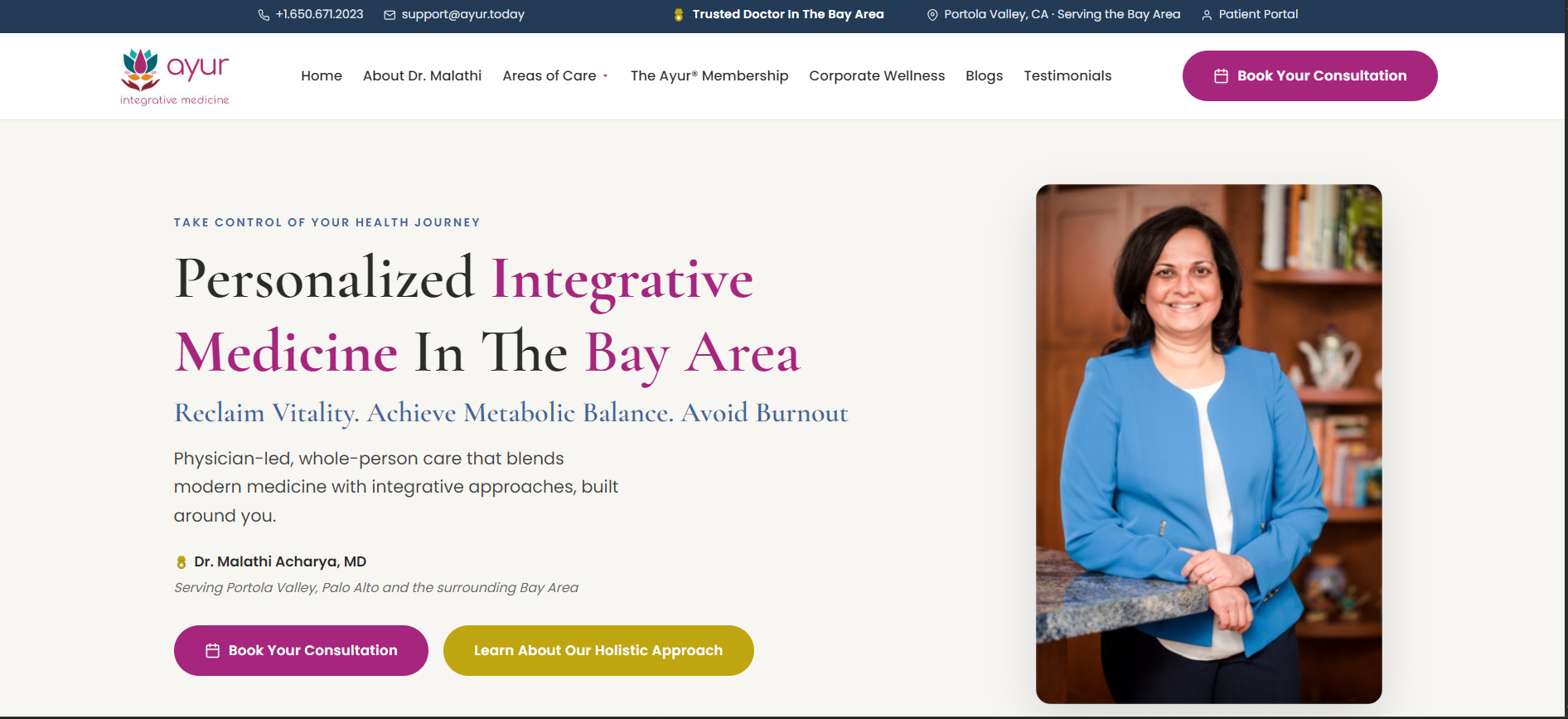
For Ayur Integrative Medicine, we reorganized a content-rich website around Dr. Malathi Acharya's physician authority, clear areas of care, Bay Area relevance, and a more direct path to consultation. The project included website redesign, conversion optimization, SEO architecture, and local SEO.
The new homepage guides visitors from their concerns to the physician, appropriate services, practical details, and consultation options. Dr. Malathi later reported: “In just a few days after the website redesign, my discovery calls have doubled.” Individual results vary, and the quote reflects this clinic's experience rather than a guarantee.
SEO · Google Ads · Conversion support
Live Well Wellness Center
Live Well Wellness Center is a multi-provider integrative medical center serving Chandler and surrounding Arizona communities. Its website has to help prospective patients navigate a broad service mix, including primary care, hormone services, IV therapy, weight management, and acupuncture, while also making provider information and appointment access easy to find.
Our work with Live Well has included SEO, Google Ads, conversion tracking, and patient acquisition strategy. The project illustrates an important design lesson: a growing clinic needs distinct service routes and accurate measurement, not one generic page that asks every visitor to follow the same path.
A portfolio should be evaluated in context. Look beyond colors and animation. Ask whether the site makes the clinic's positioning, expertise, services, geography, and next step easier to understand. That is the standard these projects are designed to meet.
Make mobile UX, speed, and accessibility foundational
Many patient journeys happen on a phone, sometimes while the person is tired, distracted, or stressed. Use readable type, generous spacing, obvious buttons, and short navigation labels. Keep phone numbers tappable. Avoid horizontal carousels, tiny accordions, and important information hidden behind hover interactions.
Google's Core Web Vitals guidance describes three user-experience measures: Largest Contentful Paint for loading, Interaction to Next Paint for responsiveness, and Cumulative Layout Shift for visual stability. In plain language, the main content should appear promptly, taps should respond quickly, and the page should not jump while loading. These metrics support user experience, but perfect scores do not guarantee rankings.
Compress images, reserve their dimensions, reduce unnecessary scripts, and test real pages rather than the homepage alone. A 1600-pixel image should not be delivered uncompressed to every phone. Schedule embeds and chat widgets can be expensive, so load them carefully.
Accessibility should be part of design and development. The WCAG 2.2 quick reference covers text alternatives, keyboard access, visible focus, labels, contrast, and error identification. Give meaningful images useful alt text, use empty alt text for purely decorative images, preserve heading order, label every form field, and make errors specific. Test with keyboard-only navigation and zoom. WCAG conformance and legal obligations require a fuller assessment than a short checklist.
Connect the website to local SEO and Google Business Profile
A local clinic's website and Google Business Profile should tell the same factual story. The clinic name, address, phone, categories, services, hours, appointment link, and practitioner information should be accurate and consistent. Link the profile to the most relevant landing page, not automatically to a generic homepage.
Create a page for each real location. Include the address, embedded or linked map, parking or access information, hours, practitioners at that office, available services, original photos, and location-specific FAQs. Do not create pages for cities where the clinic has no legitimate presence simply to capture “near me” searches.
Our functional medicine local SEO guide explains the broader profile and citation work. When asking for reviews, request honest feedback from real patients without incentives or selective positive-review screening. Google's Maps content policy prohibits fake engagement, incentives, and discouraging negative reviews. A healthcare organization should also avoid public responses that reveal or imply a reviewer's patient status. Establish a counsel-reviewed response policy.
Use on-page SEO, internal links, and accurate schema
Give each important page one primary purpose. Write a descriptive title, a natural H1, a concise meta description, logical headings, and copy that answers the searcher's question. Use location terms only where truthful. Descriptive internal links help patients and search engines understand how services, conditions, practitioners, and locations relate.
A practical link cluster might connect a digestive health article to a digestive care page, the relevant practitioner's bio, the clinic location, fees, and booking information. Link back from those pages when it helps the reader. Avoid stuffing a footer with hundreds of keyword anchors.
Structured data provides explicit clues about a page. Google's structured data documentation recommends marking up content that is actually visible and accurate. Article, BreadcrumbList, Person, Organization, FAQPage, and an appropriate local business type may be useful. Schema does not create credentials, reviews, or locations that do not exist, and it does not guarantee a rich result.
AI-assisted search does not require a secret file or special “AI schema.” Clear entities, crawlable pages, concise answers, sources, authorship, and standard SEO remain the durable foundation. Treat AI visibility as another discovery surface, not a reason to publish generic content at scale.
Handle forms, tracking, and consent cautiously
Website privacy work starts with a data map. List every form, scheduler, analytics tag, advertising pixel, chat tool, call tracker, recording tool, CRM, and email integration. For each, document what it receives, why it is needed, where it goes, how long it is retained, who can access it, and what contract applies.
Do not assume that every website form is automatically covered by HIPAA, or that a “HIPAA compliant” badge resolves every issue. Applicability depends on the entity, data, context, and handling. HHS has specific guidance for regulated entities using online tracking technologies. Clinics should assess their situation with qualified legal or privacy counsel and vendors that can support the required safeguards and agreements.
Collect the minimum necessary at the marketing stage. A general enquiry form can ask for contact information and a preferred service without inviting a detailed medical history. Keep sensitive health details out of ad-platform audiences, conversion labels, URLs, page titles, analytics events, session replay, and ordinary marketing email tools. Do not build disease-condition remarketing audiences or customer lists.
Consent banners must match the technologies actually in use and the jurisdictions served. Privacy policy text should describe reality, not a template copied from another practice. Security, HIPAA, state privacy laws, consumer health data laws, and professional rules can overlap, which is why a clinic-specific review matters.
Use content, photos, and testimonials as evidence
Original photography can make the clinic tangible: the real exterior, reception, consultation room, practitioner, care team, accessibility features, and parking route. Plan a shot list around patient questions. Generic stock photos of doctors pointing at clipboards rarely communicate anything specific.
Service copy should sound like the people who deliver the care. Interview practitioners about the first appointment, fit, limitations, common misconceptions, and how decisions are made. Then edit for clarity and clinical review. This produces more trustworthy material than generic wellness language.
Testimonials require careful governance. Use genuine statements with appropriate permission and context. Do not edit them into outcome guarantees, invent star ratings, or use stock portraits that imply a real patient. Rules vary by profession and location, so review consent, advertising, and privacy requirements with counsel. When testimonials are restricted or unavailable, use stronger process explanations, credentials, facility photos, publications, and transparent practical details.
Measure patient acquisition, not activity alone
Website measurement should follow the real funnel. A button click is not a booking, a booking is not an attended consultation, and an attended consultation is not automatically a new patient. Keep these stages separate so the clinic can find where fit or follow-through breaks down.
- Discovery: qualified organic impressions, local visibility, relevant landing-page visits.
- Enquiry: completed forms, answered calls, and valid booking requests.
- Qualification: enquiries that match service, location, eligibility, and budget.
- Consultation: scheduled and attended initial consultations.
- Patient outcome: new patients or accepted care plans where the clinic can measure appropriately.
Review performance by source, landing page, service, location, device, and lead quality. Use privacy-conscious reporting and avoid placing sensitive health detail in analytics. Our guide to conversion tracking explains why clean event definitions matter across both SEO and paid campaigns.
Common functional medicine website design mistakes
- Vague hero copy: “Optimize your wellness” does not identify a service, provider, or location.
- Everything on one page: one long services page cannot answer every distinct patient question.
- Thin condition and city pages: changing a few words does not create local or clinical value.
- Hidden practical details: unclear pricing, insurance, eligibility, and process create avoidable enquiries and abandonment.
- Weak practitioner pages: initials and a short biography do not establish scope or credentials.
- Visual overload: autoplay video, animation, popups, and oversized text can bury the decision path.
- Unqualified claims: cure language, guaranteed results, and overstated specialties undermine trust.
- Unsafe tracking: sending sensitive context to standard analytics or advertising tools creates unnecessary risk.
- No ownership plan: a site that only one developer can update becomes stale.
- Measuring traffic only: more visits are not success if qualified enquiries and attended consultations do not improve.
Should you redesign or optimize the current site?
Start with a short diagnostic rather than assuming a new visual identity is the answer. An optimization project is usually sensible when the platform is secure and maintainable, templates work on mobile, core pages can be edited, URLs are stable, and most problems involve copy, hierarchy, internal links, speed, or calls to action.
A redesign is more appropriate when limitations are structural: the content system blocks necessary pages, mobile layouts fail across templates, accessibility problems are repeated, navigation cannot represent services and locations, ownership is unclear, integrations are brittle, or the brand presentation materially reduces credibility.
| Signal | Optimize | Redesign |
|---|
| Platform | Editable and supported | Unsupported or restrictive |
| Architecture | Mostly sound | Services, locations, and providers are tangled |
| Mobile and accessibility | Localized issues | Systemic template failures |
| Brand | Credible but inconsistent | Actively undermines trust |
| Performance | Specific assets or scripts | Theme or stack is fundamentally heavy |
Before a redesign, preserve analytics history, high-performing content, URLs, metadata, redirects, and tracking definitions. A prettier launch that loses search equity or enquiry attribution is not progress. WPM's functional medicine web design service is built around these clinic-specific decisions.
A practical 60 to 90 day roadmap
Days 1 to 15: research and diagnose
- Interview front-desk and clinical teams about patient questions, poor-fit enquiries, and booking friction.
- Map services, patient concerns, practitioners, real locations, fees, and care eligibility.
- Audit analytics, Search Console, Google Business Profile, call data, forms, and schedulers.
- Inventory scripts and vendors, then flag privacy, security, accessibility, and contract questions for qualified review.
- Test priority pages at mobile widths and with a keyboard.
Days 16 to 45: build the foundation
- Approve positioning, navigation, URL map, redirect plan, and page briefs.
- Write the homepage, top service pages, practitioner profiles, process, pricing, and location pages.
- Create or commission original photography and compress every image.
- Design reusable components for CTAs, credentials, FAQs, fees, and location details.
- Configure privacy-conscious measurement with distinct enquiry and booking stages.
Days 46 to 75: implement and review
- Build responsive templates and check heading order, labels, focus, contrast, zoom, and errors.
- Add titles, descriptions, canonicals, internal links, image alt text, and accurate structured data.
- Have practitioners review clinical statements and counsel review relevant privacy and advertising issues.
- Test phone, form, booking, confirmation, and notification flows without submitting real patient data.
Days 76 to 90: launch and learn
- Crawl the site, validate redirects, XML sitemap, indexability, metadata, schema, and internal links.
- Check real-device performance and monitor forms, calls, scheduler events, and errors.
- Update Google Business Profile links and core directory references.
- Review qualified enquiries and attended consultations, then prioritize the next improvement.
Do not treat launch day as the finish. The first month of real questions and behavior usually reveals clearer improvements than another round of subjective homepage opinions.
Frequently asked questions
What makes a functional medicine website different from a general medical website?
A functional medicine website often needs to explain a longer, research-heavy patient journey, a personalized care process, practitioner expertise, self-pay details, and the relationship between services and concerns. The design still needs the same fundamentals as any strong healthcare site: clarity, accessibility, privacy awareness, accurate claims, and an easy path to contact or book.
How much does functional medicine website design cost?
Cost depends on scope, content, integrations, photography, number of locations, and whether the project is a redesign or an optimization. WPM currently lists functional medicine web design from $1,997. A clinic should compare proposals by deliverables, ownership, accessibility, content quality, tracking, and ongoing costs rather than price alone.
How long does a functional medicine website redesign take?
A focused small-clinic project may take several weeks, while a multi-practitioner or multi-location build can take longer. The schedule usually depends less on coding than on decisions, copy, photography, clinical review, integrations, and approvals. Define milestones and who signs off before work starts.
Should every condition have its own page?
No. Create a dedicated condition or concern page when the clinic genuinely supports that audience, the topic has distinct patient intent, and the team can provide useful original information. Do not publish near-duplicate pages for every keyword or city. A smaller set of strong pages is better than thin doorway pages.
Does a functional medicine website need to be HIPAA compliant?
HIPAA applicability depends on the organization, the data, and how it is handled. Not every website interaction is automatically covered in the same way. Covered entities and business associates have specific obligations, and tracking or form tools can create risk. Clinics should map data flows and assess vendors, contracts, consent, and legal requirements with qualified privacy or legal counsel.
What should be above the fold on the homepage?
State who the clinic helps, the core service or approach, the location or care area, and a calm next step. Add one clear proof cue such as named practitioner credentials or a concise process statement. Avoid rotating sliders, long mission statements, vague wellness slogans, and multiple competing buttons.
Can schema markup make a clinic rank higher?
Schema can help search engines understand page entities and may support eligible search features, but it does not guarantee rankings. Use accurate types and properties that match visible content. Article, BreadcrumbList, FAQPage, Person, Organization, and appropriate local business markup may be useful depending on the page.
How should a clinic measure whether its website works?
Track the full path: qualified enquiries, calls, completed booking requests, scheduled consultations, attended consultations, and new patients where appropriate. Keep micro-conversions such as button clicks or time on page separate. Review results by landing page, source, service, location, and lead quality without sending sensitive health information to analytics or advertising platforms.
Should we redesign the whole site or optimize what we have?
Optimize the current site when its platform is maintainable, the structure is sound, pages can be edited, and the main problems are messaging, content, speed, or conversion paths. Redesign when the platform blocks essential work, mobile or accessibility problems are systemic, architecture is tangled, branding undermines trust, or major integrations cannot be implemented safely.
Build a website around how patients actually choose
A functional medicine website works when it makes the clinic easier to understand, trust, find, and contact. That requires more than a new theme. It requires a clear position, credible clinical content, useful architecture, thoughtful privacy decisions, and measurement that reaches beyond clicks.
Wellness Practice Marketing helps functional and integrative clinics connect website design with integrative medicine marketing, SEO, local visibility, and conversion tracking. If you are deciding whether to redesign, restructure, or improve the site you already have, we can help identify the highest-priority changes.
Book a strategy call with Salem. It is a practical conversation about your clinic, current website, and acquisition gaps, without a hard sell.
Selected authoritative sources