
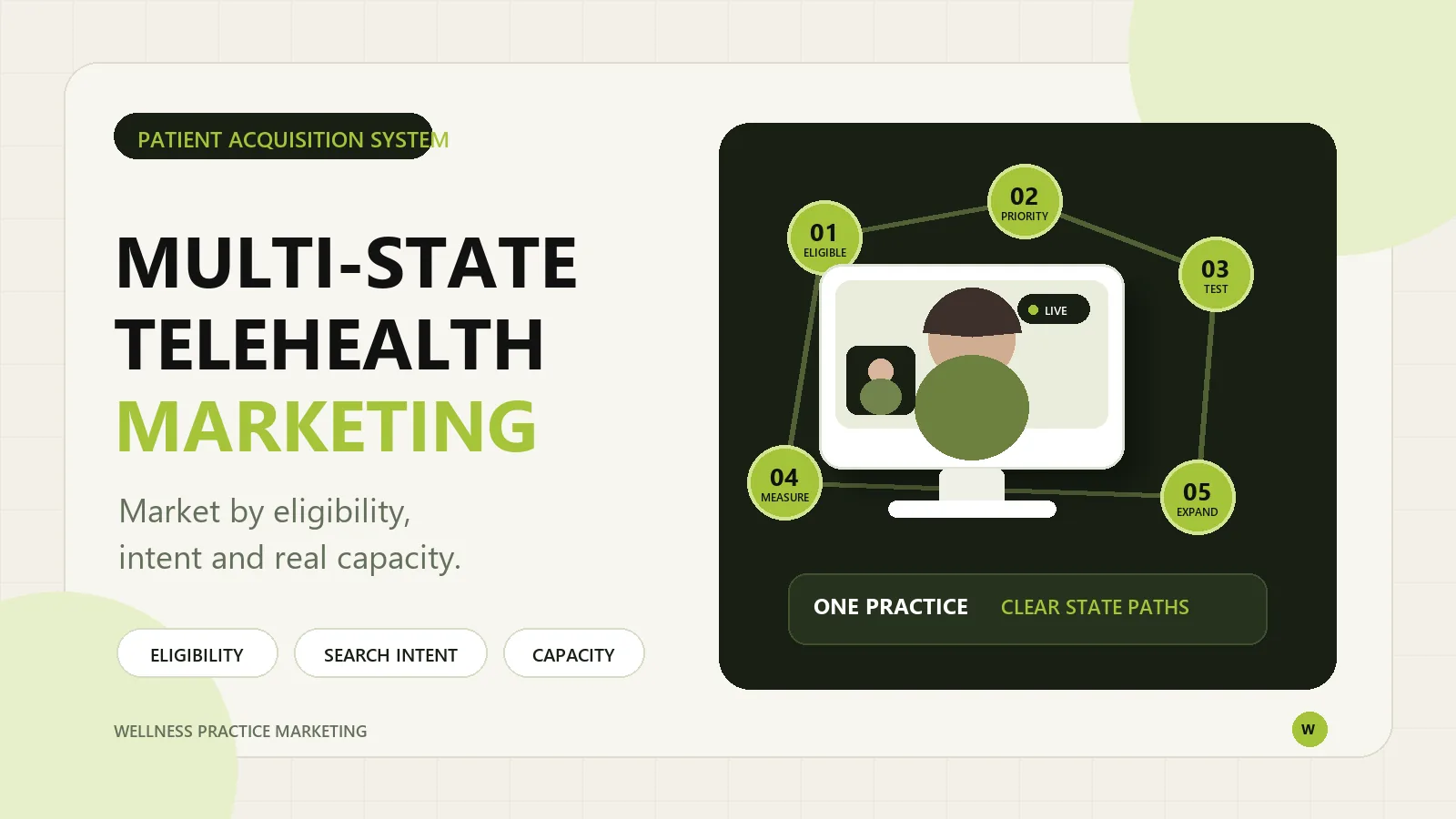
Short answer: market a multi-state telehealth functional medicine practice by treating each state as a real operating market, not another box to tick in an ad account. Confirm where each practitioner can serve patients, choose a small number of priority states, build one clear telehealth hub with genuinely useful state information, run tightly controlled search campaigns, and measure qualified patients by state.
A larger licensed footprint does not automatically create demand. It creates eligibility. The marketing work is deciding where the clinic has a credible offer, enough capacity, relevant search intent and an intake process that can correctly handle a patient located hundreds of miles away.
This guide is narrower than our complete functional medicine marketing guide. It focuses on the geographic decisions unique to telehealth: licensure boundaries, state selection, page architecture, paid-search settings, remote trust and state-level reporting.
Scope note: this is marketing guidance, not legal, licensing, medical, privacy or insurance advice. Rules depend on the provider type, patient's location, service, prescribing activity and jurisdiction. Confirm every market with qualified advisers and the relevant professional authorities before advertising or accepting patients.
1. Build the Eligibility Map Before the Marketing Map
The first marketing document should not be a keyword list. It should be an eligibility matrix approved by the clinical and compliance team. Telehealth.HHS.gov says the ability to deliver care across state lines varies based on state regulations and lists several possible routes, including full licensure, temporary practice laws, reciprocity, compacts and telehealth registration.[1]
That means a banner saying “available nationwide” can be inaccurate even when the clinic has broad reach. Availability may differ by practitioner, service, prescribing activity or patient location. Marketing should never extend beyond the scope the practice has actually confirmed.
| Field | Question to answer | Marketing use |
|---|---|---|
| Jurisdiction | Where may this practitioner serve a patient located at the time of care? | Targeting, page copy and intake routing |
| Service scope | Which advertised consultations or programs are available there? | State-specific offer and exclusions |
| Prescribing and testing | What can be ordered, prescribed, shipped or coordinated? | Accurate process explanation |
| Payment | What fee, payer or cash-pay arrangement applies? | Qualification and pricing clarity |
| Practitioner capacity | How many new patients can be handled in that state? | Budget and scheduling limits |
| Review date | Who confirmed the information and when is it checked again? | Prevents stale claims |
Connect the matrix to the scheduler and lead-routing process. A person can travel, move or book while temporarily in another state. Ask the minimum administrative location question needed before confirming eligibility, and have staff escalate uncertainty rather than improvising a clinical or legal answer.
Keep a dated change log. If a clinician's status, service availability or prescribing arrangement changes, the clinic should know which ads, pages, emails and scheduler rules need updating. Multi-state marketing fails when eligibility lives in one spreadsheet that the website and front desk never see.
2. Choose Priority States Instead of Targeting the Whole Footprint
A practice licensed in eight states does not need eight simultaneous launches. Each state creates its own search terms, competition, patient expectations, appointment times, referral relationships and learning curve. Spreading a modest budget across all of them often produces too little evidence in any one place.
Score potential states using information the practice can verify:
Operational readiness
Confirmed eligibility, practitioner capacity, scheduling, testing and follow-up processes.
Existing strength
Current patients, referring practitioners, speaking opportunities, partnerships or brand recognition.
Service demand
Search themes for the exact consultation or program, not population size alone.
Commercial fit
Fee acceptance, service economics, ad costs and the clinic's actual patient capacity.
Competitive gap
Whether suitable patients can understand why this practice is relevant without exaggerated claims.
Time-zone fit
Whether appointment times and response hours work for both patients and staff.
Pick a primary market first. This is usually the state with the strongest mix of roots, referrals, capacity and service fit, not necessarily the largest population. Add one or two expansion states after the primary market has a usable page, stable intake process and enough tracked outcomes to guide the next decision.
A practical sequencing rule: prove the message and patient journey in one market, adapt it for a second, then compare qualified-patient economics before adding a third. Licensure coverage should set the boundary. It should not dictate the launch order.
3. Position the Service, Not Just the Video Visit
“Functional medicine from anywhere” explains convenience but not why an appropriate patient should choose the practice. Telehealth is a delivery method. The offer still needs a defined service, practitioner, audience, process, fee structure and next step.
A stronger message answers five questions:
- Who is the service designed for? Use a real patient situation or area of care without implying that every visitor has a condition.
- What is the clinical first step? Explain whether it is an initial consultation, records review, assessment or another appropriate appointment.
- Who provides it? Show the practitioner's full role, credentials and relevant experience accurately.
- Where is it available? Name the confirmed jurisdictions and explain that patient location may affect eligibility.
- What does it cost? Show the consultation, program or membership fee and likely separate costs where appropriate.
For example: “Physician-led virtual functional medicine consultations for adults in the eligible states listed on this page, beginning with a detailed history and individualized evaluation.” The final wording must match the clinic's actual service. It should not promise root-cause discovery, symptom resolution or suitability before an assessment.
Health claims require more discipline than ordinary product copy. The FTC says advertisers should have adequate support for objective health-related claims and should not exaggerate the nature, extent or permanence of a study's findings.[9] A disclaimer does not repair an unsupported promise.
4. Build One Telehealth Hub With Useful State Paths
The website needs one authoritative telehealth hub that explains the overall service. This should cover the practitioner team, care model, eligible areas, process, fees, technology, testing logistics, emergency limitations and booking path. It is the page a referral partner can share without knowing which campaign the patient saw.
Then decide whether individual state pages add real value. A state page is useful when it answers material questions that differ by market. It should not exist merely to repeat a state name.
What a useful state page can include
- The practitioners who can serve eligible patients in that state.
- The specific consultations or programs available there.
- Patient-location and administrative eligibility information in plain language.
- Appointment times shown in the relevant time zone.
- Testing, pharmacy or local coordination details that genuinely differ.
- Fees, payment arrangements and important exclusions.
- Real referral relationships or resources in that market, with permission.
- A direct next step routed to the correct intake workflow.
Do not publish fifty pages with the same paragraphs and a different state name. Google defines doorway abuse to include multiple regional pages that funnel users to one destination, along with substantially similar pages placed closer to search results than a useful site hierarchy.[10] Thin state pages also create a patient problem: they look local while providing no local substance.
A better structure might be:
- /telehealth-functional-medicine/ for the complete service.
- /telehealth-functional-medicine/texas/ only if the Texas information is meaningfully distinct.
- /telehealth-functional-medicine/new-york/ only when the practice can explain New York eligibility, clinicians, service and process accurately.
Link state pages from the main hub and practitioner profiles. Do not hide them in the footer or create disconnected pages purely for search engines. For the wider information architecture, read our functional medicine website design guide.
5. Build Multi-State SEO Around Service Intent
A telehealth practice still needs search visibility, but it should not imitate a chain of physical clinics. Statewide organic discovery usually relies more on useful service, condition, practitioner and educational pages than on map rankings in places where the practice has no eligible office.
Use four page types with different jobs
- Telehealth service page: targets the core virtual consultation or program.
- Practitioner pages: establish who provides care, qualifications and eligible locations.
- State pages: answer genuinely state-specific availability and process questions.
- Educational content: addresses research questions and links to an appropriate clinical next step without diagnosing the reader.
Avoid making every article state-specific. A strong guide to preparing for a virtual functional medicine consultation can serve all eligible markets. Reserve geographic pages for information that changes with location.
Use internal links intentionally. An article about a relevant patient question can link to the telehealth service page. The service page can link to practitioner profiles and eligible state information. State pages can link back to the service hub rather than compete with it. Our integrative medicine SEO guide covers service and educational architecture in more depth.
Be careful with Google Business Profile
Online reach does not create a physical location. Google's eligibility guidance says a business generally needs in-person contact with customers during its stated hours to qualify for a Business Profile.[8] Do not create virtual offices, borrowed addresses or duplicate profiles in every licensed state. If the practice has an eligible physical location, represent it truthfully and keep the telehealth coverage clear on the website.
6. Structure Google Ads by Eligibility, Service and Evidence
Paid search can test priority states more quickly than SEO, but only when the campaign geography and landing page match the clinic's real scope. Start with the service that has capacity and a clear patient decision. Do not launch every service in every state on day one.
Separate markets when the decisions differ
Create separate campaigns for states when they need different budgets, appointment schedules, landing pages, service availability or intake rules. Several similar states can share a campaign during an early test if reporting remains clear, but do not combine them so broadly that one market consumes the budget unnoticed.
A practical structure could be:
- Campaign: Texas telehealth functional medicine.
- Ad group: online functional medicine consultation.
- Ad group: virtual integrative medicine doctor.
- Ad group: priority service consultation, when clinically and commercially appropriate.
- Landing page: the telehealth hub or a substantive Texas page.
- Primary conversion: completed qualified enquiry or confirmed consultation request.
Review advanced location options
Google says its default advanced location option can include people likely to be in or regularly in a targeted area as well as people who have shown interest in it. It also offers a presence option for people likely to be in or regularly in the target location.[2] A clinic limited to specific patient locations should review whether presence-based targeting better fits its eligibility boundary.
Location targeting is not a legal control and is not perfectly precise. Keep exclusions current, review the matched-locations report, ask location during administrative qualification and never assume an ad click proves eligibility.
Keep healthcare policy checks inside the launch
Google's healthcare and medicines policy says some healthcare content cannot be advertised, while other content is restricted by location or requires approval. Telemedicine and prescription-related services can face specific restrictions.[4] Review the exact service, landing page, keywords and target location before launch.
Google also treats health as a sensitive interest category and does not support advertiser-curated audiences for sensitive health promotion.[3] Do not upload patient lists, create condition-based remarketing audiences or use a sensitive page visit to chase people around the web. Search intent and careful contextual messaging are usually the cleaner starting point.
For campaign mechanics, see our Google Ads for functional medicine guide. It covers service-led ad groups, search terms, landing-page match and ongoing optimization.
7. Replace Physical Proximity With Remote Trust
An in-person clinic can build confidence through a familiar building, local reputation and face-to-face logistics. A telehealth practice has to make credibility, boundaries and process visible before the patient ever enters a video room.
Show the actual practitioner, not a library of generic wellness photographs. Include a complete professional role, licensure information where appropriate, relevant training, a restrained care philosophy and a short video explaining how the first appointment works. Link to independently verifiable credentials when useful.
Make the remote process concrete:
- The visitor chooses or requests the correct appointment.
- Staff confirm location, service fit and basic administrative eligibility.
- The patient receives secure intake and technology instructions.
- The practitioner conducts the appropriate clinical assessment.
- Testing, follow-up and local coordination occur according to the confirmed plan.
Explain what cannot happen remotely. If some assessments require an in-person provider, say so. If emergencies are outside the service, provide clear instructions. If labs, supplements, medications or shipping have separate costs, do not bury them.
Testimonials should describe genuine experiences without turning one person's outcome into a promise for the next. Ask for appropriate permission, avoid scripted cure language and never reveal patient status in a public review response. The objective is informed trust, not certainty that the clinic cannot responsibly provide.
8. Measure State-Level Patient Acquisition Without Building a Privacy Problem
A national traffic total is not enough. The clinic needs to know whether each priority state produces appropriate patients and whether the team can convert enquiries into attended consultations.
| Stage | Definition | State-level question |
|---|---|---|
| Genuine enquiry | A deduplicated contact from a real person | Where was the person located? |
| Administratively eligible | Matches location, service and basic payment criteria | Could the clinic serve them? |
| Consultation scheduled | A confirmed first appointment or appropriate next step | Did availability match the market? |
| Consultation attended | The scheduled step occurred | Did reminders and time zones work? |
| Accepted new patient | The person entered care after appropriate evaluation | Which source and state produced the outcome? |
| Not eligible | A consistently coded administrative reason | Should targeting or page copy change? |
Use neutral marketing labels. An event called “form_completed” is safer than sending a diagnosis, medication, symptom or treatment name into an advertising platform. Do not put health details in URLs, campaign names, analytics event values or ordinary lead-notification emails.
HHS says the HIPAA Rules apply when information collected through tracking technologies or disclosed to tracking vendors includes protected health information, and its bulletin describes obligations for regulated entities using those tools.[5] A cookie banner alone is not a compliance strategy. Inventory every tag, form, scheduler, call-tracking number, chat widget and embedded video, then have the clinic's qualified privacy advisers review the actual data flow.
Keep marketing reporting and clinical records appropriately separated. Advertising platforms can report aggregate campaign actions. The practice's secure system should determine whether an enquiry was eligible, attended and became a patient. Our clinic conversion tracking guide explains how to connect those stages without pretending every click is a patient.
9. Add Referrals, Content and Email Around Search
Search can capture existing demand, but a telehealth practice also needs familiarity in markets where nobody knows the brand yet. Build supporting channels one state at a time.
Referral development
Create a concise referral page for practitioners in each priority state. Explain who the clinic is appropriate for, the service boundary, the first step, how records are handled and how the referring professional can contact the team. Start with relationships adjacent to the service rather than buying a giant directory list.
Educational content
Publish around questions the clinic hears repeatedly before a suitable patient books. Useful topics might explain the virtual consultation process, what information to prepare, how local and remote providers can coordinate, or how a program's fees are structured. Keep clinical content evidence-informed and reviewed by the appropriate professional.
Email follow-up
A prospective patient may not be ready after one visit. A short sequence can explain the practitioner, service, eligibility, first appointment, fees and booking options. Separate optional marketing consent from required appointment communication, stop messages when someone opts out, and use systems appropriate to the data involved.
Do not let supporting channels become an excuse to avoid the core offer. A webinar, lead magnet or newsletter cannot fix unclear eligibility, a vague program or a scheduler that sends every state into the same broken workflow.
10. Adapt the Framework for the United States, United Kingdom and Canada
The same strategic idea travels: define where the practitioner can serve people, select priority markets, make the geographic scope clear and measure suitable patients. The regulatory unit does not travel unchanged.
United States
State boundaries are central to licensure and often to campaign structure. Use the approved eligibility matrix, confirm patient location during intake and review advertising, privacy, prescribing and professional rules for the actual service and state.
United Kingdom
Do not translate “multi-state” into “nationwide” without reviewing the service. The GMC's remote-prescribing principles say professionals should continue to follow guidance from the relevant regulators and consider safeguards for remote care.[6] A service involving patients overseas adds further registration, indemnity and prescribing questions. Marketing should state the real coverage rather than imply that an online appointment removes jurisdictional limits.
Canada
Province and territory requirements, professional college guidance, privacy rules and indemnity arrangements require market-specific review. The Canadian Medical Protective Association advises physicians to consider applicable virtual-care or telemedicine licensing requirements and the standards of their regulatory authority.[7] Build province-level plans only after the clinical operation has confirmed them.
If one business serves more than one country, create distinct market reviews, terminology and patient routes. Do not send Canadian or UK visitors through a US eligibility form simply because the website language is English.
11. A Practical 90-Day Multi-State Rollout
Days 1 to 30: define the boundary
- Complete and approve the practitioner-by-state eligibility matrix.
- Choose one primary state and no more than two early expansion states.
- Confirm the priority service, capacity, fee and patient-fit criteria.
- Map the intake, scheduling, testing and follow-up process.
- Audit the website, forms, tracking tools and data destinations.
- Set definitions for genuine enquiry through accepted new patient.
Days 31 to 60: build the patient path
- Publish the telehealth hub and only the state pages that add material value.
- Update practitioner pages with accurate coverage and credentials.
- Create the state-aware enquiry and routing process.
- Write restrained ads for the primary state and one service.
- Review policy, geographic settings, tracking and the landing page before launch.
- Brief staff on location questions, exclusions and escalation.
Days 61 to 90: learn before expanding
- Review search terms, matched locations and ineligible enquiries weekly.
- Compare genuine enquiries, scheduled consultations and attendance by state.
- Interview staff about recurring confusion and fix the page or form.
- Strengthen referral outreach and publish one useful supporting resource.
- Adjust budget to capacity rather than maximizing raw lead volume.
- Add another state only when the first market has reliable operations and usable evidence.
The goal is not to claim the largest map. It is to build a repeatable way to enter a market, explain the service truthfully, reach appropriate patients and learn what happens after the enquiry.
Frequently Asked Questions
Should a telehealth functional medicine practice market in every state where it can see patients?
Usually not at first. Choose one primary state and a small number of expansion states using real capacity, service demand, referral strength and operational readiness. Add markets only when the practice can serve and measure them well.
Does a telehealth practice need a separate page for every state?
No. Create a state page only when it offers meaningful information for patients in that state, such as practitioner eligibility, available services, pricing, testing logistics, appointment times and local referral arrangements. Near-identical pages with only the state name changed are not useful.
What Google Ads location setting should a multi-state telehealth clinic review?
Review advanced location options carefully. Clinics commonly need presence-based targeting so campaigns focus on people likely to be in or regularly in eligible states, rather than also reaching people who merely showed interest in those locations. Settings must match the clinic's actual service eligibility.
Can a telehealth-only practice use Google Business Profile in every state it serves?
Serving patients online in a state does not by itself create an eligible physical location. Google says a business generally must make in-person contact with customers during stated hours to qualify. Do not create virtual offices or profiles for places where the practice does not operate an eligible in-person location.
What should a multi-state telehealth practice measure?
Measure genuine enquiries, state eligibility, service fit, scheduled consultations, attended consultations and accepted new patients by state and channel. Keep advertising platform data separate from the clinic's secure patient systems and review privacy requirements before implementing tracking.
Build a Smaller, Stronger Multi-State System
Multi-state reach becomes an advantage only when the practice can explain and operate it. Start with an approved eligibility map, one priority service, one primary market, a clear remote patient journey and reporting tied to qualified outcomes. Expand after the system works, not because another state can be selected in the ad account.
If your clinic is licensed across several states but patient acquisition is scattered, book a strategy call with Salem. WPM can review the market sequence, website architecture, Google Ads opportunity, landing pages, intake path and measurement before recommending where to invest.
Sources
- [1] Telehealth.HHS.gov: Licensing across state lines
- [2] Google Ads Help: About advanced location options
- [3] Google Ads Policy: Health in personalized advertising
- [4] Google Ads Policy: Healthcare and medicines
- [5] HHS: Use of Online Tracking Technologies by HIPAA Covered Entities and Business Associates
- [6] General Medical Council: Remote prescribing high level principles
- [7] Canadian Medical Protective Association: Virtual care
- [8] Google Business Profile: Business eligibility and ownership guidelines
- [9] Federal Trade Commission: Health Products Compliance Guidance
- [10] Google Search Central: Spam policies for Google web search
This article is marketing education, not medical, legal, licensing, privacy, insurance or regulatory advice. Verify the requirements that apply to the practice, practitioner, service and patient location.