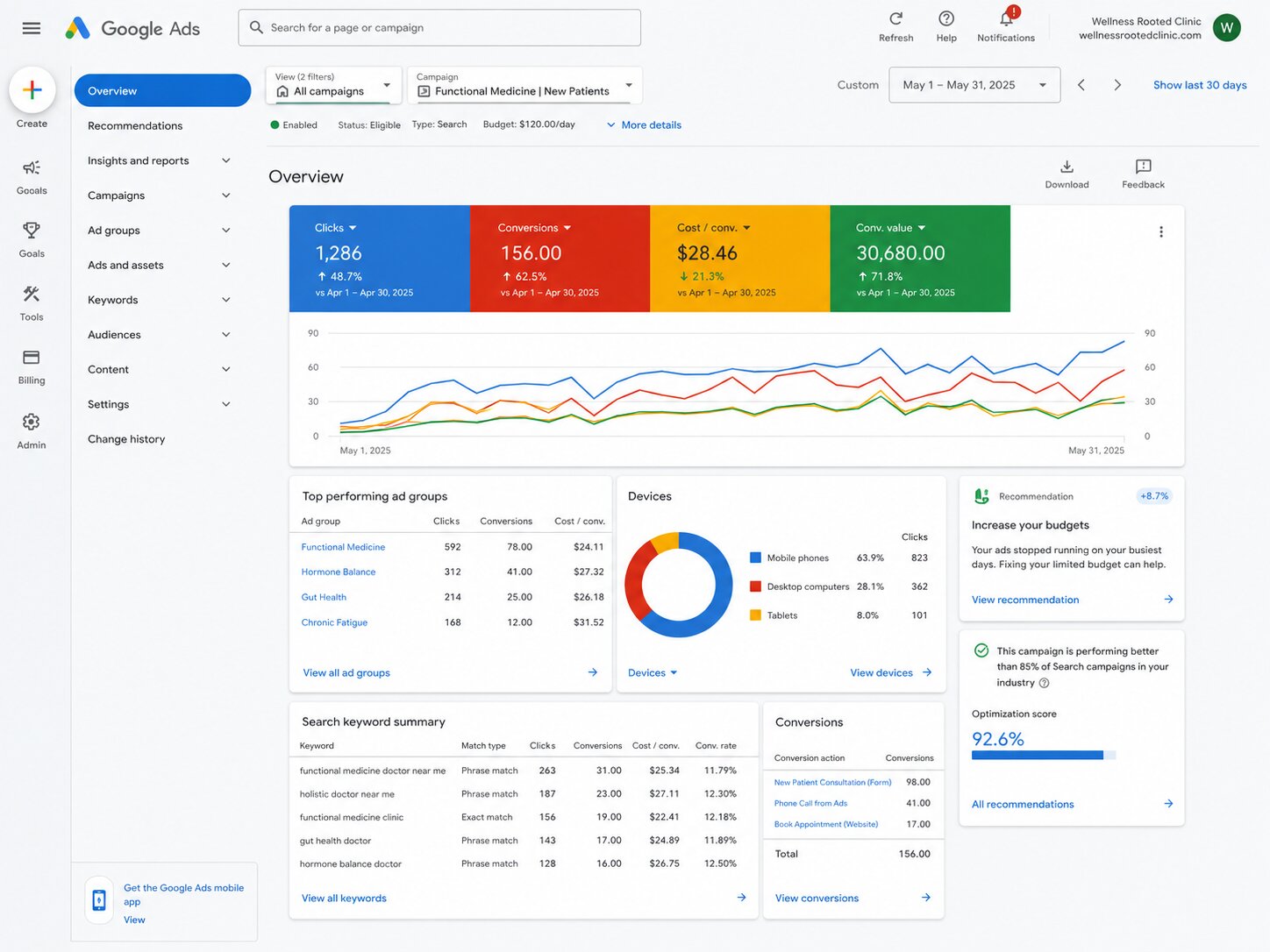
Google Ads for Functional Medicine: Everything Your Clinic Needs to Know
How to attract high-intent patients with paid search — keywords, compliance, campaign structure, landing pages, budgets and optimization, explained for functional and integrative medicine clinics.
By Salem Sidi, founder of Wellness Practice Marketing · Updated July 2026 · ~30 min read
What this guide covers
Part 1
Introduction: Why Google Ads Works for Functional Medicine
Every day, thousands of people type searches like "why am I always tired even after sleeping", "SIBO specialist near me" or "functional medicine doctor for thyroid" into Google. These are not casual browsers. They are people who have often spent months — sometimes years — being told their bloodwork is normal while they still feel unwell. Google Ads is the only marketing channel that puts your clinic in front of these people at the exact moment they are looking for help.
That is the core reason paid search outperforms almost every other channel for functional medicine: you are not interrupting anyone. You are answering a question they just asked.
Is Google Ads right for every functional medicine practice?
No — and it's better to know that before spending a euro. Google Ads works when three conditions are met:
Your patient economics support it. If a new patient is worth 1,500€+ over their care journey, paying 80–250€ to acquire one is excellent business. If you sell single 60€ consultations with no follow-up, the math gets hard.
You can absorb new patients. If your calendar is already full for two months, fix capacity before buying demand.
Someone answers enquiries fast. A lead that waits 24 hours for a reply books somewhere else. Speed-to-lead matters more than any bidding strategy.
How patients search for functional medicine today
Functional medicine patients rarely start by searching for "functional medicine". They start with their symptom ("bloating after every meal", "hair loss and fatigue woman") or a failed diagnosis journey ("normal thyroid labs but still exhausted"). Only later — once they've self-educated through podcasts, YouTube and articles — do they search for the modality itself and for a practitioner. Your campaigns need to meet them at both stages.
The biggest marketing challenges functional medicine clinics face
Explaining a different care model in a 90-character ad: longer consultations, deeper testing, higher investment.
Healthcare ad policy restrictions that generalist marketers constantly trip over.
Competition from both sides: conventional clinics with bigger budgets and wellness influencers giving away free content.
A longer decision cycle — patients research for weeks before booking a high-ticket first consultation.
Why functional medicine is different from traditional healthcare marketing
A conventional clinic sells convenience and urgency: "doctor near me, today." Functional medicine sells a process — investigation, personalization, partnership. Your marketing must educate while it converts. Ads that copy the urgent-care playbook ("Book now! Same-day appointments!") attract the wrong patient: someone looking for a quick fix who will balk at your prices and your protocols.
Understanding search intent
Every keyword carries an intent. "What is functional medicine" is informational — the searcher wants to learn, not book. "Functional medicine doctor Madrid price" is transactional — this person is comparing providers. Paying transactional-level prices for informational clicks is the single most common way clinics waste budget.
High-intent vs low-intent patients
Signal
High intent
Low intent
Search phrasing
"specialist", "near me", "cost", "book", city names
"what is", "can", "symptoms of", "vs"
Ad strategy
Bid aggressively, direct to booking page
Exclude, or serve educational content cheaply
Landing page
Offer + credentials + booking
Guide or article with soft CTA
Common mistakes clinics make before running ads
Sending paid traffic to a generic homepage instead of a dedicated landing page.
No conversion tracking — spending money with no idea what works.
No clear offer (what exactly does the first visit include and cost?).
Nobody assigned to answer enquiries within minutes.
Judging results after one week instead of one quarter.
Part 3
Google Ads Fundamentals
What is Google Ads?
Google Ads is Google's pay-per-click advertising platform. You choose the searches you want to appear for, write ads, and pay only when someone clicks. For clinics, the flagship format is the Search campaign: text ads shown above organic results when someone searches your chosen keywords.
How Google Ads actually works
Every time someone searches, Google runs an instant auction among all advertisers targeting that query. Your position isn't determined by bid alone — it's bid multiplied by quality. A relevant, well-built campaign routinely beats bigger budgets.
The auction, Quality Score and Ad Rank
Quality Score (1–10) grades your keyword on expected click-through rate, ad relevance, and landing page experience. Higher score = lower cost per click for the same position.
Ad Rank = your bid × Quality Score (plus ad asset impact). It decides whether and where your ad shows.
Practical implication: a clinic with a 8/10 Quality Score can pay half of what a 4/10 competitor pays for the same click. Relevance is the cheapest bidding strategy that exists.
Match types
Exact match [functional medicine doctor madrid] — tightest control, highest intent precision.
Phrase match "functional medicine doctor" — matches the phrase plus close variants.
Broad match — widest reach, only safe when paired with Smart Bidding and rigorous negative keywords.
Campaign types
For clinics: Search (the workhorse — 80%+ of budget), Performance Max (automated multi-channel, useful once conversion data exists), Display and YouTube (retargeting and awareness only — never expect direct bookings from cold display traffic).
Smart Bidding explained
Smart Bidding lets Google's machine learning set bids per auction using signals you can't see (device, time, search history). Strategies like Maximize Conversions and Target CPA work well — but only after your account has real conversion data (ideally 30+ conversions in 30 days). Before that, they optimize on noise.
Conversion tracking basics
A conversion is the action that matters: a booking form submitted, a call made, an appointment scheduled. Without tracking, you cannot optimize — you're flying blind. Part 9 covers the full setup.
Part 4
Google Ads Policies for Functional Medicine
Healthcare advertising policies
Google restricts healthcare advertising more than almost any other category. The rules exist to protect vulnerable searchers, and Google enforces them with automated systems that disapprove first and ask questions never. Knowing the lines keeps your account alive.
Medical claims you should never make
❌ "Cure your Hashimoto's" — cure claims are prohibited.
❌ "Reverse autoimmune disease guaranteed" — outcome guarantees are prohibited.
✅ "Root-cause approach to thyroid health" — describes your model without promising outcomes.
✅ "Comprehensive testing and personalized protocols" — factual service description.
Supplement advertising rules
Google maintains a list of prohibited supplements and restricts claims for the rest. Never build ads around specific supplement products or claims that a supplement treats a disease. Advertise the clinical service, not the products you may recommend inside it.
Functional medicine compliance and restricted conditions
Personalized advertising (audience targeting) based on health conditions is prohibited — you cannot build an audience of "people with IBS". Keyword targeting on condition searches, however, is allowed: bidding on "SIBO treatment" is fine; the restriction is on profiling people, not on answering searches. Some areas (experimental treatments, certain hormone therapies) face extra scrutiny — describe services conservatively and factually.
Common reasons functional medicine ads get disapproved
Cure/treatment outcome language in headlines.
Supplement product names in ad copy.
Landing pages making claims the ads carefully avoided.
Missing business information or unclear pricing on the landing page.
"Before/after" style implied outcomes.
How to stay compliant
The compliance test: describe what you do (testing, consultation length, personalized protocols, practitioner credentials), never what the patient will get as a clinical outcome. Audit the landing page with the same eyes as the ad — Google reads both.
Part 5
Keyword Research for Functional Medicine
The eight keyword families
Family
Examples
Intent
Service
functional medicine consultation, functional nutritionist
High
Condition
SIBO specialist, Hashimoto's doctor, PCOS clinic
Very high
Location
functional medicine doctor [city], near me
Very high
Symptom
chronic fatigue help, bloating after eating specialist
Medium–high
Competitor
[competitor clinic name]
High but sensitive
Educational
what is functional medicine, gut health diet
Low — usually exclude
Brand
your clinic name
Defensive — cheap, protect it
Long-tail
functional medicine doctor for thyroid who takes new patients
Very high, low volume
How to find high-intent keywords
Start with your own patients: what did they search before finding you? Mine your intake forms and ask at first visits. Then expand with tools — Google Keyword Planner (free, inside Google Ads), Google Autocomplete and "People also ask", and competitor analysis tools like Semrush. The best keywords are the ones where the searcher has a problem you demonstrably solve.
Prioritizing keywords by ROI
Rank every keyword by (intent × your margin on that service) ÷ competition. A condition keyword for your flagship program beats a generic "functional medicine" keyword every time: clearer intent, better-matched landing page, higher Quality Score, cheaper clicks.
Seasonal search trends
Health searches spike in January (resolutions), September (back-to-routine) and around hormonal-health awareness moments. Budget more aggressively in those windows; the same spend produces more patients.
Negative keywords: the profit protector
Negative keywords block searches you never want to pay for. Every functional medicine account should exclude from day one: free, cheap, jobs, salary, course, certification, training, what is, definition, insurance coverage (unless you accept it), reviews of [other clinics], and DIY-intent terms like protocol pdf. Review the search terms report weekly and keep adding — this single habit typically saves 15–30% of budget.
Part 6
Campaign Structure
The ideal account structure for a clinic
Campaign 1 — Brand: your clinic name. Tiny budget, protects your reputation from competitors bidding on you.
Campaign 2 — Core services: functional medicine + practitioner keywords, grouped by service.
Campaign 3 — Conditions: one ad group per condition cluster (gut, thyroid, hormones, fatigue…). This is usually the profit center.
Campaign 4 — Locations (if multi-area): geo-specific keywords and pages.
Ad groups: SKAGs vs thematic
Single-keyword ad groups (SKAGs) are obsolete — close variants merged them away. Use thematic ad groups: 5–15 tightly related keywords sharing one intent and one landing page. "SIBO specialist / SIBO doctor / SIBO treatment clinic" belong together; "SIBO" and "menopause" never do.
Geographic targeting
Target the radius your patients actually travel from — for most clinics 20–40 minutes, not a whole region. Critically, set location options to "Presence" (people in your area), not "Presence or interest", or you'll pay for clicks from other countries researching your city. Telehealth practices can target nationally, but should separate local and national campaigns with different pages and budgets.
Budget allocation, devices and scheduling
Start with ~70% of budget on condition + service campaigns, 20% locations, 10% brand.
Mobile drives most clicks; make sure your booking flow works flawlessly on a phone before adjusting device bids.
Run ads when someone can respond to enquiries. If nobody answers at 11pm, either schedule ads off or ensure next-morning follow-up is automatic.
Audience layering and scalability
Layer audiences in "Observation" mode (site visitors, health-interest segments) to gather data without restricting reach — then bid up on segments that convert. Structure campaigns so scaling means raising budgets, not rebuilding: clean separation by intent, consistent naming, one landing page per theme.
Part 7
Writing Ads That Convert
The anatomy of a great search ad
A responsive search ad gives you up to 15 headlines and 4 descriptions; Google assembles combinations. Your job: make every asset meaningful, front-load the keyword, and speak to the patient's actual situation.
Headlines that increase CTR
Mirror the search: "Functional Medicine Doctor in [City]"
Name the frustration: "Normal Labs, Still Exhausted?"
Differentiate: "90-Minute First Consultations"
Credential: "Physician-Led Root-Cause Care"
Action: "Book Your Initial Assessment"
Descriptions that build trust
Use descriptions to explain the model and pre-qualify: "Comprehensive testing, personalized protocols and real follow-up. In-person in [City] or online. See pricing and availability." Mentioning that pricing is visible filters out mismatched clicks before you pay for them.
Calls to action
"Book a call", "Check availability" and "Get your assessment" outperform generic "Learn more" for high-intent searches. Match CTA weight to intent: symptom searches get softer CTAs than "specialist near me" searches.
Dynamic keyword insertion — use with care
DKI inserts the user's keyword into your headline automatically. In healthcare it's risky: combined with condition keywords it can generate non-compliant headlines. If you use it, restrict it to service keywords only.
Ad assets (extensions)
Sitelinks: Pricing · About the Doctor · Conditions We See · Book Online
Structured snippets: Conditions: fatigue, gut health, thyroid, hormones…
Call + location assets: essential for local clinics; they expand your ad's footprint and CTR.
What functional medicine patients actually want to read
They've been dismissed, rushed and given five-minute appointments. The ads that win acknowledge that experience: time, thoroughness, being heard, a real plan. Trust signals (physician-led, credentials, years in practice, review count) matter more here than discounts ever will.
Part 8
Landing Pages: Where Clicks Become Patients
Why landing pages matter more than ads
The ad's only job is the click. Everything else — trust, education, booking — happens on the page. A mediocre ad with a great landing page beats a great ad with a homepage, every time. Sending paid traffic to your homepage forces visitors to navigate, and navigation is where conversions die.
Anatomy of a high-converting clinic landing page
Above the fold: headline matching the search, one-sentence value proposition, practitioner photo, single CTA button.
The problem, named: mirror the patient's experience ("You've done the tests. Everything came back 'normal'. You still feel terrible.").
Your approach: 3–4 steps of how care works — testing, first visit length, protocol, follow-up.
Credentials: practitioner bio, certifications, years of experience.
Testimonials: real patients, specific outcomes framed as experiences (compliance-safe), video if possible — see our client testimonials for the format.
Pricing transparency: at minimum the first-visit investment. Hiding prices generates unqualified calls and wasted clicks.
FAQ: answer the 6–8 real objections (insurance, duration, online options, what's included).
Booking: embedded calendar or short form. Every extra field costs conversions — name, contact, and one qualifying question is enough.
Mobile optimization and page speed
Over 65% of clinic-search clicks are mobile. The page must load in under 3 seconds on a phone; every extra second cuts conversions roughly 7%. Compress images, avoid heavy builders, keep the booking button visible without scrolling. This is exactly why we build clinic sites in fast, clean HTML.
Privacy considerations
Health data deserves extra care: use GDPR-compliant forms with explicit consent, avoid sending health-condition details through ad-platform tracking, and if you serve US patients, ensure your forms and tracking setup respect HIPAA constraints (no PHI in URLs, analytics or ad pixels).
Part 9
Conversion Tracking: Measuring Real Patient Acquisition
The tracking stack every clinic needs
Form tracking: fire a conversion when the booking/contact form submits successfully — not on button click.
Call tracking: Google call reporting or a call-tracking number that swaps in for ad visitors, counting calls over 60–90 seconds as conversions.
Appointment tracking: if you use an online scheduler, track the confirmation step — that's the real conversion, not the page visit.
CRM integration and offline conversion imports
A form fill isn't a patient. Import offline outcomes back into Google Ads: which leads booked, which showed up, which became ongoing patients. With that data, Google's bidding optimizes toward actual patients instead of curious form-fillers. This is the single biggest lever most clinic accounts never pull.
Enhanced conversions
Enhanced conversions send hashed first-party data (email, phone) with conversions, recovering attribution lost to cookie restrictions. Enable it — it's free accuracy.
Rule of thumb: if you can't say what a new patient cost you last month per campaign, tracking isn't done yet. "We get some calls from Google" is not a measurement.
Part 10
Bidding & Budget
How much should functional medicine clinics spend?
Realistic starting points for a single-location clinic: 500–1,500€/month in ad spend. Below ~500€ you rarely generate enough data to optimize. The correct question isn't "how much should I spend" but "at what cost per patient am I profitable?" — then spend as much as possible below that line.
Benchmarks to orient yourself
Metric
Typical range (functional/integrative)
Cost per click
1.50–6€ (ES) · $4–12 (US metros)
Landing page conversion rate
5–15%
Cost per lead
20–80€
Cost per new patient
80–250€
These vary enormously by city and niche — treat them as sanity checks, not targets.
ROAS vs patient lifetime value
Judging ads on the first consultation fee alone understates reality. If the average patient completes a 4-month program worth 2,000€ and refers others, a 200€ acquisition cost is a 10× return. Calculate your true LTV before deciding ads "don't work".
Choosing a bidding strategy
Launch (weeks 1–4): Manual CPC or Maximize Clicks with strict CPC caps — you're buying data.
Data phase (15–30 conversions): Maximize Conversions.
Maturity: Target CPA set at your profitable acquisition cost; raise budget while CPA holds.
Budget scaling
Scale in +20–30% steps every 2–3 weeks, never doubling overnight (it resets bidding-algorithm learning). Watch "Limited by budget" status and Search Impression Share: if you're profitable and losing 60% of available impressions to budget, the growth lever is sitting right there.
Part 11
Optimization: The Weekly and Monthly Routine
Search terms report — your goldmine
Weekly: read the actual searches that triggered your ads. Add converting terms as keywords; add irrelevant ones as negatives. This 20-minute habit compounds more than any other optimization.
Improving Quality Score and CTR
Tighten ad groups so ads mirror their keywords precisely.
Test headlines that name the patient's frustration, not your service list.
Improve landing page relevance — the page must deliver exactly what the ad promised.
Improving conversion rate and reducing cost per patient
A/B test one landing page element at a time: headline, CTA placement, pricing visibility, form length.
Add a second CTA path (WhatsApp or call) for people who won't fill forms.
Fix speed-to-lead: an auto-reply plus a human follow-up within 15 minutes can double booked rates from the same spend.
Scaling winning campaigns
When a campaign holds target CPA for 3–4 weeks: raise budget 20–30%, expand its keyword theme with close variants, and clone its structure into the next condition niche. Scale what's proven; don't dilute it with unrelated keywords.
Part 12
Advanced Strategies
Dynamic Search Ads
DSA targets searches based on your website content — useful for discovering keyword gaps once you have a content-rich site. Keep it in a separate low-budget campaign with aggressive negatives.
Performance Max for clinics
PMax spreads ads across Search, Maps, YouTube, Display and Gmail automatically. It can work for clinics with solid conversion data and good creative assets, but never let it replace your core Search campaigns — run it alongside, feed it offline conversion data, and watch where spend actually goes.
Remarketing and Customer Match
Health-condition-based remarketing lists are restricted, but you can still remarket to general site visitors with brand-level messaging ("Still researching? Meet our practitioners"). Customer Match (uploading patient emails) faces similar healthcare restrictions — use it conservatively for reactivation of existing patients where policy allows.
Broad match + Smart Bidding and value-based bidding
The modern Google playbook: broad match keywords, Target CPA/ROAS bidding, and conversion values assigned by lead quality. It works when — and only when — your tracking feeds real patient values back into the system. With value-based bidding, Google learns that a booked SIBO program is worth 10× a newsletter signup and bids accordingly.
AI, automation rules and scripts
Use automation for the mechanical work: rules that pause ads when budgets run away, scripts that alert on disapprovals or broken landing pages, AI-drafted headline variants (always human-reviewed for compliance). Never automate policy judgment — that stays human in healthcare.
Part 13
Local Growth
Google Business Profile & Google Ads together
Link your Google Business Profile to Google Ads to unlock location assets: your address, map pin and hours appear with ads, and you become eligible for ads in the Local Pack and Google Maps. A complete, review-rich profile also lifts ad credibility — searchers check it before clicking.
Local Search Ads and Maps visibility
When someone searches "functional medicine near me", paid Map listings appear above organic ones. These clicks are among the highest-converting in the entire account — prioritize eligibility (linked GBP + location assets + local campaigns).
Radius targeting and multi-location campaigns
Set radius by real patient travel behavior, not administrative boundaries. Multi-location clinics: one campaign per location, each with its own budget, radius, phone number and landing page — never one campaign "targeting everywhere" with a generic page.
Local landing pages
Each location page needs: city in the headline and title, embedded map, local phone, local testimonials, directions/parking, and that location's team. Localized pages convert measurably better and raise Quality Score for geo keywords.
Part 14
Measuring Success: The Metrics That Actually Matter
Metric
What it tells you
Healthy signal
CTR
Ad relevance to the search
5%+ on branded/local, 3%+ on condition terms
Conversion rate
Landing page + offer strength
5–15%
CPC
Auction competitiveness + Quality Score
Stable or falling over time
Cost per lead
Front-end efficiency
Within your modeled range
Cost per acquisition (patient)
The number that matters
Below your profitability line
Impression share
How much available demand you capture
Growing; watch what's lost to budget vs rank
Search lost IS (rank)
Quality/bid problem
Falling as Quality Score improves
Patient lifetime value
The ceiling on what you can afford to spend
Known, not guessed
Vanity metrics — impressions, clicks, even leads — mean nothing in isolation. The report that matters fits in one sentence: "Last month we invested X and acquired Y new patients at Z€ each, against an average patient value of W." That's the sentence we build every client report around.
Part 15
Google Ads by Functional Medicine Niche
The framework in this guide applies everywhere, but each niche has its own search language and decision triggers:
Gut health clinics
The richest symptom vocabulary in functional medicine: bloating, SIBO, IBS, reflux, food intolerance. Symptom keywords convert unusually well here because sufferers are desperate for specifics. Lead with testing depth.
Hormone & thyroid clinics
"Normal TSH but still exhausted" is the defining search. These patients have been dismissed repeatedly — ads acknowledging the full-panel testing gap (free T3/T4, antibodies) speak their language instantly.
Autoimmune care
Long, research-heavy patient journeys. Educational retargeting works harder here than anywhere else. Compliance caution is highest — no remission promises, ever.
Women's health, PCOS & menopause
High search volume, strong community-driven education (patients arrive informed), and clear condition language. Menopause searches are surging year over year; perimenopause even faster. Separate campaigns per condition — the intents differ.
Men's health
Lower search volume, higher privacy sensitivity. Discreet, factual ad copy outperforms lifestyle imagery. Testosterone-related terms carry extra policy scrutiny — frame around symptoms and evaluation, not treatment.
Chronic fatigue & weight management
Fatigue searchers have usually seen multiple doctors — differentiation through process depth wins. Weight management requires the most careful compliance work in the entire field: Google heavily restricts weight-loss claims; frame everything around metabolic health evaluation.
Longevity & preventive medicine
A different buyer: proactive, affluent, comparison-shopping on sophistication. Keywords like "longevity clinic", "healthspan doctor" and biomarker-related searches are growing fast with relatively low competition — an early-mover opportunity. We work with several of these practice types — see who we work with.
Part 16
Common Problems & Frequently Asked Questions
Troubleshooting quick reference
Problem
Most likely cause
First fix
No leads
Tracking broken, or landing page mismatch
Verify tracking fires; align page to ad promise
Expensive clicks
Broad keywords, low Quality Score
Tighten match types; rebuild ad-page relevance
Low conversion rate
Homepage traffic, slow mobile page, hidden pricing
Dedicated landing page with visible offer
Poor quality leads
Vague offer, missing pre-qualification
State price range and process in ad + page
Ads not showing
Budget caps, low Ad Rank, disapprovals
Check status column first — always
Limited by budget
Profitable demand exceeds spend
If CPA is good: raise budget; if not: cut keywords
Disapproved ads
Healthcare policy language
Remove outcome claims; re-audit landing page
Competitors outranking you
Their Quality Score, not just budget
Win relevance; add assets; strengthen page
Is Google Ads worth it?
When patient lifetime value supports the acquisition cost — yes, unambiguously. It's the only channel delivering active demand within weeks. Clinics for whom it "didn't work" almost always had a structural issue from this guide's checklist, not a channel problem.
How long until I see results?
First enquiries: 2–3 weeks. Reliable optimization data: 60–90 days. Judge the channel on a quarter, not a fortnight.
How much should I spend?
500–1,500€/month to start for a single location, then scale based on cost per patient versus patient value (Part 10).
Should I hire an agency or run ads myself?
Self-managing works if you can invest 5–10 hours weekly and tolerate learning-curve waste. Otherwise, a healthcare-specialist agency typically recovers its fee through avoided disapprovals, cleaner structure and better landing pages. Whoever runs it — demand the one-sentence report from Part 14.
SEO or Google Ads first?
Ads first for immediate patient flow; SEO in parallel for compounding visibility. The keyword data your ads generate makes your SEO strategy sharper.
Should I advertise specific conditions?
Yes — condition campaigns are usually the highest-ROI part of a clinic account. Keyword-target conditions freely; just never make outcome promises in the copy (Part 4).
Why are my clicks expensive? Why aren't people booking?
Expensive clicks: relevance problem (Part 11). Clicks without bookings: landing page or lead-handling problem (Parts 8 and 9). The auction is almost never the real culprit.
Want this system built for your clinic?
We run Google Ads exclusively for functional and integrative medicine clinics — compliant campaigns, condition landing pages, real conversion tracking and weekly reports that fit in one sentence. Book a free strategy call with Salem and find out what your patient acquisition could look like.
Free 30-minute call · No long-term contracts · 100% specialised in functional & integrative medicine
Get a free marketing audit
We only work with a limited number of clinics per area. Fill in the form and we'll reach out via WhatsApp to see if you qualify.