
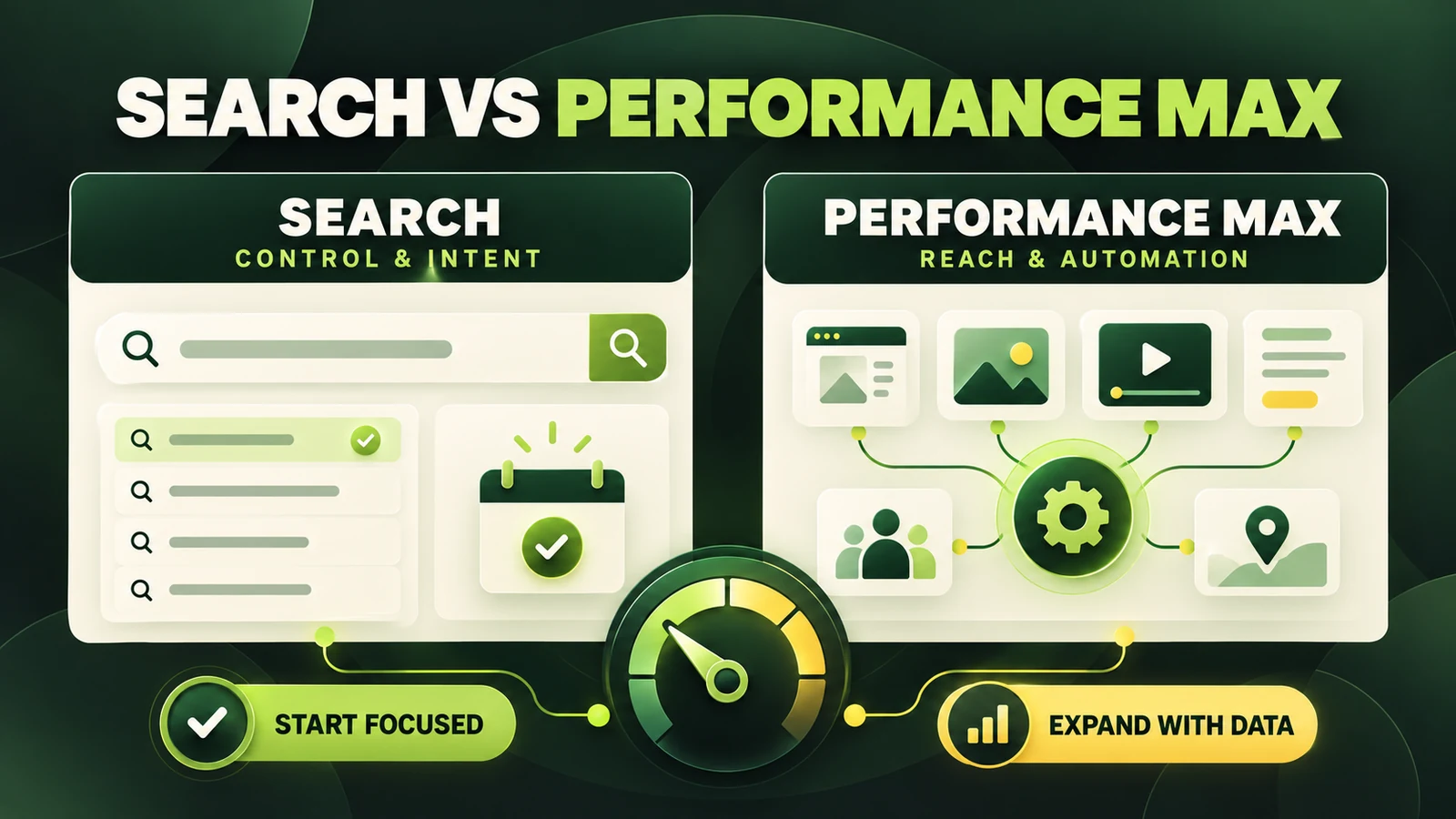
The short answer: start focused, then expand with evidence
For most local clinics, Search should be the first Google Ads campaign. It connects ads to active searches, makes queries easier to inspect and gives a small team clearer control over services, locations, landing pages and budget. Performance Max can become useful later, when the clinic has reliable conversion data, qualified-lead feedback, enough creative assets and a reason to expand beyond Search.
Performance Max is not an upgraded Search campaign. Google describes it as a goal-based campaign type that can access inventory across Search, Display, YouTube, Discover, Gmail, Maps and Search partners. That breadth can find incremental demand, but it also increases the number of placements, formats and signals the clinic must evaluate.
Current-product note: Google Ads features and controls change frequently. This guide was reviewed against Google's documentation on October 16, 2026. Confirm the options available in your account before launch. Healthcare policy and privacy requirements still apply regardless of campaign type.
This article focuses on campaign selection. For the wider setup, including keywords, landing pages and conversion goals, see our Google Ads guide for functional medicine practices.
1. Understand the core difference
| Decision factor | Search campaign | Performance Max |
|---|---|---|
| Primary reach | Search results and selected Search Network settings | Multiple Google channels from one goal-based campaign |
| Intent input | Keywords, match types and search queries | Goals, assets, landing pages, search themes and audience signals |
| Creative | Mainly responsive search ad text and assets | Text, images, logos and video across formats |
| Control | More direct campaign and query-level structure | More automation, with exclusions and newer reporting controls |
| Best early use | Prove demand for defined clinic services | Expand after clean measurement and a stable baseline |
Search themes in Performance Max are not the same as keywords. Google says they provide broader context to its AI, while audience signals are suggestions rather than hard targeting boundaries. A clinic therefore should not assume that entering a service term and an audience makes PMax behave like a keyword campaign.
2. Why Search is the default clinic starting point
A clinic normally begins with a narrow business question: can we acquire appropriate new patients for one service in one eligible area at a sustainable cost? Search makes that question easier to test because the campaign can be organized around explicit service intent.
- Queries are easier to diagnose. The team can see whether people searched for care, jobs, training, free information, products or unrelated meanings.
- Landing pages can stay specific. A hormone consultation ad can reach the matching service page rather than relying on broad URL expansion.
- Budget is easier to concentrate. A small clinic can fund its most valuable location-service combination first.
- Negative-keyword learning is clearer. The search-terms workflow reveals exclusions without guessing; use our negative-keyword guide for health clinics.
- Front-desk feedback is easier to connect. A booked or rejected inquiry can be traced back to a service, campaign and query theme.
Search is not fully manual. It uses automated bidding, responsive ads, close variants and other machine-learning systems. The practical distinction is that the clinic begins with a tighter expression of demand and clearer diagnostic levers.
3. When Performance Max can help a clinic
Performance Max becomes more credible when Search already produces meaningful conversions and the clinic wants incremental reach rather than rescue. Useful conditions include:
Stable conversion signal
Primary goals represent real calls, forms or bookings, not page views and button clicks.
Lead-quality feedback
The clinic can distinguish valid, qualified, booked and attended inquiries.
Creative readiness
Approved images, logos, video and copy accurately represent the service in every format.
Incremental objective
The team knows what PMax should add beyond the Search baseline and how it will measure that addition.
A clinic with multiple suitable services, strong local brand assets and enough budget to support learning may benefit from cross-channel discovery. Performance Max can also use Maps and other inventory that may support local action. The value comes from additional qualified demand—not simply a lower platform-reported conversion cost.
4. When Performance Max is likely to hurt
PMax is a weak starting choice when the clinic's measurement teaches the system the wrong lesson. If every short call, spam form and directions click is primary, automation may find more of those cheap actions rather than more appropriate patients.
Delay the test when:
- the account has few meaningful conversions or several inflated primary goals;
- the clinic cannot return valid-lead or booking outcomes;
- brand searches are mixed with non-brand acquisition and not separated in analysis;
- there are no approved image or video assets for healthcare advertising;
- Final URL expansion could send traffic to unsuitable pages;
- the service is limited to narrow jurisdictions or eligibility rules that have not been reviewed;
- the budget is too small to support both the existing Search baseline and a distinct test; or
- the team expects audience signals to restrict delivery to a chosen audience.
Broad reach also increases policy exposure. Every asset, destination and targeting choice must comply. Review our Google Ads healthcare policy guide for clinics before enabling additional formats or audience strategies.
5. Pass the measurement gate first
Before PMax, audit the conversion-action table. Each goal should have an owner, a trigger, a value rationale and a decision about whether it is primary or secondary. Test calls and forms end to end. Do not import every analytics event as a bidding goal.
- Count a connected call only after a defensible duration or other quality check.
- Separate completed forms from form starts and contact-page views.
- Return qualified, booked or attended outcomes when the workflow and privacy review support it.
- Keep sensitive health details and unnecessary personal data out of ad-platform parameters.
- Compare channel results with total valid inquiries, not only Google's attributed conversions.
The system cannot infer that a low-cost lead was outside the service area unless the clinic supplies a usable signal or the campaign excludes that geography. Automation amplifies the definitions it receives.
6. Pass the asset gate
Google's current PMax specifications require text, horizontal and square images, and a square logo for standard asset groups without a Merchant Center feed. Google also recommends vertical imagery and multiple variations. If no video is supplied, Google may create one automatically; clinics that need precise visual and claims control should provide an approved video or review the applicable settings before launch.
Build an asset set around one coherent service:
- accurate clinic and practitioner photography with documented usage rights;
- headlines that describe the consultation without promising an outcome;
- descriptions consistent with the landing page, eligibility and location;
- logos that remain legible across square placements;
- video that still communicates clearly with sound off; and
- landing pages that can withstand Final URL expansion, or URL controls that limit it appropriately.
Do not fill the asset group with generic wellness imagery merely to satisfy a quantity recommendation. More assets help only when each one is accurate, differentiated and safe to show independently.
7. Review controls before activation
Performance Max offers more controls than it did at launch, but they must be configured deliberately. Review:
- Search themes: provide relevant business context, but treat them as signals rather than keywords.
- Negative keywords: block completely irrelevant or unsafe terms without over-restricting useful discovery.
- Brand exclusions: separate existing brand demand when the test is meant to measure acquisition. Google recommends brand exclusions over negatives for comprehensive brand blocking.
- Final URL expansion: decide whether Google may select another page and generate text from it.
- Location options: confirm the campaign matches the clinic's real service area and eligibility.
- Placement and content suitability: apply account-level exclusions appropriate to the clinic's brand.
- Channel and search-term reporting: use the available insights to investigate where results actually came from.
If Search and PMax run together, understand prioritization rather than assuming they compete evenly. Google currently states that an identical eligible exact-match Search keyword is prioritized over PMax, while other queries depend on relevance, Ad Rank and campaign settings.
8. Use a controlled expansion test
- Freeze the baseline: document recent Search spend, valid leads, bookings and cost per outcome.
- Define incrementality: specify what additional qualified volume would justify PMax.
- Protect brand analysis: use the appropriate brand exclusions when the objective is non-brand growth.
- Constrain destinations: review Final URL expansion and exclude pages that should not receive paid traffic.
- Launch one coherent asset group: keep service, audience context, creative and destination aligned.
- Keep Search stable: avoid simultaneous restructures that destroy the comparison.
- Review quality weekly: share invalid, qualified and booked outcomes, not just conversion totals.
- Decide by prewritten rules: expand, revise or stop based on total qualified acquisition—not the best-looking interface metric.
Where available and suitable, Google Ads experiments can help measure the uplift of adding Performance Max to an existing mix. An experiment still needs clean goals and operational lead feedback; design alone cannot correct a weak conversion definition.
9. Clinic decision scorecard
| Question | If no | If yes |
|---|---|---|
| Does Search already produce valid leads? | Build the Search baseline | Continue |
| Are primary conversions accurate? | Repair measurement | Continue |
| Can the clinic report lead quality? | Create the feedback workflow | Continue |
| Are all visual and text assets approved? | Build the asset library | Continue |
| Is there enough budget for a distinct test? | Concentrate on Search | Define incrementality |
| Are URLs, brands, locations and exclusions reviewed? | Finish controls | Test PMax |
Frequently asked questions
Should a clinic start with Performance Max or Search?
Most should start with focused Search because it makes intent and lead quality easier to diagnose. Test PMax after the clinic has reliable conversion signals, creative and budget for incremental reach.
Can Performance Max replace Search?
It can access Search inventory, but it spans multiple channels and uses different controls. Preserve Search for proven high-intent services unless evidence shows a different structure works better.
Are PMax audience signals strict targeting?
No. Google says they are suggestions that help its AI learn. Delivery can extend beyond the signaled audience when the system predicts that doing so can meet the campaign goal.
Do clinics need video for Performance Max?
Video supports PMax inventory. If you do not provide one, Google may generate it. Clinics with strict creative and claims requirements should prepare an approved video and review current settings.
How do we know whether PMax worked?
Compare total valid leads, qualified leads, bookings and acquisition cost against the stable Search baseline. Separate branded demand and inspect channel and search-term insights before attributing growth to the test.
Choose the campaign that matches your evidence
Search is usually the right first campaign because it lets a clinic prove one service, one market and one conversion path. Performance Max becomes useful when automation has trustworthy goals, quality feedback, approved assets and enough budget to explore beyond that foundation.
Wellness Practice Marketing builds and audits Google Ads systems for functional and integrative clinics. If you want a campaign plan based on your service demand, measurement and budget, book a strategy call.
This article provides general marketing education, not legal, medical or privacy advice. Review current platform policies and obtain qualified guidance for your clinic.
Authoritative sources
- Google Ads Help: Search targeting and controls for Performance Max
- Google Ads Help: Performance Max specifications and format requirements
- Google Ads Help: About search themes
- Google Ads Help: Performance Max negative keywords
- Google Ads Help: Performance Max brand exclusions
- Google Ads Help: Performance Max questions, signals and controls
- Google Ads Help: Performance Max channels