
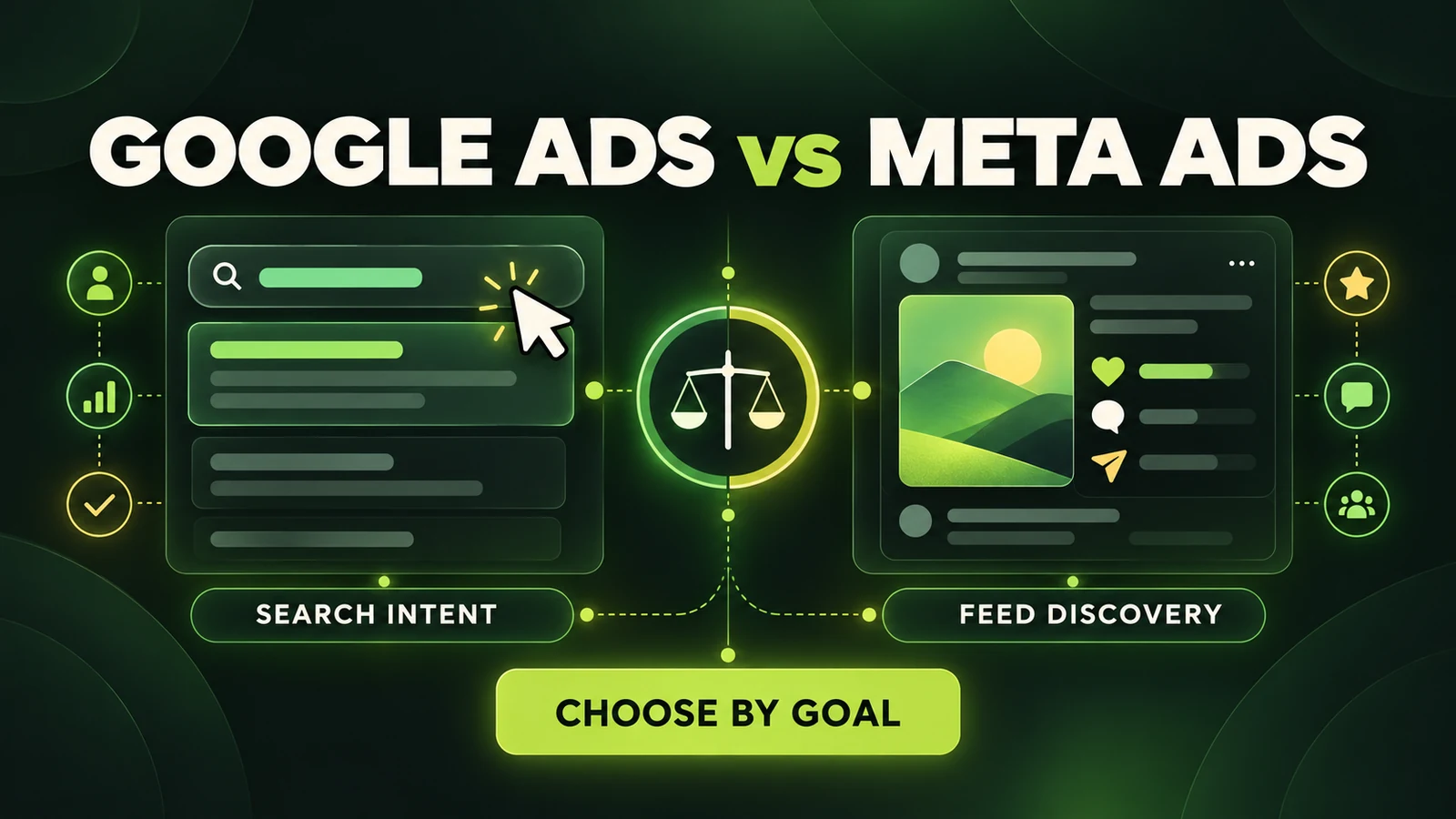
Google Ads vs Meta Ads for functional medicine clinics is not a contest with one universal winner. Google Search is designed to meet people who are already expressing demand through a query. Meta places visual messages into Facebook and Instagram feeds, where the clinic usually has to earn attention before it can generate intent.
That difference affects the offer, creative, lead quality, follow-up and measurement. A clinic promoting a well-known service with steady local searches may get a clearer first test from Google. A clinic introducing an unfamiliar program may need Meta's educational reach, provided it can create persuasive content and nurture people who were not actively looking to book.
This guide turns that distinction into a practical decision. For the underlying philosophy, read why we prefer search intent over social media attention. For campaign structure, see our complete guide to Google Ads for functional medicine.
Short answer: start with Google Search when qualified patients already search for the service. Consider Meta when the offer needs education, the clinic can produce strong visual creative, and the team has a deliberate follow-up system. Do not split a small test budget simply to be present everywhere.
Google Ads vs Meta Ads at a Glance
| Decision factor | Google Search | Meta Ads |
|---|---|---|
| Patient context | Actively searching | Browsing a feed or story |
| Main job | Capture existing demand | Create or develop demand |
| Core input | Keywords, query relevance and landing page | Creative, message, audience and offer |
| Typical first signal | Relevant search, click, call or form | View, engagement, click or lead |
| Creative workload | Moderate; copy and landing pages matter | High; fresh images and video matter |
| Common risk | Paying for irrelevant or low-fit searches | Cheap leads with weak intent |
| Best fit | Known service with measurable search demand | Educational offer with a strong visual story |
This is a starting framework, not a performance promise. Either platform can fail with a vague offer, weak destination, broken tracking or slow response. Either can work when its campaign matches how prospective patients encounter and evaluate the service.
When Google Ads Is the Better Starting Channel
Google describes Search campaigns as a way to reach people actively searching for products and services. For a clinic, that can mean queries for a practitioner type, service, condition-related support or location. The patient has already taken the first step by asking a question.
Google Search is usually the more direct first test when:
- people use recognizable language for the service;
- the clinic serves a defined location or licensed telehealth area;
- the offer and first step are clear;
- a relevant landing page answers price, process and suitability questions;
- staff can answer calls and forms promptly; and
- completed enquiries and bookings can be tracked reliably.
Search also reveals the words people use. Search-term reviews can expose irrelevant research, jobs, free resources, insurance mismatches or services the clinic does not provide. A disciplined negative-keyword workflow for health clinics helps protect the budget.
The limitation is available demand. Google cannot manufacture unlimited searches for a service. In a small market or for an unfamiliar program name, a tightly controlled campaign may simply have too little relevant volume. Expanding keywords carelessly creates traffic, but not necessarily suitable patients.
When Meta Ads Can Be the Better Fit
Meta ads appear across feed-led placements such as Facebook and Instagram. The advertiser is not responding to a search query; the creative must interrupt scrolling, establish relevance and make the next step feel worthwhile.
Meta can be useful when:
- the audience experiences a problem but does not know the clinic's service name;
- the offer benefits from visual education, practitioner explanation or a clear story;
- the clinic can produce several credible creative angles rather than one static ad;
- the conversion path supports a lower-commitment first step, such as an educational event or screening call;
- the practice has capacity for follow-up and nurture; and
- the team can distinguish curious leads from suitable prospective patients.
Meta is not automatically the cheaper channel. A low form cost can hide weak contact rates, out-of-area leads, poor service fit or no-show appointments. Creative fatigue also matters: a concept that works now may stop earning attention, requiring new hooks, formats and evidence.
Compare Lead Quality, Not Platform Cost per Lead
A Google lead and a Meta lead may arrive with different levels of readiness. Someone searching for a functional medicine consultation near them has declared intent. Someone who responded to an educational feed ad may still be deciding whether the problem, approach and clinic are relevant.
That does not make one lead inherently good and the other bad. It means the clinic should use the same downstream stages for both channels:
- Tracked lead: the call, form or booking was recorded.
- Contactable lead: staff could reach the person.
- Qualified lead: service, geography and practical fit were confirmed.
- Booked consultation: an appointment was scheduled.
- Attended consultation: the prospective patient showed up.
- Acquired patient: the person began paid care.
Compare cost, volume and elapsed time at each stage. Platform dashboards are useful for delivery, but the clinic's scheduling or CRM record is the source for qualification and attendance. Our guide to clinic conversion tracking explains how to keep weak clicks separate from meaningful outcomes.
What Should a Small Clinic Do With a Limited Budget?
Concentration usually produces a clearer lesson than splitting a small budget across two platforms, several services and multiple locations. Choose one priority offer and one main acquisition hypothesis.
Start with Google when relevant search demand exists and the clinic can build a strong service page. Start with Meta when demand must be created and the clinic already has the creative and follow-up capacity to educate prospects. The decision should come from evidence, not a desire to appear on every channel.
Set a test window and decision rules before launch. Define what would count as relevant traffic, a qualified lead, an acceptable booking rate and a safety limit. Do not declare a winner after a handful of clicks, and do not keep spending indefinitely without a learning question.
How the Two Platforms Can Work Together
Google and Meta can complement each other, but the sequence matters. Search can capture high-intent demand while Meta introduces the clinic's perspective through educational creative. Insights can travel between channels without copying tactics directly:
- use recurring search questions to shape Meta videos and educational posts;
- use Meta comments and objections to improve Search ad copy and landing-page FAQs;
- keep platform budgets and conversion actions separate so contribution is visible;
- compare both channels at the qualified, booked and attended stages; and
- scale only when the front desk can absorb more enquiries.
Retargeting requires special caution in healthcare. Google's current personalized-advertising policy treats health as a sensitive interest category and restricts advertiser-curated audiences for covered health content. Meta's customer-list terms require the advertiser to have the necessary rights, permissions and lawful basis. Clinics should review current platform rules, consent, page context, vendor data flow and applicable privacy law before creating any audience. Do not assume that a pixel installation makes a healthcare retargeting tactic acceptable.
A Practical Channel Decision Checklist
Score the clinic honestly against these questions:
- Demand: do suitable patients search for this service in the target area?
- Awareness: do prospects understand the service, or must the clinic first explain the problem and approach?
- Offer: is the next step specific, credible and easy to evaluate?
- Assets: is there a strong landing page for Search or a repeatable creative system for Meta?
- Operations: who responds, how quickly, and how are leads qualified?
- Measurement: can the clinic trace leads through booking, attendance and acquisition?
- Policy: has the team checked current health-advertising, targeting and data-use rules?
If the answers favor active demand, a clear service page and direct booking, test Search first. If they favor education, strong creative and structured nurture, Meta may deserve the first controlled test. If neither channel has the required foundation, fix the offer, page, tracking and follow-up before buying traffic.
Frequently Asked Questions
Are Google Ads or Meta Ads better for functional medicine clinics?
Google Search is usually stronger for existing demand. Meta is often better suited to awareness and education. The clinic's service, market, creative capacity and follow-up determine the better starting point.
Which platform produces higher-quality leads?
Search often begins with stronger declared intent, but quality must be verified downstream. Compare qualified, booked, attended and acquired patients rather than raw lead totals.
Should a small clinic use both?
Usually only after one channel has a clear offer, reliable tracking and a repeatable process. Splitting a small test can make both results difficult to interpret.
Can clinics retarget website visitors?
Do not assume so. Health content can trigger targeting restrictions, and privacy requirements apply. Review current platform rules and obtain appropriate compliance advice.
How should performance be compared?
Use the same real-world funnel for both platforms: qualified leads, bookings, attendance, acquired patients, acquisition cost and time to conversion.
Choose the Channel That Matches Patient Intent
Google Search and Meta solve different acquisition problems. Search is strongest when patients already know what they want. Meta is strongest when the clinic can turn attention into informed interest through credible creative. Start with the problem your practice actually has, measure the full patient path and add complexity only when the first system is understood.
If you want a search-led acquisition system built around qualified patient intent, explore our Google Ads management for wellness clinics or book a strategy call below.