
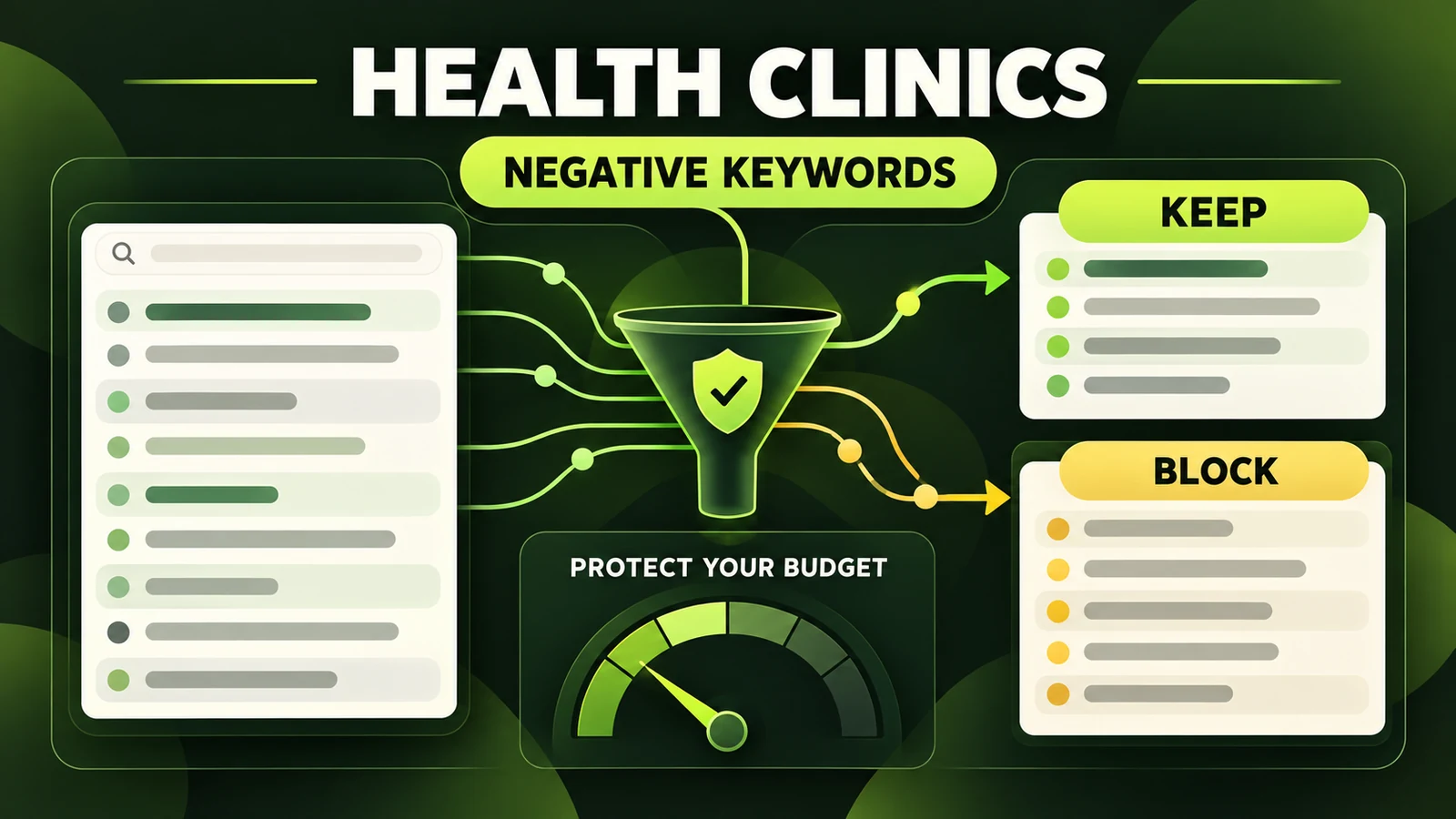
Negative keywords for health clinics prevent Google Ads from serving on searches that are irrelevant to the service being promoted. They can protect budget and improve the quality of the traffic that reaches a clinic website. They can also quietly block qualified patients when they are copied from a generic list without context.
The safest approach is not to paste hundreds of exclusions on launch day. Start with terms that are clearly outside the clinic’s business, review actual search terms, and add exclusions at the narrowest useful scope. Every candidate below requires a service check before it goes live.
This is the implementation guide. For campaign architecture, landing pages and measurement, use our parent guide to Google Ads for functional medicine. To see why real queries matter, read our healthcare search-terms case study.
Rule before copying: never exclude a word merely because it looks informational or expensive. Exclude it only when the query reveals an intent, service, location or audience the clinic cannot serve.
How Negative Keywords Work in Search Campaigns
Google supports broad, phrase and exact negative match for Search campaigns. These negative types do not behave like positive match types. Google also warns that negative keywords do not expand to every close variant or synonym, although casing and misspellings are handled automatically. Singulars, plurals and genuinely different wording may need separate review.
| Negative type | Syntax | What it blocks | Clinic use |
|---|---|---|---|
| Broad | medical jobs | Searches containing every negative term, in any order | Clear unwanted themes where word order does not matter |
| Phrase | "medical jobs" | The same terms in the same order, with words before or after | Specific multiword intents that recur |
| Exact | [medical jobs] | Only that exact query without additional words | One proven irrelevant query when broader blocking is risky |
Suppose a hormone clinic sees hormone therapy jobs. A broad negative for jobs can stop other job-seeking searches too. An exact negative for [hormone therapy jobs] blocks only that query. The broader option is efficient when employment intent is never valuable; the exact option is safer when a word has mixed meaning.
Choose the Narrowest Safe Scope
Negative keywords can sit at the ad-group, campaign, shared-list or account level. Scope determines the possible damage.
- Ad-group level: route a query away from one tightly themed group while allowing another group to serve.
- Campaign level: exclude an intent from one service campaign, such as surgery terms from a non-surgical weight-management campaign.
- Shared list: apply a reviewed theme to several selected campaigns and manage it centrally.
- Account level: block a term across eligible Search and Shopping inventory. Reserve this for exclusions that are truly irrelevant everywhere.
Google currently allows one account-level list with up to 1,000 negatives. Campaign-level lists can contain up to 5,000 keywords, and an account can hold up to 20 such lists. Capacity is not a target. A short, explainable list is safer than a large list nobody audits.
A Core Candidate List for Health Clinics
These terms commonly signal employment, education, wholesale or unrelated-provider intent. Treat them as candidates, then remove anything relevant to the clinic.
| Intent | Candidate negatives to review | Important exception |
|---|---|---|
| Employment | jobs, job, career, careers, salary, vacancy | Do not apply to recruitment campaigns |
| Professional education | degree, school, course, certification, training, exam | Keep if the clinic sells education or practitioner training |
| Wholesale or supply | wholesale, supplier, distributor, bulk | Keep if products are part of the offer |
| Animal care | veterinary, vet, dog, cat | Do not use for integrative veterinary services |
| Free resources | free pdf, free download, template | Do not broadly exclude free if free consultations are offered |
Avoid treating research, study, symptoms, cost or reviews as universal negatives. Functional medicine patients often research extensively before booking. Those queries may be early-stage, but they can still belong to a legitimate care journey.
Weight-Loss Clinic Negative Keyword Candidates
For a clinician-led, non-surgical weight-management campaign, review:
bariatric surgery,gastric sleeve,gastric bypassandlap bandif surgery is not offered or referred.personal trainer,gym membershipandfitness classwhen the offer is medical care rather than fitness services.calorie calculator,free meal planandrecipewhen the campaign is strictly appointment-led.wholesale,coupon codeandbuy onlinewhen the clinic does not sell products online.
Do not automatically exclude medication names, cost or near me. Even if a clinic does not prescribe a particular drug, those searches can reflect someone comparing medically supervised options. Review the complete query, landing page and lead quality first.
Hormone Clinic Negative Keyword Candidates
steroid cycle,bodybuilding steroidsandpost cycle therapywhen the clinic does not serve performance-enhancement intent.hormone therapy jobs,endocrinology fellowshipandmedical trainingfor patient-acquisition campaigns.buy hormones online,wholesale hormonesandsupplierwhen treatment requires a clinical consultation.- Named procedures, pellet brands or fertility services only when the clinic definitively does not provide them.
Be careful with words such as men, women, menopause, thyroid, testosterone and estrogen. They may define the patient population or care being sought. Do not use exclusions to make clinical eligibility decisions that belong in the service page and intake process.
Naturopathic and Functional Medicine Candidates
naturopathic school,naturopathic degree,board examandpractitioner certificationwhen recruiting students is not the goal.naturopath salary,naturopath jobsandclinic jobsfor patient campaigns.veterinary naturopath,holistic vetand pet-related terms unless animal care is offered.supplement wholesale,private label supplementsandmanufacturerwhen the clinic is not a supplier.
Do not block homeopathy, nutrition, acupuncture or conventional specialty terms at account level simply because they are separate services. They may belong in another campaign, describe a comparison-stage patient, or overlap with the clinic’s actual care model.
General Wellness Clinic Candidates
Wellness is a broad word, so campaign-level exclusions matter. Review spa, massage, yoga, gym, retreat, corporate wellness and beauty salon only against the services promoted in that campaign. A multi-service center may want several of these searches, while a medical wellness clinic may not.
Competitor names also need judgment. Blocking them may improve relevance, but it can remove comparison-stage demand. Consider ad policy, trademark usage, cost, conversion quality and the ethics of the landing page before deciding. A competitor name is not an automatic negative.
A Repeatable Search-Term Review Workflow
- Open Campaigns → Insights and reports → Search terms.
- Add the Keyword, Match type, Campaign, Ad group, Clicks, Cost and relevant conversion columns.
- Read the whole query. Label it qualified, uncertain, irrelevant or misrouted.
- For irrelevant terms, identify the smallest word or phrase that captures the unwanted intent without blocking valid variants.
- Choose exact, phrase or broad negative match and the narrowest appropriate scope.
- Check the proposed exclusion against positive keywords, other services and existing negative lists.
- Record the reason, owner and date, then monitor impressions and conversions after the change.
Google describes the search-terms report as the place to find queries that triggered ads and recommends adding less relevant phrases as negatives. The visible report may not represent every query, so treat it as an important operating view rather than a perfect census.
How Often to Review Negative Keywords
During the first two weeks of a new campaign, review search terms two or three times per week. Early reviews catch obvious mismatches before they repeat. Once targeting stabilizes, move to a weekly review. A mature account can use a monthly audit, with extra reviews after adding broad-match keywords, launching a service, changing geography or applying a shared list.
Do not judge only by zero conversions. A query with one click has almost no evidence. Remove searches because the intent is wrong, not because a tiny sample failed to convert. Cost becomes useful after intent has been assessed.
Common Negative Keyword Mistakes
- Copying a giant list: imported negatives can conflict with real services.
- Using broad negatives for ambiguous words: terms such as
natural,doctororinsurancecan remove qualified searches. - Applying everything account-wide: an exclusion for one service can suppress another.
- Ignoring singulars and plurals: negative matching does not expand like positive matching.
- Never checking applied lists: a list that exists but is not attached to the intended campaign does nothing.
- Reporting savings without evidence: blocked future clicks are not directly observable revenue.
Frequently Asked Questions
What are negative keywords in Google Ads?
They prevent ads from serving for searches that match excluded words or phrases. Search campaigns support broad, phrase and exact negative match.
Should a health clinic use a universal list?
Use a small shared list only for terms irrelevant to every applicable campaign. Review all service-specific candidates individually.
How often should clinics review search terms?
Review several times during the first two weeks, then weekly while targeting changes. Stable campaigns can move to a monthly audit.
Can negatives block qualified patients?
Yes. Check the complete query, match type, scope and positive-keyword overlap before adding one.
Build a List You Can Explain
Effective negative keywords for health clinics come from service boundaries and observed search intent, not from the longest downloadable spreadsheet. Begin with obvious exclusions, inspect the complete query, choose the narrowest safe match and scope, and document why each shared negative exists.
If you want us to audit search terms, repair exclusions and manage the full campaign, explore our Google Ads management for wellness clinics or reserve a call with Salem below.