
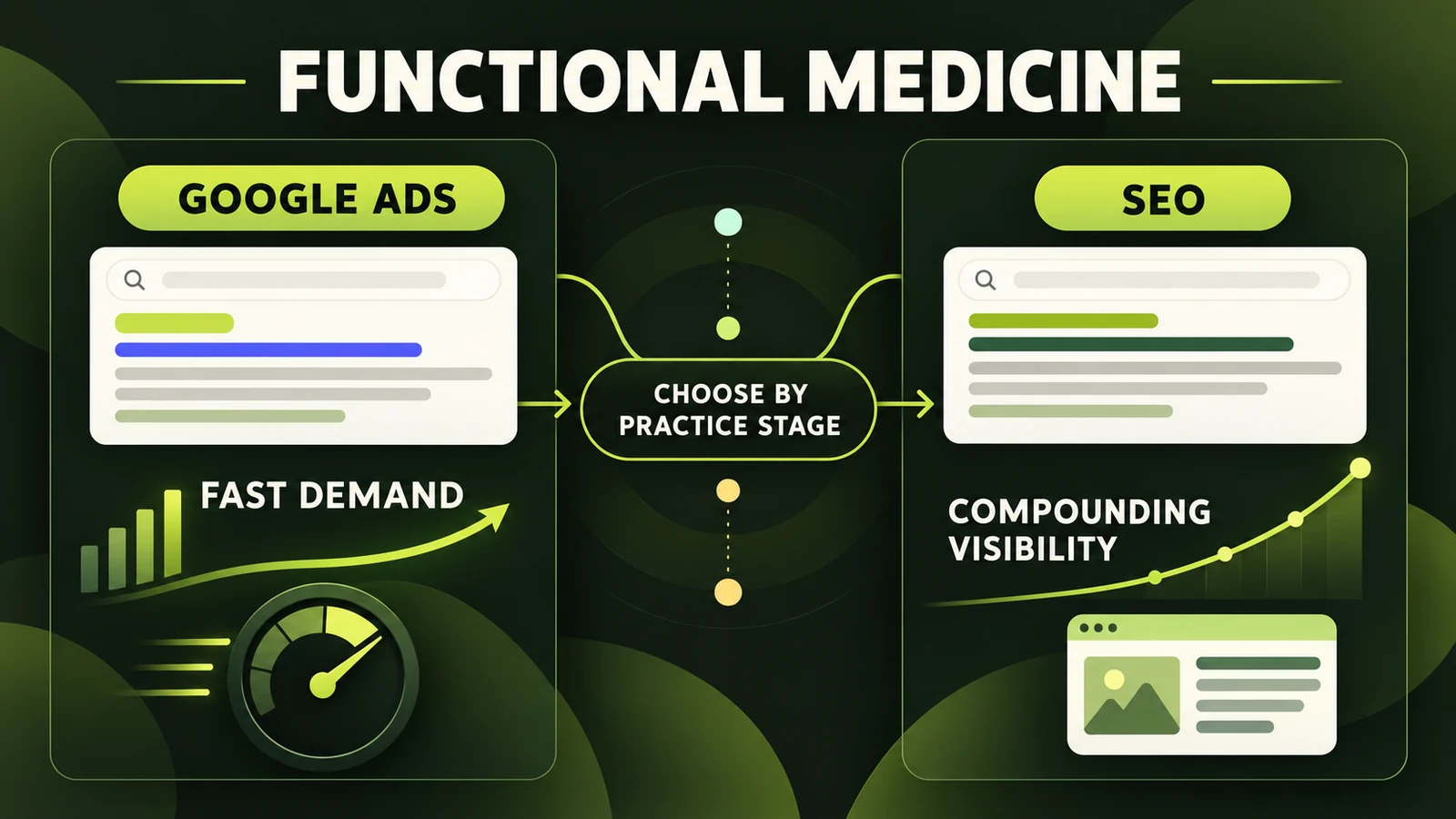
Choosing between Google Ads and SEO for a functional medicine practice is not really a contest between a good channel and a bad one. It is a decision about when you need demand, how much control you need, and whether your practice can wait for an asset to compound.
Google Ads can place a relevant offer in front of people who are searching now, provided the campaign, landing page and tracking are ready. SEO can earn visibility without paying for each click, but Google does not promise a ranking or a deadline. Its own documentation says some search improvements may appear in days while others can take several months.
The practical answer is simple: choose Google Ads first when near-term appointment demand and fast testing matter most. Choose SEO first when the practice has enough patient flow, a longer runway and weak foundational visibility. If budget and capacity allow, use Ads to capture demand while SEO builds the durable base underneath it.
Short answer: Google Ads buys controlled access to existing search demand. SEO builds an owned body of pages, local signals and authority that can keep attracting searches over time. Your first channel should solve the practice’s current constraint.
Google Ads vs SEO for a Functional Medicine Practice: The Direct Comparison
| Decision factor | Google Ads | SEO |
|---|---|---|
| Speed | Can enter auctions as soon as an eligible campaign launches | Discovery, indexing and ranking take time; no fixed deadline |
| Control | High control over budget, location, keywords, schedule and landing page | Control over the site and content, not the ranking position |
| Cost model | Media spend plus management and landing-page work | Strategy, technical work, content, local SEO and ongoing maintenance |
| Durability | Traffic usually stops when campaigns stop serving | Useful pages can continue attracting visits, but rankings can change |
| Testing | Fast feedback on queries, offers and landing pages | Slower feedback because visibility and traffic must develop first |
| Best fit | Immediate capacity, launches and controlled experiments | Long-term category visibility and reduced paid dependence |
What Google Ads Gives a Functional Medicine Practice
Google Ads offers speed because an eligible ad enters an auction whenever a relevant search occurs. According to Google, the auction considers the bid, ad and landing-page quality, expected impact of assets, thresholds, search context and competition. Paying more is therefore not the whole strategy; relevance and the post-click experience matter.
That control is valuable for a practice with open appointment capacity. You can target a defined area, focus on one service, send traffic to a dedicated page and measure forms, qualified calls or confirmed bookings. You can also pause, narrow or reallocate the campaign when capacity changes.
The tradeoff is ongoing spend. Google describes campaign budgets as average daily amounts, and actual daily spend can fluctuate while remaining subject to spending limits. The practice must budget for the media itself as well as the work required to manage search terms, negatives, ads, landing pages and conversion tracking.
Ads also reveal demand quickly. Search-term and conversion data can show whether people use the language you expected, whether a service attracts qualified enquiries, and where the booking journey breaks. That makes Ads a useful validation channel before investing heavily in a broad content plan. For campaign implementation, see our guide to Google Ads for functional medicine.
What SEO Gives a Functional Medicine Practice
SEO builds searchable assets: service pages, practitioner information, location signals, educational content, internal links and a technically accessible website. You do not pay Google each time somebody clicks an organic result. A strong page can support patient acquisition long after its publication date.
But SEO is not free and it is not instant. The cost moves from media spend to research, writing, technical improvements, local optimization, reviews, authority building and maintenance. Google’s SEO guidance also makes clear that inclusion and ranking are not guaranteed. Search systems need time to discover changes and evaluate whether a site is consistently helpful and reliable.
SEO has its greatest strategic value when a practice wants to be found across a connected set of services, questions and locations. A patient may first encounter an educational page, later compare a service page, check the practitioner and reviews, and return through a branded search. That wider research journey is difficult to represent with one last-click report.
If your immediate priority is Maps, local rankings and a Google Business Profile, use our dedicated functional medicine local SEO guide. This article stays focused on the channel decision.
Compare the Economics, Not Just Cost per Click
For Google Ads, calculate the maximum affordable cost per acquired patient from real practice numbers:
Maximum lead cost = maximum patient acquisition cost × lead-to-patient rate.
Hypothetical example: if a practice can afford $300 to acquire a new patient and 25% of qualified leads become patients, the maximum qualified-lead cost is $75. This is an illustration, not an industry benchmark.
Then include management, landing-page and tracking costs when assessing the channel, not just the Google Ads invoice. A campaign that appears profitable before agency and operational costs may not be profitable after them.
For SEO, use a longer evaluation window. Track the cost of strategy, technical work and content against non-branded impressions, qualified organic enquiries and new patients over time. Avoid dividing one month’s SEO fee by that month’s leads during the build phase; that ignores the delayed and cumulative nature of the work. Also avoid treating every organic lead as free once rankings mature. The site still needs maintenance and useful updates.
Choose Google Ads First When Speed and Control Are the Constraint
Google Ads is usually the more logical first move when:
- The clinic has near-term appointment capacity and needs qualified enquiries now.
- A new service or location needs a controlled demand test before a larger content investment.
- The practice serves a defined geographic area with clear, high-intent searches.
- The website has a credible service page, transparent next step and reliable conversion tracking.
- The practice can fund a meaningful test without expecting every click to become a patient.
Do not start Ads merely because it is faster. If calls go unanswered, the offer is vague, the booking experience is broken or the practice cannot identify which enquiries became patients, more traffic will amplify those problems. Fix the conversion path first.
Choose SEO First When the Foundation Is the Constraint
SEO deserves priority when:
- The clinic already has enough short-term demand and can wait for organic visibility to develop.
- The site lacks clear service, location, practitioner and trust pages.
- The practice wants visibility across many patient questions, not only a small set of transactional searches.
- Local competitors have stronger Maps profiles, reviews and service relevance.
- Paid acquisition would be financially uncomfortable until patient value and follow-up are clearer.
SEO should also come first when the landing experience is too weak to justify paid clicks. Improving page clarity, proof, speed, mobile usability and booking flow benefits both channels. Our SEO service for naturopathic and functional medicine practices covers that foundation.
When the Right Answer Is Both
Ads and SEO can share the same commercial strategy without duplicating the same work. Ads can focus on a small group of high-intent services while SEO develops service depth, local relevance and answers to the questions patients ask before booking.
The useful feedback loop looks like this:
- Launch tightly scoped Ads around one service and one location or eligible telehealth market.
- Measure completed forms, qualified calls and bookings rather than page views.
- Review actual search terms, lead quality and patient objections.
- Use those insights to improve service pages and prioritize genuinely useful SEO topics.
- As organic visibility grows, evaluate paid and organic performance by query theme instead of automatically turning Ads off.
A Channel Decision Framework by Practice Stage
| Practice stage | Likely priority | Reason |
|---|---|---|
| Pre-launch | SEO foundation, then a small Ads launch | Build essential pages and tracking before paying for traffic |
| New clinic with open capacity | Ads first, SEO in parallel if affordable | Capture current demand while the organic base develops |
| Established but weak non-branded visibility | SEO first or balanced | Reduce overreliance on referrals and branded search |
| Launching a new service | Ads test first | Validate language, demand and lead quality before scaling content |
| Near capacity | SEO foundation and selective Ads | Build future visibility without flooding the schedule |
Capacity changes the answer. A fully booked practice does not need maximum lead volume. It may need stronger positioning, a waitlist, recruitment or selective promotion of one underused service. Marketing should respond to the operational bottleneck.
A Practical 90-Day Starting Plan
Weeks 1–2: calculate patient value and capacity, define qualified leads, repair the booking journey, confirm analytics and choose one priority service. Audit existing rankings, Google Business Profile coverage and the pages already available.
Weeks 3–6: if Ads is the priority, launch a narrow Search campaign with controlled geography, negative keywords and a dedicated landing page. If SEO is the priority, fix indexability and core service pages before publishing a large blog calendar.
Weeks 7–12: review enquiry quality with the front desk, not just platform conversions. Improve the weak step: query targeting, page clarity, response speed or booking completion. Use verified search and patient-question data to choose the next SEO page. Do not scale both channels simply because 90 days have passed; scale after the measurement is trustworthy.
Three Expensive Decision Mistakes
Choosing SEO because it sounds free. Good SEO requires sustained expert work, and delayed results require financial runway.
Choosing Ads because it sounds immediate. Eligibility can be immediate; profitability is not. The campaign still needs relevance, a strong page, tracking and lead handling.
Splitting a small budget across everything. Funding Ads, weekly articles, social media and a redesign at once can leave every channel underpowered. Choose the constraint, fund the appropriate channel, set a review date and expand when the evidence supports it.
Frequently Asked Questions
Is SEO or Google Ads better for a new functional medicine practice?
If the website and tracking are ready and the clinic needs patients soon, a narrow Google Ads campaign is usually the faster starting point. Build essential SEO pages at the same time if budget allows.
How long does SEO take for a functional medicine practice?
There is no guaranteed timeline. Google says some improvements may be reflected in days while others can take several months. Competition, site history, technical quality, content and local authority all affect the pace.
Should a practice stop Google Ads after SEO starts working?
Not automatically. Compare lead quality and acquisition cost by service and query theme. Ads may remain valuable for priority services, launches and competitive searches even when organic visibility is strong.
Can Google Ads data improve SEO?
Yes. Search terms, lead quality and landing-page behavior can inform SEO priorities, but paid performance does not guarantee organic ranking. Use the data to understand demand, then create genuinely useful pages.
Choose the Channel That Solves Today’s Constraint
Use Google Ads when you need controlled access to current search demand and have the operational foundation to convert it. Use SEO when you can invest patiently in a broader, durable visibility asset. Use both when immediate capacity and long-term growth matter at the same time.
The right decision is measurable: define the bottleneck, choose one priority service, track qualified outcomes and review the economics on a timeline appropriate to the channel.
If you want a channel plan based on your services, market and capacity, explore our Google Ads management and functional medicine SEO, or reserve a call with Salem below.