
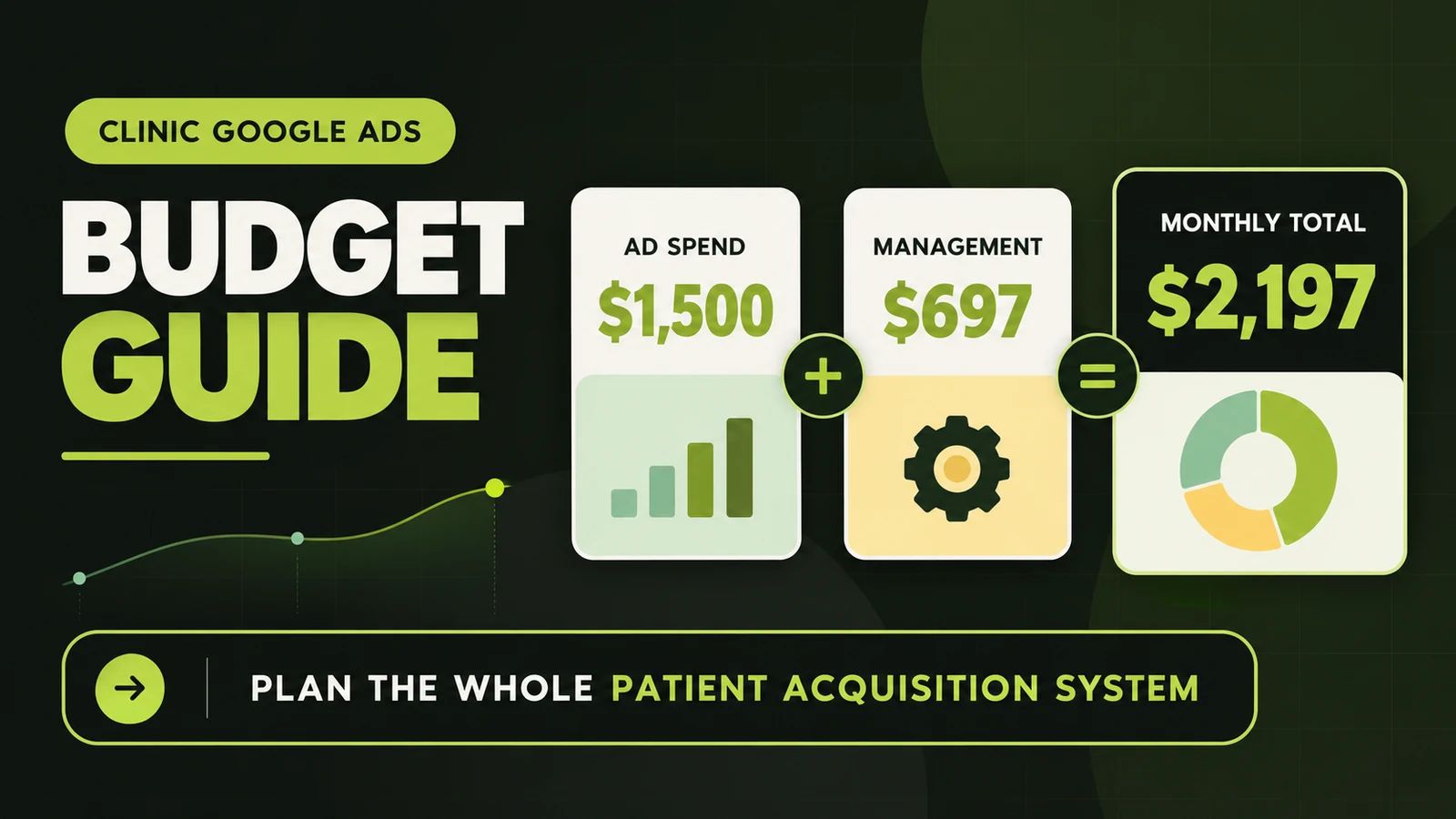
If you are trying to work out how much Google Ads costs for a clinic, the honest answer is not a single monthly number. Your total cost has three parts: the money paid directly to Google, the cost of managing the campaigns, and any supporting work needed to turn clicks into booked patients.
For a focused local clinic campaign, we generally consider $1,000 to $1,500 per month in ad spend a practical testing range. A multi-service clinic or a practice targeting a larger, more competitive area may need $2,000 to $3,500 or more. These are planning ranges, not industry averages or guarantees. The right budget depends on local search demand, click prices, conversion rate and the value of a new patient.
At Wellness Practice Marketing, Google Ads management is $697 per month plus ad spend. That means a clinic starting with $1,500 in media spend would plan for a direct monthly advertising investment of $2,197 before optional landing-page or tracking work.
Short answer: A realistic starting budget for many independent clinics is approximately $1,697 to $2,197 per month when combining $1,000–$1,500 in ad spend with our $697 management fee. Your clinic may need less or more after reviewing actual keyword demand and patient economics.
How Much Does Google Ads Cost for a Clinic? Start With Three Cost Categories
A quote that says “Google Ads costs $1,500 per month” is incomplete unless it explains where that money goes. Ask for the budget to be divided into the following categories.
| Cost | What it pays for | Who receives it |
|---|---|---|
| Ad spend | Clicks and traffic generated through Google Ads | |
| Management fee | Strategy, setup, optimization, reporting and ongoing account work | Agency or specialist |
| Supporting work | Landing pages, call tracking, analytics or booking-flow improvements | Agency, developer or software provider |
Keeping these costs separate makes proposals easier to compare. It also prevents a common misunderstanding: an agency fee is not money entering the ad auction, and a large media budget does not compensate for weak tracking or a poor landing page.
1. The Ad Spend Paid to Google
Google Search Ads usually operate through an auction. You are not buying a fixed package of patients. Each eligible search triggers an auction in which bids, ad and landing-page quality, competition, the search context and the expected impact of ad assets influence whether an ad appears and what a click costs. Google explains those factors in its official guide to the ad auction.
This is why two clinics with the same monthly budget can receive very different results. A naturopathic clinic in a smaller market may face a different auction from a hormone clinic targeting a large metropolitan area. Even within one account, each service can have a different cost profile.
Google uses average daily budgets rather than a perfectly even daily spend. It may spend up to twice the average daily budget on a high-opportunity day while respecting the applicable monthly spending limit. Clinic owners should understand that behavior before treating one busy day as an overspend. See Google’s explanation of how budget changes and spending limits work.
What One Anonymized Clinic Account Cost
In one multi-service wellness clinic account we manage, three Search campaigns spent $20,690.60 over 12 months and recorded 414 tracked conversions. The blended cost was $49.98 per conversion, but the service-level result varied substantially:
| Service campaign | Spend | Tracked conversions | Cost per conversion |
|---|---|---|---|
| Naturopathic medicine | $7,376.80 | 260 | $28.37 |
| Weight loss | $7,368.02 | 97 | $75.96 |
| Hormone replacement | $5,945.78 | 57 | $104.31 |
This is one account, not a healthcare benchmark. It shows why “What does a clinic lead cost?” is too broad a question. The same clinic, location and management team produced costs ranging from $28.37 to $104.31 depending on the service.
The figures are also tracked conversions, not confirmed new patients. A conversion may be a form submission, qualified phone call or another configured action. The clinic still needs to measure how many enquiries become attended appointments and paying patients.
2. The Google Ads Management Fee
A management fee pays for the work around the ad spend: campaign structure, keyword research, ad copy, negative keywords, location targeting, conversion tracking, search-term reviews, budget allocation, testing and reporting. Without that work, Google can still spend the budget, but it may optimize toward the wrong actions or allow irrelevant searches to consume money.
Agencies price this work in several ways: a flat monthly fee, a percentage of ad spend, a tiered plan or a hybrid. A percentage model may make sense for a large account, but it can create ambiguity for a small clinic. Ask whether the fee rises automatically when you increase ad spend and whether setup is charged separately.
Our standalone Google Ads management for wellness clinics is $697 per month plus ad spend, with monthly cancellation and no long-term contract. The ad account should remain owned by the clinic.
3. Costs That May Sit Outside the Quote
The cheapest management proposal is not necessarily the lowest-cost route if important pieces are excluded. Before approving a quote, check whether it includes:
- Conversion setup for forms, calls and completed bookings
- A dedicated landing page for the promoted service
- Call-tracking software or forwarding-number fees
- Analytics configuration and consent management
- Copy or design changes after launch
- Booking-system integration and lead-quality reporting
If your website is slow, unclear or difficult to use on a phone, spending more on clicks can amplify the problem. In that situation, a focused landing page may be a better first investment than immediately increasing the media budget.
What Is a Sensible Minimum Clinic Google Ads Budget?
There is no universal minimum imposed by Google that makes a campaign successful. The practical minimum is the amount needed to buy enough relevant traffic to learn something without spreading the budget too thinly.
For many local, cash-pay clinics, we use $1,000–$1,500 per month as a planning range for one focused service and one defined market. That is roughly $33–$50 per day. A lower budget can run, but it may take longer to produce enough clicks and conversions for meaningful decisions—especially when several services or locations share the same account.
Start with one service when the budget is limited. Choose the service using patient value, capacity, search demand and the clinic’s ability to handle enquiries. Trying to promote naturopathic care, weight loss, hormones, IV therapy and telehealth from one small budget usually leaves every campaign underfunded.
What Makes Clinic Google Ads More or Less Expensive?
- Service: Search demand and advertiser competition differ between general naturopathic care, weight loss, hormone services and other treatments.
- Location: A dense metropolitan area can have more competitors than a smaller local market.
- Keyword intent: High-intent searches such as “clinic near me” may cost more but can be closer to a booking decision than broad educational searches.
- Relevance: Closely aligned keywords, ads and landing pages can improve auction performance. Paying a higher bid is not the only way to compete.
- Conversion rate: Better mobile usability, clearer service messaging and a simpler booking path can reduce the cost of each enquiry without lowering click prices.
- Tracking quality: If button clicks are treated like completed enquiries, reported performance can look better than the business result.
- Follow-up: Slow callbacks and missed calls increase the effective cost of acquiring a patient even when the ad campaign is working.
Calculate Cost per Patient, Not Just Cost per Lead
The number that matters to the clinic is not cost per click. It is the cost to acquire a patient who attends and generates enough value to justify the investment.
Use this simple sequence:
- Cost per lead = ad spend divided by qualified leads.
- Lead-to-patient rate = new patients divided by qualified leads.
- Cost per new patient = total advertising cost divided by new patients.
For a clearly labeled hypothetical example, suppose a clinic spends $1,500 on ads and $697 on management. It receives 20 qualified enquiries and 8 become new patients. The media-only cost per lead is $75, while the total acquisition cost is $274.63 per new patient: $2,197 divided by 8.
Whether that result is profitable depends on gross profit and patient value—not revenue alone. A clinic offering a one-time low-cost appointment has different economics from a supervised multi-month program.
Three Monthly Planning Scenarios
| Scenario | Ad spend | WPM management | Direct monthly total |
|---|---|---|---|
| Focused local test | $1,000 | $697 | $1,697 |
| Stronger single-service campaign | $1,500 | $697 | $2,197 |
| Multi-service or larger-market plan | $3,000 | $697 | $3,697 |
These examples are planning scenarios, not promises of a particular number of patients. Before launch, use Keyword Planner and the clinic’s target locations to estimate available search volume and likely click costs. After launch, replace forecasts with the clinic’s own qualified-lead and booked-patient data.
When a Clinic Should Not Increase Its Google Ads Budget Yet
More budget is not the right answer when the clinic cannot define a conversion, answer enquiries promptly or identify which leads became patients. Fix the measurement and follow-up system first.
It can also make sense to delay a launch if the service page makes medical promises, lacks practitioner credibility or does not explain what happens after someone enquires. Google Ads creates traffic; it does not repair the patient journey on its own.
For a broader view of where paid search fits, read our Google Ads for functional medicine guide. If you are deciding how much to allocate across channels rather than Google Ads alone, use our functional medicine marketing budget guide.
The Bottom Line
For many independent clinics, a sensible first plan is $1,000–$1,500 in monthly ad spend for one priority service, plus management and any necessary tracking or landing-page work. Under WPM’s current $697 monthly management fee, that creates a direct starting range of about $1,697–$2,197 per month.
Do not judge affordability from cost per click alone. Model the complete path from search to qualified enquiry, booked appointment and collected patient value. Then use real clinic data to decide whether to increase, reallocate or reduce the budget.
If you want a clinic-specific estimate, we can review your services, market, current website and patient economics before recommending a budget. Explore our Google Ads management service or reserve a call with Salem below.