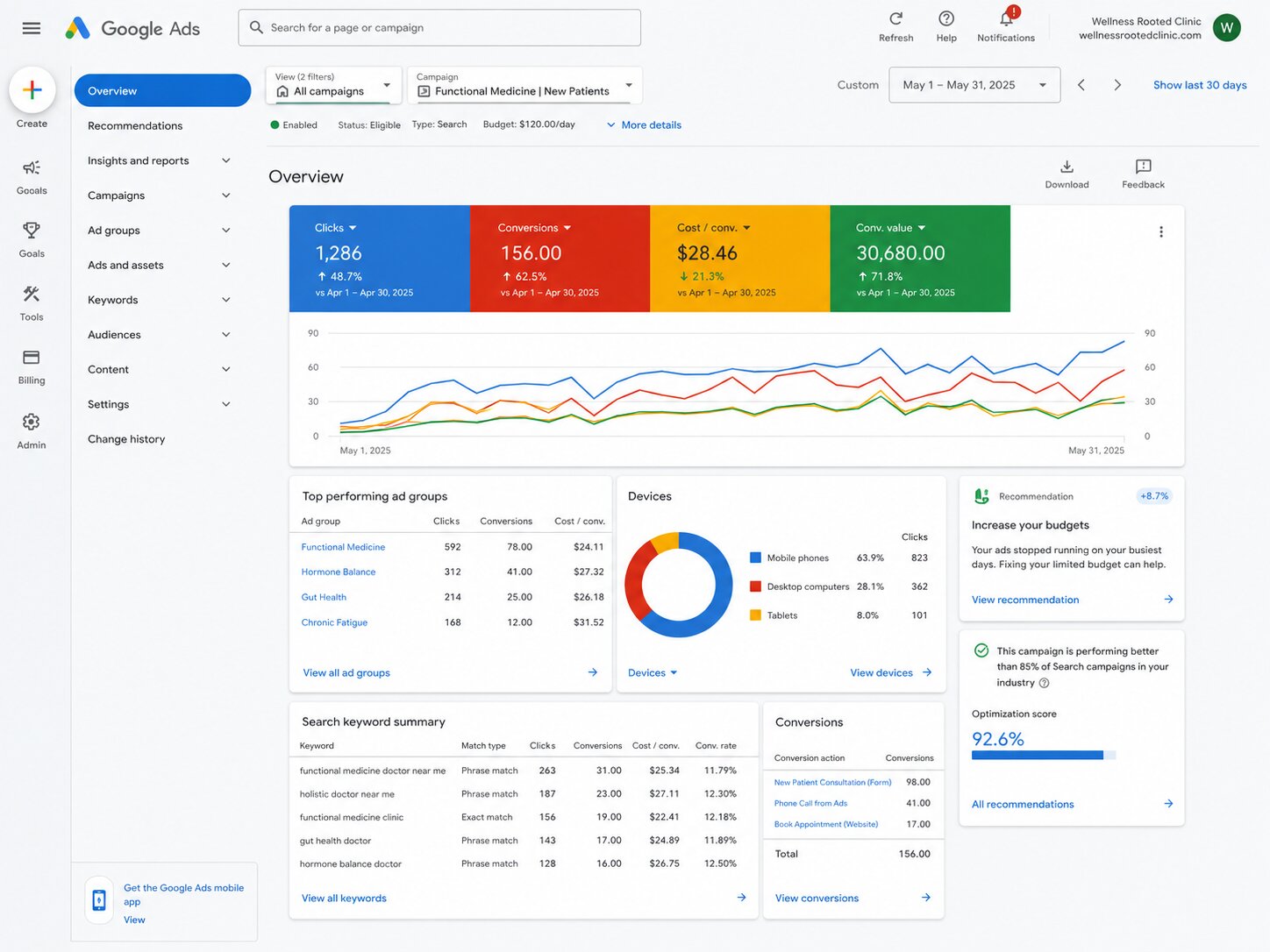
Part 1
Introduction
What is Google Ads?
Google Ads is Google's pay-per-click advertising platform. You choose the searches you want to appear for, write the ad, and pay only when someone clicks. For a nutrition practice, that means showing up at the top of Google the moment someone types "dietitian near me" or "nutritionist for gut health," ahead of every organic result.
Why Google Ads works for nutritionists and dietitians
Every day, people search for exactly what you offer: help losing weight sustainably, managing diabetes through diet, resolving digestive issues, fueling athletic performance. These are not passive browsers; they are people actively looking for a professional. Google Ads for nutritionists works because it captures that intent at its peak, instead of interrupting someone who wasn't thinking about nutrition at all.
The economics work too. A client who books a package or ongoing counseling is typically worth 500 to 2,000+ dollars over the relationship. Paying 40 to 120 dollars to acquire that client is excellent business.
Is Google Ads right for your nutrition practice?
Three conditions need to be true:
- Your client economics support it. If you only sell single 60-dollar sessions with no packages or follow-up, the math gets hard. If you sell programs, it works.
- You have capacity. If your calendar is already full for six weeks, fix capacity before buying demand.
- You respond fast. A lead that waits 24 hours for a reply books with someone else. Speed-to-lead matters more than any bidding strategy.
How clients search for nutrition services
Nutrition searches split into two big patterns: problem searches ("how to lower cholesterol with diet," "constant bloating after meals") and provider searches ("registered dietitian near me," "sports nutritionist online"). Problem searchers are researching; provider searchers are ready to book. Your ad budget belongs primarily on the second group, while content and SEO nurture the first.
Google Ads vs SEO: which should you choose?
| Channel | Time to results | Cost structure | Best role |
|---|
| Google Ads | 2 to 3 weeks | Pay per click, scales with budget | Immediate client flow, keyword data |
| SEO | 4 to 12 months | Time or retainer, no per-click cost | Durable visibility, lower long-term cost |
It is not either/or. Run ads for immediate demand while SEO compounds in the background, and let your ads data tell you which keywords deserve SEO investment. We cover the full multi-channel picture in our complete marketing guide for functional and wellness practices.
Part 2
Understanding Search Intent
Understanding the nutrition client journey
A typical journey: months of frustration with a health or performance issue, self-education through articles and videos, a decision that professional help is worth paying for, comparison of two or three providers, and a booking. Google Ads intercepts the last two stages directly. Everything about your campaign, from keywords to landing page, should assume the person has already decided they want help and is choosing who to trust.
High-intent vs informational searches
"What foods help IBS" is informational: the searcher wants an answer, not an appointment. "Dietitian for IBS near me" is high-intent: the searcher wants a provider. Bidding on informational searches is the fastest way to burn a nutrition ad budget. Reserve paid clicks for searches that name a provider type, a service, or a location.
Commercial keywords that drive appointments
The patterns that convert: provider + location ("nutritionist in Austin"), provider + condition ("dietitian for PCOS"), provider + modality ("online nutrition coaching"), and "near me" variants. These searches are lower volume than symptom searches, but each click is worth several times more.
Local vs online nutrition practices
Local practices target a radius around the office and lean on "near me" searches and Google Business Profile integration (Part 12). Online practices trade proximity for reach: they target every state or region where they are licensed and bid on "online nutritionist" and "virtual dietitian" keywords, which have grown steadily since telehealth normalized. Hybrid practices should run both as separate campaigns, because the economics and competition differ.
Choosing the right services to advertise
Do not advertise everything. Pick the one or two services with the best combination of client value, demand and capacity: usually a signature program or your strongest specialty (Part 13 covers niches). One well-funded campaign for your best service outperforms five underfunded campaigns for everything you offer.
Part 3
Google Ads Fundamentals
How Google Ads works
You build campaigns containing ad groups; each ad group holds a set of closely related keywords and the ads written for them. When someone searches one of your keywords, your ad enters an instant auction against every other advertiser bidding on that search.
The Google Ads auction explained
The auction is not won by the highest bid alone. Google multiplies your bid by your Quality Score to determine Ad Rank. A relevant ad pointing to a relevant page can beat a competitor bidding twice as much. This is why specialists consistently pay less per click than generalists in health niches.
Search campaigns explained
Search campaigns show text ads on Google results pages. For nutrition practices, search is where you start and where most of your budget should stay. Skip Display and Performance Max until search is consistently profitable; they spend money on low-intent placements that rarely book consultations.
Match types
Exact match ([dietitian near me]) shows only for that search and close variants. Phrase match ("dietitian near me") allows surrounding words. Broad match lets Google interpret freely, which with limited data means expensive irrelevance. Start with phrase and exact; earn your way to broad match only after conversion tracking has months of data.
Quality Score
Google's 1 to 10 rating of keyword relevance, based on expected click-through rate, ad relevance, and landing page experience. Higher Quality Score means lower cost per click and better positions. The practical lever: tightly themed ad groups where the keyword appears in the ad and on the landing page.
Ad Rank
Your bid times your Quality Score, plus the impact of your ad assets. It determines whether you show and in what position. Improving relevance is almost always cheaper than raising bids.
Smart Bidding
Google's automated bidding strategies (Maximize Conversions, Target CPA) work well once you feed them real conversion data. Before that, they optimize blind. Start with manual or Maximize Clicks while tracking beds in, then switch to conversion-based bidding after 30 to 50 tracked conversions.
Campaign structure best practices
One campaign per major theme, one ad group per tight keyword cluster, 5 to 15 keywords per ad group, and ads written specifically for each group. Structure is covered in depth in Part 5.
Prefer to learn the platform basics on video first? This walkthrough of Google Ads for nutritionists on YouTube is a solid visual companion to this section.
Part 4
Keyword Research for Nutritionists & Dietitians
Finding high-intent keywords
Start from the searches a ready-to-book client makes, not the topics you like teaching. Type your service into Google and note the autocomplete suggestions, check the "People also search for" panels, and mine your own inquiry emails for the exact language clients use.
Nutritionist keywords
"Nutritionist near me," "certified nutritionist [city]," "holistic nutritionist," "functional nutritionist online." Note that "nutritionist" attracts a broader, more wellness-oriented searcher than "dietitian."
Dietitian keywords
"Registered dietitian near me," "RD for weight loss," "dietitian that takes insurance [city]." Dietitian searches skew more clinical and insurance-driven; if you are an RD, bid on both families, since many searchers use the terms interchangeably.
Service-based keywords
"Nutrition counseling," "meal planning service," "nutrition coaching online," "medical nutrition therapy." Map each service keyword family to its own ad group and landing page.
Condition-based keywords
"Dietitian for PCOS," "nutritionist for IBS," "diabetes nutrition counseling," "prenatal nutritionist." Condition keywords are the highest-converting family in most nutrition accounts: lower volume, far higher intent, and usually cheaper clicks than generic terms.
Local keywords
Every core keyword plus your city and neighboring towns. "Near me" searches do not require the words "near me" on your page; Google resolves them by location, which is why your geographic settings (Part 5) and Google Business Profile (Part 12) matter.
Competitor keywords
Bidding on competitor names is legal and sometimes useful, but converts poorly for local health services and can start bidding wars. Low priority; spend elsewhere first.
Long-tail keywords
Longer, more specific phrases ("online dietitian for hypothyroid weight gain") have tiny individual volume but exceptional intent. Phrase match on your condition keywords will capture most long-tails automatically; review the search terms report to find winners worth promoting to exact match.
Negative keywords
The list that protects your budget from day one: free, jobs, salary, course, degree, certification, school, "how to become," recipes, and any conditions or services you do not offer. Add insurance-related negatives only if you are cash-pay.
Keyword research tools
Google Keyword Planner (free, inside Google Ads) for volume and cost estimates; Google autocomplete and People Also Ask for real phrasing; your search terms report, once live, for what people actually typed. Paid tools like Ahrefs or Semrush help, but a local nutrition practice can build a complete keyword map without them.
Part 5
Campaign Structure
Organizing campaigns by service
A clean starting account: one brand campaign (your practice name, cheap insurance against competitors), one core campaign ("nutritionist/dietitian + city"), and one campaign per flagship service or condition ("weight management," "gut health nutrition"). Separate campaigns let you control budget per theme.
Creating effective ad groups
Each ad group holds one tight keyword theme. "Dietitian for PCOS" and "nutritionist for menopause" belong in different ad groups with different ads, even inside the same campaign. The test: could one headline honestly serve every keyword in the group? If not, split it.
Geographic targeting
Local practices: target a realistic driving radius, and set location options to "presence" (people in your area) rather than "presence or interest," which quietly includes people worldwide who searched about your city. Online practices: target licensed states or regions explicitly.
Budget allocation
Weight budget toward the campaigns closest to revenue: 60 to 70 percent to your core and condition campaigns, 10 percent to brand, the rest to testing. Move money monthly toward whatever produces the cheapest booked consultations.
Device targeting
Most nutrition searches happen on mobile. Do not exclude devices early; instead, check the device report after 60 days and adjust bids if one device books consultations meaningfully cheaper.
Ad scheduling
Run 24/7 at first: people research health at night. Once you have data, trim only hours that spend without ever converting. If nobody answers your phone on weekends, make sure weekend traffic lands on a booking form, not a dead line.
Building a scalable account
Scalability comes from consistency: the same naming conventions, the same one-theme-per-ad-group rule, and conversion tracking from day one. An account built this way can absorb double the budget without restructuring.
Part 6
Writing Google Ads That Generate Appointments
Writing high-converting headlines
Headline 1 names the search: "Registered Dietitian in Denver." Headline 2 differentiates: "Personalized Plans, Real Food." Headline 3 carries proof or the CTA: "Book a Free Discovery Call." Mirror the searcher's words; relevance is what earns the click.
Writing effective descriptions
Name the pain, then the process: "Tired of diets that don't stick? Work one-on-one with a licensed dietitian on a plan built around your life, your labs and your goals." Specific beats clever, and process beats promises.
Calls to action that increase bookings
"Book a Free 15-Minute Call" outperforms "Contact Us" because it tells the person exactly what happens next and lowers commitment fear. Use one CTA consistently across ads and landing page.
Using ad assets
Add sitelinks (About, Services, Pricing, Book Now), callouts ("Licensed RD," "Virtual & In-Person," "Evening Appointments"), structured snippets listing your services, and a call asset during office hours. Assets make your ad physically larger and lift click-through rate at no extra cost.
Building trust through your ads
Credentials in the copy ("Registered Dietitian," "MS, RDN"), review counts if strong, and years in practice. In a health decision, trust signals outperform discounts.
Common ad copy mistakes
Generic wellness language ("Transform your health!"), promising outcomes ("Lose 10kg in 8 weeks", also a policy violation, see Part 8), ignoring the searcher's actual words, and writing one ad for every keyword in the account.
Part 7
Landing Pages
Why dedicated landing pages outperform homepages
Your homepage serves every visitor and every goal, which means it serves the ad clicker poorly. A dedicated page that mirrors the search ("Nutrition Counseling for PCOS in Miami") with one call to action typically doubles conversion rate, which halves your cost per client without touching the ads.
Anatomy of a high-converting nutrition landing page
- Headline matching the ad and the search
- Subheadline naming the client's pain in their words
- One primary CTA, repeated down the page
- Your photo and credentials (people book people)
- The process in three simple steps
- Testimonials relevant to this service
- FAQs covering price, insurance and "will this work for me"
- No navigation menu leaking clicks away
Mobile optimization
Most paid clicks are mobile. Tap-sized buttons, clickable phone number, a form that can be completed in under a minute, no pinch-zooming. Test the page on your own phone before launch, every time it changes.
Page speed
Every extra second of load time sends a share of paid clicks straight back to Google. Compress images, avoid heavy page builders, and aim for loading under 2.5 seconds on mobile data.
Building credibility
Real photography over stock, credentials and license numbers where relevant, association logos, media mentions, and specific testimonials. The person arriving from an ad has never heard of you; the page has one visit to earn trust.
Appointment booking best practices
Embed online scheduling directly on the page rather than linking away to it. Offer a low-friction first step (a free discovery call converts better than a 200-dollar initial consult as the first ask), confirm bookings instantly, and remind by email and SMS.
Part 8
Google Ads Policies for Nutrition Professionals
Healthcare advertising policies
Google restricts health advertising to protect users. For nutrition professionals the practical rules are: no cure claims, no guaranteed outcomes, no misleading health statements, and extra scrutiny on anything touching prescription drugs or clinical treatment claims.
Personalized advertising rules
You cannot target people based on their health conditions, and remarketing lists built from health-related pages face restrictions. Target by search intent (what they typed), not by who they are.
Weight loss advertising guidelines
The strictest area for nutrition professionals. Prohibited: specific weight loss amounts or timelines ("lose 5kg in 2 weeks"), before/after imagery implying guaranteed results, and body-shaming angles. Safe framing: sustainable habits, personalized plans, professional support. "Work with a dietitian on sustainable weight management" passes; "Drop 3 dress sizes by summer" gets disapproved.
Nutrition and supplement claims
Selling or heavily featuring supplements triggers additional restrictions, and some ingredients are banned from ads outright. If supplements are part of your practice, keep ad copy focused on counseling services and keep supplement sales off the landing page.
Writing compliant ads
Describe the service and process, not the outcome: what happens in a consultation, who you help, your credentials, and how to start. Compliant copy is also, conveniently, the copy that builds the most trust.
Avoiding ad disapprovals
Expect an occasional disapproval even with clean copy; automated review systems are imperfect. When it happens, adjust the flagged language and resubmit or appeal. Never try to trick the filters with creative spelling; that risks account suspension rather than a single disapproved ad.
Part 9
Conversion Tracking
Why conversion tracking matters
Without tracking, you know what you spent and nothing else. With it, you know which keyword produced a booked consultation for 45 dollars and which spent 300 without a single inquiry. Every optimization in Part 11 depends on this data existing.
Tracking contact forms
Fire a conversion on the thank-you page or form-submit event, not on page views. Test it monthly; forms silently break more often than anyone expects.
Phone call tracking
Use Google call assets with call reporting, or a call tracking number that swaps in for ad visitors. Count calls over a meaningful duration (60+ seconds) so wrong numbers don't pollute the data.
Appointment booking tracking
The conversion that matters most. Most scheduling tools (Calendly, Acuity, practice management systems) can fire a confirmation event or redirect to a thank-you page you can track.
Enhanced conversions
Enhanced conversions send hashed first-party data (like the email a client submits) back to Google, recovering conversions that cookie restrictions would otherwise lose. Turn it on; it is a checkbox plus a small tag adjustment, and it materially improves Smart Bidding accuracy.
Offline conversion tracking
The gap between "booked a call" and "became a paying client" hides your real economics. Importing offline outcomes (who actually purchased a program) lets Google optimize toward clients, not just inquiries. Worth setting up once volume justifies it.
Measuring cost per new client
The only number that ultimately matters: total spend divided by new paying clients. Track it monthly alongside cost per lead and cost per booked call, and judge every campaign decision against it.
Part 10
Budget & Bidding
How much should nutritionists and dietitians spend?
Minimum viable: enough for about 10 clicks a day in your market, which for most cities means 500 to 1,500 dollars per month in ad spend. Below that, data accumulates too slowly to optimize. Commit to 90 days before judging the channel.
Average cost per click
Nutrition and dietitian keywords typically run 2 to 8 dollars per click in most US markets, cheaper than therapy or medical keywords, with condition-specific terms often at the low end. Competitive metro areas and weight-loss terms run higher.
Average cost per lead
With a matched landing page converting at 5 to 10 percent, expect 30 to 90 dollars per lead and roughly 50 to 150 dollars per booked consultation. Against client values of 500 to 2,000+ dollars, that leaves a wide profit margin, if your follow-up converts calls into clients.
Choosing the right bidding strategy
Phase 1 (no data): Maximize Clicks with a cost-per-click ceiling. Phase 2 (tracking live, conversions flowing): Maximize Conversions. Phase 3 (30 to 50+ conversions recorded): Target CPA set near your actual cost per booked call, tightened gradually.
Scaling your budget
When cost per booked call is profitable for four consecutive weeks, raise budget about 20 percent at a time; larger jumps reset Google's learning. Scale into your winning campaigns, not into new experiments.
Benchmarks in context: for a deeper dive into healthcare PPC budgets, auction mechanics and compliance, read our complete guide to Google Ads for functional medicine; the mechanics are the same, and the compliance sections overlap heavily with nutrition.
Part 11
Optimizing Your Campaigns
Search terms reports
The report showing what people actually typed before clicking. Review weekly for the first two months: promote converting terms to exact-match keywords, and add irrelevant ones as negatives. This single habit separates profitable accounts from money pits.
Expanding negative keywords
Your negative list should grow every week. Recurring nutrition-account offenders: recipe searches, degree and certification searches, "free meal plan," and celebrity diet names you don't want association with.
Improving click-through rate
Mirror the search in headline 1, add every relevant ad asset, and test one emotional angle against one credential angle. Higher CTR raises Quality Score, which lowers your cost per click across the board.
Improving conversion rate
Almost always a landing page problem, not an ads problem: mismatch between ad and page, slow mobile load, weak or buried CTA, or a first ask that feels too big. Fix the page before touching bids.
Lowering cost per acquisition
In order of leverage: cut non-converting search terms, tighten ad-to-page relevance, improve the landing page, then adjust bidding. Bid changes are the last lever, not the first.
A/B testing ads
Keep two or three ads live per ad group and let Google rotate them. Every month, pause the loser and write a new challenger. Test big differences (angle, offer, proof) rather than punctuation.
Scaling winning campaigns
More budget on winners, expansion into adjacent condition keywords, a second geographic radius if relevant, and only then new campaign types. Growth comes from feeding what works, not from constant reinvention.
Part 12
Local Google Ads
Targeting local clients
For an office-based practice, the majority of bookable searches include local intent. Combine radius targeting, city keywords, and location assets so you show prominently for "dietitian near me" in your service area.
Google Business Profile and Google Ads
Link your Google Business Profile to your Ads account. It powers location assets, enables local ad formats, and lets your reviews reinforce your ads. A well-maintained profile also compounds your organic Maps visibility; we cover that side fully in our local SEO guide, and everything in it applies to nutrition practices.
Location extensions
Location assets append your address, map pin and distance to your ads. For local health services they measurably lift click-through, because proximity is part of the buying decision.
Radius targeting
Set a radius that reflects real driving behavior, usually 15 to 30 minutes, not an entire metro area. Watch the "locations" report and trim areas that spend without booking.
Advertising multiple locations
One campaign per location, each with its own radius, budget and location-specific landing page. Shared campaigns hide which office actually earns the spend.
Local landing pages
Each location page needs its own address, map, team, hours and testimonials, mirroring the campaign that points to it. A city name swapped into a template is not a local page, and both Google and clients can tell.
Part 13
Advertising Different Nutrition Services
Each niche below deserves its own ad group and landing page when you advertise it. The pattern: name the niche in the keyword, the ad, and the page headline.
- Weight management: the highest demand and the strictest policies (see Part 8). Frame around sustainable habits and professional support, never amounts or timelines.
- Sports nutrition: performance-driven searchers respond to data and outcomes framing ("fuel strategy," "body composition"). Strong for both local athletes and online coaching.
- Women's health nutrition: PCOS, fertility, prenatal, menopause. High-intent, underserved keywords with excellent conversion rates.
- Gut health: IBS, SIBO, bloating, low-FODMAP support. Searchers are educated and motivated; condition-specific pages win here.
- Diabetes nutrition: steady year-round demand for prediabetes and type 2 support. Clinical credentials matter most in this niche's ad copy.
- Heart health nutrition: cholesterol and blood pressure searches, often triggered by a recent doctor visit. Position as the practical next step after the diagnosis.
- Pediatric nutrition: picky eating, allergies, growth concerns. The searcher is the parent; empathy-led copy outperforms clinical copy.
- Eating disorders: approach with care: sensitive-category rules apply, and copy must be supportive, never triggering. Work with tight keywords and expect extra ad review.
- Corporate wellness: a B2B offer; search volume is thin, so pair a small campaign with LinkedIn outreach.
- Online nutrition counseling: the growth segment. Target licensed states, lead with convenience plus credentials, and expect slightly longer decision cycles than local searches.
Part 14
Common Google Ads Mistakes
- Targeting broad keywords. "Nutrition" or "healthy eating" will spend your month's budget on people who want recipes.
- Ignoring negative keywords. Without them, you pay for job seekers, students and freebie hunters.
- Sending traffic to your homepage. Typically halves conversion rate versus a matched landing page.
- Tracking the wrong conversions. Counting page views or button clicks as "conversions" makes bad campaigns look good.
- Writing generic ads. If your ad could belong to any nutritionist anywhere, the click goes to whoever sounded specific.
- Using broad match too soon. Broad match without conversion data is Google guessing with your money.
- Neglecting mobile users. Most clicks are mobile; a desktop-only mindset quietly wastes the majority of spend.
- Making non-compliant health claims. Outcome promises get ads disapproved and accounts flagged (Part 8).
Part 15
Frequently Asked Questions
Is Google Ads worth it for nutritionists and dietitians?
Yes, when your client economics support it. With clients worth 500 to 2,000+ dollars and acquisition costs of 40 to 120 dollars per client in a well-run account, the return is clear. It is the only channel that reaches people at the exact moment they search for nutrition help.
How much should I spend each month?
Start at 500 to 1,500 dollars per month in ad spend, enough for roughly 10 clicks a day. Judge on cost per booked consultation after 90 days, not on clicks or impressions.
How long does it take to see results?
First inquiries within 2 to 3 weeks; meaningful optimization data over 60 to 90 days, which is when cost per client starts to fall.
Can I advertise virtual consultations?
Yes. Target the states or regions where you are licensed, make coverage clear on the landing page, and bid on "online nutritionist" and "virtual dietitian" keywords, which keep growing.
Should I invest in SEO or Google Ads first?
Ads first if you need clients this quarter; SEO in parallel for compounding visibility. Your ads data will tell you exactly which keywords deserve SEO investment.
Do I need a landing page?
Yes. A dedicated, matched landing page typically doubles conversion rate versus your homepage, which halves your cost per client. It is the highest-leverage asset in the whole system.
Can I manage Google Ads myself?
You can, with 5 to 10 hours a week and tolerance for learning-curve waste. Most practitioners are better served in the clinic. If you'd rather have it handled by specialists, our team manages Google Ads for nutritionists and wellness practices every day, with compliant campaigns, dedicated landing pages and transparent reporting built in.