
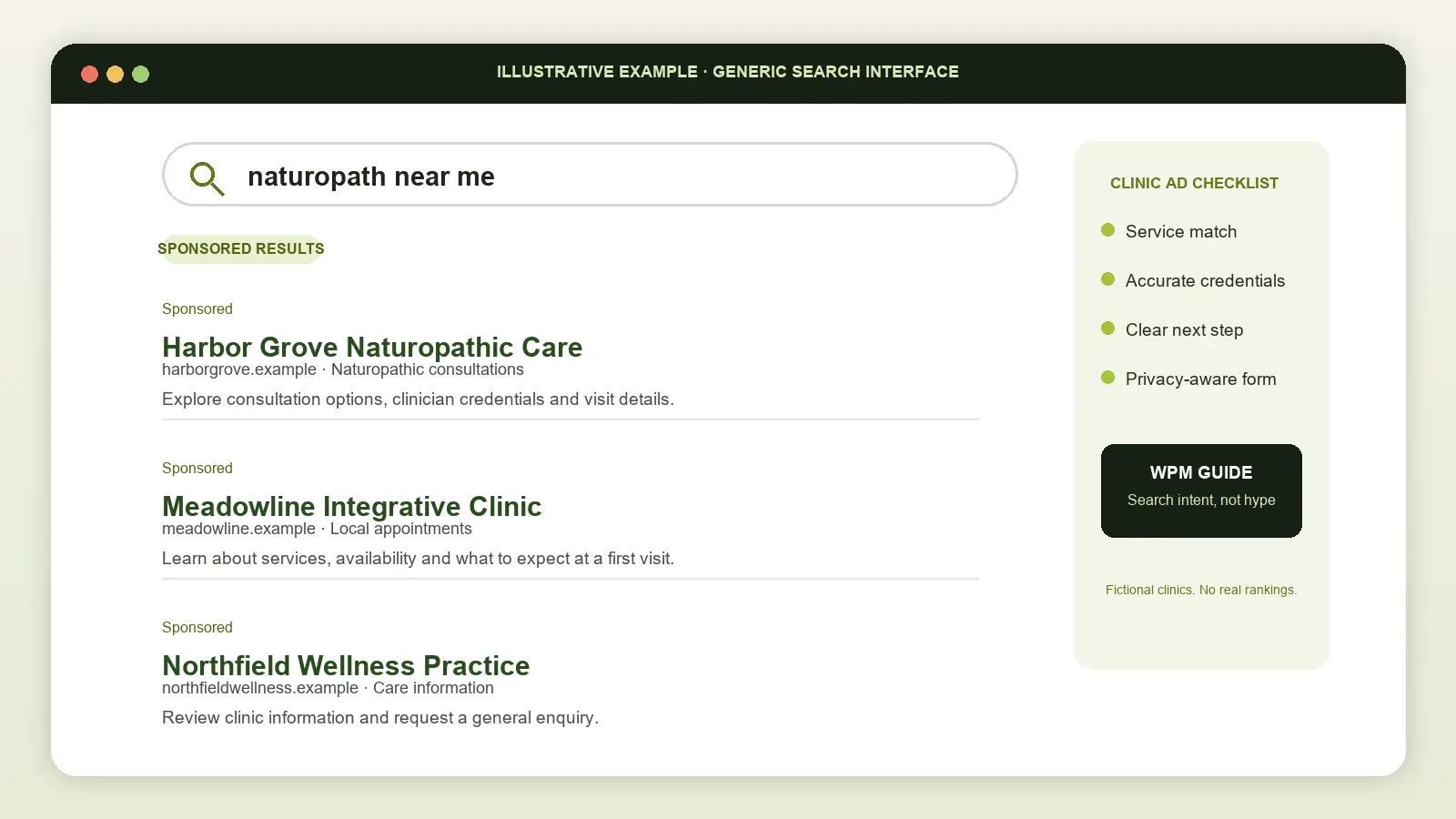
Google Ads for naturopathic clinics can put a clinic in front of people who are actively researching a local provider, a consultation, or a clearly defined service. That is useful intent. It is not a promise that every searcher is a fit, every click becomes an enquiry, or every enquiry becomes a patient.
The best paid-search programs are built around that distinction. They connect a real service, a truthful ad, a relevant landing page, a practical next step, and a tracking system that separates reported actions from clinic outcomes. They also respect healthcare advertising rules, practitioner scope, privacy, and the fact that a prospective patient is making a high-trust decision.
This guide is for US-based naturopathic, functional, integrative, hormone, metabolic, and wellness clinics. It explains how to evaluate, launch, and improve Google Search campaigns without generic keyword dumping, outcome promises, or unsafe data practices. It is marketing guidance, not medical, legal, privacy, or licensing advice.
Why Google Search can fit a naturopathic clinic, and when it does not
Search ads are distinct from interruption advertising. A person typing naturopathic doctor near me or naturopathic primary care has expressed a question with provider or service intent. A well-matched ad can make the clinic easier to evaluate at that moment.
That does not mean Google Ads is automatically the right channel. A campaign cannot correct an unclear offer, a team with no new-patient capacity, a booking path that fails on mobile, or a clinic that is not licensed or available for the market it targets. It also should not be used to make readers believe they have a condition or need a particular treatment.
Before launch, verify five basics: the service is genuinely offered, the provider and geography claims are accurate, the clinic can answer enquiries promptly, the economics can be measured beyond clicks, and the landing experience protects patient information appropriately.
Start with capacity, economics, and service priorities
Begin with the business question, not the campaign settings. Which consultation or service should receive more qualified enquiries? Who is eligible to provide it? Which locations, telehealth states, hours, and appointment types can the team support? What makes an enquiry qualified for the clinic?
Build a simple handoff definition with the front desk. A reported form submission can be invalid, out of area, or about a service the clinic does not provide. A call may be unanswered. A booking-button click may never reach a scheduler. Track those actions, but let the clinic's follow-up process define a qualified enquiry, scheduled consultation, attended consultation, and new patient.
Prioritize services by real capacity and economics, not by the widest keyword volume. A clinic might test naturopathic doctor near me, naturopathic primary care, hormone consultation, or functional medicine consultation only where the exact service, credentials, and care model are truthful. Do not advertise a condition, specialty, or location merely because it attracts searches.
Structure campaigns by service and intent
A generic campaign with every wellness term in one ad group makes it difficult to control spend or learn what is working. A tighter structure gives each service-intent theme its own keywords, ad copy, landing page, and conversion view.
| Campaign theme | Example query intent | Appropriate destination |
|---|---|---|
| Naturopathic provider | naturopathic doctor near me | Provider or naturopathic consultation page |
| Naturopathic primary care | naturopathic primary care | Primary-care page, only if truly offered |
| Hormone consultation | hormone consultation near me | Accurate hormone consultation page |
| Functional medicine consultation | functional medicine consultation | Relevant functional medicine service page |
Separate campaigns can have separate locations, schedules, budgets, negatives, and landing pages. They also make it easier to compare reported form submissions, calls, completed booking requests, and later qualification feedback by service. The goal is clarity, not an unnecessarily fragmented account.
Set geography and schedule to match reality
Use location targeting around actual clinic access and truthful telehealth eligibility. Exclude areas the clinic cannot serve. Do not imply a local office where none exists. Schedule call-focused ads only when someone can answer, or make the expected response timing clear. If a clinic uses a call extension or call asset, ensure the number, hours, and after-hours handling are accurate.
Build keywords from search terms, match types, and negatives
Start with a constrained keyword set. Exact and phrase match can help a new campaign understand how closely a query aligns with the offered service. Broad match is not inherently wrong, but it needs disciplined conversion definitions, search-term review, negative keywords, and budget control. It is not a substitute for strategy.
Review the actual search terms on a recurring schedule. Add irrelevant terms as negatives where appropriate, including job-seeking, school, free-training, unrelated products, or services the clinic does not provide. Do not add negative keywords just because a searcher uses a health concern. Instead, evaluate whether the query is relevant, safe to serve, and matched to a real page.
Write compliant responsive search ads
Responsive search ads should make a modest, verifiable claim: the type of consultation, the local area or eligible telehealth scope, and the next step. They should not promise cures, guaranteed outcomes, symptom resolution, or treatment suitability. Credentials must be described accurately. Avoid fear-based language, fake scarcity, and any copy that asserts or implies the searcher has a sensitive condition.
Google's healthcare and medicines policy and personalized advertising policy should be reviewed alongside local rules. Platform policy can change, and professional advertising, licensure, and privacy requirements may be stricter. Have applicable counsel or compliance leadership review claims and targeting.
Safer ad pattern: name the actual service, describe an informational or consultation-focused next step, state accurate location or availability, and send people to a page that gives enough context to decide. Do not use patient testimonials, ratings, or outcome claims as a shortcut for trust.
Match the landing page to the search, then reduce friction
The landing page should continue the same service promise, not send every searcher to a general homepage. A person who searched for a naturopathic consultation should see the service, practitioners, eligibility, location or telehealth limits, what the first step involves, and a clear contact or appointment option.
Make the mobile path usable. Phone numbers should be tappable. Booking buttons should open reliably and explain what happens next. A short general enquiry form can collect contact details and the service of interest. It should not ask for a detailed medical history. Keep sensitive health information out of ad audiences, conversion labels, URLs, analytics event names, and ordinary marketing systems. Do not upload PHI or build condition-based remarketing and customer-list audiences.
This message match also supports organic discovery. Our guide to showing up for services, not only a clinic name explains why useful, dedicated service pages matter. For design and conversion details, see our functional medicine website design guide.
Use a tracking taxonomy that does not overstate outcomes
Track useful actions, then name them honestly. A taxonomy might separate ad calls, website calls, general form submissions, completed booking requests, booking-button clicks, text-button clicks, qualified enquiries, scheduled consultations, attended consultations, and new patients. The final stages usually need clinic or CRM feedback rather than an ad-platform tag.
WPM's conversion tracking guide covers the operating principle: a clean event definition is more valuable than a flattering dashboard total. Record whether the action was reported by Google Ads or verified by the clinic. Never label a click as a booking or patient without evidence.
A WPM anonymized account snapshot, not a benchmark
Our Google Ads budget allocation case study analyzed one anonymized multi-service wellness-clinic account from March 13 to September 12, 2026. It reported $10,922.04 in spend, 3,704 clicks, and 226 primary tracked conversion actions. Naturopathic medicine accounted for 149 reported conversion actions at a $24.33 reported CPA, while medical weight loss recorded 44 at $82.90 and hormone replacement recorded 33 at $110.61.
Those figures are not a prediction for another clinic. The 226 actions included appointment-button clicks, ad calls, forms, text-button clicks, and website calls, not confirmed new patients. The value of the snapshot is the decision process: separate service lines, understand what each tracked action represents, and compare that evidence with capacity and follow-up quality before reallocating budget.
Device data can change the diagnosis too. In our seven-day mobile versus desktop Google Ads case study, mobile spent $365.42 and reported three conversion actions at a $121.81 reported CPA, while desktop spent $80.03 and reported four at a $20.01 reported CPA. It is a small, account-specific sample, not evidence that desktop always wins. It is a reason to inspect device, landing-page, and call-handling experience before changing bids.
Set budgets with clinic economics, not promises
Budget planning is a constraint exercise. Start with the monthly amount the clinic can responsibly test, the number of new consultations it can serve, and the value of a qualified consultation to the business. Then decide what evidence would justify continuing, pausing, or expanding a service theme. Keep an explicit reserve for experiments and landing-page improvements.
Do not convert a reported CPA into a claimed cost per patient. The case studies above demonstrate why. A lower reported cost per conversion might reflect many button clicks rather than booked consultations. The right question is whether the clinic can connect the campaign to quality, attendance, and appropriate downstream revenue with privacy-conscious records.
Optimize through controlled experiments
Make one meaningful change at a time when possible: a keyword theme, negative list, ad message, landing-page CTA, location radius, schedule, or conversion definition. Document the hypothesis and the decision rule. A campaign with several simultaneous changes can produce activity without a reliable explanation.
- Review search terms and disapproved assets weekly during early launch.
- Check call handling, forms, and scheduler completion with the clinic team.
- Compare results by service, geography, device, landing page, and hour.
- Use qualified-enquiry feedback to remove poor-fit traffic, not to guess from clicks.
- Protect a stable baseline before testing a major expansion.
Use paid search alongside SEO and local visibility
Paid search can capture defined demand now. SEO and Google Business Profile work can improve durable discovery, service relevance, and local trust over time. They should reinforce the same factual services and practitioner information. Neither replaces the need for a clear website and a reliable response process.
For organic foundations, read our integrative medicine SEO guide and the guide to functional medicine local SEO. A clinic can also use paid search query themes to inform content priorities, but it should not create thin, repetitive condition or city pages simply to chase terms.
Common failure modes to avoid
- One generic campaign: it masks service-level demand, irrelevant search terms, and different economics.
- Broad claims: cure language, guarantees, inflated credentials, and fake urgency can breach trust and policy.
- Tracking only clicks: a button interaction is not a verified outcome.
- Sending every visitor to the homepage: it breaks message match and makes evaluation harder.
- Ignoring location and availability: advertisements should reflect real access, hours, and telehealth eligibility.
- Unsafe data collection: do not request detailed medical history in ordinary forms or use sensitive health inference for remarketing.
- Review manipulation: do not buy, incentivize, or selectively solicit reviews, and do not misrepresent patient experiences.
A practical 90-day rollout
| Period | Priority | Deliverables |
|---|---|---|
| Days 1 to 15 | Readiness and measurement | Service map, capacity review, policy review, landing-page audit, conversion taxonomy |
| Days 16 to 45 | Focused launch | Service-led campaigns, ads, negatives, location settings, call and form checks |
| Days 46 to 75 | Qualification feedback | Search-term review, landing-page fixes, device analysis, clinic follow-up reporting |
| Days 76 to 90 | Measured expansion | Keep, pause, or test service themes based on quality and capacity, not vanity metrics |
At the end of 90 days, the useful output is not a claim that the account is “optimized.” It is a documented view of which search themes produce reported actions, which actions become qualified enquiries, where the process leaks, and which next test is worth funding.
Create a practical review rhythm
Early campaign management should be operational, not theatrical. In the first week, confirm that ads can serve, policy approvals are understood, location settings are correct, landing pages load, calls route correctly, forms arrive, and booking links work. These checks are more important than declaring a winner from a handful of interactions.
During the first month, review search terms and the clinic's qualitative feedback together. A front-desk note that a caller was outside the service area, seeking a service not offered, or unable to book can explain more than a dashboard column. Treat those notes as a prompt to tighten pages, negatives, schedules, or eligibility copy. Do not record detailed medical context in the advertising account.
Every month, compare spend and reported actions by service theme with qualified-enquiry feedback. If a campaign produces useful interest but not enough qualified enquiries, investigate message match, availability, and intake before increasing budget. If a campaign produces a high share of poor-fit enquiries, pause or narrow it rather than trying to make the sales team filter faster.
Document decisions in plain language. A useful monthly note records the service theme, the change, the reason, the observed reported actions, the clinic-quality signal, and the next decision date. That record prevents the account from being optimized around memory, preference, or a single noisy week. It also makes it easier to explain why a campaign was narrowed, held steady, or tested further.
That discipline also protects the clinic from chasing platform activity that cannot be tied to a sensible business decision. More impressions, higher click-through rate, or a lower reported CPA may be useful diagnostic signals, but none should override eligibility, patient experience, clinical capacity, or privacy obligations.
Align practitioners, front desk, and marketing
Clinic marketing often breaks at handoff. The ad team can only optimize toward the signals it receives, while clinical and front-desk teams can only respond to what reaches them. Agree on response expectations, ownership, refusal or emergency messaging, and the smallest useful intake fields. A general marketing enquiry should not become a substitute for clinical triage.
Ask practitioners to review scope and credential language. Ask the team handling enquiries which questions repeatedly cause confusion. Then update ads and landing pages with factual answers, such as consultation format, provider type, self-pay details, and geographic limits. This makes the campaign more useful without claiming treatment outcomes.
Frequently asked questions
Are Google Ads allowed for naturopathic clinics?
Google Ads can be used to promote lawful, accurately described clinic services, subject to Google policies and applicable professional, advertising, privacy, and licensure rules. Review the current policy for your location, services, claims, and targeting before launch.
What keywords should a naturopathic clinic target?
Start with specific, service-led terms that match services the clinic actually provides, such as naturopathic doctor near me, naturopathic primary care, or a named consultation. Search-term review, not a universal keyword list, should decide what stays.
How much should a clinic spend on Google Ads?
There is no universal budget. Set a test budget that can produce enough meaningful data while the clinic can answer enquiries and serve new consultations. Judge it against verified downstream economics, not an assumed cost per patient.
Should we use broad match keywords?
Broad match can be useful only when tracking, negatives, budgets, and search-term review are mature. A new account commonly benefits from tightly themed phrase and exact match testing before expanding.
Is a booking button click a booking?
No. It is a reported interaction unless the booking system confirms completion. Keep booking-button clicks, completed booking requests, scheduled consultations, attended consultations, and new patients as separate stages.
Can we remarket to people who visited condition pages?
Avoid remarketing or customer-list strategies that infer sensitive health interests. Do not upload PHI or use ordinary marketing forms to collect detailed medical history. Obtain qualified privacy and legal advice for your specific setup.
Should paid search replace SEO or Google Business Profile work?
No. Paid search can test and capture defined demand while SEO and local visibility build durable discovery. The landing page, profile, service pages, and tracking should tell the same factual story.
How long before we optimize a new campaign?
Check setup and search terms immediately, then make decisions once there is enough data for the decision at hand. Avoid daily overreaction. A 90-day plan creates room for technical fixes, qualification feedback, and measured experiments.
What should a naturopathic landing page include?
Match the searched service, show accurate practitioner credentials and local or telehealth eligibility, explain the first step, provide a calm contact option, and collect only the information needed for that stage.
Build a more accountable Google Ads program
Wellness Practice Marketing helps functional, integrative, naturopathic, hormone, metabolic, and wellness clinics build search campaigns around real services, accurate measurement, and a clearer path to qualified enquiries. Explore our Google Ads management, wellness PPC agency, and marketing for naturopathic clinics services.