
A clinic owner will often tell us, "We are already on Google." Then we look at the data and find something more specific.
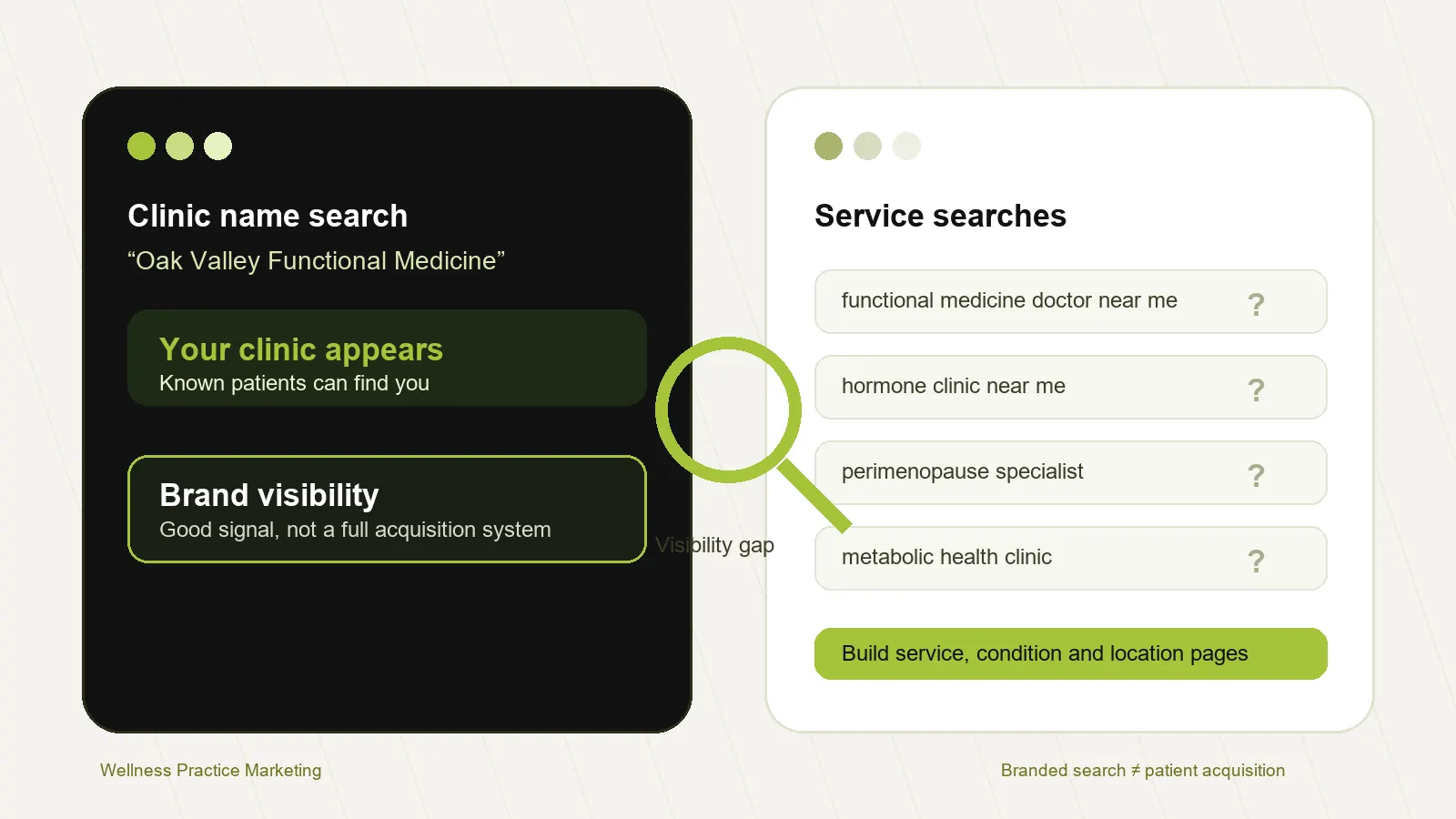
The clinic appears when someone searches its exact name. It may also appear for the physician's name, the practice address, or a branded phrase like "Oak Valley Functional Medicine reviews." That is branded search. It means Google understands that your clinic exists.
But when a new patient searches functional medicine doctor near me, hormone clinic near me, perimenopause specialist, integrative medicine doctor, medical weight loss clinic, or metabolic health doctor, the clinic is missing.
That is the real problem.
Ranking for your name protects demand you already created. Ranking for your services creates the chance to be discovered by patients who do not know you yet.
For functional, integrative, naturopathic, longevity, hormone and metabolic health clinics, this distinction matters because many patients search long before they know which practice they will contact. They may start with symptoms, compare treatment approaches, look for local options, read physician profiles, check reviews and only then book a consultation.
If your website only wins when the patient already knows your name, your SEO is not yet a patient acquisition system.
Brand Search vs Service Search
Brand search happens when someone searches for your clinic, doctor or business by name. Examples include:
- oak valley functional medicine
- dr jane smith integrative medicine
- your clinic name reviews
- your clinic name phone number
These searches are important. They help patients confirm your location, read reviews, find your number and return to your website. If you do not appear for your own name, there may be a basic indexing, Google Business Profile, naming or reputation issue that needs attention.
Service search is different. It happens when someone searches for care before choosing a clinic. Examples include:
- functional medicine doctor near me
- hormone therapy clinic in Austin
- perimenopause doctor near me
- integrative medicine for autoimmune support
- weight loss clinic for insulin resistance
- naturopathic doctor for gut health
These searches are usually more valuable for growth because they contain active demand. The patient is not looking for your logo. They are looking for help, a provider, a treatment option, or a clinic that seems credible enough to contact.
This is why integrative medicine SEO and functional medicine marketing need to be built around patient intent, not only around the practice name.
Why Branded Ranking Is Not a Patient Acquisition System
A clinic that ranks for its name may still be almost invisible to new patients. This creates a false sense of security.
Branded ranking usually reflects existing awareness from referrals, signage, social media, email, events, past patients, offline reputation, physician relationships or paid ads. It is valuable, but it does not prove that your website can attract demand on its own.
The business consequence is simple. If most organic traffic comes from branded searches, the clinic is depending on people who already heard about it elsewhere. That limits growth, makes referrals carry too much weight, and leaves high-intent searches available for competitors.
A clinic may have excellent physicians, strong outcomes, a beautiful office and loyal patients, yet still lose search visibility to a competitor with clearer service pages, stronger local SEO, better titles and more useful condition content.
SEO should help the right patients find you when they are still deciding who to trust. That means your website must answer more than "Who are we?" It must answer "What do we help with, where do we provide it, who provides the care, why are we qualified, and what should the patient do next?"
Common Reasons Service Visibility Fails
1. One Generic Services Page Carries Everything
Many clinics list functional medicine, hormone therapy, gut health, weight loss, longevity, IV therapy and nutrition on one page. That page may be useful for existing visitors, but it is rarely strong enough to rank for each service.
Google has to decide what the page is mainly about. If the answer is "many unrelated things," the page often becomes relevant for none of them strongly enough.
2. No Dedicated Service, Condition or Location Pages
Patients search in different ways. Some search by service, some by condition, some by location and some by provider type. A strong site architecture reflects that.
For example, hormone therapy visibility may require a dedicated hormone page, supporting perimenopause and menopause pages, physician credentials, local references, reviews, FAQs and internal links from related pages. A single sentence on a services list is not enough.
3. Weak Titles and H1s
Search engines and patients both rely on the page title and H1 to understand relevance quickly. A page titled "Our Services" with an H1 of "What We Do" gives away one of the easiest SEO opportunities.
Compare that with a page titled "Functional Medicine Doctor in Denver" or "Hormone Therapy Clinic for Perimenopause in Austin." Those are clearer, provided the page truthfully supports the claim.
4. Poor Google Business Profile Alignment
Local visibility depends heavily on relevance, distance and prominence. Your Google Business Profile should reinforce what the website says, not tell a different story.
Categories, services, business description, photos, reviews, website links and appointment links should align with the clinic's actual services. Our guide to functional medicine local SEO covers this local layer in more detail.
5. Thin Physician Authority
Healthcare is a trust market. Patients want to know who is providing care, what the provider is licensed to do, what experience they have and how they approach treatment.
A service page without a named physician, credentials, clinical perspective or review process feels thin. It also wastes one of the strongest authority assets the clinic has.
6. Weak Internal Links
Internal links help Google and patients understand which pages belong together. Your hormone therapy page should link to perimenopause, menopause, weight management, physician bio and booking pages when relevant. Your perimenopause article should link back to the hormone therapy page.
Without internal links, even good pages can sit isolated and underperform.
7. No Local Relevance
Many wellness clinic websites sound like they could belong in any city. Local pages and service pages should include accurate signals about the community served, clinic location, telehealth availability, nearby areas, parking or access when relevant, and any truthful geographic limits.
Do not create fake city pages or claim locations where you do not operate. That is misleading and can damage trust.
8. Slow or Confusing Website Experience
If a patient lands on your page and cannot quickly understand the offer, provider, location, cost expectations or booking path, the search visibility is wasted.
Technical speed matters, but so does clarity. A beautiful website that hides the next step behind vague language will leak leads.
9. No Conversion Tracking
If organic calls, forms and bookings are not tracked, the clinic cannot separate visibility from business impact. This is the same lesson we apply in paid search. Conversion tracking matters because otherwise every channel looks cleaner than it really is.
What Strong SEO Architecture Looks Like
A stronger structure usually starts with a clear hierarchy:
- Homepage: who the clinic helps, primary positioning, location and main next step.
- Core service pages: functional medicine, integrative medicine, hormone therapy, medical weight loss, metabolic health, longevity, nutrition or other real services.
- Condition pages: perimenopause, fatigue, gut health, insulin resistance, thyroid concerns, autoimmune support, brain fog or other concerns the clinic responsibly addresses.
- Location pages: real clinic locations or truthful service-area pages with unique local value.
- Physician pages: credentials, licensing, training, approach, media, publications and appointment path.
- Educational articles: practical answers that support the service and condition pages.
This structure gives every important topic a home. It also prevents your blog from trying to do the job of your core service pages.
For example, a hormone clinic might build a service page for hormone therapy, a condition page for perimenopause, a page for metabolic health, a physician profile, and an article explaining why patients search for brain fog, weight gain and sleep problems. Each page has a distinct purpose, then internal links connect the cluster.
How to Build Dedicated Pages for Services, Conditions and Locations
A dedicated page should not be a keyword stuffed brochure. It should help a patient decide whether the clinic is relevant, credible and worth contacting.
For a functional medicine service page, explain who the service is for, what types of concerns are commonly evaluated, how the consultation works, what makes the approach different, who provides care, what is included, what is not promised and how to book. If SEO is a priority, connect the page to a specialist offer such as SEO for naturopathic and functional medicine clinics.
For a hormone therapy page, avoid promising balanced hormones, weight loss or symptom resolution. Instead, explain evaluation, labs when appropriate, individualized discussion, safety considerations, provider credentials and the consultation process.
For perimenopause, talk in the language patients use: sleep changes, brain fog, cycle changes, weight changes, mood shifts and uncertainty about what is normal. Make it clear that the page is educational and that care decisions require consultation with a qualified clinician.
For weight loss and metabolic health, build around the patient problem rather than a generic diet pitch. Search language may include insulin resistance, prediabetes, stubborn weight gain, metabolic health, GLP-1 alternatives or medical weight loss. A related search-intent lesson appears in our case study on patient search language in Google Ads.
For integrative medicine, clarify what the clinic actually does. The term can mean different things to different patients. Your page should connect philosophy to specific services, providers and conditions instead of staying abstract.
For locations, be accurate. A real location page can include office details, parking, nearby areas served, physician availability, local reviews, photos and location-specific FAQs. A fake location page is not a strategy. It is a trust problem.
Local SEO and Google Business Profile Alignment
For many wellness clinics, Google Maps and local results are the difference between being considered and being invisible.
Your Google Business Profile should support the same service themes as your website. That means accurate categories, services listed in patient language, a business description aligned with the website, fresh photos, consistent name, address and phone information, relevant appointment links, and ethical review generation from real patients.
GBP alone cannot compensate for a weak website. The website and profile should reinforce each other. If the profile says hormone clinic, the website should have a strong hormone page. If the website promotes functional medicine, the profile should not look like a generic medical office with no services listed.
For clinics that need both organic and paid search, integrative medicine marketing often works best when SEO, Google Business Profile and conversion tracking are planned together.
How to Measure Non-Branded Visibility
Do not judge SEO by total traffic alone. A clinic can grow branded traffic without becoming more discoverable to new patients.
- Branded impressions: clinic name, physician names, exact business variations.
- Non-branded service impressions: hormone therapy, functional medicine doctor, integrative medicine clinic, weight loss doctor.
- Condition impressions: perimenopause, fatigue, gut health, insulin resistance, thyroid concerns.
- Local modifiers: near me, city names, neighborhood names and local provider searches.
- Clicks by page: which service and condition pages attract visitors.
- Leads by source: calls, forms, online bookings and qualified enquiries from organic search.
- Google Business Profile actions: calls, website clicks, direction requests and messages.
In Google Search Console, export queries and tag them as branded or non-branded. In GA4, track calls, forms and bookings. In your CRM, note which leads became qualified consultations. If paid search is running too, compare SEO insights with Google Ads budget allocation and query data to see where real demand is strongest.
A Practical 60 to 90 Day Action Plan
Days 1 to 15: Diagnose the Gap
- Export Google Search Console queries and separate branded from non-branded.
- List the services and conditions that should generate new patient demand.
- Audit titles, H1s, internal links, physician pages and location signals.
- Check Google Business Profile categories, services, photos and links.
- Verify that forms, calls and booking actions are tracked.
Days 16 to 45: Fix the Foundation
- Rewrite titles and H1s for the highest priority pages.
- Create or improve the top two to four service pages.
- Add physician credentials, authorship and review language where appropriate.
- Improve internal links between services, conditions, physician profiles and booking paths.
- Update Google Business Profile services and links to match the website.
Days 46 to 90: Expand the Cluster
- Create supporting condition pages for high-intent patient searches.
- Add one real location or service-area page if there is a truthful reason to do so.
- Publish one or two educational articles that support the service pages.
- Review non-branded impressions and early query growth.
- Measure whether organic visitors are calling, submitting forms or booking.
The goal during the first 90 days is not to chase every keyword. It is to make the clinic's most important services understandable, crawlable, locally relevant and measurable.
Mistakes to Avoid
- Do not create fake local pages. If you do not have a real presence or truthful service relationship with a city, do not pretend that you do.
- Do not promise rankings. SEO depends on competition, authority, geography and execution. No agency can ethically guarantee a specific position.
- Do not make medical outcome promises. Avoid cure claims, guaranteed symptom improvement or guaranteed weight loss.
- Do not buy or fake reviews. Reviews must be genuine and compliant with platform rules and healthcare regulations.
- Do not publish generic AI content at scale. Thin articles can dilute trust and distract from the pages that actually drive patient acquisition.
- Do not send every click to the homepage. Service searches should land on specific, relevant pages.
- Do not ignore tracking. Rankings are not the business goal. Qualified enquiries are.
FAQ
Why does my clinic show up when I search its name?
Because Google already has enough signals to connect your brand name with your website, Google Business Profile, address, reviews and directories. That is useful, but it mostly helps people who already know you.
Why does my clinic not show up for services like functional medicine doctor near me?
Service searches are competitive and require relevance beyond your brand. Google needs clear pages, local signals, physician authority, internal links, reviews and a strong match between the page, the search query and the location.
Is ranking for my clinic name good enough?
No. Branded visibility protects demand you already created. A patient acquisition system also captures non-branded searches from people looking for a service, condition or provider before they know your clinic exists.
Do I need separate pages for every service?
You need separate pages for important services when each service has distinct search demand, patient intent and clinical detail. Avoid creating thin duplicate pages just to target keywords.
Should wellness clinics create condition pages?
Often, yes. Condition pages can match how patients actually search, such as perimenopause, insulin resistance, fatigue, gut health, thyroid concerns or weight management. They should be medically responsible and connected to relevant services.
Can I create location pages for nearby cities?
Only if the location information is truthful and useful. Do not create fake offices, misleading locations or doorway pages. For real service areas, explain availability, travel radius, telehealth limits and local relevance accurately.
How long does non-branded SEO take?
There is no universal timeline. In the first 60 to 90 days, clinics should usually measure indexing, impressions, query growth, page improvements and early leads rather than expecting guaranteed ranking outcomes.
How should I measure progress?
Separate branded and non-branded performance in Google Search Console, track calls and forms in GA4, review Google Business Profile interactions, and compare leads by source, page and query theme.
Want to Know Why Your Clinic Is Invisible for Its Services?
At Wellness Practice Marketing, we help functional, integrative, naturopathic, longevity, hormone and metabolic health clinics build search visibility around real patient intent.
That can include service page strategy, local SEO, Google Business Profile alignment, conversion tracking, and when appropriate, compliant Google Ads management to capture demand while SEO compounds.
If your clinic shows up for its name but not for the services patients search before they know you, we can review the gap and identify the highest priority fixes.