
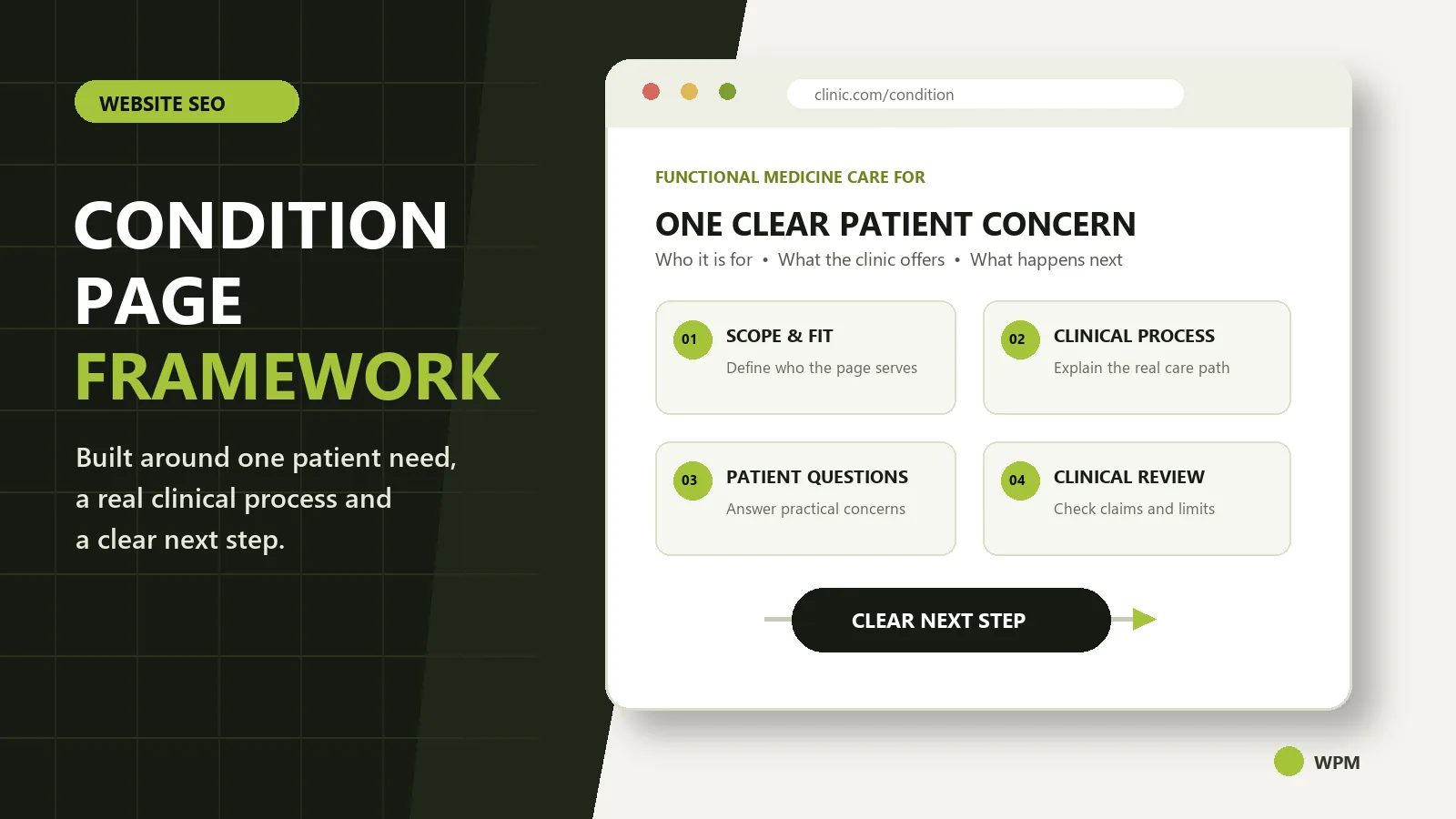
What makes a useful functional medicine condition page?
A useful condition page helps a prospective patient answer five questions: Is this clinic relevant to my concern? What can the clinic responsibly offer? Who would I see? What would the first step involve? What should I do next? It connects patient education to the clinic's real scope and process without diagnosing the reader or promising an outcome.
Unlike a general medical explainer, the page should add the information only the clinic can provide: fit, limitations, provider credentials, process, appointment details and a truthful route to care.
Google says its systems give more weight to content aligned with strong experience, expertise, authoritativeness and trust for topics that can significantly affect health. Its people-first guidance also asks whether content serves an intended audience and leaves a reader feeling they learned enough to achieve their goal.[1] For a condition page, the goal is not self-diagnosis. It is a better-informed decision about whether and how to contact the clinic.
This guide focuses on implementation. For the wider website journey, see our functional medicine website design guide. For the person behind the care, use our field-by-field guide to a functional medicine provider bio page.
Important: this is marketing guidance, not medical, legal or regulatory advice. Advertising and professional rules vary by service, provider and jurisdiction. Have appropriate clinical and compliance reviewers approve the final page.
1. Decide whether the idea belongs on a condition page
Many clinics create overlapping URLs because they start with keywords rather than page purpose. Before writing, decide which patient question the page must own.
| Page type | Core question | Illustrative example |
|---|---|---|
| Condition page | Is this clinic relevant to someone seeking care related to this concern? | Functional medicine care for SIBO in Austin |
| Service page | What does this consultation, program, test or therapy involve? | Functional medicine consultations |
| Blog article | What should I understand about one narrow question? | What records should I bring to a digestive health consultation? |
| Campaign landing page | Should I take the action promoted by this ad or email? | Request a digestive health consultation |
Create a condition page only when the clinic genuinely accepts patients with that concern, can explain its role accurately and has a defined next step. Use a service page when the search is about an appointment type or intervention. Use an article when the reader needs one focused answer. Use a campaign page when the visitor has arrived from a specific message and one action should dominate.
Do not create one URL for every wording. If “functional medicine for SIBO,” “SIBO functional medicine clinic” and “functional doctor for SIBO” lead to the same provider, process and next step, they belong in one keyword map and usually one substantial page. A second page is justified only when the intent and content are genuinely different.
2. Choose conditions the clinic is ready to represent
A long “conditions we support” list is not a publishing plan. Prioritize topics with four kinds of readiness. Mark each one clear, partial or not ready. If any area is not ready, keep the topic in the backlog.
- Clinical fit: a qualified provider genuinely evaluates or manages people with this concern within their licence and scope.
- Patient demand: the topic appears in Search Console queries, intake calls, referral conversations, front-desk questions, paid-search data or credible keyword research.
- Operational fit: the clinic accepts these enquiries, can route them correctly and has capacity for the relevant appointment.
- Distinct information: the clinic can explain a real provider, process, location, limitation or patient question that is not a condition-name swap.
Build a one-page intent map
For each approved topic, record the main patient need, one natural primary phrase, close variations that mean the same thing, four to six questions the page should answer and the terms that belong elsewhere. Also list exclusions: services the clinic does not offer, areas outside scope and unsupported words such as “cure,” “reverse” or “guaranteed.”
| Field | Illustrative SIBO page |
|---|---|
| Primary intent | Evaluate a local clinic that works with patients seeking care related to an existing or suspected SIBO concern |
| Primary phrase | Functional medicine for SIBO in Austin |
| Questions | Is a diagnosis required? What records are reviewed? Who provides the visit? How does the clinic coordinate with existing care? |
| Separate service page | Functional medicine consultation |
| Separate article | What records to bring to a digestive health consultation |
| Exclusions | Guaranteed conclusions, universal testing panels and cure language |
The example is a content map, not medical copy. A clinician must decide what terminology, boundaries and urgent-care language are appropriate. Search language should shape the page's focus, but the clinic's real service and the reader's next decision control the final wording.
If your clinic ranks only for its own name, this mapping exercise also shows which non-branded needs deserve a permanent home. Our guide to why clinics show up for their name but not their services explains the broader architecture.
3. Build the clinical source pack before the writer starts
The writer should not infer the clinic's process from competitor websites. A short clinician interview or written brief should establish the facts first.
- The concerns and presentations the clinic accepts, plus important exclusions
- Whether an existing diagnosis, referral or record is required
- What the provider reviews at the first appointment
- Tests that may be considered, stated as conditional rather than universal
- Services the clinic provides and situations it refers elsewhere
- How the provider coordinates with primary or specialist care
- The relevant clinician, accurate credentials and provider profile
- Appointment format, locations, telehealth limits, fees and booking route
- Questions front-desk and clinical teams repeatedly answer
- Authoritative references for any medical definitions or clinical statements
- The qualified person who will review the complete draft
Set one firm editorial rule: if a clinical statement cannot be traced to the source pack or an authoritative current reference, it does not go live. Keep those sources with the page brief so later updates do not rely on memory.
Display “medically reviewed” only after the named reviewer has checked the complete page, including headings, images, FAQs, calls to action and metadata.
4. Use this 12-block condition-page framework
The structure can repeat across the site. The substance cannot. Each page needs its own clinical inputs, patient questions, provider, scope, limitations and practical details.
First-screen orientation
Name the concern, care context and truthful location. Say who the page is for, what the clinic offers and what action follows.
Patient situation
Recognize why someone may be researching the topic without telling the reader that a symptom list proves a diagnosis.
Short sourced overview
Explain the condition briefly in plain language and link to an appropriate clinical, government or public-health source.
Fit and limits
State who may be appropriate, what the clinic does not provide and where primary, specialist or urgent care may be needed.
Evaluation process
Describe the real sequence from history and records through fit, further evaluation and discussion of next steps.
Care options
Name only real services. Explain how choices are made rather than presenting one protocol as suitable for every reader.
Relevant clinician
Introduce the provider's role and relevant qualifications, then link to the full profile rather than duplicating it.
First appointment
Cover format, location, preparation, records, referral requirements, fees where published and what happens afterward.
Appropriate proof
Use accurate credentials, process detail, clinic photography and permitted patient feedback without implying typical outcomes.
Real questions
Answer four to six questions from intake calls, Search Console and clinician interviews, not filler written for keywords.
One next step
Match the CTA to the real route: request a consultation, book an offered fit call or ask the clinic about eligibility.
Review information
Show the author, real clinical reviewer, credentials, review date and editorial responsibility when those facts are accurate.
Write the first screen for orientation, not persuasion alone
A useful H1 names the concern and care context. Add geography only when it affects local relevance or eligibility. The supporting copy should identify the clinic's service without implying that every reader is suitable.
Functional Medicine Consultations for People Seeking Support With [Condition or Concern] in [Location]
Explain that the clinic evaluates fit through an individual consultation, identify the qualified provider and describe the actual next step. Do not claim that the clinic has already identified the reader's problem.
Describe the patient's situation without diagnosing
Reflect the questions people bring to the clinic: perhaps they have an existing diagnosis, are seeking another perspective or want to understand whether the clinic's service fits alongside current care. Avoid a long checklist followed by “If you have three of these symptoms, you may have...” That structure turns marketing copy into a self-assessment tool the clinic may not be qualified to offer.
Keep the medical overview short and sourced
One or two paragraphs are often enough to define the topic and correct a common misunderstanding. Link to a primary or authoritative source for medical facts. The condition page should not compete with national health publishers on a general definition. Its distinctive value is the clinic-specific process that follows.
Make limits visible
Explain whether the clinic requires a prior diagnosis, whether it works alongside another provider and what falls outside scope. If certain presentations require urgent evaluation, the clinical reviewer should supply the exact language. Clear limits can reduce poor-fit enquiries and build more trust than vague claims about treating the whole person.
Show the process patients can verify
A practical sequence might include reviewing current concerns, history, medicines, supplements and previous records; deciding whether the clinic is a suitable fit; considering further evaluation only when appropriate; and discussing an individual plan or referral. Publish only steps the clinic can deliver consistently.
Do not promise that one proprietary test will reveal a hidden answer for every patient. If testing may be discussed, say what decision it informs and that the choice depends on the individual case.
Explain the first appointment in operational detail
Tell the reader where and how the appointment occurs, who they will meet, what to prepare, whether a referral is required, how long the administrative process takes and what happens after the visit. Link to current fees, insurance or reimbursement information where available. Practical detail often answers more conversion objections than another paragraph about philosophy.
5. Write specific copy without making unsafe promises
Functional medicine copy often becomes risky where the clinic tries hardest to sound different. “Reverse the root cause,” “heal your gut” and “succeed where conventional medicine failed” communicate clinical efficacy, certainty or superiority. Adding “may” does not automatically fix the overall impression.
The FTC's health-products guidance tells marketers to consider express and implied claims, the overall net impression and whether objective health claims have adequate substantiation.[3] UK ASA guidance says a claim that a therapy can diagnose, treat, help with or cure a medical condition is unlikely to be acceptable unless the advertiser is suitably qualified and holds robust supporting evidence.[4] Canada's Competition Bureau states that advertising or marketing something in a false or misleading way is against the law.[5]
Those are broad frameworks, not a complete review of every profession or locality. US state boards, UK professional rules and Canadian provincial colleges may add requirements. The clinic should identify the rules that apply to its provider and service before publication.
| Risky copy | Why it is risky | Safer direction |
|---|---|---|
| “We identify and reverse the root cause.” | Promises a finding and an outcome | Explain what the provider reviews and how they decide whether the service is an appropriate addition to care. |
| “Our protocol heals your gut.” | States efficacy and presents one protocol as universal | Describe how individual recommendations are discussed based on history, findings and scope. |
| “Conventional medicine only masks symptoms.” | Creates a misleading either-or comparison | Explain how the clinic can coordinate with existing primary or specialist care. |
| “Most patients improve within weeks.” | Makes a measurable result and timing claim | Remove it unless properly supported and permitted. Explain the follow-up process instead. |
| “This treatment may cure fatigue.” | “May” does not rescue an unsupported cure claim | Describe the consultation, evaluation, limitations and referral pathway. |
The safer language is not empty. It makes strong factual claims about what the clinic can verify: provider qualifications, services, process, access, coordination and next steps. Keep outcome uncertainty separate from operational clarity.
Testimonials require the same care. A patient story can imply that a result is typical even when a disclaimer says otherwise. Check whether testimonials are permitted for the profession and jurisdiction, obtain appropriate authorization, protect privacy and do not use a testimonial to communicate a claim the clinic could not make directly.
6. Connect the page with on-page SEO, internal links and accurate schema
Give the page one primary purpose. Use a unique title tag, one natural H1, a useful meta description and headings that help a reader scan the decision. Include the clinic's city or service area only when it is truthful and relevant. Do not repeat the exact keyword in every heading.
Google's spam policies describe doorway abuse as pages created to rank for similar queries that funnel users to an intermediate destination.[2] A clinic can avoid that pattern by consolidating close variants, refusing city-name swaps and requiring every page to contain a distinct provider, process, scope or patient need.
Build a small, deliberate internal-link path
- Link from a conditions hub, relevant service page or strong educational article to the condition page.
- Link from the condition page to the relevant service and provider profile.
- Connect truthful location, fee, new-patient and booking information.
- Link one or two genuinely useful articles to the condition page.
- Add reciprocal links where they help the reader continue the same decision.
Do not link every condition to every service or repeat the same exact-match anchor sitewide. Each link should answer the next question. For a broader local structure, use our functional medicine local SEO guide.
Use schema to describe visible facts
Structured data can identify the page, breadcrumb, author and organization. Google says markup should represent the page's main content and that marked-up content must be visible to users.[6] Add FAQ schema only when the visible page contains genuine questions and answers. Do not add a diagnosis, rating, credential, review or service to the markup when the page does not show and support it.
Schema is not a substitute for clinical review, useful copy or a coherent website. It also does not guarantee a rich result. Validate every JSON-LD block and keep it aligned when the visible page changes.
7. Design one proportionate next step
Choose the primary CTA before the draft. It should match the clinic's real intake process, such as “Request a new-patient consultation,” “Book a 15-minute fit call” when the clinic genuinely offers one, or “Call to ask whether this service is appropriate.”
Explain what happens after the click. Who responds? Is the next interaction administrative or clinical? Does the clinic first check location, age, referral or provider availability? Does the link open a scheduler for the correct appointment? A vague “Start your journey” button hides information the reader needs.
Repeat the same primary action after the process, after practical appointment information and at the end. A quieter secondary option can serve readers who are not ready, but it should not compete with the main path.
Keep the form appropriate to the stage. Ask only for information needed to route the enquiry. Health histories, diagnoses and detailed symptom descriptions should not be sent casually through marketing forms, analytics events or advertising platforms. Review booking, privacy and tracking separately from the copy.
8. Measure the page as a patient-acquisition path
Rankings alone do not show whether the page helps the practice. Review four connected layers.
| Layer | Measures | Question |
|---|---|---|
| Visibility | Impressions, clicks, query themes and click-through rate | Is the page appearing for the intended concern and location? |
| Engagement | Entrances, provider-link clicks, CTA clicks, phone clicks and scheduler visits | Can visitors find the information and next step? |
| Conversion | Submitted enquiries and completed bookings | Does the page produce an appropriate action? |
| Lead quality | Qualified enquiries, attended consultations and poor-fit reasons | Does the page set scope and eligibility clearly? |
Use the pattern to choose the edit. Impressions without clicks can indicate weak search alignment or an unclear title. Clicks without enquiries point toward first-screen clarity, trust, practical details or CTA friction. Enquiries that repeatedly fall outside scope mean the eligibility, location, pricing or referral language needs work. Little visibility can justify checking indexing, internal links, duplication and whether the page adds anything distinct.
Record the publish date, review date, material edits and definition of a qualified enquiry. Do not call the page a success because one phrase moved or a failure because it did not produce an immediate booking.
9. Functional medicine condition-page publishing checklist
Topic and intent
- The clinic genuinely accepts patients seeking care related to this concern.
- A qualified provider confirmed scope, limitations and appropriate terminology.
- The page owns one meaningful intent rather than one exact phrase per URL.
- Overlapping condition, service and article pages are differentiated.
Clinical accuracy and claims
- Medical definitions and claims use current authoritative sources.
- The page does not diagnose the reader from a symptom list.
- Tests and care options are conditional, not universal.
- There are no cure, reversal, guaranteed result, guaranteed safety or fixed-timeline claims.
- The copy does not disparage conventional care or suggest abandoning it.
- Testimonials, if permitted, do not imply unsupported outcomes.
- A named qualified reviewer approved the complete page.
Usefulness and conversion
- The first screen says who the page is for, what the clinic offers, where and what to do next.
- Fit, limitations, coordination and first-appointment details are clear.
- The provider, service, location, fees and booking route link correctly.
- FAQs come from real patient questions.
- One primary CTA matches the intake process and explains what happens next.
Search and maintenance
- Title, H1, description and canonical URL are unique.
- Internal links connect the page in both directions where useful.
- Structured data matches visible content and validates.
- Calls, forms or scheduler actions are measured appropriately.
- A page owner and real review date are assigned.
Start with one condition the clinic genuinely serves. Complete the source pack, write the page in the 12-block order, have the right clinician review its full impression and connect it to the relevant service, provider, location and booking route. That process creates a durable patient resource, not another page produced only to fill a keyword gap.
If you need help planning the architecture, WPM's SEO service for functional and naturopathic clinics connects condition pages with local visibility, internal links and measurement. If the website itself needs restructuring, see our functional medicine web design service.
Frequently asked questions
What is a condition page on a functional medicine website?
A condition page is a permanent clinic page for people evaluating care related to one defined health concern. It connects balanced education with the clinic's real scope, provider, evaluation process, practical appointment details and next step. It is not an online diagnosis or a generic blog post.
Should every condition have its own page?
No. Create a separate page only when the clinic genuinely serves that patient group, there is meaningful patient demand, the care pathway can be explained accurately and the page will add distinct value. Close keyword variations that lead to the same provider and process should usually share one page.
What should a functional medicine condition page include?
Include a clear first screen, patient context without diagnosis, a short sourced overview, fit and limits, evaluation process, conditional care options, the relevant provider, first-appointment details, appropriate proof, real FAQs, one clear call to action and visible clinical review information.
Who should review a condition page before publication?
A qualified clinician who understands the topic, the clinic's actual scope and the rules that apply in the relevant jurisdiction should review the complete page. Marketing, legal or compliance review may also be appropriate. Display the reviewer name and date only when a real review occurred.
Can clinics use one template for all condition pages?
The section structure can repeat, but the substance cannot. Each page needs condition-specific patient questions, clinical sources, scope, limitations, provider information, process and practical details. Pages that merely swap the condition or city name create a poor experience and can overlap with one another in search.
Turn the framework into a real clinic page
Wellness Practice Marketing helps functional and integrative medicine clinics turn patient search intent into specific, trustworthy pages and measurable enquiry paths. If your site has a long conditions list but few pages that explain fit, process and the next step, book a strategy call with Salem to identify the highest-priority opportunities.
This article is for general marketing education. It is not medical, legal, privacy or regulatory advice. Use qualified advisers for the requirements that apply to your clinic, profession, services and location.
Authoritative sources
- Google Search Central: Creating Helpful, Reliable, People-First Content
- Google Search Central: Spam Policies for Web Search
- Federal Trade Commission: Health Products Compliance Guidance
- UK Advertising Standards Authority: Health Therapies and References to Medical Conditions
- Competition Bureau Canada: Deceptive Marketing Practices
- Google Search Central: Introduction to Structured Data Markup