Part 1
Introduction
What is local SEO?
Local SEO is the practice of optimizing your online presence so your clinic shows up when people nearby search for what you offer. For a functional medicine practice, that means appearing when someone types "functional medicine doctor near me," "SIBO specialist in [city]," or "integrative clinic for hormone testing" into Google. It covers three overlapping systems: your Google Business Profile, your website, and the trust signals (reviews, citations, links) that tell Google your clinic is real, relevant and reputable.
For the broader organic strategy around service pages, condition content and AI-assisted discovery, read our guide to SEO for integrative medicine clinics.
Why local SEO matters for functional medicine clinics
Most functional medicine patients start their search locally, even if they'd travel further for the right practitioner. They want someone they can see in person, at least for the first visit, and Google's local results (the Local Pack and Google Maps) are the first thing they see before any organic listing. If your clinic isn't showing up there, you're invisible at the exact moment a ready-to-book patient is looking.
Unlike Google Ads, local SEO builds an asset. Every review, every optimized page and every citation compounds over time instead of disappearing the moment you stop paying for clicks. It's slower to build, but it becomes one of the most cost-efficient patient acquisition channels a clinic has once it matures. It's also the foundation of how we approach wellness practice marketing for every clinic we work with: build the compounding assets first, then layer paid channels on top.
How patients search for functional medicine doctors
Local searches for functional medicine fall into a few clear patterns:
- Direct + location: "functional medicine doctor Austin", "integrative clinic near me"
- Condition + location: "thyroid specialist Denver", "gut health doctor near me"
- Comparison searches: "best functional medicine clinic in [city]", "functional medicine reviews"
- Modality searches: "root cause medicine near me", "holistic doctor [city]"
Notice how many of these already include "near me" or a location, either typed explicitly or inferred by Google from the searcher's device. That single detail is what separates local SEO from traditional SEO.
Local SEO vs traditional SEO
Traditional SEO competes for national or topic-wide rankings: a blog post about "what is functional medicine" can rank for searchers anywhere in the world. Local SEO competes within a radius: your clinic is only ever shown to people searching from, or explicitly targeting, your service area. The ranking factors overlap, but local search adds an entire layer that traditional SEO doesn't touch: your Google Business Profile, your physical address, your reviews, and your local citations.
The local patient journey
A typical local search-to-patient journey looks like this: a symptom search leads to a modality search ("functional medicine" or "root cause approach"), which leads to a location-qualified search once the patient decides they want an in-person option. At that point Google shows the Local Pack, the patient compares two or three clinics on reviews, photos and services, checks the website of their top pick, and calls or books. Every part of this guide maps to a step in that journey; miss one and you lose patients who were otherwise ready to book.
This guide covers local search in depth. For every other channel, see our complete functional medicine marketing guide.
Part 2
How Google Local Search Works
Understanding Google's local ranking factors
Google has confirmed that local rankings come down to three factors: relevance, distance and prominence. Everything in this guide exists to improve your standing on one of these three.
Relevance
How well your Google Business Profile and website match what the searcher is looking for. A clinic categorized correctly as "Functional Medicine Practitioner" with services, descriptions and content that clearly discuss functional medicine will out-rank a generic "Doctor" listing for functional medicine searches, even if the generic listing is otherwise strong.
Distance
How far your clinic is from the searcher, or from the location implied in their search. You can't manipulate distance directly (and you shouldn't try to fake your address), but you can make sure your service area settings and location pages accurately reflect every area you legitimately serve.
Prominence
How well-known and well-regarded your clinic is, both online and offline. This is where reviews, citations, backlinks and overall web presence come in. Prominence is the factor most within your control over time, and the one this guide spends the most effort on.
The Local Pack explained
The Local Pack is the map with three business listings that appears at the top of Google for local searches, above the standard organic results. For most functional medicine searches, the Local Pack captures the majority of clicks: patients rarely scroll past it. Ranking in the top three of the Local Pack for your core keywords is the single highest-leverage local SEO outcome available to a clinic.
Google Maps rankings
Google Maps uses the same three ranking factors as the Local Pack, but shows more results and lets patients filter by rating, hours and distance. A strong Maps presence, complete profile, high rating, frequent photos, matters because many patients open Maps directly to compare nearby options rather than searching Google first.
Organic results vs Google Maps
Your website's organic ranking and your Google Business Profile's Local Pack ranking are related but separate systems. A clinic can rank #1 in the Local Pack while its website sits on page two organically, or vice versa. The strongest local SEO strategy optimizes both, since some searches trigger the Local Pack and others show only standard organic results.
| Ranking factor | What it means | What you can influence |
|---|
| Relevance | How well your profile and website match the search | Categories, services, descriptions, website content |
| Distance | How close you are to the searcher or their target location | Accurate service area and location settings |
| Prominence | How well-known and trusted your clinic is | Reviews, citations, backlinks, overall web presence |
Part 3
Google Business Profile
Why your Google Business Profile is your most important local SEO asset
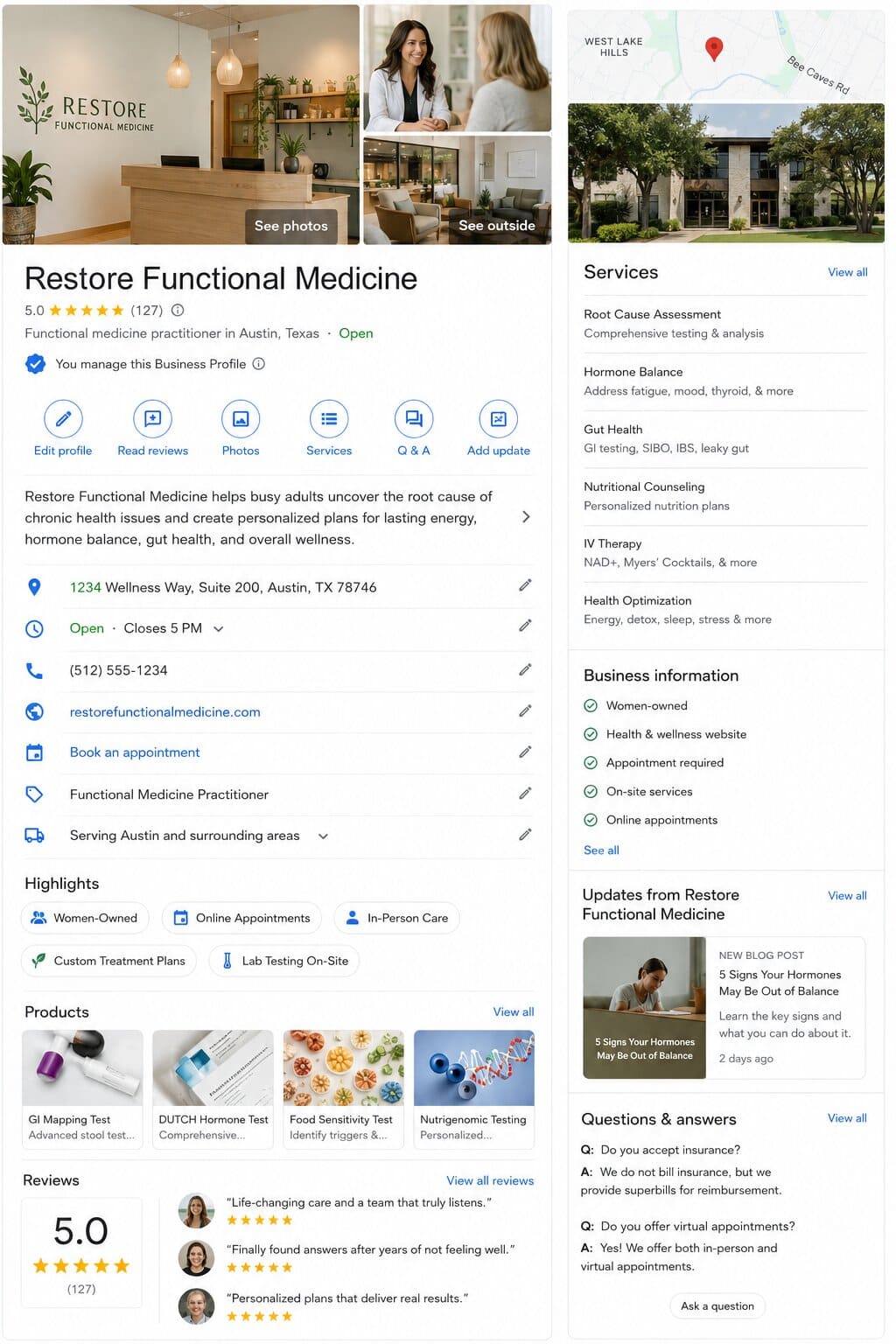
If you optimize only one thing from this guide, make it your Google Business Profile (GBP). It's free, it's what patients see first, and it directly controls your Local Pack and Maps visibility. A complete, active, well-reviewed profile will consistently outperform a website with excellent SEO but a neglected GBP.
Creating and verifying your profile
Claim your listing at business.google.com if you haven't already, and complete verification, usually by postcard, phone or video, depending on your account and country. An unverified profile won't show consistently in local results, so this step is non-negotiable before anything else in this section matters.
Choosing the right business categories
Your primary category carries significant ranking weight. Use the most specific accurate option, "Functional Medicine Practitioner" if available in your region, or "Alternative Medicine Practitioner" or "Naturopathic Practitioner" where that fits better, rather than a generic "Doctor" category. Add secondary categories for every service you genuinely offer: nutritionist, wellness center, hormone specialist, and so on.
Writing an optimized business description
Your GBP description should explain what functional medicine is, who you treat, and what makes your approach different, in plain language a first-time patient would understand. Work in your city and core services naturally. Avoid keyword stuffing; Google's algorithm and human reviewers both penalize descriptions that read like a list of search terms instead of a business explanation.
Selecting services
List every individual service you offer inside the GBP services tab: functional medicine consultation, gut health testing, hormone panel review, IV therapy, and so on. Each listed service is a small relevance signal, and services with descriptions rank better than services listed by name alone.
Products vs services
The Products tab is meant for tangible items (supplements, testing kits) rather than clinical services. Clinics that sell supplement lines or at-home test kits should use this section; it's a secondary opportunity, not a substitute for a complete services list.
Business attributes
Attributes (wheelchair accessible, women-led, online appointments, languages spoken) help you match more specific searches and filters. Fill in every attribute that honestly applies. They're a small factor individually, but they add up, and some patients filter search results by attributes directly.
Service areas
If you see patients from a wider region than just your city, or run a service-area business without a public storefront, define your service area explicitly in GBP settings. Be realistic: listing service areas far outside where you can plausibly serve patients dilutes relevance rather than expanding it.
Appointment links
Add a direct booking link if you use online scheduling. Removing the friction between "found you on Google" and "booked an appointment" measurably increases conversion from profile views, and Google favors profiles that support in-platform actions like booking.
Messaging
Enable GBP messaging so patients can text a question directly from your profile before calling. Response time matters here as much as it does for leads from your website; a message left unanswered for days reads as a closed or unresponsive business.
Questions & answers
The Q&A section is public and editable by anyone, including you. Seed it yourself with the questions patients actually ask (do you take insurance, do you see patients virtually, what conditions do you treat) and answer them clearly. Monitor it regularly since competitors occasionally post misleading questions or answers.
Google Posts
Posts let you share updates, offers and articles directly on your profile. They expire after seven days for standard posts, which is exactly why posting regularly (twice a month at minimum) signals an active, real business rather than an abandoned listing.
Photos that build trust
Upload real photos of your clinic, your team, your waiting room and, with consent, your space in use. Profiles with 10 or more quality photos consistently receive more calls and direction requests than sparse profiles. Avoid stock photography; patients can tell, and so can Google's spam detection systems.
Videos
Short videos, a walkthrough of your clinic, a welcome message from the practitioner, perform well precisely because so few competitors bother to add them. Even a 30-second phone-recorded clip adds a level of trust and differentiation that photos alone can't.
Maintaining an active profile
Treat your GBP as a living channel: respond to every review within 48 hours, post updates twice monthly, refresh photos every month, and re-check your categories, services and attributes quarterly. Inactive profiles gradually lose ranking position to actively maintained competitors, even without any change in review count.
Related: Local SEO only works if the website behind your Google Business Profile can hold the traffic it sends. See our guide to functional medicine web design for what a conversion-ready clinic website needs.
Part 4
Keyword Research for Local SEO
Finding local keywords
Local keyword research starts with the same tools as any SEO project (Google's autocomplete, Search Console, a keyword tool) but is filtered through one extra question: does this term make sense with a city or "near me" attached? Most functional medicine keyword lists split cleanly into a handful of recurring patterns.
Functional medicine + city keywords
The foundation of local keyword targeting: "functional medicine doctor [city]", "integrative medicine clinic [city]". These belong on your homepage, your Google Business Profile, and any dedicated location pages, never stuffed unnaturally, but present in titles, headers and body copy where they read naturally.
"Near me" searches
"Near me" searches ("functional medicine near me", "gut doctor near me") are handled almost entirely by Google's own location detection rather than by the literal words on your page. You don't need to write "near me" verbatim into your content; you need a verified address, accurate service area, and strong local relevance signals so Google associates your business with that searcher's location.
Condition + location keywords
Highly qualified searches like "thyroid specialist [city]" or "SIBO treatment near me" indicate a patient who already knows what they're dealing with and is choosing a provider. These deserve their own condition pages (Part 6) rather than being folded into a general services page, since a dedicated page ranks better and converts better for this specific intent.
Service keywords
Searches for a specific offering rather than a condition: "hormone testing [city]", "IV nutrient therapy near me". Map these to individual service pages the same way you would condition keywords; a page that matches search intent precisely will consistently outrank a page trying to cover everything at once.
Competitor keyword research
Look at what's already ranking in your city's Local Pack and organic results. Note which services, conditions and phrases competitor websites emphasize; gaps in their content (a condition they don't mention, a service they bury) are opportunities for a page that covers it better.
Keyword mapping
Once you have your keyword list, map each one to exactly one page: homepage for brand and core "[practice type] + city" terms, service pages for service keywords, condition pages for condition keywords, location pages for each additional city served. Two pages competing for the same keyword split your own ranking potential; a clean map prevents that.
Part 5
Website Optimization
Why your website impacts local rankings
Google cross-references your Google Business Profile against your website to confirm relevance and legitimacy. A clinic whose website barely mentions functional medicine, loads slowly, or contradicts the address and phone number on its GBP sends a weak or conflicting signal that can cap how high your profile ranks, regardless of how good the profile itself looks.
Optimizing your homepage
Your homepage should state, within the first screen, what you do, who you treat, and where you're located. This isn't just for patients; it's the clearest relevance signal you can give Google about your practice type and service area.
Creating service pages
Every core service (functional medicine consultations, gut health testing, hormone therapy) deserves its own page rather than a shared paragraph on a general services page. Dedicated pages rank for more keywords and convert better because they can speak directly to that service's specific patient concerns.
Creating location pages
If you serve multiple distinct areas, a properly built location page (see Part 11 for multi-location detail) helps you rank in each one. A thin page that just swaps the city name is worse than no page at all; each one needs unique, useful content about serving patients in that specific area.
Optimizing title tags
Include your primary service and city in your title tags where it reads naturally: "Functional Medicine Doctor in Austin | [Clinic Name]" rather than a generic "Home" or just your clinic's name. Title tags are one of the strongest on-page relevance signals available.
Meta descriptions
Write a genuine, compelling summary of the page for the searcher, not a keyword list. Meta descriptions don't directly influence rankings, but a well-written one increases the click-through rate from search results, which does influence rankings indirectly over time.
Header structure
Use a single H1 per page that states the core topic, and H2/H3 subheadings that organize the content logically, the same structure this guide uses. Clean heading hierarchy helps both search engines and patients scanning the page quickly find what they need.
Internal linking
Link between your homepage, service pages, condition pages and location pages using descriptive anchor text ("functional medicine web design" rather than "click here"). Internal links distribute ranking authority across your site and help Google understand how your pages relate to each other.
Local landing pages
Beyond city-specific pages, consider dedicated landing pages for high-value condition or service searches that pair with local intent, especially if you're also running Google Ads. See our guide to Google Ads for functional medicine for how paid and organic landing page strategy overlap.
Mobile optimization
The majority of local searches happen on a phone, often while the patient is out and comparing options in real time. A site that isn't fully responsive, with tap-friendly buttons and readable text without zooming, loses patients at the exact moment they're closest to booking.
Website speed
Slow-loading pages hurt both rankings and conversions. Every additional second of load time increases the chance a patient bounces back to the Local Pack and clicks a competitor instead. Compress images, avoid bloated page builders, and test regularly.
Core Web Vitals
Google's Core Web Vitals (loading speed, interactivity and visual stability) are a confirmed ranking factor. A clinic website built on clean code, without excessive third-party scripts, tends to pass these benchmarks by default; a heavily plugin-laden site usually needs deliberate work to catch up.
Part 6
Local Content Strategy
Service pages
Each service page should explain what the service involves, who it's for, what to expect in a first session, and answer the two or three questions patients most commonly ask about it. Thin, one-paragraph service pages rarely rank against competitors who've invested real content into theirs.
Condition pages
A condition page (thyroid health, gut health, hormone imbalance) targets patients who've already identified what they're dealing with. These pages tend to convert at a higher rate than general service pages because the visitor's intent is so specific; they deserve equal investment.
City-specific content
Beyond a location page's basic structure, genuinely useful city-specific content, patient demographics you commonly see in that area, insurance networks relevant to that region, directions from major landmarks, helps a page earn its ranking rather than appearing templated.
FAQ pages
An FAQ page, or FAQ sections within service and condition pages, captures long-tail question searches ("does functional medicine take insurance", "how is functional medicine different from conventional") and pairs naturally with FAQPage schema (Part 10) for enhanced search results.
Blog content that supports local SEO
Blog posts don't need a city name in every title to support local SEO. A well-written educational post builds topical authority and earns links and shares, both of which strengthen your overall domain and indirectly lift your local rankings alongside your organic ones.
Related: content and paid search work best together, not as competing priorities. See our full breakdown of functional medicine marketing to see how the two connect.
Patient resources
Intake forms, what-to-expect guides, and condition-specific resources add genuine value beyond marketing copy. They also tend to attract natural backlinks from patient communities and directories, which Part 9 covers in more depth.
Internal linking strategy
Link condition pages to the relevant service pages, and both to your location pages where applicable ("we treat thyroid conditions at our [city] clinic"). This web of internal links reinforces topical relevance for every page it touches.
Part 7
Local Citations
What are citations?
A citation is any online mention of your clinic's name, address and phone number (NAP), whether or not it links back to your site. Directories, healthcare listings and local business databases all count. Citations are a prominence signal: the more consistent, accurate mentions Google finds across the web, the more it trusts that your business is real and correctly located.
NAP consistency
Your Name, Address and Phone number must match exactly across every citation, down to abbreviations ("St." vs "Street", "Suite 4" vs "#4"). Inconsistent NAP data is one of the most common, and most damaging, local SEO problems, since it actively confuses Google about which listings belong to the same business.
The most important healthcare directories
Prioritize the directories patients and Google trust most for healthcare: Healthgrades, Zocdoc, WebMD's provider directory, and your relevant national medical board listing if one exists. A presence on these carries more weight than a dozen generic, low-authority directories.
Functional medicine directories
Beyond general healthcare directories, list your clinic on functional and integrative medicine-specific directories (the Institute for Functional Medicine's practitioner finder is a strong example). These carry topical relevance in addition to general citation value.
Local business directories
Standard local directories, Yelp, Apple Maps, Bing Places, the Better Business Bureau, still matter for citation consistency even if patients rarely browse them directly for a functional medicine clinic. They round out your citation profile and occasionally surface in local pack-adjacent results.
Citation audits
Periodically search your clinic's name and old addresses (if you've moved) to find outdated or duplicate listings. A citation audit tool, or a manual search across the directories above, will surface most inconsistencies worth fixing.
Fixing inconsistent listings
Claim and correct every listing you find with wrong information, and request removal of true duplicates (two listings for the same location). This is tedious, unglamorous work, but it removes conflicting signals that would otherwise cap your local ranking ceiling regardless of how strong everything else is.
Part 8
Reviews & Reputation Management
Why reviews matter
Reviews influence both rankings (as a prominence signal) and conversion (as the deciding factor for a patient choosing between two similarly ranked clinics). A clinic with 60 reviews at 4.9 stars will consistently out-convert one with 8 reviews at the same rating, even at an identical Local Pack position.
See it in practice: real patient stories are one of the strongest trust signals a clinic can show. Browse our testimonials to see how that trust translates into results for clinics we work with.
How to get more Google reviews
The single biggest lever is simply asking, consistently, at the moment a patient is most satisfied: right after a session where they expressed feeling better, or after a positive follow-up conversation. A direct link (from your GBP short link) removes friction from the ask.
Asking patients ethically
Ask every patient, not just the ones you suspect will leave a glowing review; selectively soliciting reviews only from happy patients violates Google's policies and, more practically, produces a review profile that reads as curated rather than authentic. Never offer discounts or incentives in exchange for a review.
Responding to positive reviews
Reply to positive reviews with a genuine, specific response rather than a copy-pasted "thank you." A reply that references what the patient mentioned shows future readers, and Google, that a real person is engaged with the profile.
Handling negative reviews
Respond calmly, acknowledge the concern without violating patient privacy (never confirm someone was a patient in a public reply if HIPAA or your local equivalent applies), and offer to resolve the issue offline. Never argue publicly; future patients judge you more on the response than on the original complaint.
Common review mistakes
The recurring errors: ignoring reviews for months, responding defensively to criticism, buying fake reviews (which Google actively detects and penalizes), and only asking for reviews in occasional bursts instead of building a steady, ongoing habit.
Building long-term trust
A steady trickle of new reviews, month after month, signals an active, trusted, ongoing practice far more convincingly than a single push that nets fifty reviews in one month and then goes quiet. Build review generation into your regular patient follow-up process rather than treating it as a one-time project.
Part 9
Local Link Building
Why backlinks matter
Backlinks from other reputable websites remain one of the strongest prominence signals Google uses, locally and nationally. For a clinic, the goal isn't volume; a handful of relevant, local, genuinely earned links outperforms hundreds of low-quality directory submissions.
Local partnerships
Cross-referral relationships with complementary local practitioners (a physical therapist, an acupuncturist, a naturopath) often come with a natural website link alongside the patient referral itself. These links carry real local relevance since the linking site shares your geographic and topical focus.
Healthcare associations
Membership in functional medicine or broader healthcare associations frequently includes a directory listing with a backlink. Beyond the SEO value, association membership itself is a credibility signal patients notice.
Local sponsorships
Sponsoring a local wellness event, a run, a health fair, often earns a link from the event's website. These tend to be genuinely local and relevant, exactly the profile Google rewards over generic paid links.
Community events
Hosting or speaking at a community health talk, a workshop, a local wellness panel, generates coverage and links from local news outlets, community calendars and attendee blogs, on top of direct patient exposure.
Guest articles
Contributing an article to a local publication, a regional health blog, or an industry publication earns both a link and exposure to an audience that's already interested in health topics. Aim for genuine expertise contributions rather than thinly veiled promotion.
PR opportunities
Local journalists regularly need expert sources for health stories. Positioning yourself as a go-to quote for functional and integrative medicine topics in your area builds both authority links and direct visibility.
Local news mentions
Even a passing mention in a local news piece, "New clinic brings functional medicine to [city]," carries outsized citation and trust value relative to the effort involved. Local newsrooms are often more receptive to a well-pitched story than clinics assume.
Part 10
Technical Local SEO
Local business schema
LocalBusiness schema (JSON-LD) tells Google explicitly what your business is, where it's located, its hours and its contact details, in a format search engines can parse with certainty rather than inferring from page text. Every clinic website should carry this on its homepage at minimum.
Medical schema
Where applicable, MedicalBusiness or MedicalClinic schema, and Physician schema for individual practitioners, adds specificity that generic LocalBusiness schema doesn't capture, reinforcing relevance for health-specific searches.
Breadcrumb schema
Breadcrumb markup (Home > Services > Functional Medicine Consultation) helps Google understand site structure and often displays directly in search results, giving your listing a cleaner, more structured appearance that can improve click-through rate.
XML sitemaps
A current, accurate XML sitemap submitted through Search Console ensures Google discovers every service, condition and location page you publish, rather than relying purely on crawling and internal links to find them.
Robots.txt
Make sure robots.txt isn't accidentally blocking pages you want indexed, a surprisingly common issue after a site redesign or migration. A quick check in Search Console's coverage report will surface any pages Google is being told to skip.
Canonical tags
Canonical tags tell Google which version of a page is authoritative when similar content exists at multiple URLs, important for clinics with both www and non-www versions, or with URL parameters from tracking links, to avoid diluting ranking signals across duplicate versions.
HTTPS
A valid SSL certificate is baseline table stakes at this point, both as a minor ranking factor and as a trust signal patients (and their browsers) actively check for on a healthcare website handling personal information.
Crawlability
Google needs to be able to reach every page through internal links or the sitemap; orphaned pages with no internal links pointing to them are far less likely to be indexed or ranked, regardless of their content quality.
Indexing issues
Periodically check Search Console's Page Indexing report for pages marked "Discovered, not indexed" or "Crawled, not indexed." These usually point to thin content, duplicate content, or crawl budget issues worth investigating rather than ignoring.
Part 11
Multi-Location Clinics
Creating location pages
Each location needs its own dedicated page with unique content: the specific address, hours, practitioners at that site, and something genuinely specific to that location rather than a copy-pasted template. Google can detect near-duplicate location pages, and they tend to cannibalize each other's rankings rather than each ranking independently.
Individual Google Business Profiles
Every physical location needs its own GBP listing, verified separately, rather than one profile trying to represent multiple addresses. Link each location page on your website to its corresponding GBP listing for consistency.
Avoiding duplicate content
The most common multi-location mistake is templating location pages so heavily that only the city name changes. Write genuinely distinct content for each: different practitioner bios, different local details, different testimonials where possible.
Internal linking between locations
Link location pages to each other and to a central "our locations" hub page, and make sure each location's page links back to shared service and condition pages rather than duplicating that content locally.
Managing multiple practitioners
Where multiple practitioners see patients across locations, individual practitioner bio pages (with Physician schema) help both patients choosing a specific provider and Google's understanding of who practices where, especially useful when patients search a practitioner's name directly.
Part 12
Measuring Success
Google Search Console
Search Console shows which queries bring impressions and clicks to your site, and your average position for each. Watch for local-intent queries climbing in position over time as the clearest evidence your local SEO work is compounding.
Google Analytics
Beyond raw traffic, track which landing pages local visitors arrive on and what they do next, whether they view your contact page, click to call, or fill out a booking form, to understand which content is actually driving patient action.
Google Business Profile Insights
GBP's built-in insights show how customers found your listing (direct search vs discovery search), what actions they took (calls, direction requests, website clicks), and how your photo views compare to similar businesses. This is the most direct local-specific data source available.
Rank tracking
Track your position for core keywords in the Local Pack and organic results over time, ideally with a tool that checks from the actual city being targeted, since local rankings vary by searcher location in ways a generic rank tracker can miss.
Call tracking
A dedicated tracking number for your Google Business Profile and website lets you attribute calls specifically to local search, separate from calls originating through other channels, closing the loop between ranking improvements and actual patient contact.
Appointment tracking
If you use online booking, track which traffic source and landing page each booked appointment originated from. This is the metric that actually matters: rankings and traffic are only useful insofar as they produce booked patients.
Local SEO KPIs
The metrics worth reviewing monthly: Local Pack position for your top 5 to 10 keywords, total and new review count, GBP actions (calls, direction requests, website clicks), organic traffic to location and service pages, and appointments attributed to organic or local search.
| Metric | Where to find it | Review frequency |
|---|
| Local Pack position (top keywords) | Rank tracking tool | Monthly |
| New & total reviews | Google Business Profile | Weekly |
| GBP actions (calls, directions, clicks) | GBP Insights | Monthly |
| Organic traffic to location/service pages | Google Analytics | Monthly |
| Appointments from organic/local search | Booking system or call tracking | Monthly |
Part 13
Common Local SEO Mistakes
Keyword stuffing
Repeating "functional medicine doctor [city]" unnaturally throughout a page reads poorly to patients and can trigger spam signals in Google's algorithm. Write for the person reading the page; the keyword relevance follows naturally from genuinely useful content.
Duplicate location pages
Covered in Part 11, but worth repeating as its own mistake: templated location pages that differ only by city name actively work against you rather than simply being neutral.
Inconsistent NAP information
A phone number that's changed but not updated everywhere, an old address still listed on a directory, quietly caps your local rankings even while everything else improves.
Ignoring reviews
An unanswered negative review sitting at the top of your profile for months does more damage than the review itself; the lack of response is what patients (and Google) actually notice.
Thin service pages
A one-paragraph service page rarely ranks against a competitor's thorough, genuinely helpful page covering the same service, no matter how well everything else on your site is optimized.
Slow websites
A slow-loading site actively works against every other local SEO effort: patients bounce back to the Local Pack, and Core Web Vitals performance factors into ranking directly.
Poor mobile experience
Given that most local searches happen on mobile, a site that isn't genuinely mobile-optimized loses patients precisely when they're closest to booking.
Neglecting Google Business Profile
The single most common mistake on this list: claiming a GBP listing once and never touching it again. Every part of Part 3 requires ongoing maintenance, not a one-time setup.
Part 14
Local SEO vs Google Ads
Which delivers faster results?
Google Ads, without question. A well-built campaign can produce enquiries within 2 to 3 weeks; local SEO typically needs 60 to 90 days for initial movement and several months for full authority, as covered in our complete guide to Google Ads for functional medicine.
When to invest in local SEO
Local SEO makes sense as a long-term, compounding investment for any clinic planning to operate in the same location for years. The earlier you start, the more of a head start you build against competitors who haven't started yet.
When Google Ads makes more sense
Ads make more sense when you need patients now, a new clinic, a slow month, spare capacity to fill, since they produce visibility immediately rather than over months. Ads are also the better tool for testing which keywords and offers actually convert before committing to a long-term content strategy built around them.
| Channel | Time to results | Cost structure | Best for |
|---|
| Local SEO | 2–8 months | Time or retainer, no per-click cost | Compounding, long-term visibility |
| Google Ads | 2–3 weeks | Pay per click, scales with budget | Immediate demand, testing offers |
Combining both strategies for maximum growth
The strongest approach isn't a choice between the two channels; it's sequencing them together. Run Google Ads to fill the calendar immediately while local SEO work compounds in the background, then gradually shift budget away from paid keywords once their organic rankings mature. Most established clinics that combine both channels see the most stable, resilient patient flow available to a single-location or multi-location practice.
Part 15
Frequently Asked Questions
How long does local SEO take?
Expect initial Local Pack movement within 60 to 90 days of a properly optimized profile, meaningful ranking gains within 4 to 8 months, and full authority within 8 to 12 months. Reviews, citations and content all compound, which rewards clinics that start early.
Can I rank without a physical clinic?
It's harder. Google's local system is built around a verified address, so telehealth-only practitioners are usually better served by strong organic and national SEO rather than the Local Pack, though a service-area business setup in GBP can still provide some local visibility without a public office.
How many reviews do I need?
There's no fixed number, but clinics competing seriously in mid-sized cities generally need 30 to 50+ reviews at 4.7 stars or higher, with steady new reviews arriving monthly. Recency and consistency matter more than total volume.
Should I create a page for every city?
Only where you can write genuinely unique, useful content for each one. A templated page with just the city name swapped is thin content that can suppress rankings sitewide; build one only for cities where you have a real, defensible presence.
How often should I update my Google Business Profile?
Treat it as an active channel: post updates at least twice monthly, respond to every review within 48 hours, add photos monthly, and review your categories and services quarterly.
Can local SEO replace Google Ads?
Eventually and partially. Local SEO builds compounding, largely free visibility, but takes months to mature and rarely fully replaces paid search for immediate demand. Running both together, as covered in Part 14, produces the most reliable results.
What is the cost of local SEO?
A professionally managed programme typically runs 500 to 1,500 per month depending on how many locations and pages are involved. Unlike Google Ads, there's no separate media spend, but results take longer to appear and compound rather than scaling instantly with budget.