
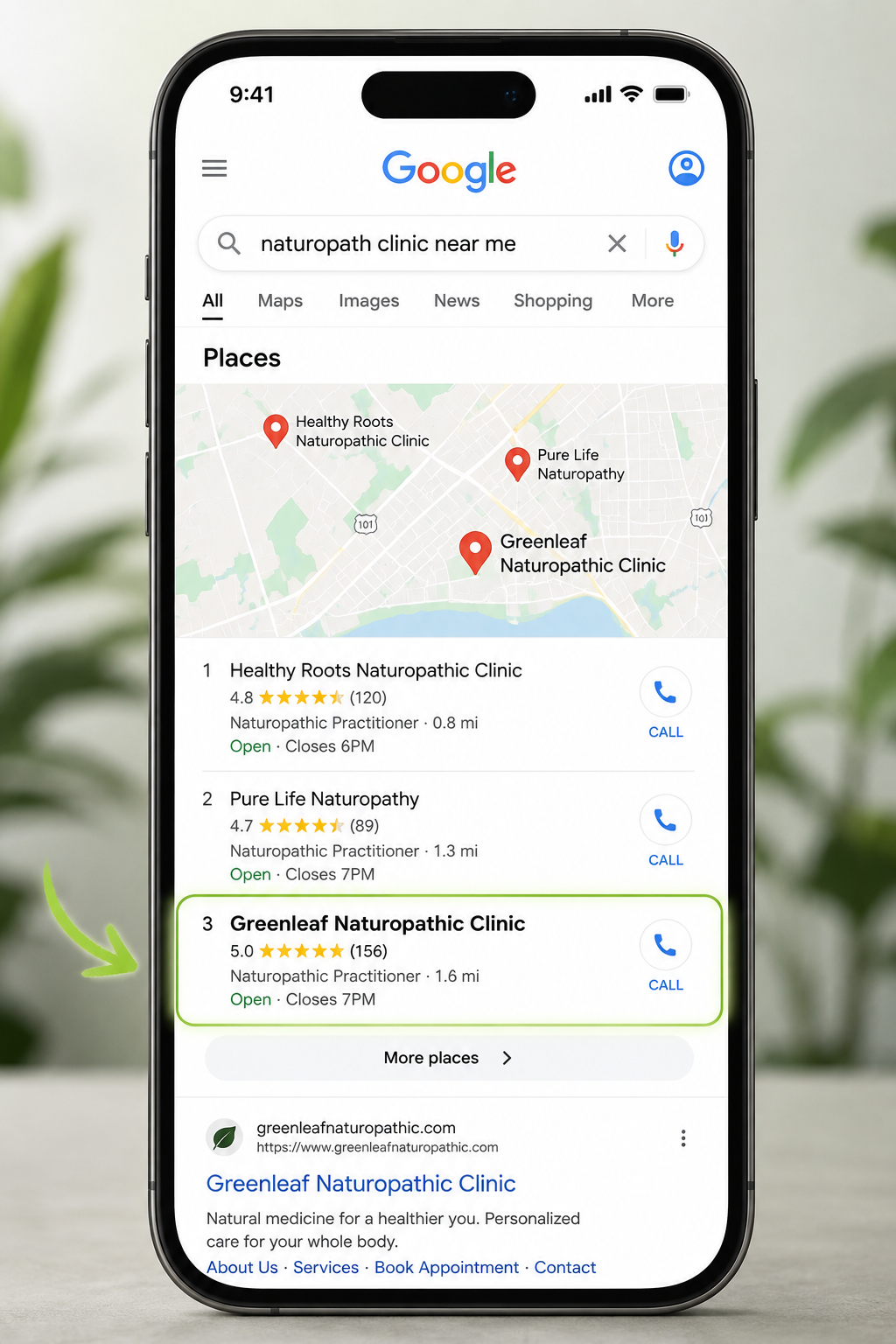
Ranking on page one is usually treated as the goal.
But when we reviewed six months of Google Search Console data from a multi-service wellness clinic, one service line showed why rankings alone can be misleading.
The clinic was already appearing on page one for several hormone-related searches. In some cases, it was ranking inside the top 3 to top 10 positions.
Yet the click-through rates were extremely low. That means Google was showing the clinic to the right audience, but searchers were often choosing another result.
The Dataset
We analyzed Google Search Console performance from March 13 to September 10, 2026. Across the site:
- 176,841 impressions
- 2,922 clicks
- 1.65% average CTR
- 16.75 average position
For this article, we focused specifically on hormone-related searches and the clinic's hormone replacement therapy page.
This is one clinic's dataset. It should not be treated as an industry benchmark.
The Hormone Therapy Page Had Visibility, but Very Few Clicks
The clinic's hormone replacement therapy page generated:
- 4,791 impressions
- 5 clicks
- 0.10% CTR
- 18.18 average position
At first glance, the average position makes the weak click volume seem unsurprising. But the individual queries tell a more interesting story. Several hormone-related searches ranked much higher.
Some Hormone Queries Were Already Ranking on Page One
Here are several examples from Search Console:
| Query | Impressions | Clicks | CTR | Avg. Position |
|---|---|---|---|---|
| hormone replacement therapy | 555 | 3 | 0.54% | 2.94 |
| hormone replacement therapy chandler | 789 | 1 | 0.13% | 9.36 |
| hormone therapy near me | 194 | 1 | 0.52% | 6.53 |
| bioidentical hormone replacement therapy | 26 | 1 | 3.85% | 3.69 |
| hormone therapy | 70 | 1 | 1.43% | 10.50 |
The standout query is "hormone replacement therapy." The clinic appeared at an average position of approximately 2.94 — effectively a top-three organic ranking.
Yet from 555 impressions, it received only 3 clicks, for a CTR of 0.54%.
That is the core finding.
Ranking High Did Not Guarantee Traffic
This is the mistake many clinics make when evaluating SEO. They ask: "What position are we ranking?" But a better question is: "Are people actually clicking us when we appear?"
For this clinic, the answer was often no. The website was visible. Google clearly considered the site relevant enough to rank it prominently. But visibility alone was not enough to earn the click.
The Local Hormone Query Was Even More Striking
The clinic also appeared for "hormone replacement therapy chandler." This is a much more commercially relevant search because it combines the treatment with the clinic's local market.
Search Console recorded 789 impressions, an average position of 9.36, 1 click, and a CTR of 0.13%.
The clinic was already on page one for hundreds of local searches. But almost none of those impressions turned into traffic. That is a very different SEO problem from not ranking at all.
This Changes What We Would Optimize
If the clinic were ranking on page three, the priority would be straightforward: improve rankings.
But when a page is already showing in positions 3 to 9 and still receives almost no clicks, the problem may be elsewhere. Potential causes include:
- Weak title tags
- Unclear positioning
- Generic meta descriptions
- Competitors with stronger trust signals
- Better-known brands in the SERP
- More compelling local language
- Search results featuring maps, ads or other SERP features
- A mismatch between the searcher's intent and the snippet
- Limited differentiation from other hormone clinics
Search Console cannot tell us which one of these is responsible. But it does tell us where to investigate.
The Page May Be Ranking Without Winning the Comparison
Searchers do not view a ranking in isolation. They see a page of competing options. For a query like "hormone replacement therapy chandler," the clinic may be competing against hormone clinics, functional medicine practices, women's health clinics, men's health providers, medical spas, national directories, local map results, and paid ads.
A position of 6, 7 or 9 can technically be page one while still receiving very little attention. Even a top-three ranking can underperform if the result does not look trustworthy or relevant enough.
This Is Why CTR Deserves More Attention in Healthcare SEO
Clinic owners often focus heavily on rankings because rankings are easy to understand. But CTR is what connects visibility to traffic.
A page can generate thousands of impressions and still produce almost no visits. The hormone replacement page is a good example — 4,791 impressions but only 5 clicks. That means the page was appearing regularly, but the result was not translating into traffic. From a business perspective, that matters more than the ranking screenshot.
There May Be a Messaging Problem, Not an Authority Problem
One of the most useful interpretations from this dataset is that the clinic had already earned some degree of Google's trust. Google was willing to show the site for valuable hormone-related searches.
The next question becomes: why are patients not choosing it? That points toward SERP presentation and page positioning.
For example, a result titled around broad hormone therapy may be less compelling than one that clearly communicates bioidentical hormone therapy, the local market, physician-led care, women's or men's hormone care, perimenopause or menopause expertise, or personalized treatment.
The exact answer would require reviewing the live SERP and metadata, but the Search Console data tells us where the opportunity is.
A Page-One Ranking Can Still Be an Underperforming Asset
This is the broader lesson. SEO success should not be measured only by "we rank on page one." A stronger framework is: Are we appearing? Are we ranking competitively? Are searchers clicking? Are those visitors converting?
This clinic had already made progress on the first two steps for several hormone queries. The weakness was between visibility and traffic. That makes CTR optimization potentially more valuable than simply creating more hormone-related content.
What We Would Test First
For a page showing this pattern, we would start with the search result itself. That means reviewing:
- Title tag
- Meta description
- Local modifiers
- Service naming
- Trust language
- Practitioner credentials
- Search intent alignment
- Competing SERP snippets
We would also compare the page with other service lines that are getting stronger CTR from similar rankings. The objective would be simple: turn existing visibility into more qualified clicks before chasing more impressions.
The Takeaway
This wellness clinic was already ranking on page one for several hormone-related searches. One major query averaged position 2.94. Another local service query averaged 9.36. Yet CTR remained extremely low.
For "hormone replacement therapy," the site received only 3 clicks from 555 impressions. For "hormone replacement therapy chandler," it received 1 click from 789 impressions.
The lesson is simple: ranking is not the same as getting traffic. A clinic can earn page-one visibility and still lose most of the available clicks.
For healthcare SEO, the next opportunity is often not just improving position. It is improving the reason a patient chooses your result.
At Wellness Practice Marketing, we use Search Console data like this to identify where clinics already have visibility but are failing to turn that visibility into traffic and patient enquiries. WPM specializes in SEO for functional and integrative medicine practices.