
When clinics run Google Ads across multiple services, it is easy to assume each service deserves a similar share of the budget.
Our data suggests that can be a costly mistake.
We analyzed six months of Google Ads performance from a multi-service wellness clinic in Arizona. The clinic was advertising three primary service lines:
- Naturopathic medicine
- Medical weight loss
- Hormone replacement therapy
The interesting part was not the budget.
Each campaign spent almost the same amount.
The interesting part was what happened after that money was spent.
The Dataset
We analyzed Google Ads data from March 13 to September 12, 2026.
Across the account:
- Ad spend: $10,922.04
- Impressions: 78,715
- Clicks: 3,704
- Primary tracked conversions: 226
Google Ads counted several actions as primary conversions, including appointment-button clicks, calls, form submissions and text-message clicks.
That distinction matters.
These are tracked conversion actions, not confirmed new patients.
Three Campaigns, Almost Identical Spend
The clinic spent roughly one-third of its advertising budget on each service.
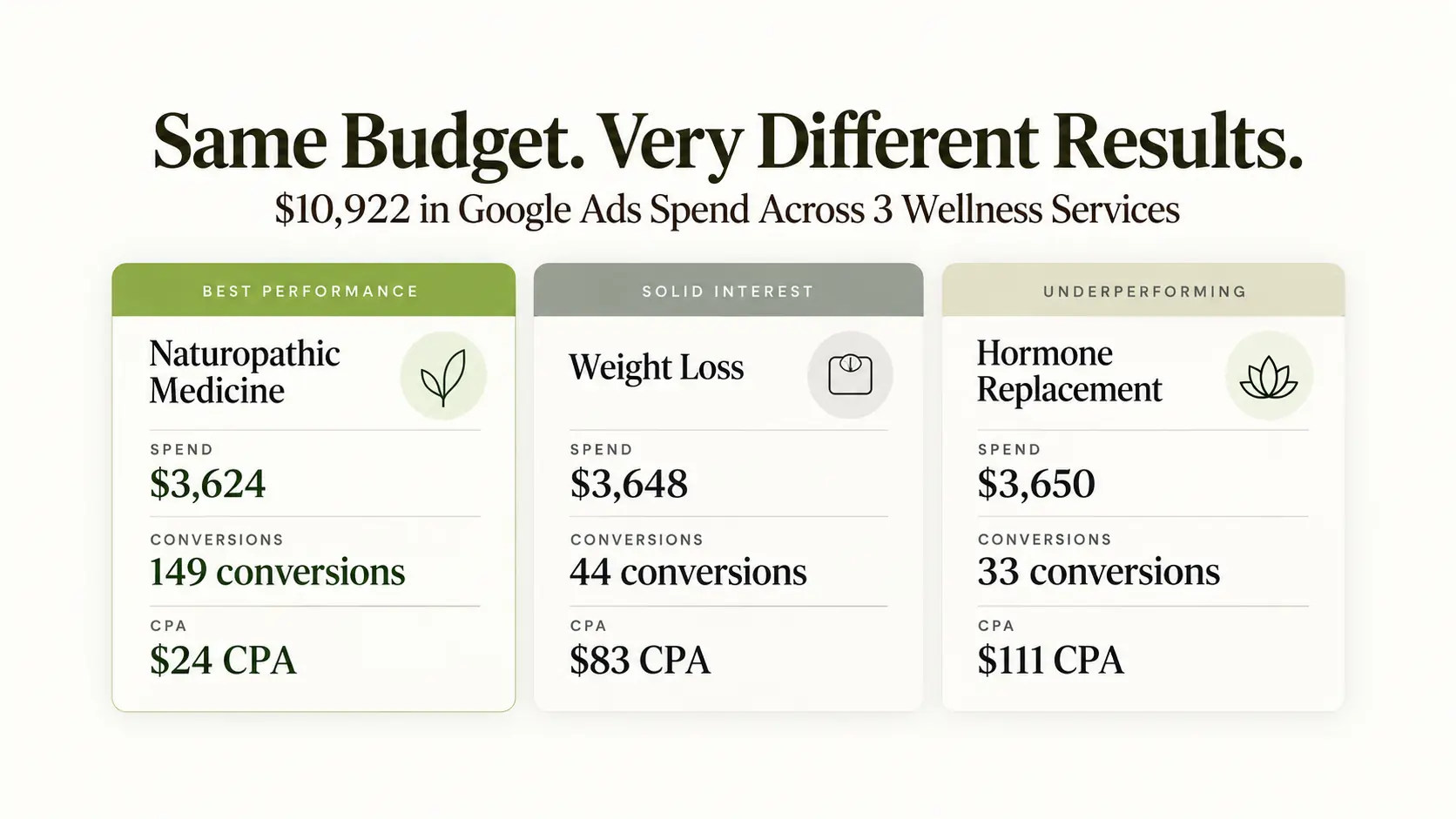
| Service | Spend | Primary Conversions | Cost per Conversion |
|---|---|---|---|
| Naturopathic medicine | $3,624.43 | 149 | $24.33 |
| Medical weight loss | $3,647.64 | 44 | $82.90 |
| Hormone replacement | $3,649.98 | 33 | $110.61 |
The spend difference between the highest- and lowest-spending campaign was only about $26.
The conversion difference was much larger.
Naturopathic medicine produced 149 tracked conversions.
Weight loss produced 44.
Hormone replacement produced 33.
In other words, naturopathic medicine generated approximately 66% of all primary conversions while consuming only about 33% of total ad spend.
The Cheapest Service Generated Conversions 4.5x More Efficiently
The difference becomes even clearer when we look at CPA.
Naturopathic medicine: $24.33 per tracked conversion
Weight loss: $82.90 per tracked conversion
Hormone replacement: $110.61 per tracked conversion
Hormone replacement therefore cost approximately 4.5 times more per conversion than naturopathic medicine.
And this was not a comparison between different clinics, cities or advertising platforms.
The campaigns operated inside the same clinic account, during the same six-month period, in the same local market.
That makes the difference difficult to explain with budget alone.
Why Equal Budgets Did Not Produce Equal Results
The data does not prove one single cause.
Several factors can influence campaign performance:
- Search demand
- Competition
- Cost per click
- Search intent
- Keyword selection
- Landing-page relevance
- Offer positioning
- Patient urgency
- Match types
- Conversion tracking
- Campaign structure
What the dataset does show clearly is that service lines did not have equal advertising economics.
Allocating equal budgets did not produce equal results.
Search Intent Appears to Matter
The keyword data helps explain part of the difference.
One of the strongest naturopathic keywords was "naturopathic doctors near me". It generated:
- $1,224 in spend
- 57.5 tracked conversions
- $21.29 CPA
Compare that with one of the largest weight-loss keywords, "weight loss clinics near me". It generated:
- $1,901 in spend
- 16.9 tracked conversions
- $112.38 CPA
The naturopathic keyword produced tracked conversions at less than one-fifth of the CPA.
Again, this does not mean "naturopathic" keywords will always outperform weight-loss terms.
It means they did in this account, during this period.
That is exactly why service-level performance should be measured rather than assumed.
Broader Keywords Were Not Always the Winners
Some of the more expensive terms also showed weaker economics.
For hormone replacement, the phrase-match keyword "hormone therapy replacement" spent approximately $2,017 and generated 11 conversions for a CPA of approximately $183.
Meanwhile, more specific terms performed better. For example, "hormone clinic for women" produced a CPA of approximately $40.76.
The same pattern appeared in weight loss. The broad keyword "weight loss clinics near me" generated conversions at approximately $112 CPA, while the more specific phrase "medical weight loss near me" generated three tracked conversions at approximately $19.76 CPA.
The sample for the latter is much smaller, so it should not be treated as proof that phrase match is universally better.
But it is enough to justify reallocating attention toward the terms producing the strongest results.
Equal Budget Allocation Can Hide Strong and Weak Service Lines
This is the main lesson from the account.
If we only looked at spend, the three campaigns appeared balanced.
If we looked at conversions, they were anything but balanced.
Naturopathic medicine was generating most of the tracked results.
Hormone replacement was consuming nearly the same amount of money for far fewer conversions.
That creates an obvious strategic question: should the campaigns continue receiving equal budgets?
Not necessarily.
A clinic may still choose to support a less efficient service because:
- margins are higher
- patient lifetime value is higher
- capacity is available
- it is strategically important
- the service has stronger downstream revenue
- the current campaign still has optimization potential
But the decision should be intentional.
Budget allocation should follow business economics and measured demand, not symmetry.
Conversion Volume Is Not the Same as Patient Value
There is another important limitation in this dataset.
The 226 primary conversions included:
- 134 appointment-button clicks
- 35 calls from ads
- 21 form submissions
- 20 text-message button clicks
- 16 calls from the website
An appointment-button click does not necessarily mean a completed appointment.
A phone call does not necessarily mean a new patient.
For that reason, we would not use this dataset to claim that naturopathic medicine acquired patients for $24.
The accurate statement is: naturopathic medicine generated tracked Google Ads conversion actions at a $24.33 CPA.
To calculate true cost per booked consultation or cost per acquired patient, Google Ads would need to be connected to booking and CRM outcomes.
What Clinic Owners Can Learn From This
The biggest mistake would be to copy these numbers and assume naturopathic medicine will always outperform weight loss or hormone therapy.
That is not what this dataset shows.
The lesson is broader.
If your clinic advertises multiple services, measure them separately.
Do not assume:
- each service deserves the same budget
- each service has the same level of demand
- each conversion has the same value
- each keyword deserves continued spend
- every campaign should be optimized toward the same target CPA
Your strongest growth opportunity may already be visible inside your account.
You may simply be spreading budget too evenly to notice it.
The Takeaway
Across six months and $10,922 in Google Ads spend, this clinic allocated almost the same budget to three wellness services.
The results were dramatically different.
Naturopathic medicine generated approximately 66% of tracked primary conversions from approximately 33% of total spend, at a CPA of $24.33, compared with $82.90 for weight loss and $110.61 for hormone replacement.
The lesson is not that every clinic should move its budget into naturopathic medicine.
The lesson is that service-line economics should determine budget allocation, not an assumption that every service deserves an equal share.
At Wellness Practice Marketing, we use service-level Google Ads data like this to identify where clinics are getting the strongest return, where spend is being wasted and where campaigns deserve more investment.
If you want us to analyze how your clinic's Google Ads performance compares across services, WPM specializes in search marketing for functional, integrative and wellness practices.