
Google Ads can be one of the fastest ways for a weight loss clinic to generate consultation requests — but it's also one of the easiest healthcare advertising channels to get wrong.
Many medical weight loss clinics launch campaigns expecting immediate appointments, only to discover that ads are disapproved, traffic is expensive, or visitors click through without booking. The issue usually isn't Google Ads itself. It's campaign structure, landing page quality, conversion tracking, or healthcare advertising compliance.
Weight loss is a closely scrutinized advertising category because it often involves health claims, prescription medications, supplements, or sensitive personal topics. Google has specific Healthcare and Medicines policies that determine what advertisers can promote and how they can describe services — understanding those rules before launching saves time and reduces disapprovals.
This guide explains how Google Ads for weight loss clinics works in 2026: what services clinics can generally advertise, what commonly triggers policy issues, and how to build campaigns focused on qualified consultation requests instead of low-quality clicks — whether you operate a physician-supervised medical weight loss clinic, a functional medicine practice, or an integrative wellness clinic offering weight management programs.
Can Weight Loss Clinics Advertise on Google Ads?
Yes. Weight loss clinics can advertise on Google Ads, but campaigns must comply with Google's healthcare, medicines, and misleading claims policies. Many clinics can advertise consultation services, nutrition counseling, physician-supervised weight management programs, and wellness assessments, while some medication-related advertising has additional eligibility requirements.
The important distinction is between advertising a healthcare service and advertising a restricted medical product or making prohibited claims. A compliant campaign typically promotes a consultation, evaluation, or treatment program rather than promising dramatic results — helping patients schedule an appointment to learn whether a clinic's program is appropriate for them.
For example, an ad promoting a "Medical Weight Loss Consultation in Austin" is fundamentally different from one promising "Lose 25 Pounds in 30 Days." The first describes a healthcare service. The second makes a specific outcome claim that may create compliance problems.
Why Google reviews weight loss ads more carefully
Google treats health-related advertising differently because users rely on it for important decisions. Campaigns are reviewed for editorial quality and policy compliance — ad copy, headlines, landing page content, images, service claims, medication references, and geographic eligibility. Knowing these requirements up front reduces repeated disapprovals.
Understanding Google's Healthcare and Weight Loss Advertising Policies
These policies aren't designed to stop legitimate clinics from advertising — they exist to protect users from misleading health information and to regulate restricted products and services.
For the reusable certification, sensitive-targeting, destination and appeal workflow, read our current guide to Google Ads healthcare policy for clinics.
Healthcare and Medicines Policy
Google has dedicated policies covering healthcare products, medical services, and prescription medications — and different weight loss services fall into different policy categories. Review the Healthcare and Medicines Policy whenever a campaign involves medications or regulated treatments.
Weight loss advertising restrictions
Google generally allows clinics to advertise weight management services, but ads must avoid misleading or exaggerated claims: unrealistic timelines, guaranteed outcomes, or implications that everyone achieves identical results. Safer messaging focuses on consultations, individualized treatment plans, physician supervision, lifestyle support, or nutritional guidance.
Prescription medication restrictions
Many weight loss clinics now discuss GLP-1 medications as part of physician-supervised programs. Advertising prescription medications is significantly more restricted than advertising consultations. Rather than promoting specific medications directly, many compliant campaigns advertise consultations where patients can discuss treatment options with an eligible healthcare provider. Eligibility varies by advertiser, country, certification status, and Google's policies.
What Google generally evaluates
| Area Google reviews | Why it matters |
|---|---|
| Health claims | Claims must not be misleading or exaggerated. |
| Prescription medication references | Some medication advertising requires additional eligibility. |
| Landing page content | The landing page should accurately describe the advertised service. |
| Images and testimonials | Visuals and testimonials should not imply guaranteed outcomes. |
| Clinic transparency | Users should understand who provides the service and how to book. |
What Weight Loss Clinics Can Advertise
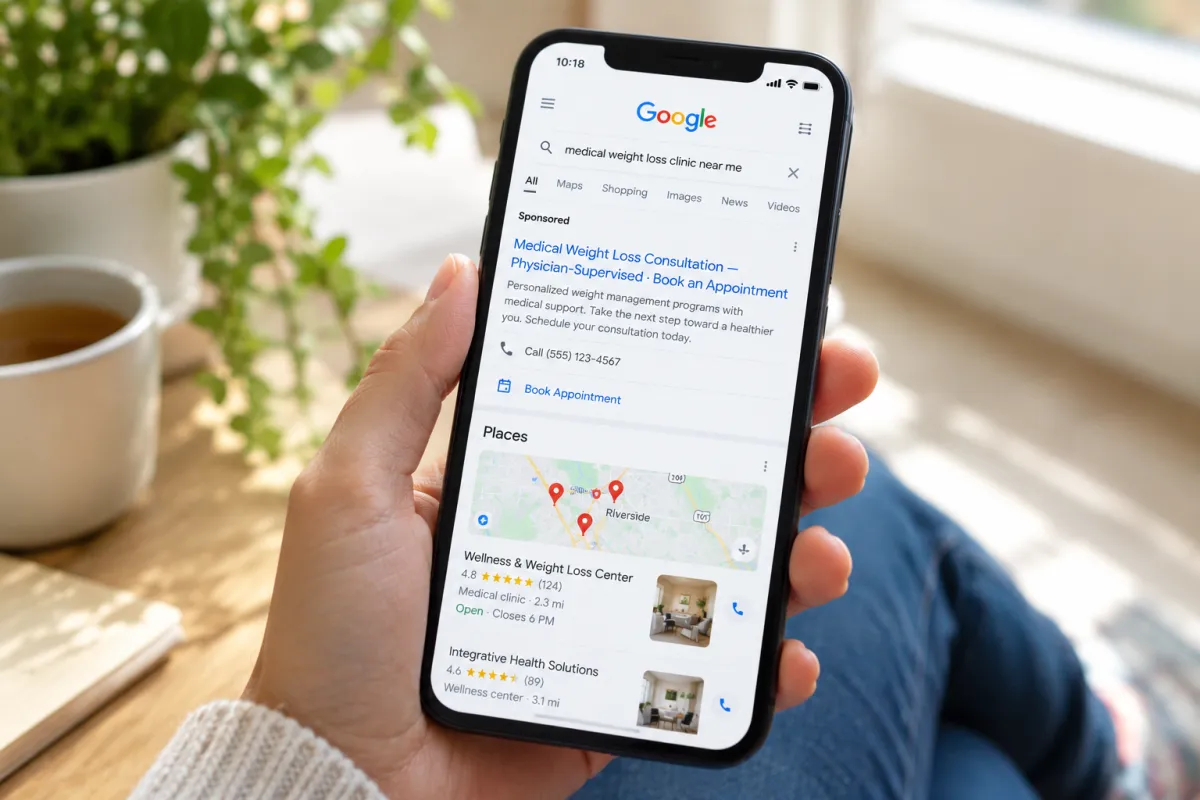
The safest campaigns advertise healthcare services — not unrealistic outcomes. Consultations work well because they're the natural next step: patients searching for help usually want an evaluation, not an immediate purchase.
Services that are generally appropriate to advertise
| Service | Advertising consideration |
|---|---|
| Medical weight loss consultation | Generally appropriate when described accurately. |
| Nutrition counseling | Generally appropriate for licensed providers and wellness clinics. |
| Physician-supervised weight management | Generally appropriate when accurately represented. |
| Wellness assessment | Often appropriate as an introductory consultation. |
| Lifestyle coaching | Generally appropriate when claims remain realistic. |
| Follow-up consultation booking | Useful for remarketing and existing patients. |
Focus ads on consultations — not transformations
Instead of advertising dramatic outcomes, advertise what patients receive during their first appointment: an individualized evaluation, provider consultation, nutrition assessment, program discussion, and a personalized wellness plan. This aligns with healthcare advertising expectations while attracting patients genuinely looking for care.
Keep your landing page aligned
The landing page should match the ad. If the ad promotes a physician-supervised consultation, the page should explain who provides consultations, what happens during the visit, how patients request appointments, and what areas the clinic serves. Consistency matters for both user experience and ad quality.
What Weight Loss Clinics Should Avoid Advertising
Many campaign problems originate from messaging rather than targeting.
- Guaranteed results: never promise specific outcomes, pounds lost, timelines, or permanent results. Describe services, provider expertise, or consultation availability instead.
- Before-and-after imagery: transformation imagery is frequently associated with misleading advertising. Use professional clinic photography, provider portraits, and educational visuals instead.
- Unsupported medical claims: don't imply your clinic can cure obesity or guarantee results for every patient — explain that treatment plans are individualized and begin with an evaluation.
- Implying medications are available to everyone: invite patients to discuss options with an eligible healthcare provider instead of promoting prescriptions directly.
- Sensational headlines: headlines designed purely to attract clicks often create policy issues. Focus headlines on services and location.
Best Google Ads Campaign Types for Weight Loss Clinics

Not every campaign type serves the same purpose. Weight loss clinics usually benefit from a combination matching different stages of patient intent.
Search campaigns: best for high-intent patients
Search campaigns are typically the foundation. They appear when someone actively searches phrases like "medical weight loss clinic near me", "weight loss consultation", "physician supervised weight loss", or "functional medicine weight loss clinic" — users who already have intent. Benefits include local targeting, high-intent searches, easier keyword control, and better alignment with consultation landing pages. For many clinics, Search is the first paid channel worth building after the website and Google Business Profile are optimized.
Performance Max: useful after your foundation is built
Performance Max distributes ads across Search, Maps, Display, YouTube, Gmail, and Discover. It can work well once conversion tracking is reliable, landing pages perform, and the clinic has sufficient conversion data — but it's generally not the best starting point for a brand-new advertiser with no tracking history.
Brand campaigns protect your clinic's name
Patients often search for a clinic after seeing reviews or hearing referrals. Brand campaigns ensure your clinic appears prominently for searches of your business name, provider names, or branded services — usually inexpensively, while preventing competitors from occupying branded searches.
Local campaign considerations
Weight loss clinics typically serve patients within a geographic radius. Structure campaigns around real service areas rather than entire states — local targeting improves relevance and focuses budget on patients who can realistically visit.
The Best Keywords for Weight Loss Clinics
Keywords determine who sees your ads. Choosing by patient intent produces better consultation quality than targeting broad wellness searches.
Start with high-intent keywords (consultations, clinics, physicians, evaluations, nearby providers), add location keywords ("medical weight loss clinic in Dallas", "weight loss consultation Austin"), and give each service its own keyword group — hormone-related weight management, physician-supervised weight loss, nutrition consultation, metabolic health consultation. Then add negative keywords for free resources, jobs, DIY programs, recipes, supplements, and unrelated fitness content to protect your budget.
Organize keywords by intent
| Intent group | Example searches |
|---|---|
| Consultation intent | "Medical weight loss consultation near me." |
| Clinic intent | "Weight loss clinic in [city]." |
| Provider intent | "Weight loss doctor near me." |
| Program intent | "Physician-supervised weight management." |
| Educational searches | Usually better suited for SEO content than Google Ads. |
For the broader paid-search framework, see our guide to PPC advertising for wellness practices.
Build Landing Pages That Convert Consultations
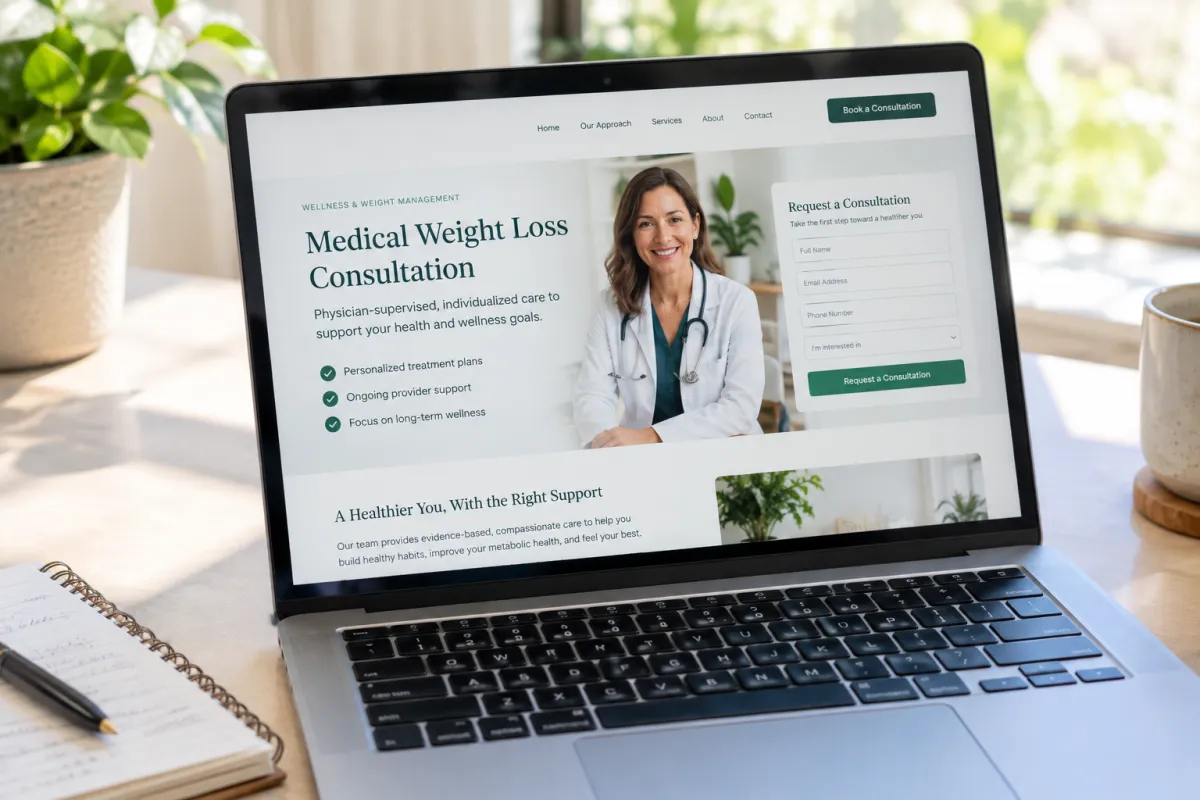
A Google Ads campaign is only as effective as the page it sends visitors to. Many clinics send paid traffic to the homepage, forcing visitors to navigate menus before finding the booking form — dedicated landing pages reduce friction and keep visitors focused on a single action.
Give every campaign its own landing page: a consultation campaign leads to a consultation page, a hormone-related weight management campaign to a hormone-focused page. Include trust signals naturally — provider credentials, clinic information, patient-focused FAQs, professional photography — and keep one primary consultation call-to-action throughout.
Landing page checklist: clear consultation headline · short program explanation · provider introduction · FAQs · consultation booking form · contact information · mobile-friendly design.
See our landing page optimization service for what a conversion-ready page looks like.
Conversion Tracking Every Weight Loss Clinic Needs
Running Google Ads without conversion tracking is like advertising with no way to measure results.
- Track consultation forms: every request should count as a conversion so Google learns which searches lead to meaningful actions.
- Track phone calls: many patients call instead of completing forms.
- Track appointment requests: measure online booking submissions separately from page visits.
- Connect Google Ads with Analytics: evaluate landing page engagement and conversion paths, not just clicks.
- Consider CRM attribution: knowing whether leads came from Google Ads, Maps, SEO, or email improves future budget decisions.
Local Targeting Strategies for Weight Loss Clinics
Most weight loss clinics don't need nationwide advertising. Target realistic service areas — cities, ZIP codes, neighborhoods, or travel radiuses patients will actually cross. Multi-location clinics should build separate campaigns per office, each with its own landing page and budget, and exclude areas outside the service radius to reduce wasted spend.
Finally, align Google Ads with your Google Business Profile: patients frequently click ads and then verify reviews on Google Maps, so a complete, optimized profile supports credibility during the decision — if yours isn't appearing, start with our guide on why your clinic isn't showing up on Google Maps.
The Biggest Google Ads Mistakes Weight Loss Clinics Make
- Sending traffic to the homepage — visitors have to hunt for information, reducing consultation requests.
- Ignoring conversion tracking — clicks alone don't measure success.
- Using overly broad keywords — broad searches attract researchers instead of consultations.
- Ignoring policy compliance — disapprovals usually stem from claims or landing page content, not campaign settings.
- Weak landing pages — a good ad cannot compensate for a confusing booking experience.
A Simple Google Ads Funnel for Weight Loss Clinics
Successful campaigns follow a patient journey instead of treating ads as an isolated tactic.
| Stage | Goal |
|---|---|
| Google Search | Patient searches for a local weight loss clinic. |
| Google Ad | Ad matches the patient's search intent. |
| Landing page | Patient learns about consultations and requests an appointment. |
| Follow-up | Email or SMS confirms the consultation request. |
| Consultation | Clinic evaluates whether the patient is an appropriate fit. |
| Retention | Ongoing communication supports long-term patient relationships. |
This funnel works best when Google Ads, landing pages, email marketing, and conversion tracking operate together instead of independently.
Google Ads Checklist Before Launching a Weight Loss Campaign
- Define one campaign objective (consultation requests).
- Build a dedicated landing page for each service.
- Use location-specific keyword groups.
- Add negative keywords to reduce irrelevant searches.
- Install consultation form conversion tracking.
- Track phone calls separately.
- Review ad copy for healthcare policy compliance.
- Add call, location, and sitelink extensions.
- Verify your Google Business Profile is complete.
- Test the mobile booking experience before launching.
This checklist prevents many of the problems clinics encounter during their first campaigns — and if you're unsure how much to invest, our marketing budget guide covers how to size ad spend by stage of growth.
Frequently Asked Questions
Can weight loss clinics advertise on Google Ads?
Yes. Clinics can generally advertise consultation services, physician-supervised weight management, nutrition counseling, and wellness evaluations, provided their ads and landing pages comply with Google's healthcare advertising policies.
Why was my Google Ads campaign disapproved?
Common reasons include misleading weight loss claims, prohibited language, restricted medication references, editorial issues, or landing page content that doesn't match Google's healthcare policies.
Can I advertise GLP-1 weight loss services?
Google has additional restrictions around prescription medication advertising. Many clinics advertise consultations rather than directly promoting prescription medications, depending on eligibility and applicable healthcare advertising policies.
Should I use Search or Performance Max campaigns?
Search campaigns are often the best starting point because they target patients actively searching for weight loss services. Performance Max can become useful after reliable conversion tracking is established.
What keywords work best for weight loss clinics?
Keywords with clear consultation intent and local intent — such as searches for nearby medical weight loss consultations or physician-supervised weight management — typically align better with patient acquisition goals than broad informational searches.
How do I track consultation requests?
Track consultation forms, phone calls, online appointment requests, and CRM attribution so you understand which campaigns generate qualified inquiries.
How much should a weight loss clinic spend on Google Ads?
There is no universal budget. Your budget should reflect your clinic's goals, geographic market, capacity for new patients, and whether your website and conversion tracking are ready to support paid advertising.
Final Thoughts: Build Google Ads Around Compliance and Consultations
Google Ads can become a powerful patient acquisition channel for medical weight loss clinics, but only when campaigns are built around realistic patient intent and healthcare compliance.
The clinics that consistently generate qualified consultation requests have several fundamentals working together: compliant ad copy, local keyword targeting, dedicated landing pages, an optimized Google Business Profile, and accurate conversion tracking. Rather than advertising every service and treatment option, they guide patients toward the next appropriate step — a consultation with a qualified provider.
If your campaigns are generating clicks but few bookings, or you've experienced healthcare-policy disapprovals, the issue is often in campaign structure rather than budget. Before increasing ad spend, audit the entire patient acquisition funnel — from keywords and ad copy to landing pages, Google Business Profile optimization, and conversion tracking.