
The short answer
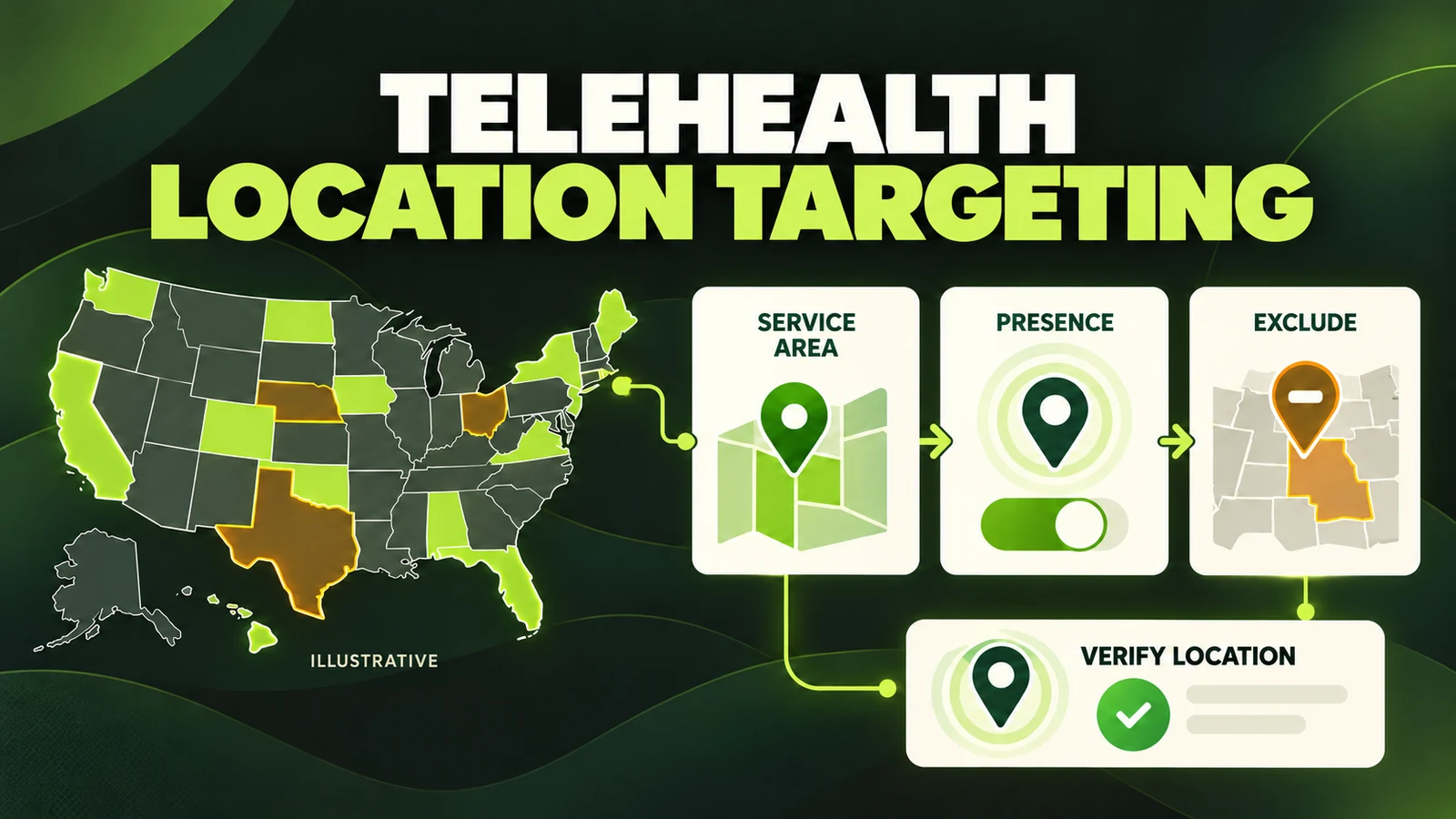
A telehealth clinic should target only locations it is currently approved to serve, select Google’s Presence option when physical location matters, exclude ineligible areas where necessary and verify the patient’s actual location during intake. Ad targeting is a budget-control layer, not proof of clinical eligibility.
The strongest setup starts outside Google Ads. Clinical and legal leadership maintains the service-area list; marketing translates that list into campaign settings and landing-page language; intake confirms the person’s current location before care proceeds.
Not legal advice: telehealth licensure, registration, prescribing, consent and professional rules vary by profession and jurisdiction. Have qualified counsel and the relevant licensing boards approve the actual service area and workflow.
1. Build an approved service-area matrix
Do not ask the media buyer to infer where a clinician may practice. HHS explains that cross-state telehealth can involve full licenses, temporary practice laws, reciprocity, compacts or telehealth registration, with requirements varying by state. It also advises providers to verify patient location before an appointment.
Create one controlled source of truth with:
- the state or country;
- the eligible clinician and profession;
- services that may be delivered there;
- license, compact or registration basis;
- effective and renewal dates;
- advertising status: active, paused or excluded; and
- the person responsible for approving changes.
A license may cover one provider but not another, or one service but not a prescribing workflow. The campaign map must follow the narrowest approved operational scope. When status changes, update advertising, landing pages, schedulers and intake scripts together.
2. Change “Presence or Interest” when location is a hard limit
Google’s default positive location option includes people likely to be in or regularly in the target area and people who have shown interest in that area. Interest can be inferred from searches, prior presence or location-related content. That broad option may reach someone outside the state who searches for a provider in it.
Google provides a narrower option: Presence: people in or regularly in your targeted locations. Google specifically says Presence should be considered when a business is in a sensitive vertical with strict targeting limitations or wants only people in specific locations.
| Option | Who may be reached | Telehealth implication |
|---|---|---|
| Presence or Interest | People in, regularly in or interested in the target | Can include people physically outside the approved service area |
| Presence | People likely to be in or regularly in the target | Better aligns ad delivery with a location-limited service area |
Presence still is not a guarantee. Google says it uses signals from settings, devices and platform behavior and cannot promise 100% accuracy. Keep the intake check even after selecting the narrower option.
3. Choose states, countries or radius targets deliberately
State or regional targeting
For a U.S. multi-state telehealth clinic, explicit state targets are usually the cleanest translation of a state eligibility matrix. Add only approved states, verify similarly named locations and review the map before saving. Other countries may expose different target types.
Country targeting
Use a whole country only when the clinic can truly serve the intended population across that country and has reviewed the relevant national and subnational rules. Targeting an entire country and relying on a long exclusion list creates more opportunities for a missed or outdated setting.
Radius targeting
A radius can support a hybrid clinic seeking patients near a physical office, but it does not follow state borders. Google also applies minimum privacy thresholds and does not permit radii under one kilometer. Never treat the radius boundary as a legal service boundary.
If patients can be seen anywhere in an approved state, a tight office radius may unnecessarily suppress demand. If the service requires occasional in-person visits, explain that operational boundary on the landing page instead of assuming “telehealth” means nationwide availability.
4. Exclude areas the clinic cannot serve
Google allows individual and bulk location exclusions. Exclusions take priority when an area is both included and excluded. They are useful when a large approved region contains a smaller ineligible area, or when a temporary operational restriction must be enforced while the positive targets remain intact.
For most state-limited clinics, targeting only eligible states is clearer than targeting the entire country and excluding every other state. Use exclusions as defense in depth, not as a substitute for a precise inclusion list.
Example structure: target three approved states with Presence selected. Exclude a specific ineligible region only if it sits inside one of those targets. Do not add nationwide targeting merely to create more impressions.
After a change, confirm the saved campaign settings rather than trusting the draft or bulk-upload file. Google notes that exclusion does not define geographic borders and location detection remains best effort.
5. Decide whether states share a campaign
One campaign can serve several approved states when the offer, clinician availability, economics, language and landing-page experience are essentially the same. This concentrates conversion data and simplifies bidding.
Separate campaigns when a state requires a distinct budget, provider, service, schedule, message or landing page. Separation can also help when search demand and cost differ enough to justify independent decisions. Avoid one campaign per state by habit when each campaign would receive too little data.
Shared campaign
Same service, provider eligibility, patient value, messaging and capacity across the approved states.
Separate campaign
Different legal scope, clinician, budget, language, pricing, landing page or operational capacity.
Ad text may name an approved region when it improves clarity, but the destination must match. A “Telehealth in Colorado” ad should not land on a page that claims nationwide care. Our guide to marketing a multi-state telehealth functional medicine practice covers the broader offer and trust strategy.
6. Set up the campaign step by step
- Approve the matrix: obtain the current service-area list from the clinic’s authorized clinical or legal owner.
- Open Locations: in Google Ads, select the campaign and open its location settings.
- Add exact targets: search for each approved state, region or country and review the matching result.
- Choose Presence: open Location options and select people in or regularly in the targeted locations.
- Add necessary exclusions: use individual or bulk exclusions only where they reduce a real gap.
- Align the destination: state who the service is for, where it is available and whether an in-person component exists.
- Test the form and calls: ensure staff can capture current location and route ineligible inquiries appropriately.
- Document the change: record the approved matrix version, campaign, editor and date.
Interface labels can change, so use Google’s current location-targeting documentation when implementing. Also check other settings that can widen reach, including campaign type, language and network selection.
7. Verify location after the click
Google Ads cannot replace patient-location verification. Add a required, accessible form field asking where the person will be located at the time of care. On calls, use a neutral script such as: “Which state will you be physically located in for the appointment?”
Do not infer eligibility from a phone area code, mailing address or the state named in the search. People travel, retain old numbers and search for family members. Confirm the current location at the point the clinic’s approved workflow requires, and provide a respectful alternative when the service is unavailable there.
Keep sensitive clinical details out of advertising parameters. Location reporting can remain at the campaign or regional level; patient records and eligibility decisions belong in the clinic’s approved systems.
8. Keep paid targeting separate from local SEO
Google Ads can target approved states without creating a physical office in each one. Local organic visibility is different. Do not create virtual offices, false addresses or unsupported local claims to imitate a multi-location practice.
Use real practice information, legitimate service-area language and useful state-specific pages only when the content materially differs. Our functional medicine local SEO guide explains how physical location, Google Business Profile and local pages fit together.
9. Run a monthly location audit
- Compare active targets with the approved license and registration matrix.
- Confirm Presence remains selected after copying or rebuilding campaigns.
- Review location reports for spend and conversions outside the intended service pattern.
- Check exclusions for conflicts and expired temporary restrictions.
- Reconcile lead location with qualified and acquired-patient outcomes.
- Test state messaging, landing pages, forms and scheduler routing.
- Record license renewals, provider changes and new state approvals before advertising them.
A click outside the expected area is a reason to investigate, not proof that Google ignored the setting. Review how Google classified the location, which campaign served the ad, the positive option, exclusions and the patient’s verified location.
Frequently asked questions
Should telehealth clinics use Presence or Presence or Interest?
When service availability depends on physical location, evaluate the narrower Presence option. The default Presence or Interest setting can include people outside the target who have shown interest in it.
Does Google guarantee the patient is in the targeted state?
No. Google describes location targeting as a best-effort system based on multiple signals. Verify current patient location in the clinic’s intake and care workflow.
Should we target the United States and exclude unlicensed states?
Usually, target only approved states. A nationwide target plus a long exclusion list is harder to maintain and easier to misconfigure.
Can we use radius targeting for telehealth?
Yes, when a local radius reflects a hybrid operational area. It does not follow state borders and should never be treated as a licensure boundary.
Where does telehealth practice legally occur?
Rules vary by profession and jurisdiction. HHS advises that cross-state delivery depends on state requirements and recommends verifying patient location. Obtain advice for the clinic’s exact providers and services.
Make the service map operational
Accurate telehealth targeting is a chain: approved service area, precise campaign settings, truthful landing pages, location-aware intake and recurring review. If one link is missing, the clinic can pay for inquiries it cannot serve.
Wellness Practice Marketing can translate an approved multi-state service matrix into campaigns, exclusions, landing pages and reporting. To build a focused telehealth acquisition system, book a strategy call.