
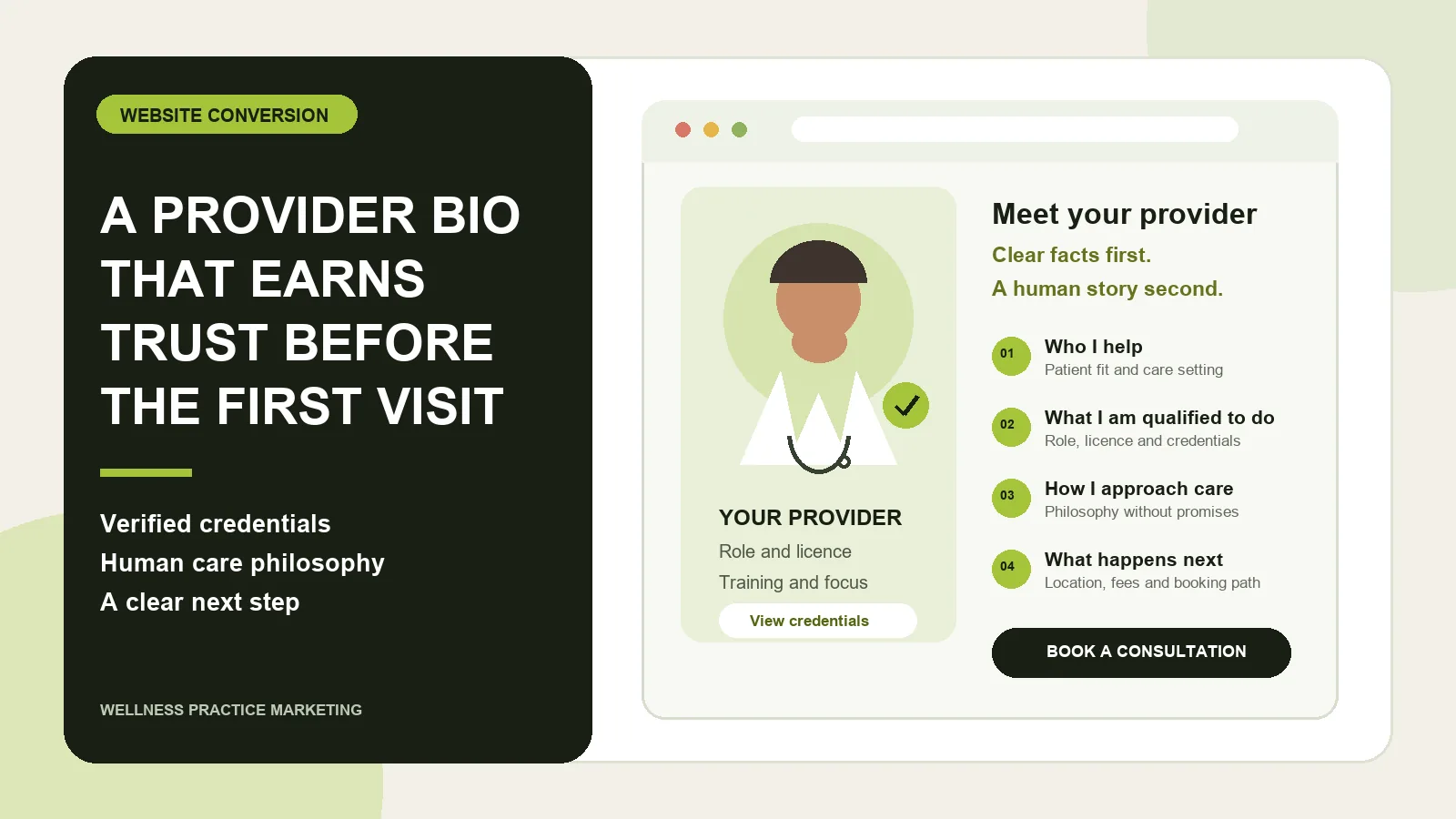
What makes a functional medicine provider bio trustworthy?
A trustworthy provider bio makes four things easy to verify: who the person is, what professional role they hold, how their experience relates to the visitor's needs and what the next step involves. It does not rely on a warm photograph, a long list of initials or a personal origin story alone.
Functional and integrative medicine patients often have more questions than a conventional directory profile can answer. They may be comparing care models, licences, training, cost, appointment length and whether the provider can help in their location. A strong page respects that research process. It puts regulated credentials and scope in plain language, explains the care philosophy without promising an outcome and connects the person to the services they actually provide.
This is a focused implementation guide. Our broader guide to functional medicine website design covers site architecture, accessibility, privacy and the full patient journey. Here, the provider profile is the product: its sections, claims, links, photography, structured data and conversion path.
Important: this is marketing guidance, not legal, medical or regulatory advice. Professional titles, testimonials, scope statements and advertising rules vary by profession and jurisdiction. Have the appropriate clinical, legal or compliance reviewer approve the page before publication.
1. Give the provider page one clear job
The page should help a prospective patient decide whether to learn more or take an appropriate next step with this provider. It should not try to prove that the clinician is the best choice for everyone.
A year-long study in a clinical setting found that first-time patients who viewed provider biographies before booking reported less uncertainty and were more likely to have deliberately selected their provider. The authors linked the lower uncertainty to greater perceived similarity.[1] That does not mean every personal detail creates trust. It suggests that useful information can help patients make a more purposeful choice.
A separate web-based experiment using fictional physician profiles found that descriptions of competence and empathy affected pre-consultation trust and expectations.[2] Because the study used vignettes rather than real clinic appointments, treat it as direction, not a conversion guarantee. A practical lesson is to show both sides of the decision:
- Competence: regulated role, education, active licence, relevant training and clearly defined services.
- Human fit: communication style, care philosophy, languages, setting and what the provider wants patients to understand.
A weak page overcorrects in one direction. A list of qualifications can feel like a CV with no patient relevance. A deeply personal story can feel warm but leave the visitor unable to verify who will provide care. The right page joins factual authority with human context.
2. Build the bio in the order patients need it
Do not begin with childhood, a career timeline or three paragraphs about why the provider entered healthcare. The opening screen should orient a new visitor quickly, especially on mobile.
Name and current role
Use the name, professional title and clinic role that are accurate in the provider's jurisdiction.
Patient-fit statement
Say which patients, concerns or care situations the provider commonly works with, without promising suitability.
Verified credentials
Separate the regulated licence from degrees, postgraduate training and functional medicine education.
Care philosophy
Explain how appointments and decisions feel in practice, using specific language rather than slogans.
Services and access
Link to services, locations, telehealth eligibility, fees and appointment types that this provider offers.
One honest next step
Label the action as a booking, discovery call, enquiry or eligibility check based on what actually follows.
The first screen
Place a current professional photograph beside a concise introduction. A useful formula is: name + role + who they work with + where or how care is delivered. Then provide a link to credentials and one primary action.
Provider name and accurate regulated title
State the patient group or concerns the provider works with, followed by the in-person location or eligible telehealth area. Explain the specific approach to history, collaboration or care planning without claiming a diagnosis or outcome before assessment.
Next step: View appointment types and fees, or request the exact administrative step your clinic offers.
This is a structure, not paste-ready medical copy. Replace each label with reviewed clinic facts. If the provider is not a physician, do not use physician language because it sounds more authoritative. If telehealth eligibility varies, link to the clinic's current eligibility information rather than naming a broad service area the clinic cannot consistently serve.
3. Present credentials so patients can understand and verify them
Initials alone are not an explanation. A visitor should be able to distinguish a professional licence from an academic degree, a board-recognized specialty, continuing education and a private certification.
| Information | How to present it | What to avoid |
|---|---|---|
| Professional role | Use the legally permitted title and identify the regulating jurisdiction when useful | Using “doctor” without enough context for the visitor to understand the role |
| Licence | Name the active licence and link to an official register where appropriate | Outdated numbers, expired jurisdictions or a generic “licensed provider” badge |
| Degree | Name the degree, institution and relevant field accurately | Turning every short course into a credential string after the name |
| Specialty or board status | Use the exact designation permitted by the relevant body | Calling a private certificate a recognized medical specialty |
| Functional medicine training | Name the organization, program and current designation precisely | Implying that training expands the provider's legal scope of practice |
| Memberships | Include only current, relevant memberships and authorized marks | Logos that imply approval, regulation or endorsement that does not exist |
The Institute for Functional Medicine's certification eligibility page, for example, treats an active healthcare licence in the applicant's primary discipline as an essential requirement and lists different eligible professional backgrounds.[4] That is a useful reminder to explain the provider's underlying profession first. Functional medicine training does not make all provider types interchangeable.
Create an internal credential record with the exact public wording, awarding body, year if relevant, verification link, renewal date and page owner. The clinic should be able to update one source of truth when a licence, role or membership changes. Do not copy credentials from an old directory profile without checking them.
Write scope statements in patient language
Connect qualifications to the work, but do not let marketing define clinical scope. “Provides nutrition counselling for adults in Ontario” is more useful than a row of unexplained letters. “Works with patients seeking support for metabolic health” is safer and clearer than implying that every visitor has a particular diagnosis or will receive a particular treatment.
4. Write a human story that helps the decision
A provider story earns its place when it explains how the person practises, communicates or relates to the clinic's patients. It should not become an unedited autobiography.
Use details that change the patient's understanding:
- Why the provider chose this area of practice, stated without attacking conventional care
- What they want a first appointment to feel like
- How they collaborate with other clinicians when appropriate
- How they explain uncertainty, options and follow-up
- Languages spoken and relevant cultural or access considerations
- What kinds of appointments they actually provide
Avoid heroic narratives in which the provider “finally found the root cause nobody else could see.” That phrasing can disparage other clinicians, imply superiority and turn one personal experience into a general medical promise. It also makes the provider the hero when the page should help the patient evaluate fit.
Replace adjectives with observable details
“Compassionate,” “holistic” and “patient-centered” appear on thousands of healthcare websites. Show what those words mean. Does the provider review submitted history before the first visit? Do they explain the purpose and limits of testing? Do they coordinate with a primary care clinician? Do they provide a written summary? Publish only processes the clinic can consistently deliver.
Vague: “A passionate expert who gets to the root cause and creates life-changing results.”
Useful: “The provider begins by reviewing the patient's history, current care and goals. During the consultation, they explain which questions can be addressed now, which may require further assessment and how follow-up decisions are made.”
The second version still needs clinical review, but it describes a process rather than guaranteeing a result. It helps the visitor picture the appointment without claiming that the provider can solve every complex case.
5. Use photography, video and patient proof carefully
Use a real, current photograph
The main portrait should look like the provider patients will meet. Use consistent lighting and framing across the team, but do not make every person look interchangeable. Add descriptive alt text that identifies the provider when that helps the page. Do not place their name, licence or biography only inside an image.
A short introduction video can help communicate voice and manner. Give it a clear title, captions and a text summary. Keep the content stable: who the provider is, how they approach first visits and where they practise. A video should support the page, not hide essential facts from visitors who cannot or do not want to play it.
Do not treat testimonials as decoration
In the United States, the FTC says endorsements must be honest and not misleading, and material connections that would affect how people evaluate an endorsement should be disclosed clearly.[5] The testimonial also cannot be used to make a claim that the clinic could not legally make itself.
Privacy creates a separate issue. HHS documented a HIPAA settlement after a dental practice disclosed protected health information while responding to online reviews.[6] A positive review does not give a clinic permission to reveal treatment details. Even confirming that the reviewer was a patient may create risk.
UK guidance says marketers must hold evidence that testimonials are genuine, retain relevant contact details, avoid misleading testimonial claims and obtain permission unless a narrow published-source exception applies.[7] In Canada, rules can be set by provincial colleges. Ontario's physician advertising policy, for example, prohibits testimonials in physician advertising and requires advertising to be accurate, factual and balanced.[8]
Practical rule: before adding reviews or testimonials to a provider profile, identify the profession, jurisdiction, privacy obligations, consent requirements and claim restrictions. Do not assume that a consent form alone resolves every issue.
6. Add the details that make the bio actionable
Trust can disappear when the biography sounds strong but the visitor cannot work out where the provider practises, what they offer or how to proceed. Connect the profile to the operational facts.
- Services: link only to services the provider actually delivers.
- Locations: name in-person locations and link to the relevant location page.
- Telehealth: describe availability accurately and link to eligibility or licensing information.
- Languages: state the level of service available, not merely personal familiarity.
- Fees: link to the provider's appointment fees, inclusions and exclusions where published.
- Referrals: explain whether a referral is required or accepted when the clinic has reviewed that wording.
- Booking: send the visitor to the right appointment type, provider and location.
Our guide to showing prices on a cash-pay clinic website explains how to connect provider, service, fee and booking information without hiding variable costs. If the practice is building a wider private-pay acquisition system, see marketing a cash-pay medical practice.
Match the call to action to readiness
A referral visitor may be ready to book. A person comparing a complex program may need fees and eligibility first. Use one primary action and a restrained secondary option:
- “View new-patient appointments” when the next screen shows bookable appointments
- “Check telehealth eligibility” when location must be confirmed first
- “Request an administrative call” when the conversation is not clinical advice
- “View services and fees” when the provider offers several distinct routes
Avoid “Start healing” or “Begin treatment” if the next step is only a lead form. The button should describe the next interaction, not the outcome a visitor hopes to achieve.
7. Give every provider a clear place in a multi-provider clinic
A team page and individual provider pages solve different problems. The team page helps visitors understand the clinic's structure. The individual page gives each clinician enough space for role, credentials, approach, services and a stable referral URL.
Use a consistent template, but do not publish duplicate bios with only the name changed. Each profile should explain that person's real responsibilities and appointment types. Also prevent scope confusion:
- Identify which provider delivers each service on the service page.
- Link the provider profile back to those services.
- Do not imply that one physician supervises, endorses or provides every service unless that is accurate.
- Make credentials and titles visually comparable without forcing them into one hierarchy.
- Show the correct booking calendar rather than a generic form that requires staff to reroute the enquiry.
For a solo clinic, the same logic still applies. Keep the provider bio on its own crawlable page even if a shorter introduction appears on the homepage. Referrals, podcast appearances, directory listings and service pages can all point to one authoritative profile instead of fragments of biography copied across the site.
8. Support search visibility without turning the bio into an SEO page
The provider's name, role and clinic relationship should appear consistently in the title, H1, opening copy, image alt text where appropriate and structured data. Consistency matters more than repeating “functional medicine doctor” in every paragraph.
Use internal links to connect four kinds of intent:
- Provider: searches for the clinician's name or credentials
- Service: searches for a consultation, program or treatment area
- Location: searches for local or eligible telehealth care
- Decision: searches about fees, process, fit and booking
The bio should own the provider-specific intent. Service pages should own service intent. Location pages should own local access. Do not create separate thin bios for “Dr. Smith functional medicine,” “Dr. Smith hormone doctor” and “Dr. Smith gut health doctor.” Use one substantial profile and link it to distinct service pages.
Use structured data to describe, not decorate
Google describes structured data as a standardized way to classify page information and recommends validating markup before release.[3] For an individual provider, accurate Person information may be appropriate, with a more specific professional type when it truthfully fits. ProfilePage may be relevant when the page is genuinely a profile page, but Google's documented rich-result use is not a promise that a clinic bio will receive a special search display.
Keep the markup aligned with visible content. Do not add a specialty, rating, award, licence, service area or affiliation that the page does not explain. Use stable links to official registers and professional profiles in sameAs only when they clearly refer to the same person.
A provider page also strengthens the author path for reviewed health content. When a clinician writes or reviews an article, link the byline to their profile and state the role accurately. Do not mark a marketing article as medically reviewed unless a qualified reviewer actually completed and approved that review.
9. Measure whether the page helps patients make a decision
Page views do not tell you whether the biography works. Agree on a small set of signals that connect the profile to the patient journey:
- Clicks from the profile to relevant service, fee or location pages
- Completed booking or enquiry requests for the correct provider
- Provider-selection questions received by the front desk
- Misrouted bookings caused by unclear role, service or location information
- Search impressions and clicks for the provider's name and role
- Attended first appointments where the patient deliberately selected the provider
Do not collect sensitive health information simply to measure a biography. Keep analytics events limited to necessary interactions and review the clinic's privacy, consent and vendor configuration before deployment. A completed booking is more meaningful than a click on a button, but the measurement method still has to fit the clinic's privacy obligations.
Ask front-desk staff what people misunderstand. If callers repeatedly ask whether the provider is licensed in their province, whether they see children or whether the first call is clinical, the page has left a decision-critical gap. Use those questions to improve the copy rather than adding another generic trust badge.
10. Functional medicine provider bio publishing checklist
| Check | Owner | Pass condition |
|---|---|---|
| Name, title and role | Provider and compliance reviewer | Exact, current and permitted in the relevant jurisdiction |
| Licence and credentials | Provider or credentialing lead | Verified against primary records, with clear credential categories |
| Scope and services | Clinical lead | Matches the provider's real role and current appointment types |
| Story and philosophy | Provider and editor | Specific, human and free of superiority or outcome claims |
| Photo and video | Provider and website owner | Current, consented, captioned where needed and usable on mobile |
| Testimonials | Legal or compliance reviewer | Permitted, supportable, privacy-safe and accurate for the market |
| Locations and telehealth | Operations lead | Current availability and eligibility are not overstated |
| Fees and booking | Practice manager | Links reach the correct provider, service, amount and next step |
| SEO and schema | Website owner | One canonical URL, one H1 and markup that matches visible facts |
| Review process | Practice owner | A named role updates the page when credentials or services change |
Add a real review date only when someone has checked the facts. Useful triggers include a licence renewal, new location, role change, new credential, revised appointment type, new telehealth jurisdiction or provider departure. Do not auto-update the date while leaving old information in place.
If the existing site makes this structure difficult, WPM's functional medicine web design service connects provider profiles with service pages, local visibility, fees and conversion paths. The Ayur Integrative Medicine website case study shows how practitioner credibility can support a broader clinic redesign.
Frequently asked questions
What should a functional medicine provider bio include?
Include the provider's current role, regulated licence, relevant education and training, patient groups or concerns they work with, care setting, care philosophy, locations or telehealth availability, practical appointment details and one clear next step. Every credential and service claim should be accurate and current.
How long should a provider bio be?
There is no universal ideal length. Put the decision-critical facts in the first screen, then use clear sections for credentials, approach, services and practical details. A useful profile may be longer than a directory card, but it should remain scannable and avoid an unfiltered career history.
Should each clinician have a separate bio page?
Usually, yes. A separate page gives each clinician a stable URL for referrals, search, service links and booking. A team overview can introduce everyone, but it should link to individual profiles rather than trying to hold every qualification and service in one page.
Can a provider bio include patient testimonials?
Only after checking the rules for the profession and location. Requirements differ across the United States, United Kingdom and Canada, and some regulators restrict or prohibit testimonials. Consent alone does not make every testimonial compliant, and the clinic must protect patient privacy.
What schema should a provider profile use?
Use structured data that truthfully represents the visible page. Person may fit an individual profile, with an appropriate professional type where supported. ProfilePage may be relevant when the page is genuinely a profile page. Validate the markup and do not add credentials, ratings or claims that visitors cannot verify on the page.
Make the provider page part of the patient journey
A strong bio is not a personality page attached to the clinic site. It is the bridge between a visitor's health question and the person they may trust with the next conversation. Build it from verified facts, explain the care philosophy in observable terms and make practical details easy to find.
Wellness Practice Marketing helps functional and integrative medicine clinics connect provider credibility, high-intent search, service pages and booking paths. If your current biographies are thin, confusing or disconnected from the services you want to grow, book a strategy call with Salem to identify the highest-priority changes.
This article is for general marketing education. It is not medical, legal, privacy or regulatory advice. Use qualified advisers for the requirements that apply to your clinic, profession and location.
Authoritative sources
- Health Communication: The Utility of Healthcare Providers' Online Biographies for First-Time Patients
- Patient Education and Counseling: Pre-consultation Information About One's Physician Can Affect Trust and Treatment Outcome Expectations
- Google Search Central: Profile Page Structured Data
- Institute for Functional Medicine: Certification Eligibility Requirements
- Federal Trade Commission: Endorsement Guides, What People Are Asking
- U.S. Department of Health and Human Services: Settlement Over Disclosures in Online Review Responses
- UK Advertising Standards Authority: Testimonials and Endorsements
- College of Physicians and Surgeons of Ontario: Advertising Policy