
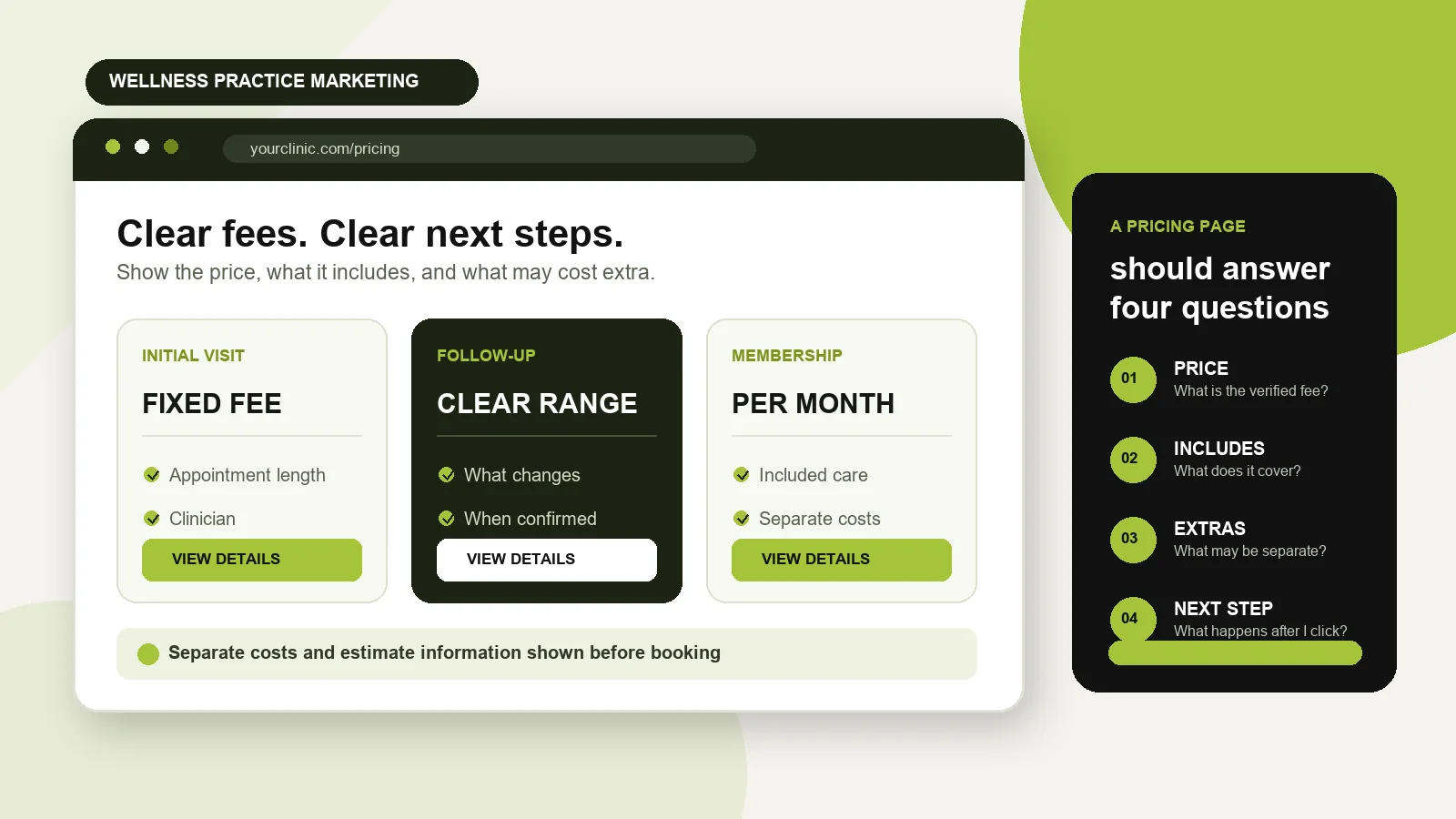
Should a cash-pay clinic publish prices online?
Usually, yes. A prospective patient should be able to understand the payment model, the known fee for the first step, what that fee includes, which costs may be separate and how to get an individualized estimate. If your total varies, publish the part you know and explain the variables instead of replacing the answer with “call for pricing.”
The goal is not to turn healthcare into a product catalogue. It is to remove avoidable uncertainty before someone gives your clinic their contact details. A clear page also gives the front desk one source of truth, reduces contradictory quotes and helps unsuitable enquiries opt out without an uncomfortable sales conversation.
This guide is narrower than our broader article on how to market a cash-pay medical practice. That article covers positioning, search, trust and patient acquisition. This one is an implementation guide for the pricing page itself: information hierarchy, wording, variable fees, legal review, internal links and measurement.
Important: this is marketing guidance, not legal, billing, tax or medical advice. Rules vary by country, state or province, profession, service and clinic type. Have the appropriate adviser review your pricing, contracts, estimate process, taxes, cancellation terms and payment policies before publication.
1. Give the pricing page one clear job
A pricing page should help a careful person answer a decision, not persuade everyone to buy. By the time the reader reaches the call to action, they should know what they are considering and which questions still require an individual conversation.
The page needs to answer seven practical questions:
- What am I paying for? Name the appointment, program or membership in language used elsewhere on the site.
- Who provides it? Identify the clinician or provider type, then link to a detailed practitioner profile.
- How much is the known fee? Show a fixed amount, genuine range or legitimate starting point.
- What is included? State visit length, included appointments, administrative support and other defined components.
- What might cost extra? Name common exclusions such as outside laboratory work, imaging, supplements, prescriptions or additional visits when applicable.
- When is payment due? Explain deposits, billing frequency, payment plans and cancellation terms accurately.
- What happens next? Label whether the next step is a paid appointment, an administrative call, an application or a request for information.
If a page shows only a price, visitors cannot compare the service. If it explains everything except the price, they cannot judge affordability. The useful unit is fee plus scope plus exclusions plus next step.
2. Choose the right way to display each fee
Not every cash-pay service fits the same pricing format. Use the most specific statement the clinic can consistently honor. Do not choose a vague range simply because it feels safer.
| Care model | Best display | What must sit beside it |
|---|---|---|
| Fixed appointment | One verified fee | Visit type, scheduled length, provider, inclusions and separate costs |
| Appointment with real variation | Verified range | What changes the amount and when the exact fee is confirmed |
| Service with an entry point | Genuine “from” price | What the starting fee buys and which common factors raise the total |
| Defined program | Total program fee, or approved payment schedule | Duration, appointments, included support, exclusions and what happens if care changes |
| Membership | Recurring fee and billing frequency | Included services, minimum term, renewal, cancellation, access boundaries and separate charges |
| Clinically determined care | Known first-step fee plus estimate process | Why later costs vary, who recommends them and when the patient receives the amount |
Use a fixed fee when the clinic controls the service
If every new-patient appointment with a particular provider has the same charge, publish that charge. Avoid “starting at” when there is no lower version of the appointment. Also avoid a wide range that makes the visitor call to learn the one price staff already know.
Use a range only when the range is real
A range should come from the clinic's actual fee schedule or billing data, not from a number chosen to look competitive. Explain the decision behind it. A follow-up may vary by scheduled duration or provider type, for example. “Price varies” without the reason is not much more useful than hiding the amount.
Treat “from” as a factual claim
A starting price should describe an option that is genuinely available to an appropriate patient. If nearly every person must pay more, the starting amount creates the wrong impression. In the United States, the FTC says advertising must be truthful and non-deceptive, and that omissions can be deceptive when they leave consumers with a material misimpression.[3] Apply the same standard to the total impression created by headings, cards, footnotes and buttons.
Show recurring commitments as recurring commitments
For a membership or concierge model, place the billing frequency next to the fee. Explain what continues automatically, how cancellation works and whether clinical services outside the membership may be billed separately. Our guide to marketing a membership or concierge medical practice covers the full enrollment path and capacity planning.
3. Build the page in the order patients need it
The pricing page should not open with a long defense of cash-pay medicine. Start with the information the visitor came to find, then add the context needed to interpret it.
- Clear page title and one-sentence payment-model explanation
- Priority appointment, program or membership cards
- Inclusions directly beside each price
- Common exclusions and variable costs
- Insurance, receipt or superbill information that the clinic has verified
- Payment timing, deposits and cancellation terms
- Good faith estimate or local pricing notice where applicable
- Short FAQs based on real front-desk questions
- One clearly labelled next step
- Last reviewed date and a route for billing questions
Lead with a plain payment-model statement
State whether the clinic is cash-pay, self-pay, out of network, hybrid, membership based or another accurately reviewed model. Do not treat these terms as interchangeable. A hybrid practice may need separate sections because the billing route depends on the service.
Group fees by decisions, not internal departments
Organize the page around what a patient can book: initial consultation, follow-up, program or membership. An internal list of billing codes may be accurate but still difficult to understand. If different providers charge different fees, identify them clearly instead of hiding the difference behind “provider dependent.”
Put inclusions beside the price
Do not make readers assemble the offer from a fee table, a services page and an FAQ. State the scheduled duration, provider and defined inclusions in the same card. Keep clinical wording restrained. The fee pays for a service and professional time, not a promised diagnosis, treatment plan or outcome.
Initial functional medicine consultation
State the clinic's verified fee and scheduled length. Name the clinician or provider type. List what the appointment normally includes, such as review of history and current concerns. Then state that testing, products, prescriptions and follow-up are separate if that is true.
Next step: label the button “Book an initial consultation” only if that is exactly what the scheduler opens.
This structure is intentionally not a sample fee. Your clinic should publish its own reviewed amount, not copy a benchmark from another market. The same rule applies to package ranges and installment plans.
Keep operational terms readable
Cancellation terms, deposits and refunds should not be hidden in pale text at the bottom of the page. Summarize the practical point near the relevant fee and link to full terms when necessary. If a deposit is credited toward the appointment, say so. If it is non-refundable, have that wording reviewed and make it prominent before payment.
4. Explain variable and separate costs without guessing
Functional, integrative and wellness care can involve costs that are not known until after a clinical assessment. That uncertainty does not require silence. Separate the known first step from later decisions.
Publish what is known
Show the verified appointment or membership fee that applies before any later recommendation.
Name common exclusions
Identify categories that may be separate, such as external labs, imaging, products or additional visits.
Explain the decision point
State whether costs depend on clinical assessment, provider selection, duration or an outside supplier.
Describe the estimate process
Tell the patient when and how an exact fee or written estimate is supplied before they agree.
State who bills for outside services when the clinic knows. “Billed separately by the laboratory” is different from “paid to our clinic.” Do not promise insurance reimbursement, HSA or FSA eligibility, tax treatment or superbill acceptance unless the responsible adviser has confirmed the wording. A receipt can support a patient's request without guaranteeing that a plan or administrator will approve it.
Keep optional items clearly optional
If supplements, products or additional services are optional, do not place them in language that makes them sound required for every patient. If something is required for a specific program, include it in the total or make the additional mandatory charge clear. The pricing page should not rely on a later call to correct the impression created online.
Do not combine price with an outcome promise
Package names such as “Hormone Reset” or “Gut Healing Guarantee” attach a fee to an implied medical result. Describe duration, appointments, access and included services instead. The clinician can discuss appropriate options after assessment. Marketing should not pre-sell a treatment plan that has not been clinically determined.
5. Adapt the page for the United States, United Kingdom and Canada
A WPM audience spans several markets. The design principle is consistent, but the legal and professional review is local. Do not copy a US notice onto a UK or Canadian clinic page and assume the job is complete.
United States
Separate the public price list from the clinic's good faith estimate process. Check federal requirements, state rules, professional advertising rules and the clinic's actual billing model.
United Kingdom
Review the CAP Code, consumer law, professional standards, sector-specific requirements and the clinic's VAT position with qualified advisers.
Canada
Review federal deceptive-marketing rules plus provincial college, consumer-protection and billing requirements that apply to the profession and service.
United States: public prices do not replace good faith estimates
CMS says that when a person is not using health insurance to pay, a provider usually must give a good faith estimate if the person requests one or schedules services at least three business days in advance. CMS also explains different delivery timelines based on how far in advance care is scheduled.[1]
Separate CMS provider guidance says information about the availability of good faith estimates for uninsured or self-pay individuals must be written clearly and displayed prominently on the provider's or facility's website, in the office and where scheduling or cost questions occur. It also says the website information should be easily searchable from a public search engine.[2]
That notice is not the same as publishing every fee, and a general price page is not an individualized estimate. Build an operational process behind the notice: identify who responds, which information they need, how the estimate is delivered and where it is documented. Have counsel or a compliance adviser confirm how the rule applies to the clinic.
United Kingdom: include non-optional charges in quoted prices
The ASA's pricing guidance says quoted prices must include non-optional taxes, duties, fees and charges that apply to all or most buyers. It also says that when a charge cannot be calculated in advance because it depends on the consumer's circumstances, marketing should make clear that it is excluded and explain how it is calculated.[4]
Do not reduce this to a website footnote. If an advertised consultation always carries a mandatory administrative charge, the main quote should not create a lower unattainable impression. Private healthcare and particular professions may have additional obligations, so use sector-specific advice rather than a generic template.
Canada: avoid unattainable advertised prices
Canada's Competition Bureau describes drip pricing as offering a price that consumers cannot actually obtain because mandatory fixed charges are added later, apart from fixed charges imposed by government such as sales tax. Its business guidance says not to promote an unattainable price and to ask whether consumers will be surprised by extra fees.[5]
That federal guidance is not the only review. Provincial and territorial rules, professional college requirements and the clinic's service model may add obligations. Have the clinic's adviser confirm terminology, fee disclosures and any restrictions before the page goes live.
6. Put prices where the patient makes the decision
A pricing hub is useful, but it should not become an information island. Someone arriving on a hormone consultation page should not need to open the footer, find “fees,” locate the right provider and return to the booking button.
- Pricing hub: maintain the complete source of truth for appointments, programs and memberships.
- Service pages: repeat the relevant fee or concise range, key inclusions and likely exclusions, then link to complete pricing details.
- Practitioner profiles: link to the fees for appointments that practitioner actually provides.
- Booking page: show the amount and appointment type again before personal details or payment are requested.
- Confirmation messages: restate payment timing, cancellation terms and the route for billing questions.
Use the same service name everywhere. If the website says “Comprehensive Consultation” while the scheduler says “New Patient Level 3,” the patient may wonder whether they selected the right option. Internal billing labels can remain internal.
On mobile, place the price and scope before a sticky booking button. Do not let the button cover exclusions or table rows. Pricing information should be HTML text, not only an image or downloadable PDF. Text is easier to read, resize, search, translate and update.
7. Write and design for clarity, not price pressure
The page should feel calm because the hierarchy is clear. It does not need countdown timers, crossed-out fake prices or an oversized “most popular” badge. Healthcare decisions require enough context to make an informed choice.
Use headings that describe the decision
“Initial consultations,” “Ongoing appointments,” “Membership fees” and “What may cost extra” are more useful than “Invest in yourself.” The emotional headline can support the page, but it should not replace the information.
Use honest comparison language
Do not claim that cash-pay is always cheaper than insurance or that a longer visit is always better care. If the clinic offers both insurance and self-pay routes, explain the administrative options without estimating an individual's plan benefits. If you compare packages, compare defined features, not implied health outcomes.
Make the call to action literal
A button should describe what happens: “View available appointments,” “Request a billing question” or “Book an administrative call.” Do not label an unpaid sales conversation as a medical consultation. Do not use “Start treatment” when the next screen only collects a lead.
For the wider website structure, see our guide to functional medicine website design. It shows how pricing, practitioner, service, location and booking pages should work as one patient decision system.
8. Target pricing intent without cannibalizing service pages
The pricing page should own questions about fees, payment models, inclusions and cost variables. Service pages should own the clinical service and location intent. Educational articles can answer narrower questions, then link readers to the relevant service and pricing pages.
Use one descriptive title and one prominent H1. Google recommends concise, descriptive page titles and says distinct title text helps users distinguish pages in search results.[6] Avoid creating separate near-identical pages for “cost,” “price,” “fees” and “investment” when one useful page can answer all four.
A practical internal-link structure looks like this:
- Service page links to the relevant pricing section with anchor text such as “appointment fees and what is included.”
- Pricing page links back to the service and practitioner for clinical context.
- Booking page links to the pricing and cancellation information before payment.
- Educational articles link to the correct service or pricing section when the reader is ready to evaluate care.
This article targets how clinic owners should present prices. It does not replace WPM's broader cash-pay marketing guide or a clinic's patient-facing pricing page. Keeping those purposes distinct reduces overlap and makes internal links more useful.
9. Measure whether the page improves the decision path
Do not judge the pricing page by traffic alone. Its job is to improve informed progression and reduce preventable confusion. Agree on a small set of business signals before publishing.
- Pricing-page visits that continue to the correct service or booking route
- Completed booking requests, not button clicks alone
- Calls and enquiries that ask questions already answered on the page
- Administrative disqualifications related to payment misunderstanding
- Bookings that reach an attended first appointment
- Complaints or corrections caused by a website and scheduler mismatch
A lower raw enquiry count is not automatically a failure if the remaining enquiries are better informed and the clinic spends less time repeating basic terms. Equally, a high click rate is not success if people discover a different price in the scheduler and abandon.
Connect the pricing-page decision with the economics in our guide to patient lifetime value versus acquisition cost. Clearer pricing can improve qualification, but the clinic still needs to understand acquisition costs, delivery costs and capacity before increasing marketing spend.
10. Cash-pay clinic pricing-page publishing checklist
Use this checklist before the page goes live and whenever the fee schedule changes.
| Check | Owner | Pass condition |
|---|---|---|
| Every displayed fee matches the approved schedule | Billing or practice manager | The website, scheduler and staff script use the same amount |
| Inclusions and exclusions are accurate | Clinical and operations leads | No implied service or product is missing from the review |
| Ranges and starting prices are supportable | Billing and legal reviewer | The amount is genuinely available and the variables are clear |
| Estimate and pricing notices are present | Compliance or legal adviser | Applicable market requirements are implemented, not merely mentioned |
| Insurance and receipt language is restrained | Billing lead | No reimbursement, coverage or tax treatment is promised |
| CTA matches the next screen | Marketing and front desk | The button label accurately describes the booking or enquiry step |
| Mobile and accessibility checks pass | Website owner | Fees, tables, focus, labels and buttons remain usable at small widths |
| Review ownership is documented | Practice owner | A named role and review trigger are recorded internally |
Add a visible “last reviewed” date only when someone has genuinely checked the content. Do not automatically refresh it. A current-looking date attached to an old fee creates more risk, not more trust.
Frequently asked questions
Should a cash-pay clinic show prices on its website?
Usually, yes. Publish enough information for a prospective patient to understand the payment model, the initial fee or genuine range, what is included, what may cost extra and how to obtain an individualized estimate. The public page must match what staff and the booking system quote.
What if the total cost depends on labs or the care plan?
Publish the known fee for the initial service, identify which costs vary, explain what drives the variation and state when the patient receives the exact amount or estimate. Do not present a starting price as if it covers variable testing, supplements, imaging or follow-up when it does not.
Is a website price list the same as a good faith estimate?
No. A public pricing page describes general fees. In the United States, a good faith estimate is a written estimate for an uninsured or self-pay individual in circumstances covered by federal rules. A public page does not replace the clinic's estimate process.
Should prices appear on one page or on every service page?
Use a central pricing page as the source of truth, then summarize the relevant fee and key exclusions on each high-intent service page. Link both ways so patients do not have to leave the booking path to find basic cost information.
Will showing prices make a clinic look cheap?
A plain fee does not define the clinic's positioning. Pair the price with the practitioner, appointment length, included services, likely separate costs and next step. This explains the offer without discounts, hype or outcome promises.
Make pricing part of the patient experience
A useful clinic pricing page does not promise that care will be affordable for everyone. It gives people accurate information early enough to make a respectful decision. That means publishing the known fee, putting scope and exclusions beside it, explaining uncertainty and keeping every booking touchpoint consistent.
Wellness Practice Marketing helps functional and integrative medicine clinics connect website structure, patient search intent, landing pages and conversion paths. If price questions are creating friction or your service pages do not explain what happens before booking, book a strategy call with Salem to review the highest-priority changes.
This article is for general marketing education. It is not medical, legal, billing, tax or regulatory advice. Use qualified advisers for the requirements that apply to your clinic and location.
Authoritative sources
- Centers for Medicare & Medicaid Services: What is a good faith estimate?
- CMS: Guidance on Good Faith Estimates and the Patient-Provider Dispute Resolution Process for Providers and Facilities
- Federal Trade Commission: Advertising FAQs, A Guide for Small Business
- Advertising Standards Authority: Compulsory costs and charges
- Competition Bureau Canada: Drip pricing
- Google Search Central: Influencing title links in Google Search