
Here's a question we ask every clinic owner who tells us Google Ads "didn't work" for them:
How many consultations did the campaign actually generate?
Almost nobody can answer it. They know what they spent. They might know how many clicks they got. But the number that decides whether the campaign was a success or a money pit — booked consultations — is usually a shrug.
That's not a Google Ads problem. That's a tracking problem. And in our experience it's the single most common difference between clinics that grow with paid search and clinics that quit it after three expensive months.
1What conversion tracking actually means
Conversion tracking tells Google Ads — and you — what happened after the click. For a clinic, the actions worth counting are concrete:
- Consultation form submissions.
- Phone calls from ads, and calls from the website after an ad click.
- Clicks on the booking or appointment button.
- Text-message taps, where the clinic offers them.
Without these signals, your account reports activity: impressions, clicks, click-through rates. Activity isn't outcomes. A campaign can look busy and produce nothing — and, more dangerously, a campaign can look quiet and be your best patient source.
There's a second reason tracking matters that has nothing to do with reporting: Google's own bidding runs on it. Modern campaigns optimize toward whatever conversion signal you feed them. Feed them nothing, and the system optimizes for clicks — any clicks, from anyone. Feed them real enquiry actions, and every day of spend teaches the account which searches produce patients. An untracked account doesn't just report badly. It learns badly.
2Without tracking, every number in the account lies
The clearest proof we can offer comes from a multi-service wellness clinic whose account we analyzed across six months. Three services, budgets split almost exactly evenly — about $3,600 each. By spend, the account looked perfectly balanced.
Tracking told a different story:
| Service | Spend | Tracked conversions | Cost per conversion |
|---|---|---|---|
| Naturopathic medicine | $3,624 | 149 | $24.33 |
| Medical weight loss | $3,648 | 44 | $82.90 |
| Hormone replacement | $3,650 | 33 | $110.61 |
One service was generating conversions 4.5 times more efficiently than another — inside the same account, the same city, the same six months. The full breakdown is here.
Now imagine that account without tracking. All three campaigns spend on schedule. All three get clicks. Nothing looks wrong — and the clinic keeps paying $110 for what it could buy elsewhere at $24, indefinitely, invisibly. That's what "we don't really do tracking" costs.
3A tracked conversion still isn't a patient
Here's the part most agencies skip, because it makes the numbers look less impressive.
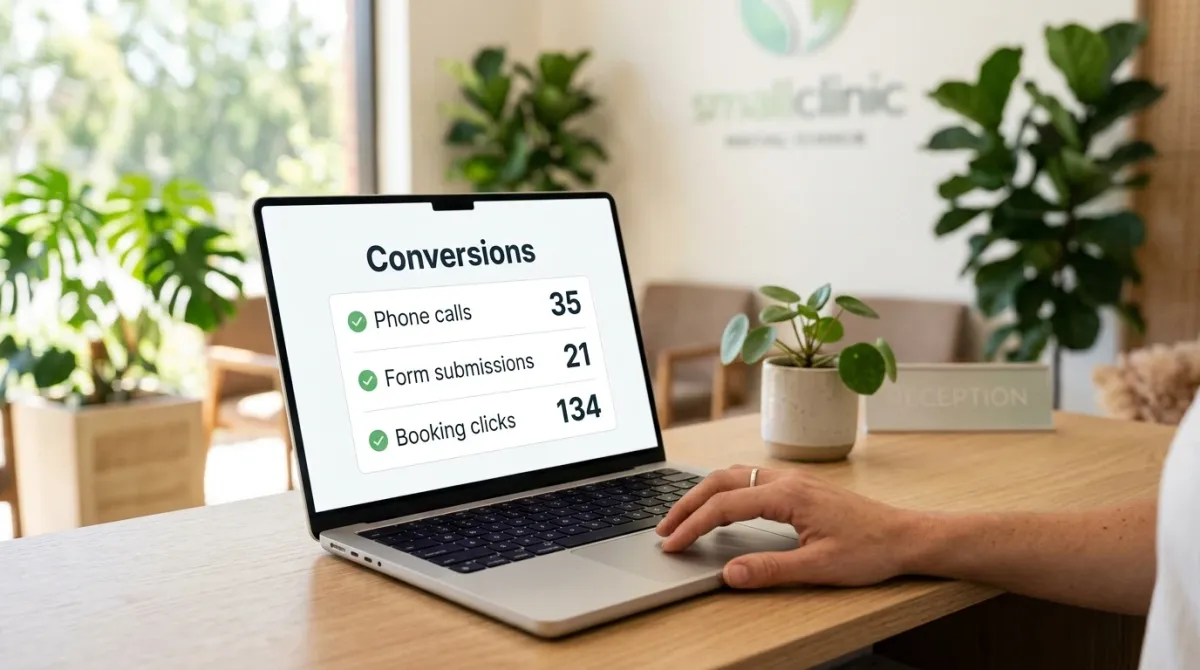
That same account's 226 conversions break down like this: 134 appointment-button clicks, 35 calls from ads, 21 form submissions, 20 text-message taps, 16 website calls. An appointment-button click is not a booked appointment. A call is not a new patient.
So we'd never claim that clinic "acquired patients for $24." The honest statement is that it generated tracked conversion actions at $24 — and the next job is connecting those actions to what actually matters:
- Click — someone arrived from an ad.
- Conversion action — they called, submitted a form, or hit "book."
- Booked consultation — the calendar says so.
- Patient — they showed up, and possibly came back.
Most clinics track nothing. Good setups track layer 2. The clinics that scale confidently connect their booking system or CRM so they can see layers 3 and 4 per campaign. Every layer you add makes the next budget decision less of a guess.
4What tracking changes in practice
Once the data exists, decisions stop being debates. From the same clinic's account:
- Keyword decisions: the phrase-match keyword "hormone therapy replacement" spent about $2,017 for 11 conversions — roughly $183 each — while "hormone clinic for women" converted at about $41. Same service, 4x difference. You only reallocate that spend if you can see it.
- Device decisions: 83% of the account's conversions came from mobile, at a 27% lower cost than desktop — the device data is here. That finding redirected effort into the mobile booking experience before any bid changes.
- Patience decisions: when we launched two campaigns for an integrative practice, the first days showed plenty of clicks and zero tracked conversions. Because tracking was in place from day one, we could say "too early to judge" with a straight face — instead of either panicking or pretending.
The rule we follow: tracking gets installed and tested before a campaign scales — never retrofitted after the budget is spent. Data you didn't collect can't be recovered.
5The mistakes that quietly corrupt tracking
Broken tracking is arguably worse than none, because it produces confident wrong answers. The failures we see most:
- Counting page views as conversions. A visit to the contact page is not a contact. Track the submission, not the arrival.
- Double counting. The same form firing a Google Ads tag and an imported GA4 event counts every lead twice — and halves your apparent cost per lead.
- No call quality threshold. Counting every 3-second misdial as a conversion flatters the numbers; a minimum duration keeps them honest.
- Tracking that dies silently. A website redesign, a new booking widget, a changed thank-you page — any of these can break tags without anyone noticing. Check conversions still fire after every site change.
- Optimizing to the wrong action. If Google's bidding is fed button clicks, it buys button clicks. Feed it the deepest action you can measure reliably.
6The minimum setup for a clinic

You don't need enterprise analytics. A clinic's baseline is:
- A conversion action for every real enquiry path: form, calls from ads, website calls, booking clicks.
- Call tracking with a sensible minimum duration.
- A tag check after any website or booking change.
- Lead-source notes at reception or intake — "how did you hear about us?" written down, every time.
- A monthly look at cost per conversion per service, not the account average — averages are where the $110 problems hide.
One more habit worth the effort: reconcile occasionally. Once a quarter, sit the front desk's "how did you find us" notes next to the ad account's conversion count. If the account claims forty leads and reception remembers six, something in the middle is broken — a form double-firing, a call tracker counting misdials, or leads that never became humans on the phone. The reconciliation takes an hour and keeps the whole system honest.
That's an afternoon of setup and thirty minutes a month. It's also the difference between running a system and funding an experiment with no results section.
The short version
Keywords, ad copy, landing pages — they all matter. But they're all guesses until conversion tracking turns them into measurements.
Every useful finding in our published case studies — the $24-vs-$110 service gap, the 83% mobile share, the keyword-level differences — exists only because tracking was in place before the conclusions were needed. The clinics that skip this step don't just lose data. They lose the ability to ever know what worked.
If you're running ads without it, stop scaling and spend the afternoon. Our PPC guide covers the wider system when you're ready.