
Most clinic owners look at their Google Ads account and ask a simple question: how many leads did we get?
That question matters, but it can hide an important difference inside the account. The same campaign can perform very differently depending on whether someone is searching from a phone or a desktop computer.
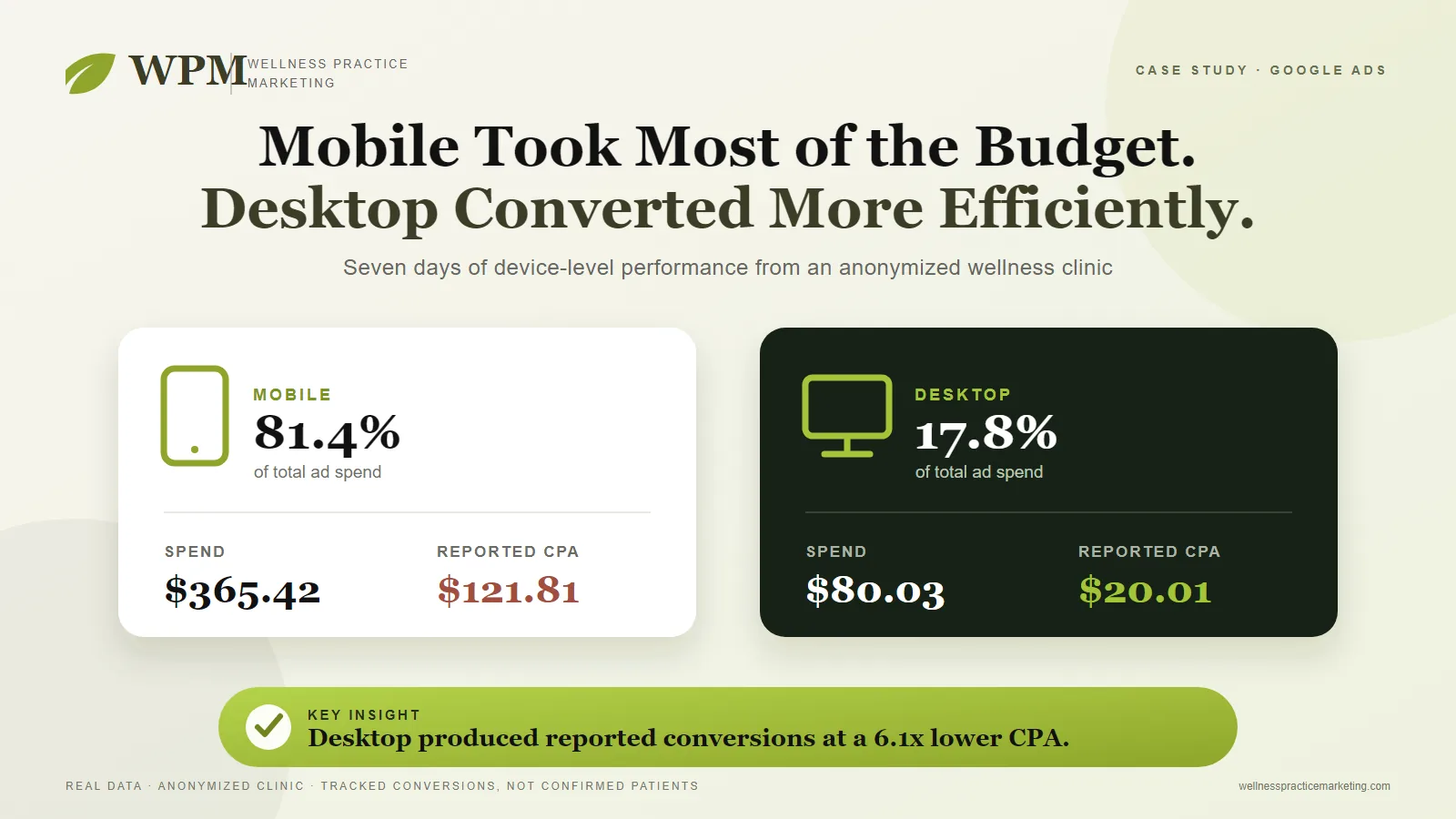
We saw that clearly during a seven-day review of an anonymized multi-service wellness clinic. Mobile devices consumed most of the advertising budget. Desktop received a much smaller share. Yet desktop produced reported conversions at a dramatically lower cost.
The device-level numbers were:
- Mobile spend: $365.42
- Mobile reported cost per conversion: $121.81
- Desktop spend: $80.03
- Desktop reported cost per conversion: $20.01
Mobile used approximately 81.4% of total account spend. Desktop used approximately 17.8%. Based on the reported CPA, desktop generated tracked conversion actions at about 6.1 times lower cost.
That does not prove desktop traffic is always more valuable. It also does not mean the clinic should stop advertising on mobile. It does mean that the device difference was large enough to investigate rather than ignore.
Important: This case study covers seven days of data. Google Ads reported conversion actions, not confirmed new patients. The findings are diagnostic signals, not universal benchmarks.
The Seven-Day Dataset
The account promoted three services: naturopathic medicine, medical weight loss and hormone replacement therapy. From September 14 to September 20, 2026, the account recorded:
- $448.81 in total Google Ads spend
- 3,249 impressions
- 148 clicks
- 7 reported primary conversions
- $64.12 overall reported cost per conversion
The account-level CPA looked reasonable in isolation. Device segmentation told a more useful story.
| Device | Spend | Reported Conversions | Reported CPA | Share of Total Spend |
|---|---|---|---|---|
| Mobile | $365.42 | 3 | $121.81 | 81.4% |
| Desktop | $80.03 | 4 | $20.01 | 17.8% |
Mobile spent more than four times as much as desktop but produced fewer reported conversions. Desktop spent less than one-fifth of the account budget and produced four of the seven reported conversion actions.
The two rows do not account for every cent of account spend because Google can report small amounts under other device categories. The meaningful observation remains the same: the overwhelming majority of spend came from mobile, while the lower reported CPA came from desktop.

Device segmentation can reveal performance differences hidden by the account-wide average.
Why the Account-Wide Average Was Misleading
An overall reported CPA of $64.12 combines every device, campaign and conversion action into one number. That average is useful for a quick health check, but it does not show where the results came from.
Imagine that a clinic owner saw only the overall number. They might conclude that the account was acquiring conversion actions for approximately $64 and continue without questioning device performance.
But the device-level view changes the conversation:
- Was the mobile landing-page experience creating friction?
- Were mobile searches less commercially focused?
- Did calls or forms behave differently by device?
- Were mobile visitors researching first and converting later on another device?
- Was Google allocating too much traffic toward the device with the weaker reported CPA?
None of those questions can be answered by the blended CPA alone.
This is why account averages can create false confidence. They compress several distinct user experiences into one convenient metric. The average may look acceptable while one segment is carrying the account and another is consuming budget without producing comparable tracked outcomes.
What the Seven Reported Conversions Actually Meant
The word “conversion” needs context, especially in healthcare advertising.
In this account, the seven reported primary conversions consisted of:
- 4 phone-call conversions
- 1 form submission
- 1 booking-button click
- 1 text-message-button click
A completed form is a clear enquiry. A qualified phone call may also be a strong lead. A booking-button click is different because the person may abandon the scheduler before choosing a time. A text-message-button click shows intent, but it does not confirm that a message was sent or that the person became a patient.
For that reason, it would be inaccurate to say desktop acquired four patients for $20 each. The precise claim is that desktop generated four reported primary conversion actions at an average cost of $20.01.
This distinction protects the clinic from optimizing toward misleading signals. If a button click is treated the same as a completed consultation request, Google may learn to find more people who click without completing the action the practice values.
Clean conversion tracking should separate:
- Completed consultation forms
- Qualified phone calls
- Completed online bookings
- Booking-page visits and button clicks
- Text-message initiations
- General engagement events
The first three can usually serve as primary conversion goals. The remaining actions may still be useful, but they are generally better treated as secondary diagnostic signals unless the clinic can confirm a direct connection to patient acquisition.
What Could Explain the Mobile Performance Gap?
The data showed a gap. It did not, by itself, prove one cause. A responsible audit should treat the following possibilities as hypotheses to test.
1. Mobile landing-page friction
Mobile visitors interact with a clinic website on a smaller screen, often while distracted. A page that feels clear on a desktop can become difficult to use on a phone.
Common problems include slow image loading, oversized headers, intrusive pop-ups, text that requires too much scrolling, forms with too many fields and call-to-action buttons that disappear below the fold. A scheduling tool can also work well on desktop but feel cramped or confusing on mobile.
When more than 80% of ad spend comes from mobile, small usability problems can become expensive quickly.
2. Different search behavior
Someone searching from a phone may be exploring options while commuting, waiting or multitasking. A desktop visitor may be sitting down specifically to compare providers, read treatment details and submit a form.
That does not make mobile traffic low quality. It means the stage of the decision process may differ. Functional, integrative and wellness services often require more research than an urgent local purchase. The person may first discover the clinic on mobile and return later on desktop.
3. Call and form tracking differences
Mobile users are naturally more likely to call or tap a text link. If those actions are not tracked accurately, mobile performance can appear weaker than it really is. The opposite can also happen: tracking every tap as a lead can make mobile look stronger than the actual patient pipeline.
The clinic needs to know whether a call connected, how long it lasted, whether it was qualified and whether the caller booked. Without that information, device CPA remains an advertising metric rather than a true patient acquisition cost.
4. Campaign and keyword mix
Device results can be influenced by the campaigns receiving traffic. In the same seven-day period, hormone replacement reported a $148.10 CPA, while weight loss and naturopathic medicine reported CPAs close to $50.
If mobile traffic was more heavily concentrated in the less efficient campaign or less specific searches, part of the device gap may have been caused by campaign mix rather than the device itself.
This is why the next step is not simply “reduce mobile.” The account should be segmented by device, campaign, keyword, search term, landing page and conversion action before budget decisions are made.
Mobile visitors may be researching in a different context and at a different stage of the decision process.
Why We Would Not Pause Mobile Based on Seven Days
A 6.1 times CPA difference is significant enough to investigate, but seven reported conversion actions are still a small sample.
Pausing mobile immediately could remove valuable demand before the clinic understands what is happening. It could also overlook cross-device behavior. A person may click an ad on a phone, research the practitioner, discuss the decision with a partner and later book from a laptop. Standard device reports may credit the final action differently depending on the attribution model and tracking setup.
Healthcare decisions can also have longer consideration periods. Some patients do not book during the first session. They may read reviews, compare credentials, check pricing and return days later.
A safer response would be to:
- Validate the conversion actions and confirm what counts as primary.
- Review at least 30 days of device data, if available.
- Compare mobile and desktop by campaign and landing page.
- Test the complete mobile enquiry process on real devices.
- Measure completed bookings and qualified calls, not just button clicks.
- Make controlled changes and monitor the outcome.
The goal is not to favor a device. The goal is to understand why one device produced a stronger measured outcome and improve the weaker experience without discarding useful traffic.
How We Would Audit the Mobile Experience
A practical mobile audit should start with the actual ad journey rather than a general website review.
Search-to-page message match
Open the ad from the same type of mobile search the patient used. If the search is for medical weight loss, the first screen should clearly communicate medical weight-loss care, the location served and the next step. Sending that visitor to a general homepage creates unnecessary work.
First-screen clarity
Within a few seconds, the visitor should understand what the clinic offers, who it serves and how to contact the practice. The main CTA should be easy to see and tap without competing against several other actions.
Speed and stability
Large images, third-party scheduling tools, chat widgets and multiple tracking scripts can slow a mobile page. Loading speed should be tested on a real cellular connection, not only office Wi-Fi. Layout shifts that move buttons while the page loads can also create accidental taps or abandonment.
Form usability
Every unnecessary field adds friction. The form should use the correct mobile keyboard for phone and email fields, display clear validation messages and confirm that the submission succeeded. The privacy language should be readable without overpowering the action.
Booking experience
If the page opens an external scheduler, the handoff must be tested. The appointment types, calendar and confirmation screen should fit a small screen. Most importantly, tracking should fire after a completed booking, not when someone merely opens the scheduler.
Trust signals
Wellness patients often research credentials and reviews before contacting a clinic. Mobile pages should present the practitioner’s qualifications, relevant testimonials, location information and a clear explanation of what happens next without forcing visitors through several menus.
The Optimization Plan We Would Test
Once tracking is reliable, the clinic can run a controlled device optimization plan.
First, repair measurement. Completed forms, qualified calls and completed bookings should be the primary goals. Booking-button and text-button clicks should remain visible as secondary actions, not carry the same optimization weight as completed enquiries.
Second, improve mobile landing pages. Each high-intent service should have a focused page with a concise first screen, clear CTA, practitioner trust signals and a simple enquiry path. The page should be tested across common phone sizes.
Third, segment performance. Device data should be reviewed by campaign, keyword, search term and landing page. If one mobile campaign is driving most of the gap, that campaign should be fixed rather than reducing mobile exposure everywhere.
Fourth, evaluate lead quality. The clinic should connect ad data to its call records, booking platform or CRM. A lower CPA does not necessarily mean better business if those enquiries rarely book or have lower patient value.
Fifth, make gradual budget or bid adjustments. If a larger dataset confirms that desktop consistently produces qualified patients more efficiently, the clinic can adjust bidding and budget allocation without eliminating mobile discovery. Changes should be incremental so the result can be measured.
Finally, repeat the analysis. Device performance can change after a landing-page redesign, campaign restructure, seasonal shift or tracking correction. This should be a recurring part of account management, not a one-time audit.
What This Means for a Wellness Clinic Owner
The business consequence is not merely that one row had a higher CPA.
If the seven-day pattern continued without intervention, the majority of the clinic’s budget would remain concentrated in the device segment producing the weaker reported outcome. That could limit the number of enquiries generated from the same spend.
At the same time, a rushed decision to remove mobile could reduce total demand and overlook mobile-assisted bookings. The correct response is measurement, diagnosis and controlled testing.
Clinic owners should ask their marketing provider for more than an account-wide CPA. A useful monthly report should explain:
- Which services generated the enquiries
- Which devices and locations produced them
- Which landing pages converted
- What actions Google counted as conversions
- How many enquiries became booked consultations
- Where budget was spent without a meaningful outcome
- What will be tested next
That level of detail turns reporting into a patient acquisition strategy.
The Limitations of This Case Study
This analysis has several limitations that matter.
- The period covered only seven days.
- The account recorded only seven primary conversion actions.
- Some primary actions were micro-conversions rather than completed leads.
- The data did not confirm how many enquiries became patients.
- Cross-device research and delayed decisions may not be fully represented.
- Campaign mix may have influenced the device comparison.
These limitations do not make the finding useless. They define how it should be used.
The data is strong enough to justify a deeper device audit. It is not strong enough to declare that desktop always beats mobile or to promise a clinic that shifting spend will produce a specific result.
Questions to Ask When Mobile and Desktop Performance Diverge
A large device gap should lead to better questions, not an immediate conclusion. Before approving a major budget change, a clinic owner can ask the person managing the account:
- Are mobile and desktop visitors seeing the same landing page and offer?
- Which campaigns and search terms account for most of the mobile spend?
- Are completed bookings tracked on the confirmation page?
- Do phone-call conversions require a meaningful call duration?
- Are tap-to-call and text-button clicks counted as leads before contact occurs?
- How does lead-to-patient conversion differ by device?
- Does the booking tool work smoothly on common phone sizes?
- What happened during the previous 30, 60 and 90 days?
These questions move the conversation beyond surface-level reporting. They also help separate three possible problems: poor traffic quality, a weak mobile experience and inaccurate measurement.
If the traffic is wrong, the solution may involve keywords, negatives, location settings or campaign structure. If the mobile page is weak, the solution may involve speed, copy, forms or booking UX. If measurement is wrong, the first priority is repairing conversion tracking so Google and the clinic are optimizing toward the same business outcome.
Without that diagnosis, a bid adjustment may hide the symptom without fixing the cause.
The Takeaway
During this seven-day period, mobile consumed $365.42, approximately 81.4% of total account spend, and produced three reported conversions at a $121.81 reported CPA.
Desktop consumed $80.03, approximately 17.8% of spend, and produced four reported conversions at a $20.01 reported CPA.
Desktop therefore produced reported conversion actions at roughly 6.1 times lower cost.
The lesson is not “turn off mobile.” The lesson is that device segmentation can reveal a patient acquisition problem hidden inside an acceptable account average.
Before changing bids or budgets, the clinic should clean up conversion tracking, examine campaign and landing-page differences, test the mobile booking journey and connect advertising data to qualified calls and completed appointments.
At Wellness Practice Marketing, we use this type of analysis to help functional, integrative and wellness clinics understand what their Google Ads numbers actually mean. If you want to know whether device performance, landing-page friction or tracking problems are limiting your campaigns, explore our Google Ads management for wellness clinics or request a free audit below.