
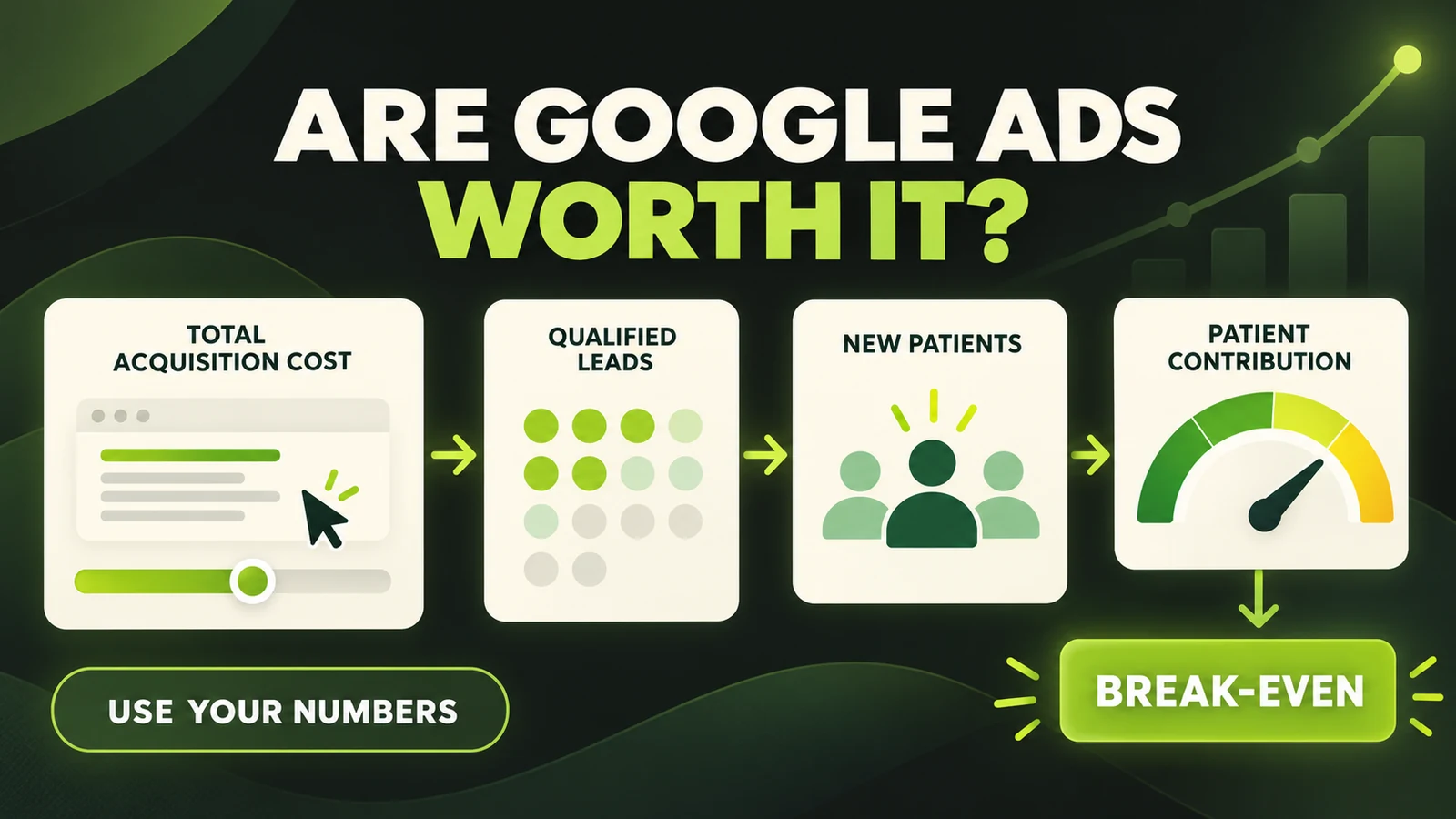
The short answer
Google Ads can be worth it for a small cash-pay practice, but only when the economics work after every meaningful cost is counted. A campaign is not successful because it produced clicks, forms or even booked consultations. It is successful when it acquires suitable patients at a cost the practice can sustain while protecting capacity and margin.
The decision rests on four numbers: patient contribution, total acquisition cost, lead-to-patient rate and collection timing. If those numbers are unknown, the honest answer is not yes or no. It is: establish the inputs, run a controlled test and compare acquired patients with the pre-agreed threshold.
1. Define what “worth it” means
For a cash-pay clinic, return is easier to connect to collected revenue than it may be for an insurance-dependent model. That still does not make gross revenue the right comparison. Delivering care consumes clinician time, supplies, laboratory administration, payment fees and other variable resources. Advertising must fit inside what remains.
Choose a clear evaluation window. A single consultation may be the right window for a one-off service. A 90-day or six-month window may better reflect a care program, membership or follow-up plan. Use cash actually collected within that window, not an optimistic lifetime estimate.
Decision standard: define a maximum acceptable acquisition cost before launch. Judge the campaign against acquired patients and contribution, while using leads as an earlier diagnostic signal.
2. Calculate patient contribution first
Patient contribution is the amount available to cover fixed overhead, marketing and profit after the variable cost of serving that patient. It is more useful than headline patient value because two practices collecting the same revenue can have very different delivery costs.
Include only revenue reasonably attributable to an acquired patient within the chosen period. Subtract costs that rise when another patient is treated: clinician compensation tied to visits, lab or supplement costs absorbed by the practice, consumables, card fees and similar items. Keep fixed rent and general payroll separate unless the added volume requires extra staffing or hours.
If contribution varies substantially by service, calculate it by service line. Blending a high-value program with a low-value one can make an underperforming campaign look healthier than it is.
3. Set an allowable patient acquisition cost
Break-even acquisition cost is not automatically an acceptable target. Spending the entire patient contribution to acquire the patient leaves nothing from that patient to support fixed costs or profit. Set an allowable cost below break-even based on the clinic’s margin objective and risk tolerance.
If patient contribution is $850 and the practice allocates 40% of it to acquisition, the allowable patient acquisition cost is $340. The 40% is a management choice, not an industry standard. A new practice with spare capacity may accept a different threshold from a full practice hiring its next clinician.
Google’s own guidance recommends measuring conversions to calculate campaign value and assigning conversion values to understand business impact. For a clinic, that means looking beyond the initial inquiry and connecting reporting to a meaningful downstream outcome, subject to appropriate privacy review.
4. Translate patient economics into a break-even cost per lead
Ad platforms usually surface a cost per lead before the clinic has enough acquired-patient data. Translate your allowable patient acquisition cost into a lead threshold using the proportion of qualified leads that become paying patients.
With a $340 allowable acquisition cost, a 10% lead-to-patient rate supports a $34 qualified lead; a 20% rate supports $68; and a 30% rate supports $102. This is why a universal “good CPL” is misleading. The same $80 lead can be unprofitable for one intake process and sustainable for another. For the intermediate operating metric, use our framework for measuring cost per booked consultation from clinic-owned booking data.
| Lead-to-patient rate | Allowable patient acquisition cost | Allowable qualified-lead cost |
|---|---|---|
| 10% | $340 | $34 |
| 20% | $340 | $68 |
| 30% | $340 | $102 |
Use qualified leads, not every call or form. Wrong-service inquiries, job seekers, spam and callers outside the service area should not be allowed to inflate performance. Our clinic conversion-tracking guide explains how to separate useful conversion actions.
5. A worked break-even example
Illustrative planning scenario: the following figures are invented to demonstrate the calculation. They are not client results, promises or market benchmarks. Replace every number with your practice data.
Assume a small cash-pay practice expects $1,200 in collected revenue from a newly acquired patient during the first 90 days. Variable delivery costs are $350, leaving $850 of patient contribution.
The clinic plans $2,400 in ad spend and $900 for campaign management, landing-page work and measurement during the month. Total acquisition cost is therefore $3,300. The practice needs four new patients to pass strict break-even because $3,300 divided by $850 equals 3.88.
If 25% of qualified leads become acquired patients, the clinic needs approximately 16 qualified leads to produce four patients. At that volume, the full-cost break-even CPL is $206.25: $3,300 divided by 16. Alternatively, $850 contribution multiplied by a 25% close rate gives $212.50 per lead before allowing for rounding. The small difference shows why planning and final reporting should use actual counts.
Breaking even is not the same as meeting the desired return. If the clinic sets an allowable acquisition cost of $340 per patient, four patients support only $1,360 in total acquisition cost. At the assumed $3,300 cost, the campaign would need ten acquired patients to come under that target. That sharper standard prevents gross revenue from disguising weak economics.
6. Count the full acquisition cost and the cash lag
Ad spend alone understates the cost of patient acquisition. Include agency or freelancer fees, landing-page production, call tracking, software and the staff time needed to respond and qualify. Separate durable setup work from recurring monthly cost, but show both so the decision is transparent. Our clinic Google Ads cost guide provides a fuller budgeting framework.
Timing matters too. Google charges while leads arrive, but a patient may book weeks later, attend later still and pay in installments. A profitable campaign can create short-term cash pressure. Track booked, attended and collected milestones by acquisition month so later revenue is credited to the correct cohort.
Refunds, cancellations and no-shows should reduce realized value. Do not count the full program value when only the deposit was collected unless historical completion and collection rates justify that forecast.
7. Five tests before a small practice spends
Search demand
Patients actively search for the service using terms the clinic can target within its actual geography.
Economic room
Patient contribution supports acquisition after management, tracking and delivery costs.
Capacity
The practice can answer quickly, schedule suitable patients and deliver care without harming service.
Conversion path
The landing page explains the service, location, pricing context and next step without unnecessary friction.
Measurement
Calls, forms, qualified leads, bookings, attendance and acquisition can be reconciled without exposing inappropriate data.
Google Ads is often a poor fit when the practice has no one to answer leads, cannot define a suitable patient, has very low contribution per patient, expects a tiny budget to prove results immediately or cannot track past the form submission. Fixing those constraints usually improves the answer more than changing bids.
If the practice has time but limited immediate budget, organic search may deserve priority. If it needs controllable demand now and can fund a proper test, paid search may come first. See our Google Ads versus SEO comparison for that channel decision.
8. Run a controlled 90-day test
- Set the economics: define the revenue window, patient contribution, allowable acquisition cost and maximum test loss.
- Narrow the offer: start with one service, a realistic location and high-intent searches rather than advertising everything.
- Prepare intake: assign ownership, response-time expectations, qualification questions and a consistent follow-up process.
- Track stages: record spend, valid leads, qualified leads, bookings, attended consultations, acquired patients and collected contribution.
- Review weekly: remove irrelevant search terms, check lead quality and verify tracking without judging profitability from a handful of clicks.
- Decide by thresholds: continue, change or stop based on cost per acquired patient and evidence about where the funnel is leaking.
A 90-day window is a planning structure, not a guarantee that every market will produce enough data. A low-volume specialty may require more time, while an obviously irrelevant campaign should be corrected sooner. Before increasing spend, confirm that marginal leads remain qualified and the team has capacity.
Frequently asked questions
Is Google Ads worth it for a small cash-pay practice?
It can be, when contribution margin, demand, intake, capacity and tracking support the required patient acquisition cost. The financial answer should use acquired patients and collected contribution, not clicks alone.
What is a good cost per lead?
There is no universal number. Multiply your allowable patient acquisition cost by the percentage of qualified leads that become patients. Recalculate when intake performance or service mix changes.
Should the calculation use revenue or profit?
Use patient contribution: collected revenue within a defined window minus variable delivery cost. Then reserve enough contribution for fixed costs and desired profit when setting the allowable acquisition cost.
How long should a clinic test Google Ads?
Use a defined test window and budget, but require enough qualified-lead and patient data to support the decision. Account for the delay between the click, appointment, attendance and collection.
What counts as a conversion?
Track stages separately. A form or connected call is an early conversion; an attended consultation and acquired patient are deeper outcomes. The campaign economics ultimately depend on real patients and contribution.
Make the decision with your numbers
Google Ads is worth testing when a small cash-pay practice knows what a patient contributes, can turn qualified inquiries into patients and can measure the full cost. The break-even formulas make the risk visible before the first click and create an objective standard for scaling or stopping.
For broader allocation decisions, use our functional medicine marketing budget guide. If you want help building a focused campaign and a clinic-specific scorecard, book a strategy call.