
The short answer
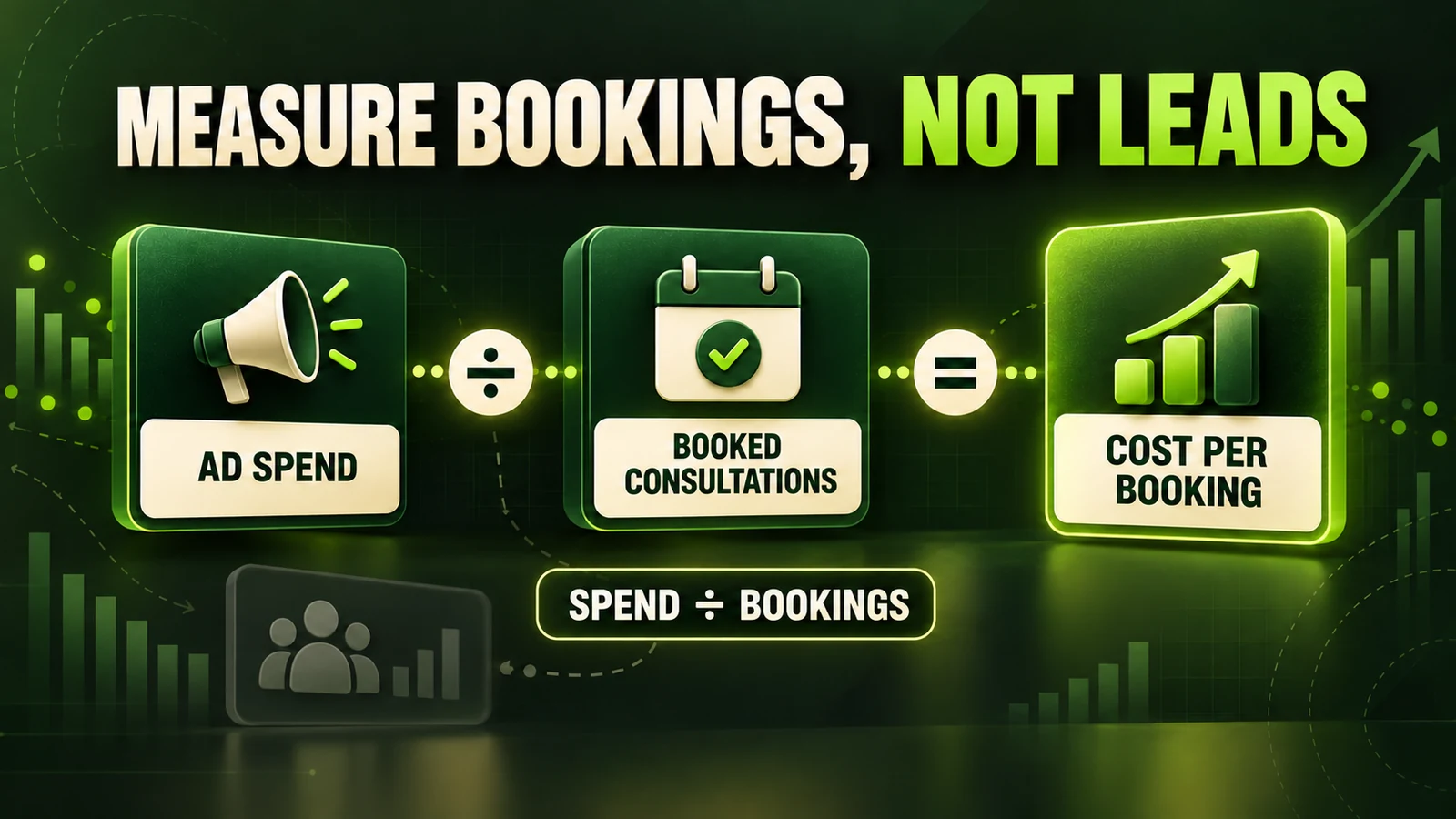
To measure cost per booked consultation, divide the marketing spend for one channel and enquiry cohort by the number of unique new-patient consultations that cohort placed in the clinic’s calendar.
Do not use a form submission, phone-button click or unanswered call as the denominator. Confirm the booking in the clinic’s scheduling or practice-management system and connect it back to the original enquiry. Keep booked, attended and acquired-patient costs separate because each answers a different question.
Why this is better than cost per lead: cost per lead shows what an enquiry costs. Cost per booked consultation shows what it costs to put an actual new-patient appointment in the diary. It reflects both marketing quality and what happens after the enquiry arrives.
1. Define exactly what counts as a booked consultation
A useful metric starts with a rule that reception, marketing and clinic leadership apply in the same way. Count a booking when a unique prospective patient has a confirmed date and time for the specific new-patient appointment being measured.
Exclude spam, tests, vendor calls, existing-patient appointments and enquiries for services the clinic does not provide. Do not count “interested,” “callback requested” or “booking page opened” as booked. If one patient reschedules, preserve one acquired booking and update its status instead of creating a second marketing outcome.
| Stage | Count it when | Do not confuse it with |
|---|---|---|
| Valid lead | A real prospective patient makes a relevant enquiry | A click, duplicate, spam submission or current-patient request |
| Booked consultation | A unique new patient has a confirmed appointment time | Intent to book or a scheduler visit |
| Attended consultation | The appointment occurred | A confirmation, cancellation or no-show |
| Acquired patient | The person begins the clinic’s defined paid care pathway | A consultation that did not proceed |
If the clinic offers free discovery calls and paid initial consultations, report them separately. They have different commitment levels and economics, so blending them produces a number that cannot guide either offer.
2. Choose media-only or fully loaded cost
Use two versions rather than debating which one is “correct.”
Media cost per booking
Ad spend divided by booked consultations. Use this to compare campaigns, services, locations and search themes inside the same channel.
Fully loaded cost per booking
Ad spend plus attributable management, creative, landing-page and measurement costs, divided by booked consultations. Use this for budgeting and commercial decisions.
Apply the same scope every period. A report that includes agency fees in October but excludes them in September creates a false trend. Shared costs can be shown separately or allocated by a documented rule, such as campaign spend share; do not quietly place them wherever the result looks best.
You can also derive the media figure from cost per valid lead and booking rate:
If a valid lead costs $60 and 30% book, the cost per booked consultation is $200. This is an illustrative equation, not a clinic benchmark.
3. Build one row per unique enquiry
You do not need a complex CRM to start. A controlled spreadsheet can work if one person owns it and the clinic handles personal information in an approved way. Create one row for each unique enquiry with:
- a non-sensitive internal enquiry ID;
- the date and time the enquiry arrived;
- source, channel, campaign and service requested;
- lead status: valid, duplicate, spam, current patient or out of scope;
- contacted and qualified status;
- booking status and original booking date;
- appointment status: scheduled, rescheduled, cancelled, no-show or attended; and
- acquired-patient status when the clinic can define and maintain it reliably.
For calls, connect the call record to the scheduling outcome rather than assuming a long call booked. For forms, prevent the thank-you event and the same person’s later phone call from becoming two leads. Our clinic call-tracking guide explains the difference between a call and a qualified call outcome.
4. Attribute bookings to the enquiry cohort, not the calendar date alone
The most common reporting error is dividing October spend by every consultation booked during October. Some of those patients first enquired in September, while some October enquiries will book in November. The numerator and denominator describe different populations.
Instead, group enquiries by the date they entered the funnel. An enquiry received on October 29 belongs to the October cohort even if the person books on November 3 and attends on November 18. Update the October cohort as it matures.
Choose a reporting delay based on the clinic’s observed time from enquiry to booking. Label recent cohorts “incomplete” rather than presenting an inflated cost as final. Google likewise warns that conversion lag can make recent CPA appear higher before delayed conversions arrive.
Keep two dates: lead-created date determines the marketing cohort; appointment date determines capacity and operational reporting. One date should not replace the other.
5. Compare campaigns beyond cost per lead
The following figures are hypothetical and illustrate the arithmetic only.
| Metric | Campaign A | Campaign B |
|---|---|---|
| Ad spend | $2,400 | $2,400 |
| Valid leads | 48 | 30 |
| Cost per valid lead | $50 | $80 |
| Booked consultations | 12 | 15 |
| Cost per booked consultation | $200 | $160 |
| Attended consultations | 9 | 12 |
| Cost per attended consultation | $266.67 | $200 |
Campaign A appears stronger on cost per lead. Campaign B is stronger on booked and attended consultations. That does not automatically make Campaign B profitable; contribution, treatment starts and capacity still matter. It does show why optimizing only toward cheap enquiries can send budget in the wrong direction.
6. Segment cost per booked consultation where decisions differ
A blended clinic number is useful for leadership, but it can hide actionable differences. Break the result down by:
- channel and campaign: Google Ads, organic search, directories or referral initiatives;
- service: keep offers with different fees, demand and patient pathways separate;
- location or provider: only where capacity and eligibility genuinely differ;
- lead route: phone, form and direct online booking; and
- new-patient appointment type: free discovery call versus paid initial consultation.
Do not slice a small data set until every cell contains one or two bookings. Start at the level where decisions are made and widen the date range when volume is low. Compare each segment with its own history rather than an unsupported internet benchmark.
7. Run a monthly reconciliation
- Export campaign spend for the chosen cohort period.
- Deduplicate the lead log and apply the written validity rules.
- Match bookings to the original enquiry using timestamp, contact details or an internal ID inside approved systems.
- Update cancellations, reschedules, attendance and acquired-patient status without duplicating people.
- Mark unmatched bookings as unattributed instead of guessing their source.
- Calculate media-only and fully loaded costs with clearly labelled denominators.
- Freeze the report after the normal booking lag, while retaining an audit trail for late corrections.
Reconcile the ad platform, call-tracking log, form notifications and appointment book. If the totals disagree, fix the record before debating campaign quality. Our guide to why clinic leads do not become booked appointments helps diagnose what the stage-by-stage data reveals.
8. Feed booking outcomes back to Google Ads carefully
A manual report tells the clinic what happened. An offline outcome connection can also tell Google Ads which ad interactions later became bookings. Google’s current enhanced-conversions-for-leads workflow can use hashed first-party data to improve matching, and Google directs current implementations toward Data Manager.
Create separate conversion actions for lead submission, qualified lead, booked consultation and any later outcome you can maintain accurately. Google distinguishes primary conversion actions used for bidding from secondary actions used mainly for observation. Do not make every micro-action primary or import bookings until the data is stable and deduplicated.
Implementation also requires a privacy review. HHS advises HIPAA-regulated entities to evaluate whether tracking technologies receive protected health information and to meet applicable Privacy, Security and Breach Notification obligations. Keep diagnoses, treatment details and free-text clinical information out of advertising-platform uploads. Obtain qualified privacy and legal advice for the clinic’s specific systems and jurisdiction.
Our Google Ads conversion-tracking guide for clinics covers conversion actions, testing and booking-system connections in more detail.
9. Use the metric without overvaluing it
Cost per booked consultation is a strong weekly operating metric because it matures faster than patient revenue. It is not the final financial answer. Pair it with show rate, cost per attended consultation, acquired-patient cost and patient contribution.
A falling cost per booking is not an improvement if no-shows rise or the booked people are unsuitable for the advertised service. Conversely, a higher cost per booking may be sustainable for a service with stronger attendance and contribution. Use the metric to locate change, then use downstream outcomes to decide whether to scale.
For the financial ceiling, see our guide to evaluating Google Ads for a cash-pay practice and the related framework for patient lifetime value versus acquisition cost.
Frequently asked questions
How do you calculate cost per booked consultation?
Divide channel or campaign spend for a defined enquiry cohort by unique new-patient consultations booked from that cohort. State whether the numerator is media-only or fully loaded.
Is cost per booked consultation the same as cost per acquisition?
No. A booking can cancel, no-show or fail to become a paying patient. Patient acquisition cost uses the clinic’s defined acquired-patient outcome and usually includes all acquisition costs.
Should cancelled appointments count?
Keep the original booking in the booked count, then report cancellation and attendance separately. If the person reschedules, do not count another newly acquired booking.
Should bookings be grouped by booking date or lead date?
For marketing measurement, assign the outcome back to the lead-created cohort. Use appointment date separately for capacity and operations.
Can Google Ads calculate this automatically?
Only if the clinic captures booking outcomes and connects them reliably to the original ad interaction. Begin with a reconciled internal report, then automate after the definitions, privacy review and data quality are sound.
Make the appointment book part of marketing measurement
Cost per lead is still useful for diagnosing ad and landing-page performance, but it should not be the finish line. Connect each enquiry to its booking status, keep cohorts consistent and let booked, attended and acquired-patient outcomes guide larger budget decisions.
Wellness Practice Marketing can help connect campaigns, calls, forms and clinic booking outcomes into a practical reporting system. To improve what your marketing is measured against, book a strategy call.