
The short answer
If your clinic receives leads but few booked appointments, do not assume you need more traffic. The loss may happen because enquiries are invalid, calls go unanswered, follow-up has no owner, staff cannot answer basic non-clinical questions, suitable appointments are unavailable, or the booking process creates too much work.
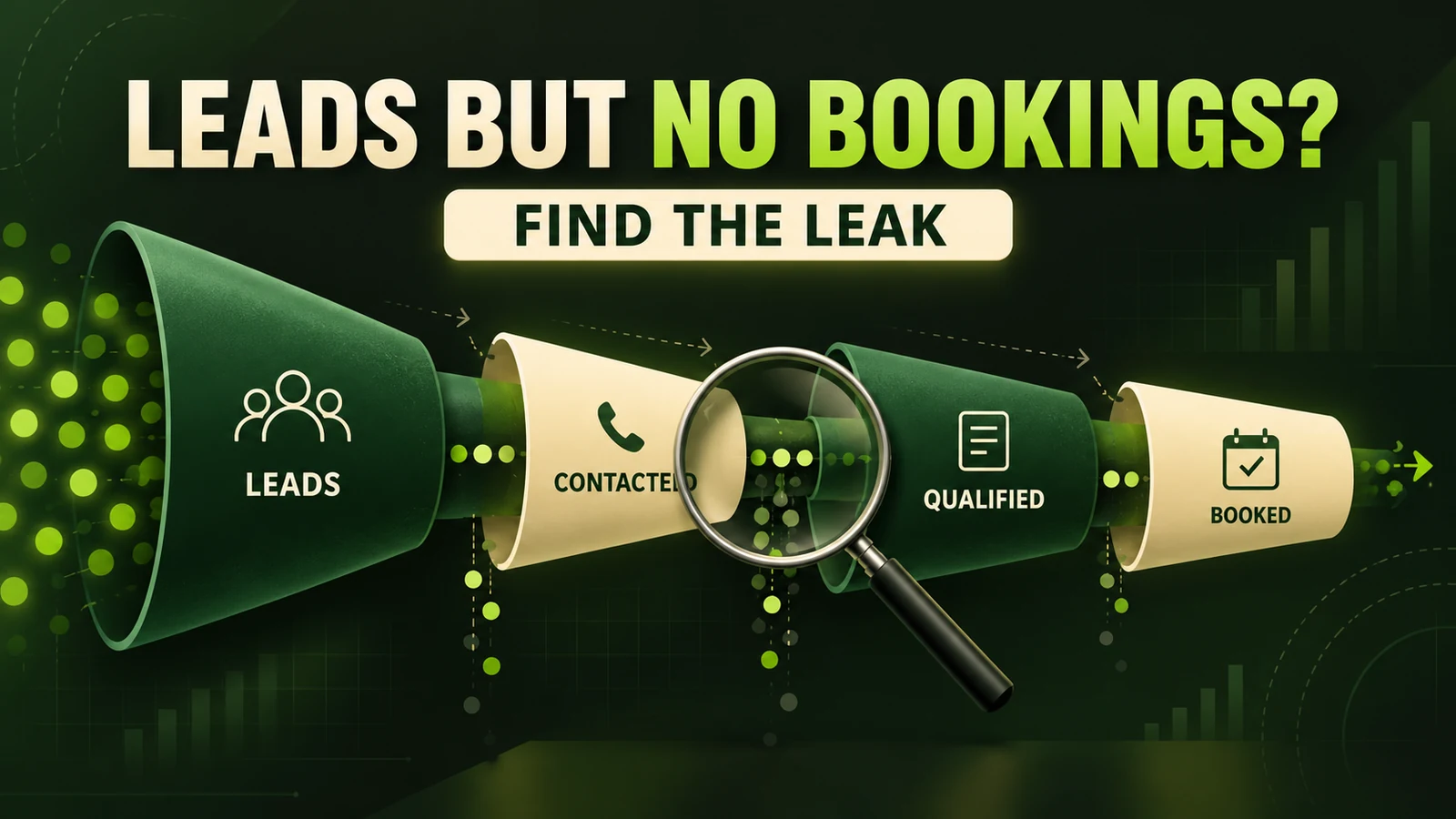
Separate the journey into measurable stages: valid enquiry, contacted, qualified, appointment offered, booked and attended. Then repair the stage with the largest fall rather than changing ads, staff scripts and website pages at the same time.
A lead is not an appointment. A form submission or phone call indicates interest. It does not tell you whether the person is eligible, reached, ready, offered a suitable time or confirmed on the calendar.
1. Define the patient acquisition stages
Many clinic reports jump from “leads” to “new patients.” Everything in between becomes invisible. Give each enquiry one current status and a clear definition.
| Stage | Definition | What a drop may indicate |
|---|---|---|
| Valid enquiry | A real person asking about a service the clinic may provide | Spam, wrong geography, wrong service or poor targeting |
| Contacted | Two-way contact occurred, not merely a voicemail left | Slow response, missed calls, bad details or weak follow-up |
| Qualified | The enquiry meets the clinic’s documented non-clinical fit criteria | Message mismatch, eligibility or affordability mismatch |
| Appointment offered | A suitable next step and real time options were provided | Unclear process, no capacity or staff uncertainty |
| Booked | A date and time are confirmed in the scheduling system | Booking friction, trust concerns or unresolved questions |
| Attended | The person completed the initial appointment | Weak confirmation, reminders, expectations or rescheduling |
Use “qualified” carefully. It should mean objective fit for the advertised next step, not a receptionist making a clinical judgment. Clinical appropriateness belongs with licensed professionals under the clinic’s approved process.
2. Measure the leak before explaining it
Choose a recent period with enough enquiries to review individually. Export calls, forms and scheduler activity, remove duplicates and connect each record to its final outcome. Calculate:
- Contact rate: contacted enquiries ÷ valid enquiries.
- Qualification rate: qualified enquiries ÷ contacted enquiries.
- Lead-to-booking rate: booked appointments ÷ valid enquiries.
- Qualified booking rate: booked appointments ÷ qualified enquiries.
- Show rate: attended initial appointments ÷ booked initial appointments.
Always label the denominator. A clinic can report a strong qualified booking rate and still have a weak overall result if most enquiries are never contacted. Do not combine calls, form submissions and booking confirmations into one conversion total without showing what each action means.
There is no universal “good” rate for every specialty, price point and acquisition channel. Establish your clinic’s baseline by service and source, then improve it. Competitor articles often publish precise conversion benchmarks without showing a comparable population or method; your own complete funnel is more actionable.
3. Fix response time and ownership
Clinics lose enquiries when a form enters a shared inbox, a missed call has no callback task, or two people assume the other person will respond. Every channel needs an owner, backup owner and response expectation that the clinic can actually staff.
During business hours
Route calls to a named team, create an alert for each form, and record the first attempted and first successful contact.
Outside business hours
Acknowledge receipt, state when a person will respond, provide urgent-care directions where appropriate, and create the next open-hours task.
An automated acknowledgement is useful, but it is not the same as contact. Measure both. Review calls that rang without an answer, reached voicemail, disconnected early or arrived during lunch and handoffs. Our clinic call-tracking guide explains how to distinguish a dial from a connected, meaningful call.
Use the person’s permitted contact method and follow the clinic’s privacy, consent and communications requirements. Keep confirmations useful and avoid placing sensitive health details in advertising or unapproved messaging systems.
4. Make the intake conversation clear, human and bounded
A person contacting a clinic often has three practical questions: Can you help with this type of concern? What happens first? What will it cost and when can I be seen? If staff cannot answer the non-clinical parts, the conversation stalls.
A useful opening is: “Thank you for contacting us about [service]. I can explain how the first appointment works, the current fee and available times. What would be most helpful to clarify first?” Answer the question asked before launching into a long script.
Give staff a reviewed reference covering services, provider credentials, fees and what they include, payment or insurance position, locations, telehealth eligibility, initial appointment length and the next available times. Also define when to transfer a question to a clinician.
Intake staff should not diagnose, recommend treatment, promise outcomes or pressure every caller to book. Their job is to create clarity, determine basic administrative fit and offer the correct next step. If the person is not ready, ask permission for an appropriate follow-up instead of treating the enquiry as lost.
5. Remove friction between “yes” and confirmation
Even a qualified, interested person can abandon the process if the clinic sends them to an unfamiliar portal, requires account creation, asks for detailed medical history before showing availability, or makes them repeat information.
Test the journey on a phone. Can someone see the consultation fee or receive a clear answer? Can they view appropriate availability? Are service and provider choices understandable? Does the confirmation explain what happens next? Keep the first enquiry form focused on the information needed to respond safely; collect full clinical intake in the proper system at the proper time.
If the desired appointment is unavailable, do not leave the person at a dead end. Offer the nearest suitable time, a waitlist, another eligible provider or a clear explanation of the next availability. Record “no suitable availability” separately from “price concern” and “could not contact.”
6. Decide whether the problem is lead quality or intake
Low booking volume can start upstream or downstream. The pattern tells you where to work.
| Pattern | Likely area to inspect | First action |
|---|---|---|
| Many invalid or out-of-area enquiries | Ads, keywords, location settings or landing-page promise | Segment by search term, campaign, service and geography |
| Valid enquiries rarely reached | Response workflow and contact data | Audit missed calls, delays and follow-up ownership |
| Reached enquiries rarely qualify | Offer, price, service scope or targeting mismatch | Compare the ad and page promise with real eligibility |
| Qualified enquiries rarely book | Intake conversation, trust, availability or booking UX | Review outcomes and test the complete booking path |
| Booked patients often do not attend | Confirmation, expectations and reminder workflow | Audit timing, clarity and rescheduling options |
Compare channels fairly. A lower-cost campaign may generate more form fills but fewer qualified bookings. A campaign with a higher cost per lead may be more efficient after qualification and attendance. This is why clinic conversion tracking must connect marketing activity to outcomes beyond the thank-you page. Use our guide to measuring cost per booked consultation to turn those outcomes into a comparable campaign metric.
7. Run a seven-day lead-to-booking audit
For seven consecutive days, maintain one row per unique enquiry. Include only the minimum information necessary for the operational review, store it in an approved system and restrict access appropriately.
- Record date and time received, channel, campaign or source, and service requested.
- Mark the enquiry valid, duplicate, spam or out of scope using written rules.
- Record the first response attempt and first successful two-way contact.
- Mark qualified or not qualified and use a standardized non-clinical reason.
- Record whether an appointment was offered and the earliest suitable time.
- Record booked, not booked, cancelled, rescheduled and attended outcomes.
- Assign one reason when no booking occurs: unreachable, wrong service, wrong geography, no capacity, fee mismatch, insurance mismatch, needs information, not ready, chose another provider or unknown.
At the end of the week, total each stage by service and source. Read a sample of form enquiries and, where lawfully recorded and appropriately governed, review call outcomes for clarity and accuracy. Choose the largest verified leak and one intervention. Re-measure before changing the next variable.
For cash-pay practices, the same reason categories can reveal whether the issue is the fee itself or uncertainty about what it includes. Our cash-pay medical practice marketing guide covers positioning and the patient decision path in more depth.
8. Send better outcomes back to Google Ads
If Google Ads treats every form fill as the primary success, automated bidding can favor campaigns that create easy enquiries rather than booked patients. Google distinguishes primary conversion actions used for bidding from secondary actions used mainly for observation. Configure them deliberately and avoid counting the same enquiry twice.
Once the clinic can reliably record downstream outcomes, evaluate importing qualified leads or booked appointments through Google’s current enhanced-conversions-for-leads workflow. As of 2026, Google directs implementations toward Data Manager and its unified enhanced-conversions setting. This is a technical and privacy project, not a spreadsheet upload to improvise: review data collection, consent, platform terms and healthcare privacy obligations before implementation.
HHS advises HIPAA-regulated entities that tracking technologies can create obligations when protected health information is disclosed. Have qualified privacy and legal professionals review the clinic’s exact tools and data flow. Better optimization never justifies sending sensitive clinical details to an advertising platform.
Frequently asked questions
What is the difference between a lead and a booked appointment?
A lead is an enquiry. A booked appointment has accepted and confirmed a date and time. Keep both stages separate in reporting.
How should a clinic calculate booking rate?
Report booked appointments divided by valid enquiries and booked appointments divided by qualified enquiries. Label each denominator so the metric cannot be misunderstood.
Does a low booking rate prove the leads are poor?
No. Missed contact, unclear answers, unavailable appointments, trust gaps and booking friction can all reduce bookings from otherwise suitable enquiries.
Should intake staff persuade every lead to book?
No. Staff should answer non-clinical questions, explain the process and offer an appropriate next step without diagnosing, promising outcomes or applying pressure.
What should we track after a form or call?
Track source, service, validity, response time, contact, qualification, appointment offer, booking, attendance and the standardized reason when a booking does not occur.
Fix the leak before buying more leads
A clinic with enquiries but an underfilled calendar does not have one generic conversion problem. It has a specific break somewhere between targeting, response, intake, availability and confirmation. Make the stages visible, fix the largest break and judge marketing by qualified bookings and attended appointments.
Wellness Practice Marketing can help connect campaign data, website enquiries, call outcomes and booking performance into one practical acquisition system. To identify the highest-impact improvements, book a strategy call.
Research sources
- Google Ads Help: Primary and secondary conversion actions
- Google Ads Help: Enhanced conversions for leads
- HHS: Use of online tracking technologies by HIPAA regulated entities
- QVitals: Healthcare lead-to-appointment workflow analysis
- Content Hall: Lead-stage and response analysis
- Zocdoc: Online booking experience analysis