
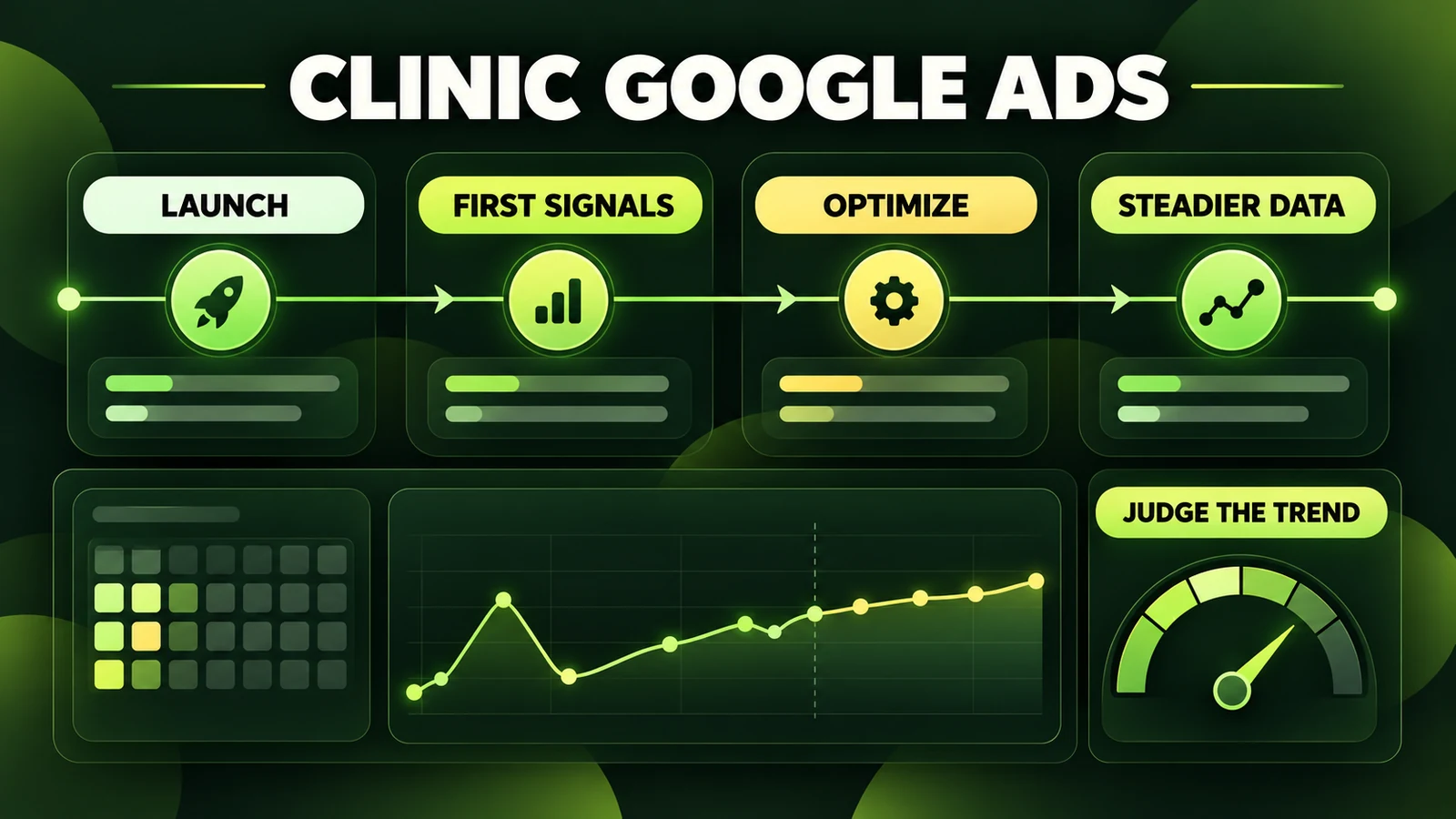
How long does Google Ads take to work for a clinic? An eligible Search campaign can begin generating impressions and clicks shortly after approval. That does not mean the clinic can judge profitability on day one. A useful decision usually needs several weeks of accurate conversion tracking, search-term review and qualified-lead feedback, followed by enough conversion cycles to see whether the pattern is improving.
The timeline depends on search demand, budget, geography, service type, competition, bidding, landing-page quality, tracking and how quickly the clinic answers enquiries. Google can deliver traffic; it cannot repair a missed-call process or turn an unclear offer into a strong one.
This guide explains what can reasonably be learned at each stage. For setup and campaign structure, read our Google Ads guide for functional medicine. For budget planning, use our guide to clinic Google Ads costs.
Practical answer: first traffic may arrive within days, early lead signals may appear in the first few weeks, and a more reliable acquisition trend often needs multiple conversion cycles. None of those milestones guarantees profitability.
Four Different Clocks Start at Launch
“Working†can refer to four different outcomes. Separating them prevents unrealistic expectations.
| Clock | What it answers | Evidence to check |
|---|---|---|
| Approval and serving | Can the ads enter auctions? | Eligible status, impressions, policy details |
| Traffic | Are relevant people clicking? | Search terms, location, click volume, landing-page engagement |
| Conversion | Are visitors contacting or booking? | Completed forms, qualified calls, confirmed appointments |
| Patient economics | Are acquired patients financially sustainable? | Qualified leads, attended visits, patient value, total channel cost |
A campaign can pass the first two clocks and fail the next two. Impressions and clicks prove that the campaign is active, not that it is profitable. Likewise, a conversion in Google Ads is not automatically a new patient. The clinic must reconcile platform actions with real lead and booking outcomes.
Before Launch: Build the Measurement Foundation
The timeline begins before the switch is turned on. Confirm the priority service, service area, patient value, affordable acquisition cost and who will respond to enquiries. Build a dedicated landing page, configure completed forms and qualified calls, and test every conversion action.
Submit ads early when a fixed opening date matters. Google says most ads are reviewed within one business day, although complex reviews can take longer. Editing an ad or asset restarts review. Healthcare language, destinations and claims should be checked before launch rather than rewritten repeatedly after the planned start date.
Days 1–7: Verify Serving and First Signals
In the first week, ask operational questions:
- Are ads approved, eligible and receiving impressions in the intended locations?
- Do visible search terms match the service being promoted?
- Are clicks reaching the correct page on mobile and desktop?
- Do test forms, calls and bookings register once in the correct account?
- Can the front desk identify the source and respond promptly?
Leads can arrive during this period, but they are not guaranteed. One lead is not proof of a winning campaign, and a few lead-free days are not proof of failure. Low local search volume or a longer patient decision cycle can make the first week sparse.
Weeks 2–4: Fix Relevance and Conversion Leaks
Once searches and clicks accumulate, remove clear mismatches, refine match types and improve ad-to-page relevance. Our guide to negative keywords for health clinics explains how to block irrelevant intent without suppressing qualified searches.
Review leads with the people who answer the phone. A tracked call may be an existing patient, vendor or wrong-number enquiry. A form may be spam or outside the service area. Platform conversion totals only become useful when the clinic distinguishes a tracked action from a qualified opportunity.
Avoid changing budget, bidding, keywords, ads and the landing page all at once. If every variable moves weekly, the team cannot tell which change helped. Fix definite errors immediately, but group discretionary tests and record their dates.
Months 2–3: Look for a Direction, Not a Perfect Average
By the second and third months, there may be enough data to compare query themes, services, devices and lead quality. “May†matters. A small clinic campaign with limited demand can still have too few qualified outcomes for confident conclusions.
Assess a rolling pattern rather than one attractive week. Compare total spend, qualified enquiries, booked consultations and acquired patients. Investigate whether performance depends on branded searches, one campaign, one device or one unusually strong month. The goal is to find a repeatable source of demand, not merely a favorable blended number.
What the Google Ads Learning Period Actually Means
Automated bid strategies may show a Learning status after a new strategy or meaningful setting or composition change. Google says the duration is driven mainly by conversion volume, the length of the conversion cycle and the bid strategy. Calibration typically takes a few conversion cycles—often one or two—but can be faster or slower.
The label disappearing does not mean the campaign is finished learning, and the absence of the label does not prove profitability. Google states that its algorithms continue learning afterward. Manual CPC does not use this learning-period status.
Repeated major edits can send a strategy back into calibration. That is why a controlled test plan matters. Do not leave obvious waste untouched, but do not reset the campaign every time a daily number moves.
Conversion Delay Makes Recent Performance Look Worse
A patient may click today, research the clinic, speak with a partner and submit a form later. Google calls the gap between the ad interaction and recorded action conversion lag. Because spend appears before all delayed conversions arrive, recent cost per conversion can initially look higher than it will after the reporting window matures.
Google recommends using the Days to conversion report and selecting an analysis period old enough to contain complete data. Clinics should also measure the delay between lead, booked consultation, attended visit and paid care in their own CRM. Advertising delay and patient-acquisition delay are related but not identical.
One Anonymized Clinic Account: Why the First Month Is Not the Verdict
The following is verified Google Ads data from one multi-service wellness clinic in Arizona, covering Search campaigns. It is not an industry benchmark. The account’s conversion definitions include fractional values, so the table reports tracked conversions—not confirmed leads, appointments or patients.
| Month | Spend | Tracked conversions | Cost per conversion |
|---|---|---|---|
| October 2025 | $1,708 | 30 | $56.90 |
| November 2025 | $1,225 | 7 | $175.00 |
| December 2025 | $1,199 | 24 | $50.00 |
| January 2026 | $1,645 | 42.5 | $38.70 |
| February 2026 | $1,814 | 39.5 | $45.90 |
| March 2026 | $1,822 | 44 | $41.40 |
| April 2026 | $1,819 | 41 | $44.40 |
The first three recorded months were volatile. November produced only 7 tracked conversions at $175 each, between October at $56.90 and December at $50. From January through April, the reported cost per conversion sat in a narrower $38.70–$45.90 range.
This does not prove that every clinic stabilizes after three months, or that these conversions became patients. It shows why a single month—good or bad—can be a poor basis for a permanent decision. The next step is to audit what was counted and reconcile those actions with qualified leads and revenue.
Why Clinic Campaigns Take Longer Than Expected
- Low demand: a narrow service in a small radius may not receive enough searches.
- Insufficient auction coverage: budget, bids, rank or schedule can limit traffic.
- Search mismatch: broad targeting may attract research, jobs or unrelated services.
- Weak landing page: visitors cannot understand the offer, credibility, price context or next step.
- Broken measurement: forms or calls happen but are not recorded—or weak clicks are counted as leads.
- Slow follow-up: qualified enquiries lose momentum before the clinic responds.
- Long conversion cycle: patients need more research before contacting or booking.
How to Reach a Useful Answer Faster
- Promote one priority service with enough demand rather than dividing a small budget across many campaigns.
- Use a page built for that service and search intent.
- Track completed forms, qualified calls and confirmed bookings correctly before launch.
- Review search terms and lead quality early.
- Agree on a test budget and decision criteria in advance.
- Import or reconcile qualified outcomes instead of optimizing indefinitely to raw form volume.
- Make documented changes and allow for conversion delay before reading the result.
When to Keep Testing—and When to Stop
Pause or restrict quickly when ads violate policy, tracking is broken, the destination is unusable, traffic is clearly outside the service area, or spending exceeds a pre-agreed safety limit. Those are not learning problems.
Continue a controlled test when the campaign is reaching relevant searches, tracking works, leads are being reviewed, and the account has not yet accumulated enough mature outcomes. “Give it more time†is only responsible when the team can explain what evidence it is waiting for and when the next decision will occur.
Frequently Asked Questions
How long does Google Ads take to work for a clinic?
Traffic may begin within days of approval, but judging direction usually requires several weeks of clean data. A steadier pattern can take multiple conversion cycles and is never guaranteed by a fixed date.
How long is the learning period?
Google says automated bidding typically needs a few conversion cycles, often one or two, after a relevant change. Volume, conversion delay and strategy affect the duration.
Should a clinic expect leads in week one?
Leads can arrive, but they are not guaranteed. Use week one to validate serving, relevance, tracking and response workflow.
When should a clinic pause?
Pause promptly for policy, tracking, landing-page, relevance or safety-budget failures. Otherwise assess against qualified outcomes and a defined test plan.
Judge the Trend, Not Day One
Google Ads can start delivering clinic traffic quickly, but reliable business conclusions take longer. Separate approval, clicks, tracked conversions and acquired-patient economics. Give each stage the right evidence window, account for conversion delay, and keep the clinic’s operational follow-up inside the evaluation.
If you want a campaign launch with clear milestones, lead-quality review and no long-term contract, explore our Google Ads management for wellness clinics or reserve a call with Salem below.