
The short answer
Smart Bidding can work with low conversion volume, but a clinic should not treat automation as a substitute for clean measurement. Google can use auction-time signals beyond one keyword or campaign; it cannot rescue a conversion goal that counts spam, booking-page views or unanswered calls as equal to qualified patient inquiries.
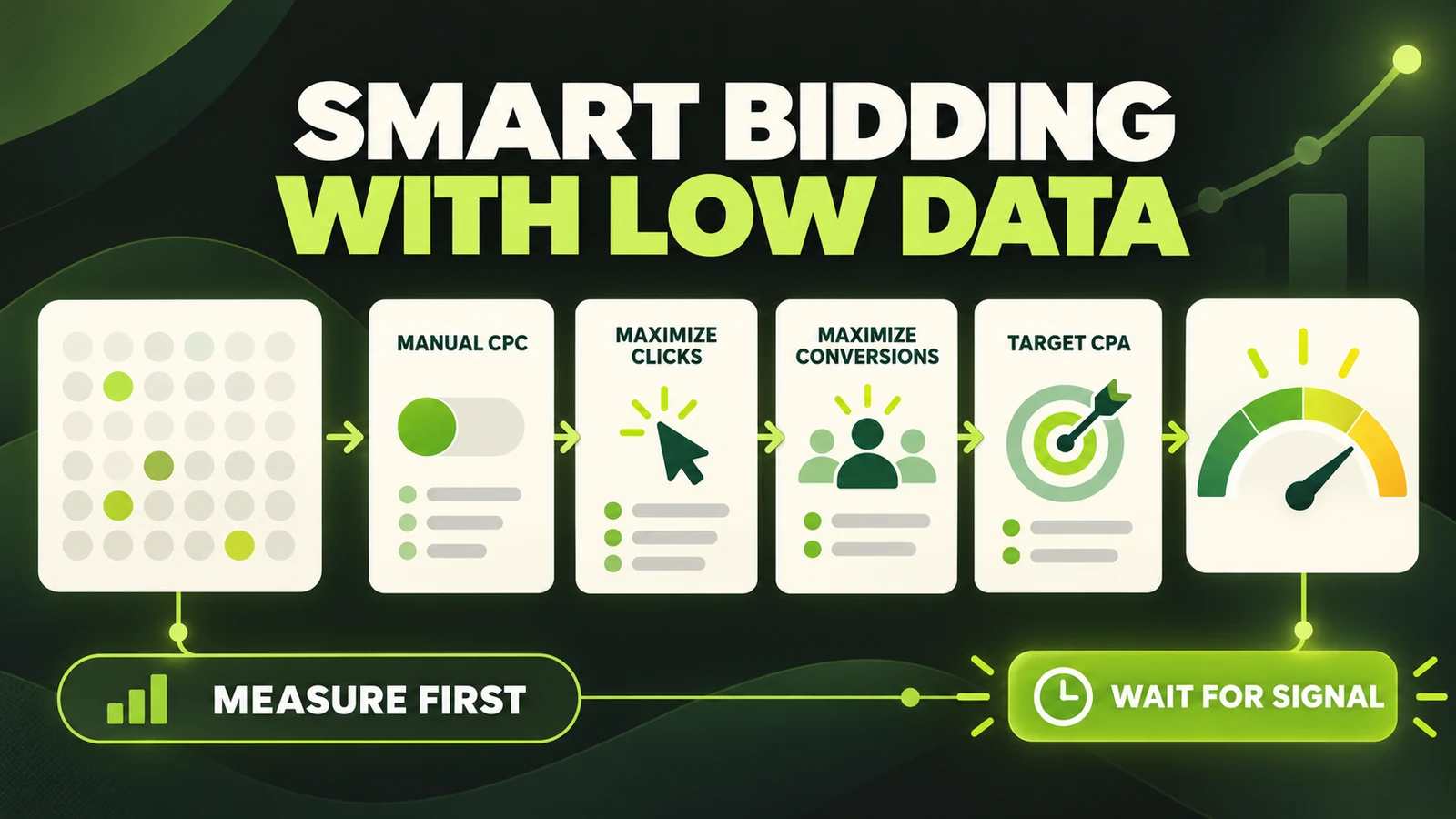
When data is sparse, use the least restrictive strategy that matches the evidence. Establish reliable primary conversions, keep the account structure concentrated, allow for conversion delay and avoid imposing an aggressive Target CPA or Target ROAS before the campaign has a credible baseline.
Core principle: low volume is not automatically a reason to avoid Smart Bidding. Low-quality, mixed or delayed conversion data is the larger risk.
1. Why low conversion volume makes bidding unstable
Smart Bidding predicts the likelihood or value of a conversion in each auction. With only a few meaningful outcomes, each new conversion has an outsized effect on the reported CPA. One additional form can make a week look excellent; one expensive week without a recorded booking can make the same campaign look broken.
Clinic data is often thin for structural reasons: a narrow service area, specialized care, a modest budget, delayed bookings or a high-value service that needs fewer patients. The answer is not to manufacture volume with weak goals. Adding page views, button clicks or every short phone call as primary conversions may give the algorithm more events while teaching it to pursue the wrong behavior.
Instead, distinguish three problems:
- Low demand: few eligible searches exist in the geography.
- Low conversion rate: traffic arrives but the offer, page or intake path does not convert.
- Low measured volume: genuine outcomes occur but tracking misses calls, forms, bookings or later qualification.
The bidding fix depends on the cause. Review our clinic conversion-tracking guide before changing strategy solely because the Conversions column looks small.
2. Compare the bidding options
| Strategy | What it optimizes | Low-volume use | Main risk |
|---|---|---|---|
| Manual CPC | Advertiser-set click bids | Controlled launch, tracking validation or very sparse demand | Misses auction-time automation and requires active management |
| Maximize Clicks | Clicks within budget | Short discovery phase when conversion tracking is not ready | More traffic does not mean more qualified leads; use a bid cap where available |
| Maximize Conversions | Conversion count within budget | Useful once primary goals are reliable, even before a precise CPA target | May spend the available budget and chase whichever primary action is easiest |
| Target CPA | Conversions around an average CPA target | Better after a realistic recent CPA baseline exists | A target set too low can restrict traffic and reduce conversion volume |
| Maximize Conversion Value | Reported conversion value within budget | Only when different outcomes have defensible values | Bad or arbitrary values redirect spend toward the wrong outcome |
| Target ROAS | Conversion value around a return target | For mature value tracking that meets platform requirements | High targets and sparse values can constrain delivery |
Maximize Clicks is automated bidding but is not Smart Bidding because it does not optimize for conversions or conversion value. Manual CPC and Maximize Clicks are temporary tools, not destinations, when the business goal is qualified patients.
3. Use thresholds as decision aids, not magic numbers
There is no single official minimum that applies to every Search Smart Bidding strategy. Google says some strategies rely on minimum historical conversion volume depending on campaign type. Search Target ROAS currently has a specific eligibility requirement: at least 15 conversions in the past 30 days at the conversion-tracking level, with conversion values set.
The ranges below are conservative planning heuristics for a small clinic, not Google requirements or performance guarantees:
| Meaningful conversions in 30 days | Practical starting point | What to do next |
|---|---|---|
| 0 or untrusted data | Manual CPC or carefully capped Maximize Clicks | Fix tracking and traffic quality before conversion bidding |
| 1–5 | Manual CPC or cautious Maximize Conversions | Consolidate structure; inspect every lead; avoid a tight target |
| 6–14 | Maximize Conversions often deserves a controlled test | Use one meaningful primary goal set and monitor conversion delay |
| 15+ | Consider Target CPA; consider Target ROAS only with valid values and eligibility | Base the initial target on recent adjusted performance, not aspiration |
Do not lower the standard to hit a threshold. Ten qualified calls are more useful than 40 mixed events that include directions clicks, ten-second calls and scheduling-page visits.
4. Why Target CPA or Target ROAS can fail early
A target is a constraint. If Target CPA is materially lower than the campaign has demonstrated, the system may enter fewer auctions and volume can fall. Google explicitly notes that a target set too low may forgo clicks that could have converted. Start near the campaign’s recent delay-adjusted CPA when a credible baseline exists, then change the target gradually after enough fresh data accumulates.
Target ROAS adds another dependency: conversion values must be meaningful. Assigning the same speculative patient-lifetime value to every form does not create value-based measurement. A spam lead, unsuitable inquiry, booked consultation and acquired patient are not equally valuable. For clinics, any import of downstream lead data also needs an appropriate privacy and compliance review.
Google recommends reporting values for four weeks or one to two conversion cycles, whichever is longer, before determining a Target ROAS and activating value-based bidding. Eligibility is therefore a floor, not proof that the value model is decision-ready.
5. Give the algorithm a stronger signal
Low-volume accounts often divide limited data across too many campaigns, services, locations and bid strategies. Consolidation can help the strategy learn from a larger pool of comparable auctions. That does not mean combining unrelated services with different economics.
- Group closely related services that share intent, geography, landing-page logic and patient value.
- Use fewer campaigns when separate campaigns do not serve a real budget, location or operational need.
- Keep one defensible primary conversion set; place diagnostic actions in secondary reporting.
- Import deeper qualified-lead or acquired-patient outcomes only when the implementation is accurate and appropriately reviewed.
- Avoid changing budgets, targets, conversion goals and structure simultaneously.
If Search itself has limited data, moving immediately to a broader campaign type does not guarantee better outcomes. Our Performance Max versus Search guide explains why broader automation requires stronger assets and measurement, not merely fewer Search conversions.
6. Respect learning time and conversion delay
Google says Smart Bidding generally needs a 7–14 day learning phase, while the calibration period can take one or two conversion cycles depending on conversion volume, conversion-cycle length and strategy. A clinic whose patients book a week after clicking should not evaluate yesterday’s spend against incomplete conversions.
Find the normal time from click to conversion, then exclude that recent period from performance judgment. If the typical delay is seven days, a report ending today contains seven days of spend that have not had the same chance to convert as older clicks. This can temporarily inflate CPA or depress ROAS.
Frequent edits create another problem. A new bid strategy, target change or campaign composition change can trigger learning. Make essential corrections when traffic is unsafe or irrelevant, but do not reset the system every few days because a small sample fluctuates. For a broader timeline, see how long Google Ads takes to work for a clinic.
7. When to switch bidding strategies
Move from click bidding to Maximize Conversions when:
- primary conversion tracking has been tested end to end;
- the selected goals represent real inquiries rather than micro-actions;
- search terms and location settings are reasonably controlled;
- the budget can tolerate automated bids while results stabilize; and
- the team can provide lead-quality feedback.
Add a Target CPA when:
- the campaign has a recent, delay-adjusted CPA baseline;
- the business has calculated an allowable acquisition cost;
- volume is sufficient to recognize a trend rather than react to one lead; and
- the initial target is realistic relative to recent performance.
Use value-based bidding when:
- conversion values reflect real business differences;
- values are reported consistently across relevant outcomes;
- the campaign meets the applicable Google eligibility requirement; and
- privacy, consent and data-handling requirements have been reviewed.
Do not switch because the interface presents a recommendation alone. Compare the recommendation with your clinic economics, goals, tracking quality and capacity. The broader Google Ads guide for functional medicine practices covers the campaign foundation that bidding depends on.
8. A low-volume clinic checklist
- Verify each primary conversion fires once and only when the intended action completes.
- Separate forms, connected calls, qualified leads, bookings and acquired patients in reporting.
- Remove weak micro-conversions from the bidding goal set.
- Review search terms, locations and lead quality before blaming the bid strategy.
- Calculate the clinic’s allowable cost per qualified lead and acquired patient.
- Check conversion delay and avoid judging the incomplete recent period.
- Consolidate compatible campaigns where fragmentation is starving each strategy.
- Choose one material change, record the date and allow an appropriate learning window.
- Review the bid strategy report, actual CPA or ROAS and total conversion volume together.
- Scale only when downstream patient quality and capacity support the extra demand.
Frequently asked questions
Does Smart Bidding work with low conversion volume?
It can. Auction-time signals may help even when one campaign has limited history, but sparse data produces wider short-term swings. Reliable conversion goals, consolidated structure and patient evaluation matter.
How many conversions are needed for Target CPA?
Google does not publish one universal minimum for Search Target CPA. Use a recent delay-adjusted CPA baseline and a realistic business target rather than treating an arbitrary count as permission to switch.
How many conversions are needed for Search Target ROAS?
Google currently requires at least 15 conversions in the past 30 days at the conversion-tracking level for Search, with valid values. More data may still be needed for a stable decision.
Should a new campaign use Maximize Clicks or Maximize Conversions?
Use Maximize Conversions when primary conversion tracking is dependable and the budget can tolerate automation. Use Manual CPC or capped Maximize Clicks for a controlled discovery phase when conversion tracking is not ready, then progress toward qualified-outcome bidding.
How long does Smart Bidding take to learn?
Google describes a standard 7–14 day learning phase and says calibration may take one or two conversion cycles. Longer conversion delays and lower volume can extend the time needed for a fair assessment.
Use automation after defining the right outcome
Smart Bidding does not need perfect data, but it needs an outcome worth pursuing. For a low-volume clinic, the strongest sequence is to validate tracking, concentrate the signal, start with a flexible strategy and add tighter CPA or ROAS constraints only when recent evidence supports them.
Wellness Practice Marketing can audit the conversion goals, campaign structure and bidding logic behind your clinic’s Google Ads account. If you want a practical low-volume plan tied to qualified patient inquiries, book a strategy call.