
The short answer
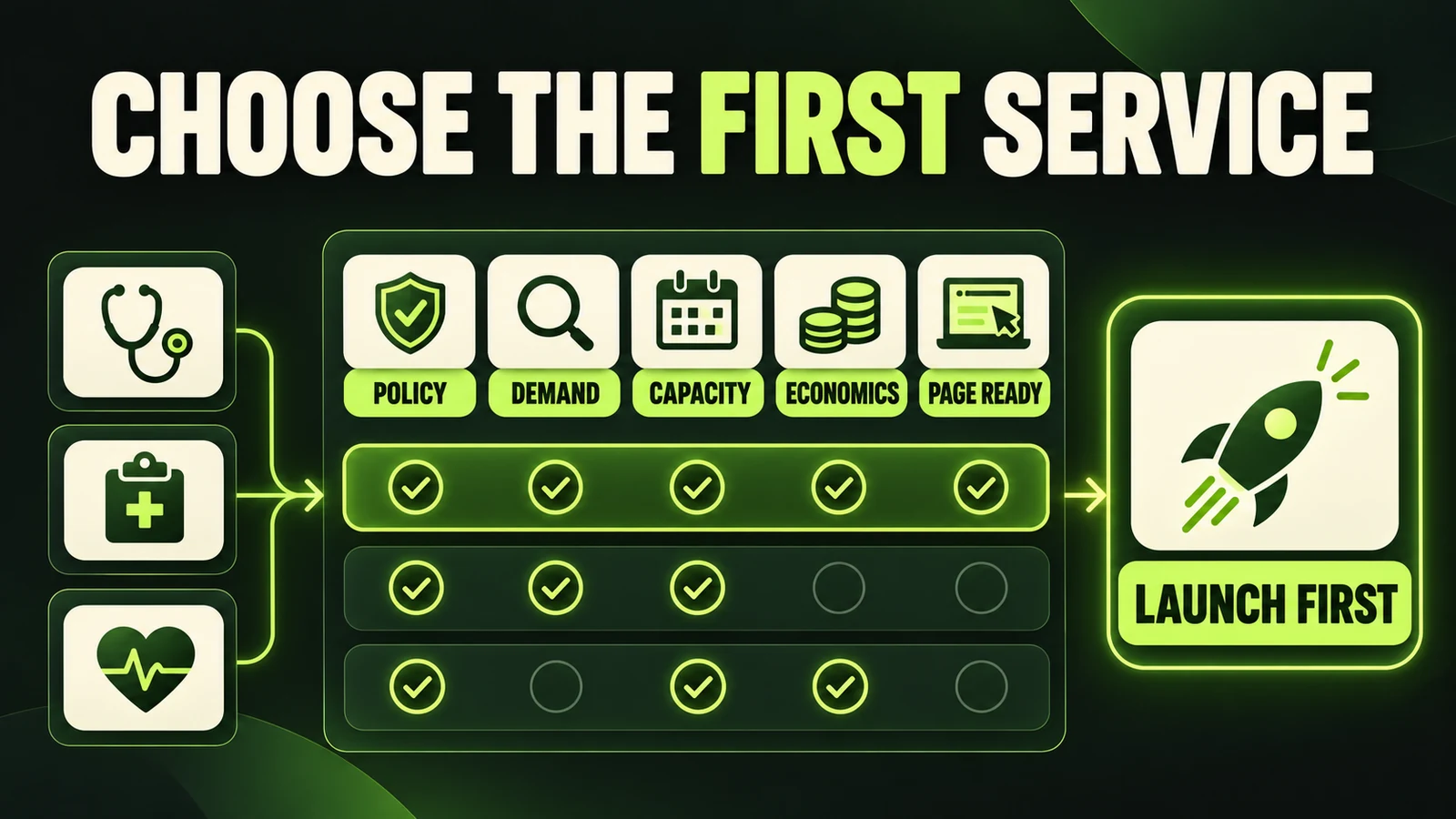
Choose the first medical service to advertise by applying four mandatory gates before comparing potential upside. The service must be eligible to promote, have real appointment capacity, offer a complete patient journey and support booking-level measurement. Any service that fails a gate belongs in a preparation queue, not a paid campaign.
Among the services that pass, prioritize the one with the strongest combination of relevant local demand, sustainable contribution per acquired patient, clear differentiation, an accurate landing page and a team ready to handle enquiries. Do not simply select the highest-priced service or the keyword with the largest search volume.
A useful starting rule: advertise the service the clinic is most ready to deliver and measure, not the service leadership most wants to promote.
1. Build a comparable candidate list
Start with services patients can recognize and book. “Functional medicine” may describe the practice, while “initial functional medicine consultation” is an appointment. Likewise, a symptom, condition, procedure and care program may represent different search intent and patient pathways.
For each candidate, write down:
- the exact appointment or program being offered;
- the provider and location or approved telehealth area;
- the intended patient and basic non-clinical eligibility criteria;
- the verified fee or payment model;
- available new-patient capacity;
- what happens after an enquiry or booking; and
- the downstream outcome the clinic can reliably measure.
Keep unlike offers separate. A low-cost standalone visit and a multi-month program may share a clinical theme but have different economics, decision cycles and qualification needs.
2. Apply four launch gates before scoring opportunity
Policy and clinical gate
The service is genuinely offered within provider scope and geography. The ad, keywords and page can meet current platform policy and applicable professional requirements.
Capacity gate
The clinic has suitable appointment inventory and downstream delivery capacity, not merely an empty slot tomorrow.
Patient-journey gate
A relevant page, working phone or form, trained intake owner and clear booking step exist before traffic arrives.
Measurement gate
The clinic can separate valid enquiries, booked consultations, attendance and acquired patients for this service.
Google’s healthcare and medicines policy varies by service and country. Some healthcare content cannot be advertised; other categories require certification or location-specific compliance. Review the actual service, destination and target geography rather than assuming approval for one clinic offer covers another. Our clinic Google Ads policy guide provides a fuller audit sequence.
A service that fails a gate can still be strategically important. The right action may be to obtain the necessary approval, hire capacity, build the service page or repair tracking first.
3. Verify patient demand and search intent
Use several signals rather than one keyword volume:
- Keyword Planner: set the clinic’s actual location and compare service, provider and appointment-oriented terms. Google says forecasts use historical search data plus bid, budget, seasonality and other factors; they are estimates, not guaranteed leads.
- Search Console: look for relevant non-branded queries already generating impressions or clicks.
- Enquiry records: count how often prospective patients ask for the service and how many are suitable.
- Referral data: identify demand arriving through physicians, partners or existing patients that search advertising may complement.
- Live search results: inspect whether the query shows local clinics, directories, educational pages, products or something else.
Volume without commercial intent is weak evidence. A broad condition term may receive more searches than a service-plus-location term while producing more research clicks and fewer appropriate bookings. Patient language also differs from internal service names, so test synonyms without making unsupported claims.
Low reported volume is not automatic rejection. Keyword tools round and aggregate data, and some sensitive or very low-volume terms may not be forecastable. Use the full evidence set and consider a tightly controlled pilot when the service otherwise passes every gate.
4. Check service economics and allowable acquisition cost
Compare contribution, not headline revenue. Subtract the variable costs required to deliver the initial visit and the care that normally follows. Include provider time, staff time, supplies, payment fees and other costs that change when another patient is added.
A service with a high fee can still be a weak advertising choice if delivery costs are high, few patients continue, refunds are common or the clinic lacks capacity. A lower-fee service may be viable when its booking path is clear and delivery efficient. Use conservative clinic data and show the uncertainty; do not borrow a generic industry benchmark.
Our patient value versus acquisition cost guide explains cohort-based contribution, while the cost per booked consultation guide connects media spend with the appointment book.
5. Audit the campaign and landing-page foundation
A promising service is not campaign-ready until the post-click experience supports the same decision. Confirm that the page:
- names the service in patient-friendly language;
- identifies the provider and verified credentials;
- explains who the service may suit without promising outcomes;
- describes the first appointment and realistic next step;
- states the payment model and verified fee where appropriate;
- shows location, telehealth area and important eligibility limits;
- offers one clear call, form or booking action; and
- works on mobile and produces a tested confirmation.
Then inspect operations. Who answers calls? Who owns forms? Can the team explain the fee and appointment without improvising? What happens outside business hours? A dedicated page cannot compensate for unanswered enquiries or unavailable appointments. See our guide to why clinic leads do not become bookings.
6. Score the services that pass every gate
Use a simple evidence scale: 0 = absent or unknown, 1 = partial evidence, 2 = strong current evidence. Do not add a service that fails a mandatory gate merely because it scores well elsewhere.
| Criterion | Question | Useful evidence |
|---|---|---|
| Patient demand | Are suitable patients actively looking for this service? | Local forecasts, Search Console, valid enquiries, referrals |
| Economics | Can the service support paid acquisition? | Contribution, current acquisition cost, continuation and attendance |
| Capacity | Can the clinic accept and deliver more appropriate patients? | New-patient slots, provider and downstream capacity |
| Differentiation | Can the clinic explain a relevant, verifiable reason to choose it? | Credentials, access, process, location, real service features |
| Page readiness | Can a searcher understand and act without a mismatch? | Dedicated page audit and mobile booking test |
| Measurement | Can outcomes be assigned to the service? | Source, campaign, validity, booking and attendance fields |
Record the source and date behind every score. If two services tie, prefer the one with clearer measurement, faster operational feedback and fewer unresolved assumptions. The scorecard is a decision record, not a claim of mathematical certainty.
7. Launch one focused pilot
- Choose one service or one genuinely related service group.
- Set the eligible location and build a demand forecast with the same geography.
- Define the primary outcome: usually a qualified booking or another verified downstream action, not a page view.
- Create tightly related keywords, negative keywords and ad copy that matches the page.
- Assign a budget the clinic can sustain through an agreed evaluation window.
- Review search terms and lead quality frequently after launch.
- Reconcile enquiries with bookings and attendance before shifting budget.
Do not launch five unrelated services with a small budget and declare all five unsuccessful. Fragmentation makes it harder to learn which searches, pages and patient pathways work. Expand after the first service produces a reliable operational and measurement baseline.
Common service-prioritization mistakes
- Choosing the highest fee: revenue is not contribution, demand or capacity.
- Choosing the largest keyword: search volume does not prove appointment intent.
- Advertising an unavailable service: marketing cannot repair a closed calendar.
- Using the homepage: a general practice page makes a specific service harder to evaluate.
- Ignoring policy until launch: eligibility and certification can change the entire plan.
- Counting every form equally: spam and unsuitable enquiries obscure service quality.
- Letting internal enthusiasm replace evidence: document why the chosen service comes first.
Frequently asked questions
Which medical service should a clinic advertise first?
Start with a policy-eligible service that has capacity, credible demand, sustainable economics, a dedicated page and booking-level measurement. A high fee alone is not enough.
Should the most profitable service always come first?
No. Profitability matters, but the service must also be searchable, deliverable, compliant and ready for an appropriate patient journey.
Should every service have a separate campaign?
Separate services when they need different budgets, locations, pages, economics or goals. Closely related services can share a structure when their intent and operations are genuinely similar.
How can a clinic estimate demand?
Combine local Keyword Planner estimates with Search Console, enquiry and referral data, patient vocabulary and live search-result analysis. Treat forecasts as estimates.
How many services should a small clinic launch at once?
With limited budget, prove one focused service or tightly related service group before spreading spend across unrelated offers.
Make service selection a documented decision
The first advertised service should survive policy, capacity, journey and measurement checks before opportunity is scored. That discipline keeps the clinic from paying to expose operational gaps and gives the campaign a clear business question to answer.
Wellness Practice Marketing can assess service demand, economics, landing-page readiness and conversion tracking before budget is committed. To prioritize your clinic’s first or next campaign, book a strategy call.