
The short answer
Do not switch off every clinic campaign at closing time by default. First identify what a prospective patient can actually do after hours. If they can submit a reliable form or book an appropriate appointment online, the campaign may continue capturing demand. If the only useful action is a phone call that nobody can answer, schedule the call element—and sometimes the campaign—to staffed hours.
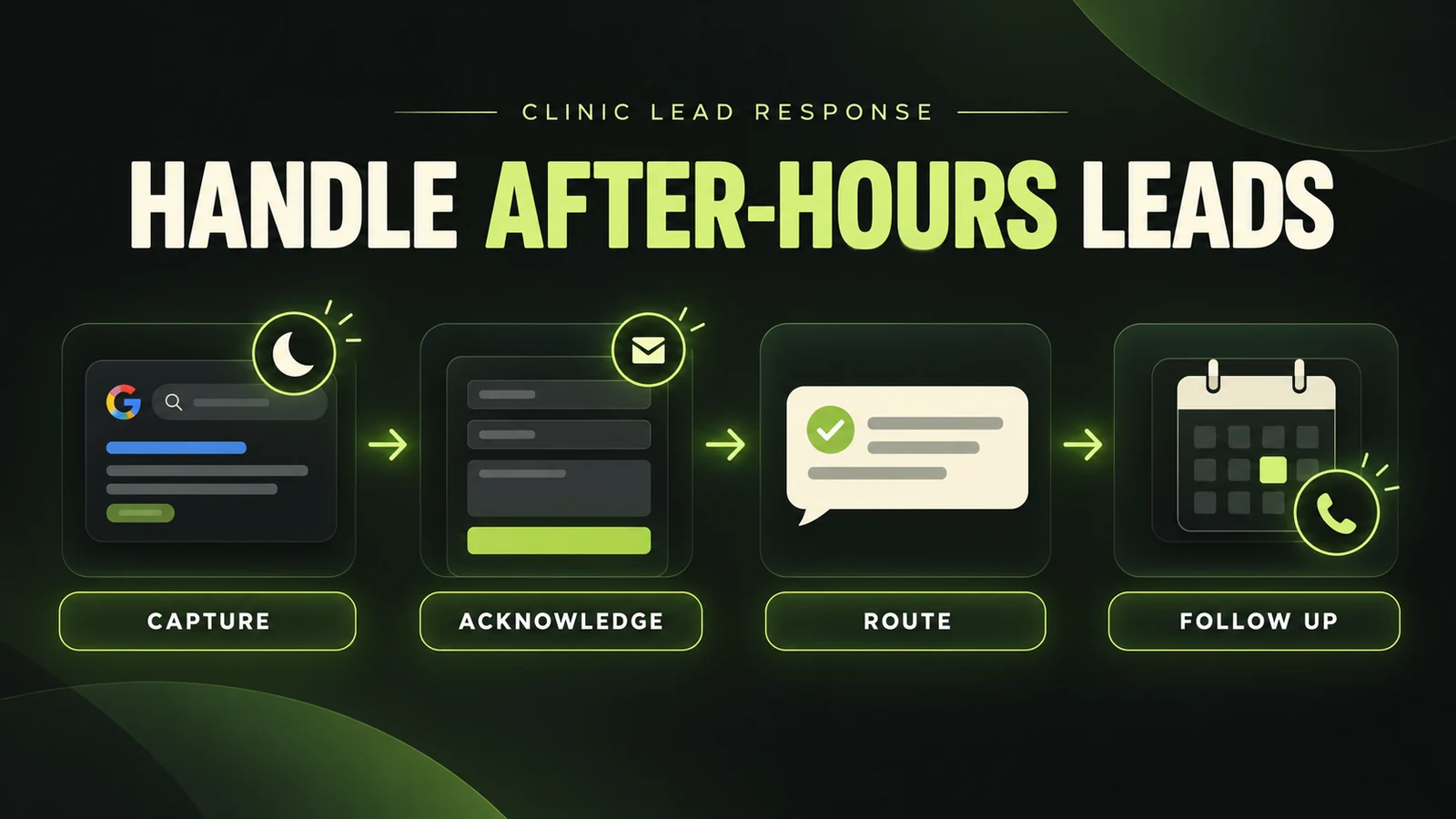
Every after-hours enquiry needs four things: successful capture, an immediate acknowledgement, one named owner and a due time for human follow-up. The automatic message confirms receipt; it does not replace a conversation or provide clinical triage.
Separate marketing access from clinical access: allowing someone to enquire at 9 p.m. does not mean the clinic offers care at 9 p.m. Your page, form and acknowledgement should make that distinction clear.
1. Decide whether the campaign should run after hours
The right schedule depends on the conversion route, not a universal rule. Audit the live experience from the ad click through confirmation before changing campaign settings.
| After-hours route | Practical setup | What must work |
|---|---|---|
| Phone only, no coverage | Show call assets during answered hours. Consider restricting the campaign if no useful alternative exists. | Accurate hours, voicemail expectations and a documented callback queue. |
| Phone plus enquiry form | Keep the form route available; hide or schedule the call asset outside answered hours. | Form delivery, acknowledgement, ownership and next-business-day follow-up. |
| Direct online booking | Keep ads eligible if patients can choose an appropriate appointment without staff assistance. | Current availability, eligibility guidance, confirmation and cancellation rules. |
| Trained answering coverage | Keep call access if the service follows clinic-approved scripts and escalation boundaries. | Correct routing, privacy controls and no ambiguity about clinical advice. |
Do not assume that late clicks are poor because they occur outside reception hours. Likewise, do not assume that an online form makes the system ready. Test the form notification, mobile layout, confirmation page and routing. A campaign is only as available as the process behind its primary action.
2. Schedule the campaign and call assets separately
Google Ads campaigns are eligible to serve all day unless an ad schedule restricts them. A campaign schedule controls when the ads can appear. A call asset can have its own schedule, which lets a clinic keep forms or booking pages visible while limiting the phone option to times when someone can answer.
This distinction prevents a blunt solution. For example, a clinic might keep Search ads eligible in the evening but schedule its call asset from 8 a.m. to 5 p.m. On the landing page, the after-hours visitor can use the form or scheduler and see exactly when the team will respond.
Check the Google Ads account time zone before building the schedule. Google states that reporting and scheduling use the account time zone, and the standard serving time zone cannot simply be changed. This matters for multi-location and telehealth campaigns: “8 a.m.” in the account may not be 8 a.m. for every person seeing the ad.
Do not hide the only conversion route by accident. Preview ads and test the landing page during both staffed and unstaffed periods. Campaign hours, call-asset hours, website hours and booking availability should tell the same story.
3. Build one after-hours lead workflow
Late enquiries often arrive through several systems: a website form, Google-hosted lead form, call-tracking platform, voicemail, chat tool or scheduler. Bring them into one queue rather than expecting reception to inspect every inbox each morning.
- Capture the source and timestamp. Store the enquiry time, campaign or source, requested service, location and preferred contact method without collecting unnecessary clinical detail.
- Confirm receipt. Trigger a transactional email or text only through an approved system and consent process.
- Create one record. Deduplicate the same person’s voicemail and form so staff can see the whole interaction.
- Assign an owner. Route by service or location only when that determines who can respond; otherwise keep one accountable intake queue.
- Set a due time. Define when staff must make the first human attempt after opening and what happens if the owner is absent.
- Record the result. Track attempted, reached, qualified, booked and closed outcomes consistently.
Google-hosted lead forms require particular attention to delivery. Google supports downloads, webhook/API connections and some CRM integrations, and advises testing the connection. A lead should not depend on somebody remembering to download a file. Use a delivery method the clinic checks and can monitor for failures.
4. Write an acknowledgement that sets honest expectations
An effective automatic reply is brief and operational. It tells the person that the enquiry arrived, who received it and when a human response is expected. It should not ask them to explain symptoms by unsecured reply or imply that a clinician is monitoring the inbox overnight.
Example framework: “Thank you for contacting [Clinic]. We received your enquiry and a member of our team will respond after [opening time or response window]. This channel is not monitored for urgent medical needs. If you need urgent help, follow [clinic-approved local instruction].”
Adapt the language to the clinic’s location, services and reviewed policies. If a scheduler is available, link to it only when the appointment type, eligibility and availability are clear. Avoid promotional nurture language in the receipt; the immediate job is confirmation and expectation-setting.
The message also gives staff leverage. When the clinic states a realistic response window, the team has a service standard to meet. Avoid promises such as “we will call first thing” unless staffing consistently supports them.
5. Run a controlled next-business-day follow-up queue
At opening, after-hours enquiries should already be visible, ordered and assigned. A simple operating routine is more dependable than whichever message appears first in an inbox.
- Review delivery errors and confirm every source fed the queue.
- Start with the oldest unhandled enquiry, then apply any clinic-approved service or scheduling priority.
- Check whether the person already booked online before calling.
- Use their requested contact method where practical and permitted.
- Answer the question they asked before moving into intake.
- Offer one clear next step: an appropriate consultation, a call at a specific time or an honest explanation that the service is not a fit.
- Record the attempt, response and booking outcome in the same record.
Avoid making reception reconstruct the lead from a generic subject line. The record should show the source page, service selected and message, with access limited according to clinic policy. Our guide to why clinic leads do not become booked appointments covers the broader intake, fit and scheduling problems that can remain even when response is fast.
For phone enquiries, distinguish a button click, an unanswered call and a connected conversation. The clinic call-tracking setup guide explains how to connect call records with meaningful outcomes.
6. Add privacy, consent and urgent-care safeguards
After-hours automation should collect only what the intake team needs to make contact and route the request. Keep diagnosis, medication and treatment-detail prompts out of advertising lead forms unless the clinic has completed an appropriate privacy and security review.
In the United States, HHS says covered providers may communicate by email when they apply reasonable safeguards, such as checking addresses, limiting disclosed information and accommodating reasonable requests for alternative communications. That does not make every advertising, CRM or messaging tool suitable. Review vendors, access, retention, consent and message content for the clinic’s obligations and jurisdiction.
Do not turn a marketing acknowledgement into an emergency assessment. Use language approved by clinical and legal leadership, identify channels that are not monitored and route urgent situations according to the clinic’s local policy. A generic worldwide emergency instruction is not a substitute for that review.
7. Measure bookings by enquiry hour, not leads alone
After-hours forms may look efficient while producing few appropriate bookings. Conversely, a smaller volume of late enquiries may book well once the response process is fixed. Compare outcomes using the hour the original enquiry arrived.
Operational measures
Valid-enquiry rate, first human response time, contact rate, duplicate rate and the share still unhandled when the clinic opens.
Commercial measures
Booked-consultation rate, attended appointments and cost per booked consultation for staffed versus after-hours cohorts.
Use the original enquiry timestamp for the cohort even if the booking happens the next day. Keep form submissions, missed calls, booked appointments and attendance as separate events. The guide to measuring cost per booked consultation provides the formulas and reconciliation process.
Segment only when the volume supports a decision. Hour-by-hour rows can create noise for a small clinic, so begin with staffed versus unstaffed periods and then inspect weekday, evening and weekend groups.
8. Run a 30-day schedule test
- Document the baseline. Export four or more weeks of spend, valid enquiries and bookings by enquiry time.
- Fix capture first. Test every form, number, acknowledgement, CRM connection and scheduler on mobile.
- Set call visibility. Align call-asset hours with dependable answer coverage.
- Keep one comparison. Avoid changing keywords, geography, offers and hours at the same time.
- Review the queue weekly. Inspect missed ownership, slow follow-up, duplicates and delivery failures.
- Judge downstream outcomes. Compare cost per booking and attendance, not only clicks or platform conversions.
If after-hours enquiries remain expensive and rarely become suitable bookings after the process works, narrow the schedule or reduce bids for those periods. If they book efficiently, protect the route and staffing that made it work. The result should come from the clinic’s data, not an internet claim about the “best” time to advertise.
Common after-hours lead mistakes
- Running a phone-led ad all night when nobody answers and no form alternative exists.
- Pausing the entire campaign even though patients can accurately self-book.
- Sending an instant reply but never creating an assigned human task.
- Promising a response time that weekends, holidays or staff absences cannot support.
- Collecting sensitive free-text details before the clinic has reviewed the system.
- Counting every after-hours form as a conversion without checking fit, booking or attendance.
- Using the campaign schedule without checking the account time zone.
Frequently asked questions
Should a clinic pause Google Ads outside business hours?
Not automatically. Keep campaigns eligible when a reliable form or self-service booking route works after hours. Schedule the phone option to answered periods, then use booking outcomes to decide whether the whole campaign needs narrower hours.
Can call assets use a different schedule from the campaign?
Yes. A call asset can appear only on selected days and hours while the campaign continues directing people to other actions.
What should an after-hours confirmation message say?
Confirm receipt, identify the clinic, state a realistic response window, explain the next step and include clinic-approved urgent-care language. Do not imply that the message is clinical advice or live triage.
How should clinics measure after-hours lead quality?
Compare valid enquiries, contact rate, bookings, attendance and cost per booked consultation by the time the enquiry arrived. Raw clicks and submissions are not enough.
Does an automatic reply replace human follow-up?
No. It confirms receipt and sets expectations. The enquiry still needs an owner, a due time and a documented human outcome.
Make every after-hours enquiry owned and measurable
The goal is not to keep every ad active around the clock. It is to make each available conversion route honest, dependable and measurable. Align call visibility with coverage, let suitable patients enquire or book when self-service works, and begin each business day with a clean queue rather than scattered notifications.
Wellness Practice Marketing can help connect Google Ads scheduling, landing pages and booking outcomes into one patient-acquisition system. To review where your clinic is losing enquiries, book a strategy call.