
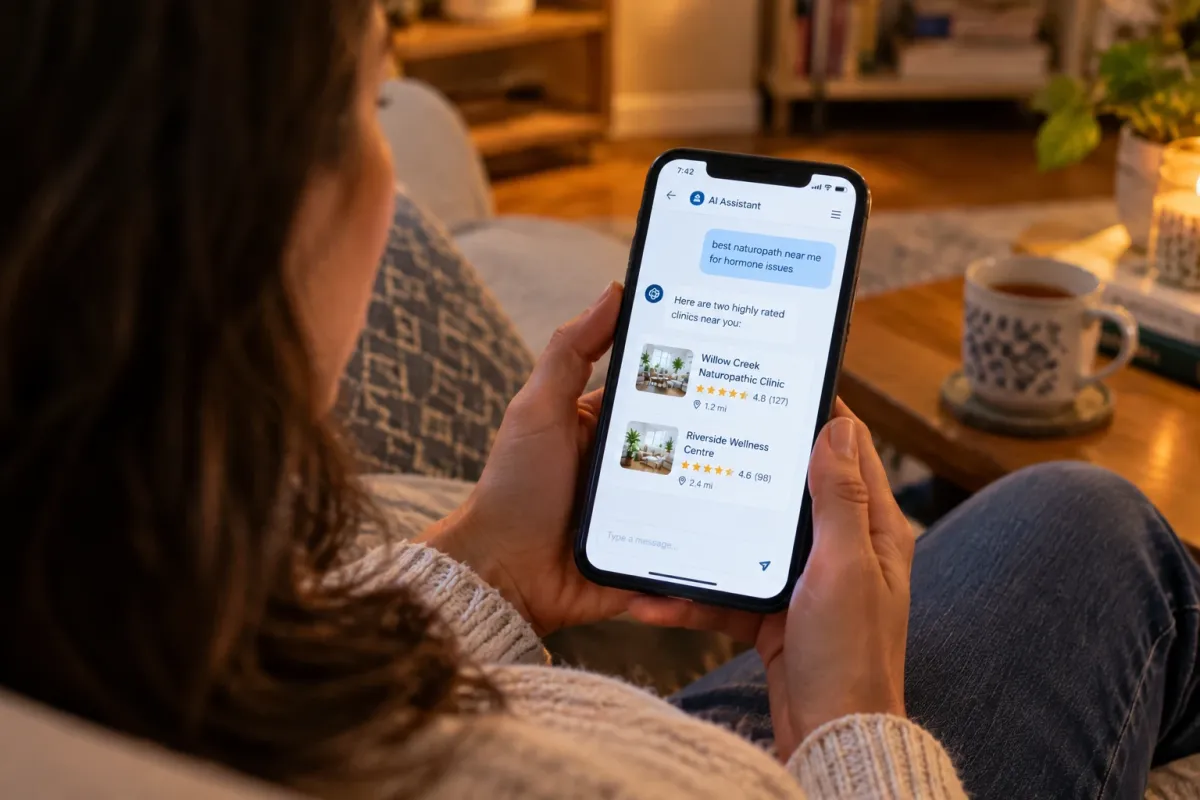
A patient recently told one of our clients how she found the practice. She didn't scroll through Google results. She asked ChatGPT to recommend a naturopath in her city who works with hormone issues, then booked with the second name it gave her.
That story is becoming less unusual every month. Google now answers many health-adjacent searches with an AI Overview before the first organic result. ChatGPT and Perplexity answer "who should I see" questions with actual clinic names. Some of your future patients will meet your practice inside an AI answer — or they won't meet it at all.
The marketing industry has already invented a name for optimizing this: GEO, generative engine optimization. And, predictably, it's already being oversold. So this article does two things: separates what's real from what's hype, and lays out what a naturopathic practice can actually do about it.
1What GEO is — and the honest limits of it
GEO means making your practice more likely to be mentioned, cited or recommended when an AI system answers a question. That covers a few different surfaces:
- Google's AI Overviews — the generated summary above results, with source links.
- Chat assistants — ChatGPT, Gemini, Claude, Copilot — answering "recommend a naturopath near me" style questions, often by browsing the live web.
- Answer engines — Perplexity and similar tools that answer with citations.
Now the honest part. Nobody — including the people selling "GEO packages" — can guarantee an AI will recommend you. These systems don't publish ranking factors, they change constantly, and their answers vary from one conversation to the next.
What we can say is where these systems get their information: the same public web your SEO already targets. AI answers lean on pages that are crawlable, clearly written, and consistent with what the rest of the web says about you. Which means GEO isn't a new discipline so much as a new reason to do the fundamentals properly.
2How an AI actually "chooses" a clinic to mention
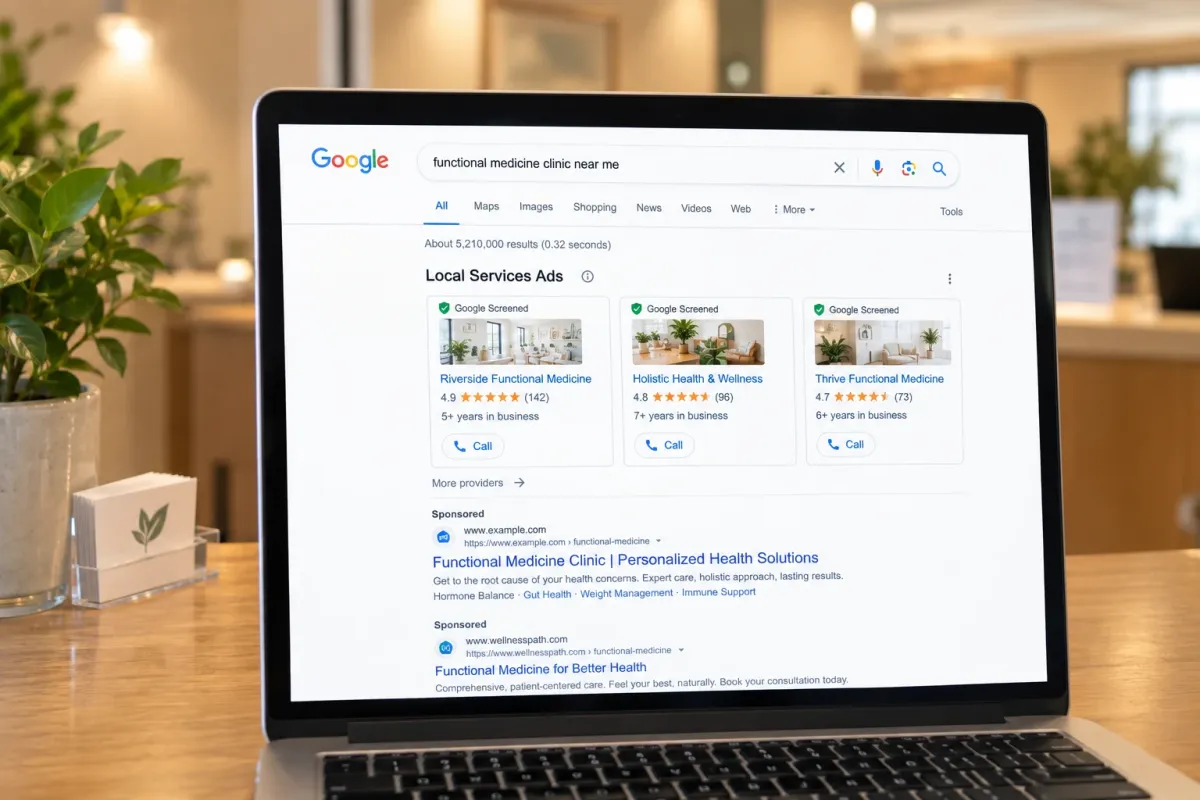
When someone asks an assistant for a naturopath in their city, the system typically does some mix of the following:
- Runs its own web searches in the background — often the same queries a person would type.
- Reads the pages that rank: local directories, Google Maps data, review platforms, and clinic websites.
- Extracts entities it can trust: practice names, locations, services, credentials, review sentiment.
- Composes an answer from whatever it could verify across more than one source.
Notice what that means: AI search sits on top of regular search. If your clinic doesn't rank for "naturopathic doctor [your city]", doesn't have a coherent Google Business Profile, and isn't mentioned anywhere except your own website, there is nothing for the AI to find, verify or repeat.
We've seen this dependency from the other side. In our Google Business Profile audit, a practice's profile said little more than "Doctor" — no services, messy service areas, outdated description. A person squinting at that profile is confused; an AI reading it has almost nothing to extract. The same gaps hurt both audiences.
3Make your practice easy to describe — everywhere, identically
AI systems are pattern-matchers. They gain confidence in a fact when several independent sources agree on it. So the single highest-leverage GEO move is boring: make every description of your practice consistent.
- Same name, address, phone on your website, Google Business Profile, directories and social profiles.
- Same positioning sentence everywhere: who leads the practice, what kind of medicine, which city. "Physician-led naturopathic clinic in Chandler focusing on hormone and digestive health" is extractable; "Redesign your health optimally" is not.
- Named practitioners with credentials — real bio pages, qualifications spelled out, photo, specialties. In the 6,000-query dataset we analyzed, practitioner pages had some of the highest click-through rates on the entire site. Patients want a person; so do the systems summarizing you.
- Structured data — proper schema markup for your organization, practitioners and articles, so machines don't have to guess.
A useful test: paste your homepage text into any AI chat and ask, "Based only on this, who is this clinic for and why should someone trust it?" If the answer comes back vague, your pages are vague — for patients too.
4Write the pages AI answers are built from
Look at what AI Overviews and Perplexity actually cite for health-adjacent questions: clear, specific pages that answer one question well. Not homepages. Not "welcome to our clinic" text.
For a naturopathic practice, the pages worth building are the ones patients' questions already point at:
- Condition pages — the mold illness page in our query dataset pulled 8,924 impressions in six months because it answered a problem people actually search.
- Service pages in patient language — "hormone testing and treatment," not "bioenergetic optimization." Patients don't use clinic vocabulary, and neither do the questions typed into AI chats.
- Honest FAQ-style answers — what a first visit costs, how long treatment takes, when you'd refer out. Direct answers are exactly the sentences AI systems lift.
One caution specific to healthcare: AI systems are noticeably conservative about health claims. Pages that promise cures or outcomes aren't just a compliance risk — they read as untrustworthy to systems trained to avoid recommending exactly that. Educational, credential-backed, appropriately-hedged writing wins on both fronts. Our content marketing guide covers the approach.
5Reviews are training data now
Ask an assistant for "a well-reviewed naturopath near me" and it will do the obvious thing: look at review counts, ratings and what reviewers actually wrote.
That changes how to think about reviews slightly. Volume and recency still matter — but so does content. A review that says "Dr. M finally figured out my thyroid issue after two years of dead ends" gives an AI a specific, quotable fact connecting your practice to a condition. Fifty reviews that just say "great clinic!" give it almost nothing.
You can't script what patients write, and you shouldn't try. But the review system in our reviews guide — ask at the right moment, make it effortless, respond to everything — naturally produces the longer, more specific reviews that both humans and machines find convincing.
6How to tell if any of this is working
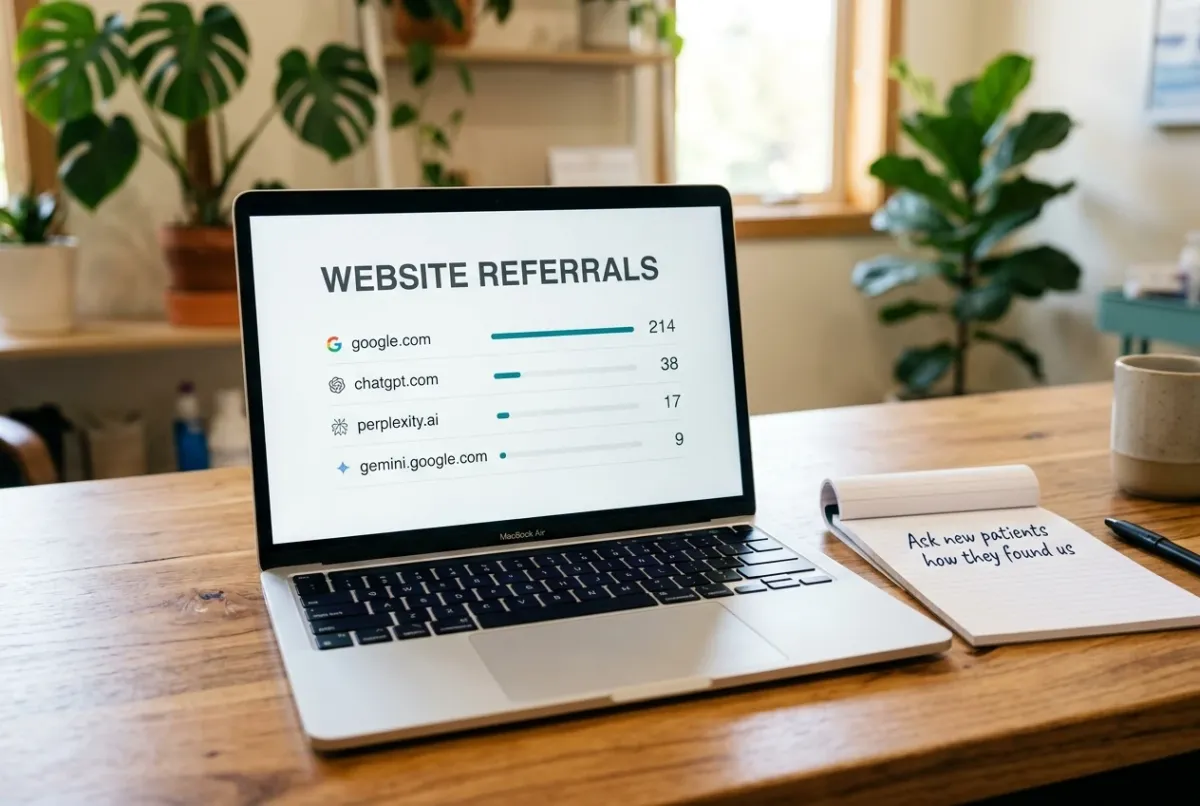
GEO measurement is genuinely immature — another thing the hype merchants skip past. But you're not flying blind:
- Ask the assistants yourself, monthly. The questions your patients would ask: "best naturopath in [city]," "who treats [condition] naturally in [city]." Note whether you appear, what's said, and what sources are cited. It's manual and imperfect — it's also five minutes.
- Watch referral traffic. Perplexity, ChatGPT, Gemini and Copilot show up as referrers in GA4. Small numbers today; a trend line worth having.
- Ask new patients how they found you — and actually record the answer. "I asked ChatGPT" is now a real intake-form answer.
- Keep tracking the boring metrics. Since AI search sits on top of regular search, your rankings, click-through rates and Business Profile discovery remain the leading indicators.
The short version
Can you "do GEO" for a naturopathic practice? Yes — but not the way it's being sold. There's no trick that gets ChatGPT to recommend you, and anyone promising one is guessing at best.
What actually moves the needle is depressingly familiar: rank locally, keep your practice described identically everywhere, publish specific pages in patient language, build real reviews, and mark it all up so machines can read it. AI systems recommend clinics the web already agrees are good and legible.
The practices that treated local SEO and reputation seriously over the past few years are already showing up in AI answers — without ever having heard the word GEO. That's the strategy. Do the fundamentals so well that every new search surface, whatever it's called next year, finds the same trustworthy answer.