
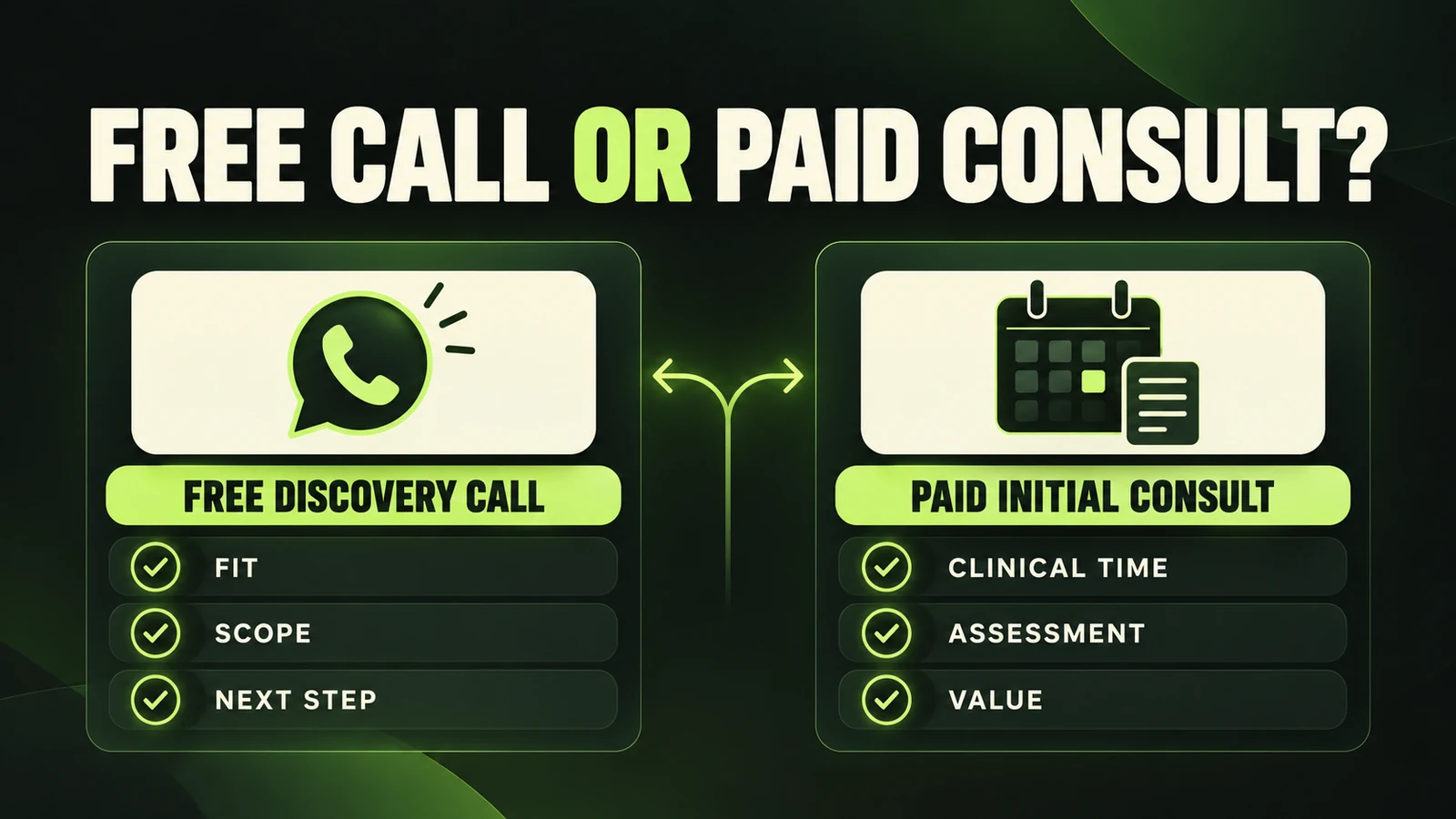
The short answer
Your clinic should offer a free discovery call when the call is genuinely a brief, non-clinical fit check: the prospective patient can ask about scope, logistics, fees and the next step, while the clinic confirms basic eligibility. Offer a paid initial consultation when the appointment includes meaningful clinician time, history or records review, assessment, individualized guidance or another service that has value on its own.
The decision is not simply “free converts better” versus “paid attracts serious patients.” Free calls reduce the financial commitment but consume capacity and can add another handoff. Paid consultations create a clearer service boundary but require enough trust and information before booking. The right model fits the work being delivered and the clinic’s actual patient journey.
Use the carry-away test: if the person leaves only knowing whether the clinic and offer may fit, the call can be a free qualification step. If the person leaves with a clinical assessment or personalized recommendations they can use, treat it as a clinical service and structure it accordingly.
1. Define the two offers before comparing them
Many clinics use “discovery call,” “consultation” and “new patient appointment” interchangeably. That creates mismatched expectations for patients, staff and marketing reports.
| Decision point | Free discovery call | Paid initial consultation |
|---|---|---|
| Primary job | Confirm basic fit and explain how the clinic works | Deliver a defined clinical appointment |
| Typical content | Scope, provider availability, location, fees and next step | History review, assessment and clinically appropriate next steps |
| Value if no further booking | Clarity about whether to proceed | The consultation itself has standalone value |
| Main operational cost | Unpaid staff or clinician time plus another funnel stage | More booking friction and a higher expectation before purchase |
| Marketing outcome | Discovery call attended, then paid appointment booked | Paid initial consultation booked and attended |
A free call should not be advertised as a clinical consultation if it does not provide one. A paid consultation should not become a sales presentation for a larger program. State what happens, who conducts it, how long is reserved, whether clinical advice is included and what the next step may be.
2. When a free discovery call makes sense
A short free call can help when prospective patients need a human answer before committing. This is common when eligibility is complex, the service is unfamiliar, the care pathway involves a larger commitment or the clinic receives many enquiries that are outside its scope.
Free works best when:
- the website cannot answer every legitimate fit or eligibility question;
- the call has a clear agenda and a firm non-clinical boundary;
- trained intake staff can handle most conversations without consuming scarce clinician time;
- the subsequent paid service and its fee are explained before the call; and
- the clinic reliably follows up and records whether the caller progressed.
The call can cover the service offered, provider credentials, location or telehealth availability, scheduling, pricing, insurance arrangements and what information is needed for the paid appointment. It should not become an informal diagnosis session.
The risk is adding a mandatory step for people who are already ready. A qualified patient who has reviewed the practitioner, fee and service may prefer to book the paid appointment immediately. Requiring everyone to wait for a free call can create more abandonment, scheduling delay and administrative work.
3. When a paid initial consultation is the stronger first step
A paid first appointment makes sense when the clinician begins substantive work immediately. Functional and integrative medicine appointments can vary widely in length and structure; the Institute for Functional Medicine advises patients to ask how the practice operates, what the appointment includes and what it costs before scheduling.
Paid is usually more coherent when:
- the clinician reviews a detailed history, records or intake materials in advance;
- the appointment includes evaluation, assessment or individualized recommendations;
- the service is useful even if no program or follow-up is purchased;
- the clinic’s website already answers routine fit, process and fee questions; or
- provider capacity is better reserved for patients who have chosen a clinical appointment.
Payment alone does not guarantee fit or attendance. The booking page still needs to explain who the appointment is for, what it includes, what it does not include, the fee, cancellation terms and what happens afterward. Our guide to showing prices on a cash-pay clinic website covers that presentation in detail.
4. Consider an optional hybrid path
The choice does not have to be one universal route. A clinic can make the paid initial consultation the primary action while offering a brief optional fit call for people with unresolved administrative questions. Ready patients move directly to care; uncertain patients can clarify scope without expecting a free clinical session.
Direct paid path
Use for patients who understand the service, provider, fee and appointment purpose and are ready to schedule.
Optional fit path
Use for questions about eligibility, logistics, scope or the appropriate appointment type. Keep clinical advice out of the call.
Another model is a paid assessment whose fee is credited toward a larger program. That can work only when the assessment has real standalone value and the credit, expiration, refund and cancellation terms are clear. Do not invent a “deposit” merely to make a sales call feel paid.
Routing should remain simple. A page with equal buttons for a free call, paid consultation, contact form, quiz and phone line can create decision paralysis. Choose one primary action and explain the alternative beneath it.
5. Compare the economics using complete pathways
Do not compare a free-call booking rate with a paid-consult booking rate and stop there. The free model has another conversion stage; the paid model produces revenue sooner but may generate fewer initial bookings.
Use the clinic’s own numbers. For each model, record valid enquiries, booked first steps, attendance, progression to paid care, refunds, staff time, clinician time and contribution. If the free call is handled by a clinician, include both the scheduled minutes and preparation or documentation time. If a paid consultation requires records review, include that delivery cost too.
Keep free calls and paid consultations separate in reporting. The guide to cost per booked consultation explains why combining different appointment types produces a metric that cannot guide the offer.
6. Design the first step around patient questions
A strong booking page should let the patient decide with as little uncertainty as possible. Before presenting a calendar, answer:
- Who is the appointment designed for?
- Who conducts it, and what are their verified credentials?
- Is it administrative, educational or clinical?
- What preparation or intake is required?
- What is included in the reserved time?
- What is the verified fee, and when is payment due?
- What may cost extra?
- What does the patient receive afterward?
- What are the cancellation, rescheduling and refund terms?
For a free call, say explicitly that the purpose is to discuss fit, scope and next steps and that it is not a clinical evaluation. For a paid appointment, describe the clinical service without promising a diagnosis, test order or treatment outcome that may not be appropriate.
Make the CTA match the event. “Book a free fit call” should open that scheduler; “Book an initial consultation” should open the paid appointment. Generic labels such as “Get started” hide a meaningful commitment.
7. Be precise about pricing, scope and communication
If an offer is described as free, its material conditions should be clear at the outset. The US Federal Trade Commission’s guidance says terms attached to a “free” offer should be disclosed clearly and conspicuously so they are not misunderstood. Avoid surprise card holds, undisclosed eligibility restrictions or a required purchase that contradicts the headline.
For US providers, paid self-pay care may also trigger Good Faith Estimate obligations. CMS says uninsured or self-pay patients generally must receive an estimate when care is requested or scheduled under applicable conditions. Clinics should review current federal, state and professional requirements with qualified advisors rather than treating a marketing page as legal guidance.
Keep the free call inside the practitioner’s scope, licensing and privacy rules. The AMA advises physicians providing personalized health advice electronically to explain limitations and how users can arrange needed care. Define when an administrative question must move to a properly structured clinical appointment.
Do not use a free call as unrecorded clinical care. If the conversation requires history-taking, assessment or individualized advice, pause and route the person into the clinic’s approved clinical process.
8. Test a change without confusing the funnel
- Write the current definitions. Document exactly what the first step includes, who delivers it and what counts as success.
- Establish a baseline. Measure a complete cohort from valid enquiry through attendance and paid care.
- Fix the page first. Make scope, fees, practitioner, preparation and next steps visible before changing the price model.
- Change one pathway. Test a direct paid route, optional fit call or revised free-call boundary without simultaneously changing traffic sources and service positioning.
- Allow outcomes to mature. Use enough volume and time for downstream paid appointments to occur; label incomplete cohorts.
- Compare contribution and capacity. Review patient fit, attendance, paid-care progression, staff workload and contribution per valid enquiry.
If free calls create many conversations but few appropriate paid appointments, first inspect targeting, page clarity and qualification. If paid consultations receive little demand, inspect whether the page establishes enough trust and explains the value before assuming the fee is wrong. Our guide to why clinic enquiries do not become appointments helps locate the actual stage where the loss occurs.
Frequently asked questions
Should a clinic offer a free discovery call?
It can when the call is a brief, non-clinical fit check covering scope, logistics, fees and next steps. Keep clear boundaries and offer a direct paid route for patients who are ready.
When should the first consultation be paid?
Charge when the appointment includes substantive clinician time, preparation, assessment, individualized guidance or another outcome valuable by itself.
Can a clinic offer both options?
Yes. The paid consultation can be the primary route, with an optional fit call for unresolved administrative or eligibility questions. Explain which route suits whom.
Who should conduct a free discovery call?
Use the person qualified for its defined purpose. Trained intake staff can often answer process, scope, fee and scheduling questions. Clinical questions should move into an appropriately structured appointment under applicable rules.
How should the clinic compare the models?
Compare valid enquiries, attendance, progression to paid care, staff and clinician time, contribution per enquiry and patient-fit outcomes. Do not compare first-step bookings alone.
Price the work, not the label
A discovery call is not automatically generous, and a paid consultation is not automatically a better filter. The clinic needs a first step that honestly represents what happens, protects clinical boundaries and gives suitable patients a clear path forward.
Wellness Practice Marketing can help audit the page, booking flow and measurement behind your clinic’s first appointment. To review which pathway fits your services and capacity, book a strategy call.