
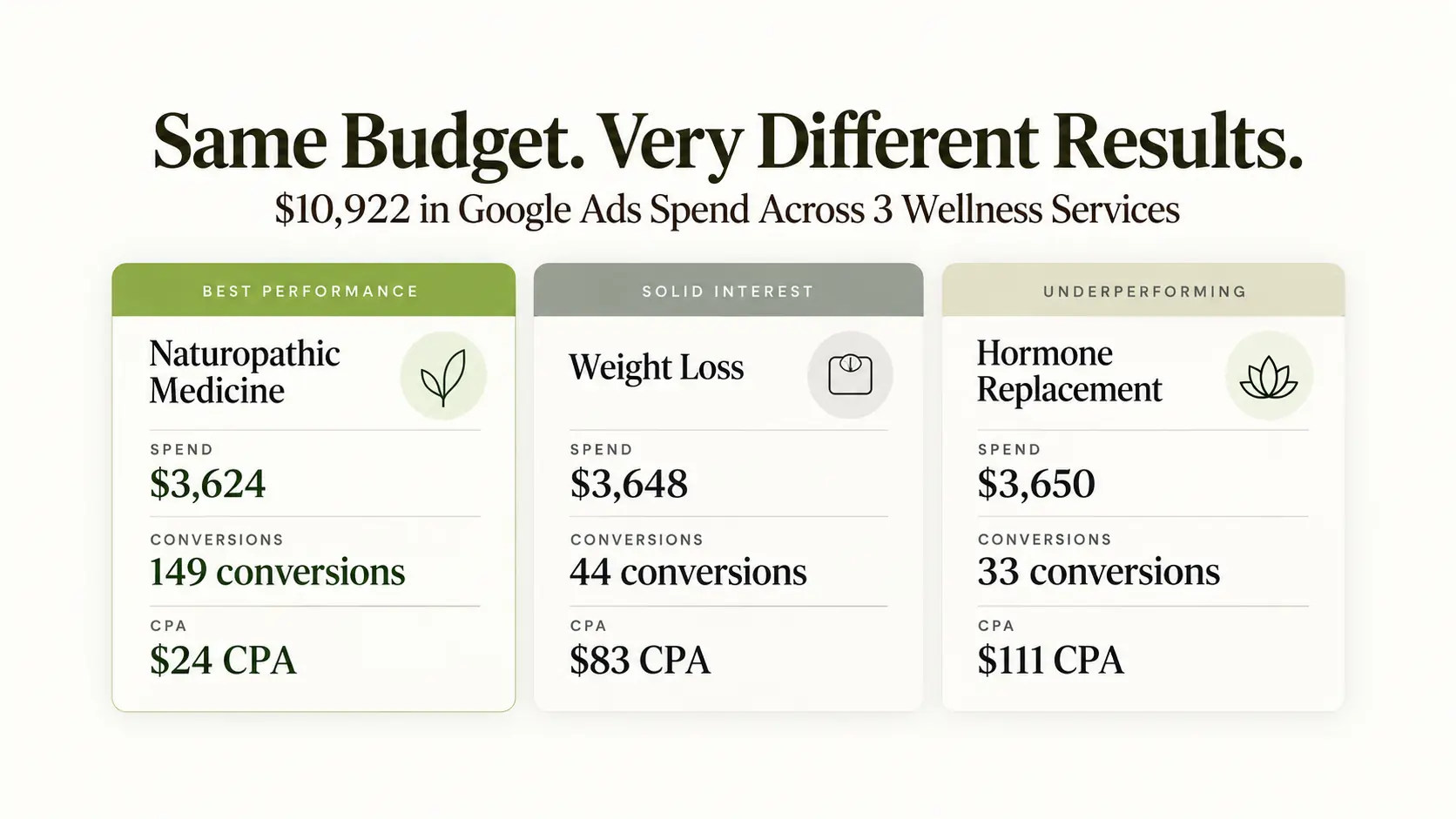
When we launched two new Google Ads campaigns for the same integrative medicine clinic, we expected the first few days to tell us very little about conversions.
That part was true. After roughly two days, neither campaign had generated enough conversion data to judge cost per lead or return on ad spend.
But the campaigns were already showing a clear difference in initial search activity. The perimenopause and hormone campaign generated 421 impressions and 13 clicks. The preventive and metabolic health campaign generated 247 impressions and 5 clicks.
The campaigns were launched at the same time, inside the same Google Ads account, for the same physician-led integrative medicine practice. That makes the comparison useful, even though the sample is still small.
What We Analyzed
We analyzed the first approximately two days of Google Ads activity from two Search campaigns running for a physician-led integrative medicine practice in California:
- Perimenopause and hormone health
- Preventive and metabolic health
The analysis covered the launch period from September 11 through the current partial September 13, 2026. Both campaigns used dedicated PPC landing pages and were running with comparable daily budgets.
This is still too early for conversion rate, cost per lead, or patient acquisition cost. At the time of analysis, neither campaign had recorded a tracked conversion.
The Early Results
| Campaign | Impressions | Clicks | CTR | Spend | Avg. CPC |
|---|---|---|---|---|---|
| Perimenopause / Hormone | 421 | 13 | 3.09% | $25.42 | $1.96 |
| Preventive / Metabolic | 247 | 5 | 2.02% | $13.74 | $2.75 |
Across the two campaigns combined: 668 impressions, 18 clicks, $39.16 in ad spend. The perimenopause/hormone campaign generated approximately 70% more impressions and 160% more clicks than the preventive/metabolic campaign during the same initial period. It also produced the higher click-through rate and the lower average cost per click.
The Perimenopause Campaign Generated More Initial Search Activity
The most obvious difference was volume — 421 impressions compared with 247. That does not automatically mean perimenopause is a larger market; there are too many variables involved to make that claim from two days of one clinic's data. Keyword selection, Google's auction behavior, match types, competition, landing-page relevance, geography and bidding can all influence impressions.
But inside this specific account, during this specific launch window, Google found more opportunities to serve the perimenopause and hormone ads. For a clinic deciding which services to promote first, that is useful information — search demand does not always distribute evenly across services.
The Click Difference Was Even Larger
The perimenopause campaign received 13 clicks; the metabolic campaign received 5 — 2.6 times as many in the first two days. Its click-through rate was also higher (3.09% vs. 2.02%).
This may suggest stronger initial alignment between the perimenopause ads and what people were searching for. It may also reflect how prospective patients understand the services differently: "perimenopause" and "hormone therapy" often describe a relatively specific problem or treatment category, while "preventive health" and "metabolic health" can be broader concepts. Google Ads tends to perform best when the patient's search language closely matches a specific service and intent.
Search Behavior Was Different Between the Two Campaigns
The perimenopause campaign triggered searches including "menopause," "how to control perimenopause symptoms naturally," "why would I see an endocrinologist," "Biote hormone pellets cost," and "Sottopelle hormone therapy."
The preventive/metabolic campaign triggered searches such as "metabolism optimizer," "how to get rid of pre diabetes fast," "diabetic specialist doctor near me," and "what controls metabolism."
These searches show one of the challenges of advertising broader wellness services. A clinic may describe a service as "preventive and metabolic health," but prospective patients do not necessarily search using those exact words — they often search for the problem instead: prediabetes, metabolism, diabetes specialist. That creates an important distinction between how clinics name their services and how patients describe what they need.
Specific Service Language May Be Easier for Patients to Search
One early hypothesis from the data is that perimenopause may simply be easier to express as a search query. "Perimenopause doctor," "hormone doctor," or "hormone clinic" map relatively cleanly to a clinical service.
Preventive and metabolic health is different. A prospective patient might never search "preventive metabolic health" — they may instead search "prediabetes doctor," "high cholesterol doctor," "metabolism doctor," "insulin resistance doctor," or "weight gain hormone doctor." The service exists clinically, but the search language may be fragmented across many different problems. That could partially explain the fewer early clicks. At this stage, that remains a hypothesis rather than a confirmed conclusion.
Mobile Dominated Both Campaigns
Of the 18 total clicks, 16 came from mobile devices — approximately 89%. Mobile also accounted for approximately 90% of total ad spend.
For healthcare practices, this has an immediate practical implication: a PPC landing page cannot simply be "responsive." The mobile experience needs to be the primary experience — fast loading, clear physician credibility, short sections, visible booking CTAs, readable service explanations, and minimal friction.
What We Are Not Concluding Yet
The campaigns are still far too new to determine which service is more profitable. There were zero tracked conversions during the period analyzed, so we cannot responsibly say perimenopause generates cheaper leads, metabolic health converts worse, one service is more profitable, or one should receive more budget.
Early Google Ads data can reveal search activity, click behavior, search-term quality, and device behavior. It cannot automatically tell you which campaign will produce the strongest patient acquisition economics.
What We Will Watch Next
- Conversion rate — which campaign turns more clicks into enquiries or booking actions?
- Cost per tracked conversion — does the higher initial search activity in perimenopause translate into efficient lead generation?
- Search-term quality — do broad-match searches become more commercially relevant as Google's bidding system gathers more data?
- Booked consultations — a tracked conversion is not necessarily a completed consultation; the strongest analysis will connect clicks with actual booking data.
- Patient quality — the real question is not which campaign gets the most clicks, but which service generates qualified patients at a sustainable acquisition cost.
What This Means for Integrative Medicine Clinics
One of the biggest mistakes in healthcare marketing is assuming every service deserves the same advertising budget. Two services can exist inside the same clinic, use the same website, target the same geographic area, and still behave very differently in Google Search.
In this account, perimenopause and hormone health generated substantially more early search activity than preventive and metabolic health. That does not mean we immediately move budget — it means we pay attention. Google Ads is valuable partly because it exposes actual market behavior: what people search, which services generate demand, which language patients use. That information can inform landing pages, SEO strategy, website navigation, service positioning and content creation, not just advertising.
The Main Takeaway
After roughly two days of advertising, the perimenopause/hormone campaign generated 421 impressions and 13 clicks, compared with 247 impressions and 5 clicks for preventive/metabolic health. That is an interesting early signal, but not yet a verdict.
The more valuable lesson is that even services promoted by the same clinic can show noticeably different search behavior almost immediately. Rather than assuming demand, we prefer to measure it. As these campaigns accumulate more data, we will continue tracking whether the early difference in search activity eventually translates into differences in enquiries, booked consultations, and acquisition cost — that is where the comparison becomes commercially meaningful.
Wellness Practice Marketing specializes in Google Ads, SEO, Local SEO, and conversion-focused websites for functional and integrative medicine practices. If you want us to analyze how patients are searching for your services, learn more about our Google Ads management for wellness and integrative medicine clinics.