
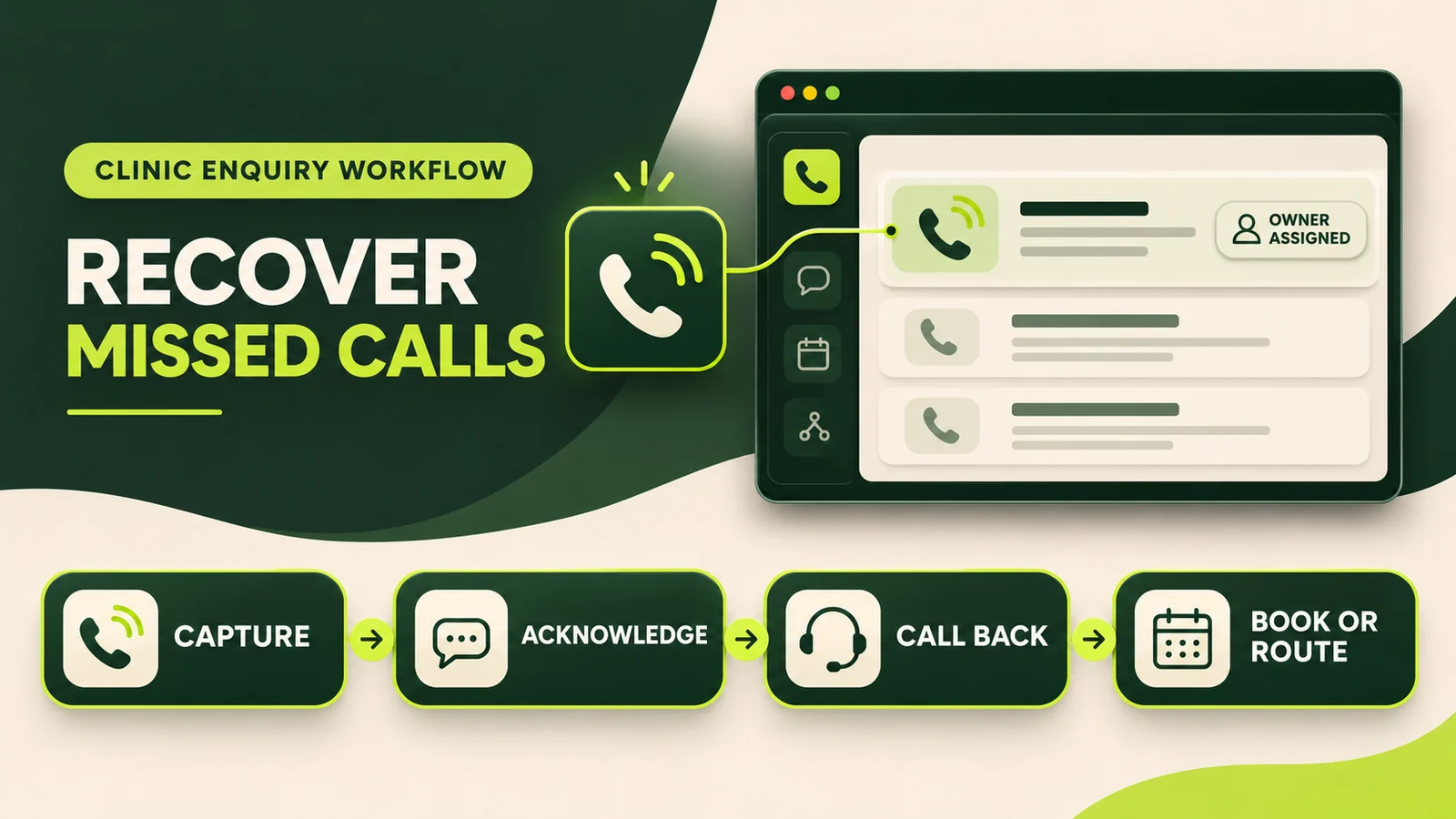
The short answer
Recover missed phone calls and lost patient enquiries by treating each one as a task, not a notification. Every actionable enquiry should enter one queue, receive an owner and due time, move through an approved contact sequence, and finish with a recorded outcome. A neutral automatic acknowledgment may help, but it does not replace human follow-up.
The clinic also needs to distinguish new-patient opportunities from duplicate calls, spam, existing-patient administration and clinical requests. Otherwise the team may inflate the size of the leak, send several messages to one person, or push a medical question through a marketing workflow.
Recovery rule: nothing stays labelled only as “missed.” It becomes booked, routed, resolved elsewhere, unreachable after the approved attempts, invalid, or do-not-contact.
1. Define what the phone system is actually reporting
A missed call, an abandoned call and a voicemail are not necessarily the same event. A caller may hang up in the phone menu, ring twice from the same number, leave a voicemail after one attempt, or submit a form while waiting for a callback. NHS England advises practices to distinguish missed from abandoned calls and remember that several calls may come from one person.
Create definitions that match the clinic’s systems:
- Missed call: the call reached a clinic line but no person or approved answering route handled it.
- Abandoned call: the caller disconnected while waiting or navigating the menu.
- Voicemail: a message was captured and needs review, routing or response.
- Lost digital enquiry: a form, email, chat or message arrived but received no owned follow-up.
- Unique actionable enquiry: one person with a request the clinic can appropriately address, after duplicates and invalid contacts are removed.
Do not assume every missed number is a prospective patient. It may be a pharmacy, vendor, current patient, wrong number or repeat call. Recovery begins with accurate classification.
2. Put every source into one visible recovery queue
List every number and inbox a patient can find: the main line, location lines, tracking numbers, Google Business Profile, advertisements, provider extensions, website forms, chat, email and social messages. Decide which system creates the authoritative task. A red light on a desk phone and a shared inbox that someone checks “when free” are not queues.
Each record needs only enough operational detail to act:
- original channel, number or form;
- timestamp and clinic location;
- caller or sender contact details when available;
- whether a voicemail or message exists;
- new, existing or unknown patient status;
- assigned owner and follow-up due time;
- current status and final disposition; and
- marketing source or campaign when reliably available.
Add a deduplication rule. If the same person calls three times and then submits a form, merge the activity into one conversation while preserving the original timestamps. This prevents multiple team members from contacting the person with conflicting information.
3. Acknowledge receipt without starting a clinical conversation
An acknowledgment tells the person the enquiry arrived and what happens next. It should identify the clinic, offer an approved next step and state a realistic response window. It should not guess why the person called or invite sensitive details into a general marketing inbox.
Automatic text-back is a safety net, not the complete recovery system. It may not reach a landline or withheld number, and replies still need an owner. Before enabling it, review applicable consent and opt-out requirements, the vendor’s data handling, message content, reply ownership and what happens outside opening hours.
Privacy scope: HHS says covered providers may leave voicemail messages but should limit the information disclosed; a name, number and request to call back may be appropriate. HHS also requires appropriate written arrangements when a business associate handles protected health information. Confirm the workflow with qualified privacy and legal advisers for the clinic’s jurisdiction.
4. Separate booking recovery from patient-care routing
When contact occurs, identify the request before trying to book. Use approved, non-clinical routing questions such as whether the person is new or returning, which service or location they are contacting, and whether they want information, a booking or a callback.
| Request type | Recovery action | Owner |
|---|---|---|
| New consultation | Explain the relevant next step, answer approved administrative questions and offer suitable availability | Intake or scheduling |
| Existing appointment | Confirm, reschedule or route according to clinic policy | Scheduling |
| Billing or records | Create a task with the correct department and set an expectation | Billing or administration |
| Clinical question | Stop the marketing script and use the approved clinical escalation route | Qualified clinical team |
| Urgent concern | Follow the clinic’s approved urgent and emergency communication protocol | Designated clinical or emergency route |
| Invalid or duplicate | Merge, close or suppress as appropriate | Queue owner |
Front-desk staff should not improvise clinical suitability, diagnose symptoms or promise outcomes. Their job is to recognize the boundary and deliver the request to the right person with a clear handoff.
5. Run a defined callback sequence
Set the response window from the clinic’s actual staffing and risk policy, then publish it internally and keep it. Avoid copying a universal internet benchmark. A staffed clinic, solo practitioner and multi-location group have different capacity, and clinical messages may require a different priority from prospective-patient questions.
- Review first: check voicemail, recent forms, prior attempts, contact preferences and any existing record.
- Attempt contact: call from a recognizable clinic number when possible and identify the clinic and staff member.
- Offer a concrete next step: provide two suitable appointment options, a secure booking route or an agreed callback time.
- Leave a limited message: follow clinic policy and avoid unnecessary health or service details.
- Create the next task: if contact fails, set the next approved attempt rather than leaving the record open indefinitely.
- Stop appropriately: cap the sequence, respect contact preferences and opt-outs, and document the close reason.
Varying an approved attempt by time of day may help reach someone whose schedule prevented the first connection. Do not turn recovery into pursuit. The person should always understand who is contacting them and how to decline further contact.
6. Use short, approved message templates
Callback opening
“Hello, this is [name] from [clinic]. I’m returning your call from [day]. Is now a suitable time to speak?”
Neutral voicemail
“This is [name] from [clinic]. Please return our call at [number] during [hours].”
Neutral acknowledgment
“This is [clinic]. Sorry we missed your call. Reply with a suitable callback time or use our booking link: [link].”
No-response close
“We tried to return your enquiry. Contact us at [number or link] when you are ready and we can help with the next step.”
These are operational examples, not legal templates. Adapt them to the clinic’s communication policy, contact preferences and jurisdiction. Do not insert a treatment, condition, test result or other sensitive detail merely to make the message feel personalized.
7. Close every record with a useful disposition
“Called back” is an activity, not an outcome. Use a short list staff can apply consistently:
- booked consultation;
- information provided and resolved;
- routed to administration or clinical team;
- callback scheduled for a specific time;
- already handled through another channel;
- unsuitable or outside clinic scope;
- invalid, spam or duplicate;
- unreachable after approved attempts; or
- do not contact.
The final outcome should close the queue task or create a new owned task. A transfer is not complete until the receiving team accepts responsibility. This is the same principle used in a strong lead-to-booking workflow: each stage needs a definition and an owner.
8. Measure recovered appointments, not just returned messages
Google Ads call reporting can show call start and end time, missed or received status, caller area information and call type for eligible tracked calls. That is useful attribution data, but it is not the clinic’s complete phone record. Reconcile advertising reports with the phone system, forms and appointment system.
Also track median and longer-tail callback time, contact attempts, booking, attendance and close reason. Segment by hour, day, location, source and request type. Keep raw missed events separate from unique people so repeated dialing does not exaggerate the leak. Connect recovered bookings to the clinic’s cost-per-booked-consultation reporting.
9. Use recovery data to prevent the next missed enquiry
Recovery is necessary, but the queue also shows where access is failing. Review missed and abandoned calls by hour, call destination and reason. If lunch, Monday morning or one location repeatedly creates a backlog, adjust routing, breaks, coverage or appointment-request options. If callers repeatedly ask the same administrative question, improve the relevant service page or phone message.
For calls outside opening hours, use the separate after-hours clinic lead workflow to decide whether the call route, form, scheduler or advertising schedule should change. For campaign attribution and privacy-aware number setup, see the clinic call-tracking guide.
Review the queue weekly with front-desk staff. Choose one operational fix, test it and annotate the change. The goal is not zero missed-call events at any cost; it is reliable access, safe routing and fewer valuable enquiries disappearing without a next step.
Frequently asked questions
What should a clinic do after missing a patient call?
Create one queue record, check for duplicates, assign an owner and due time, acknowledge through an approved channel, attempt contact and record a final outcome.
Should a clinic automatically text every missed caller?
Not without reviewing the event trigger, consent and opt-out requirements, vendor, privacy controls and reply ownership. Text-back can support recovery, but it does not replace a staffed callback.
What should a missed-call message say?
Identify the clinic, say the call was missed and offer a callback or approved booking route. Avoid naming a condition, treatment or other sensitive detail.
How should missed-call recovery be measured?
Count unique actionable missed enquiries, successful two-way contacts, consultations booked and appointments attended. Report duplicates, invalid contacts and administrative or clinical requests separately.
Turn missed enquiries into owned next steps
A clinic does not recover missed demand with one automated text. It recovers it by connecting phone and message capture, privacy-aware communication, staff ownership, appropriate routing and appointment outcomes. Once every open loop has a due time and every closed loop has a reason, the clinic can improve both marketing performance and patient access.
Wellness Practice Marketing can audit the path from search and advertising through calls, forms, callbacks and attended consultations, then identify where demand is being lost.