
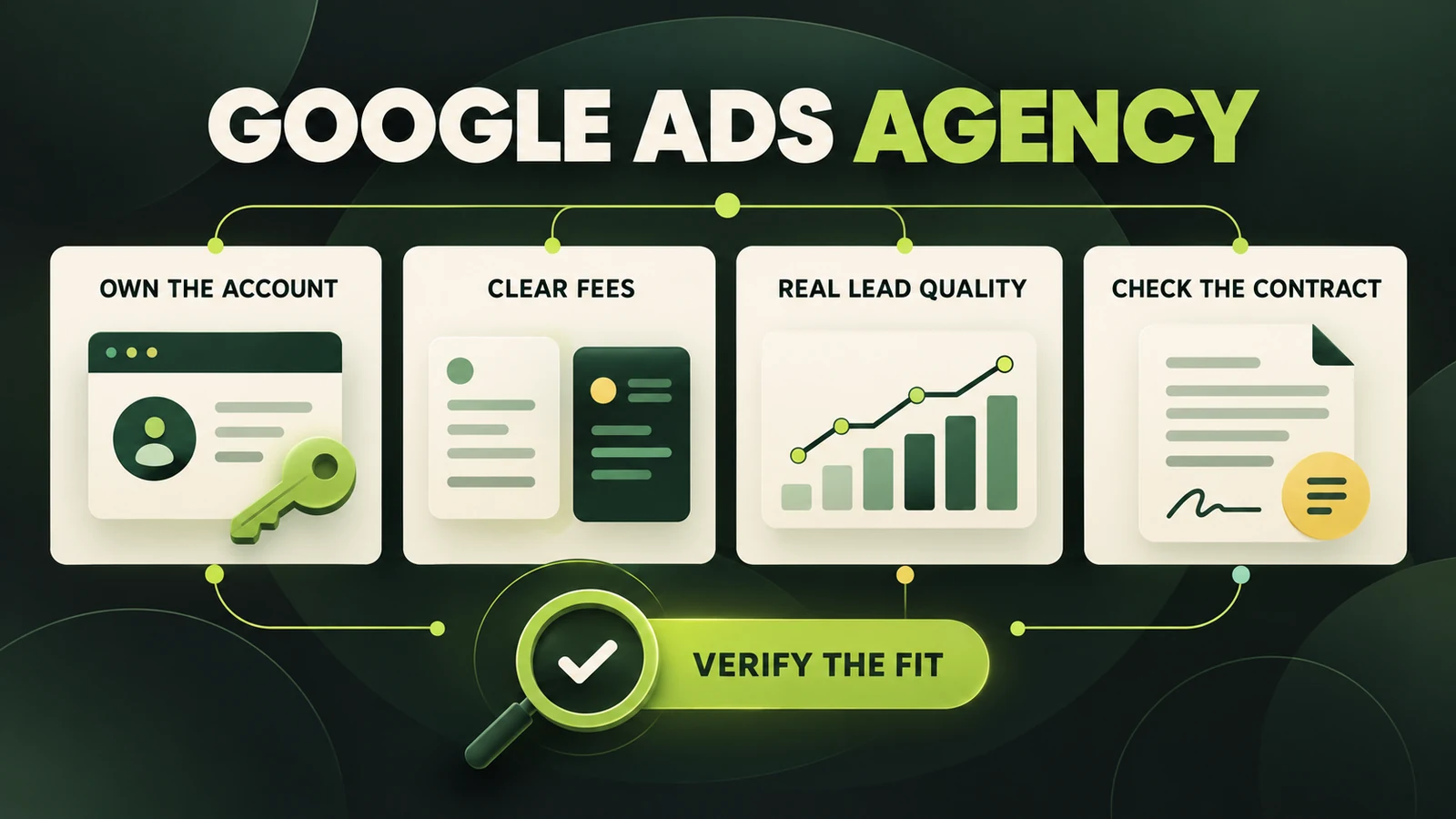
The short answer: verify the operating system, not the sales pitch
To choose a Google Ads agency for your clinic, evaluate five things before price: who controls the account, how every dollar is disclosed, how lead quality reaches the campaign, whether the team can handle healthcare policy, and what you keep when the relationship ends. A confident presentation matters less than a verifiable operating process.
This guide assumes you have already decided that specialist help may be useful. If that decision is still open, start with our framework for whether to hire a marketing agency for a functional medicine practice. Here, the narrower question is how to compare Google Ads providers without being distracted by a badge, a dashboard or a guaranteed result.
Important: Google changes product and third-party requirements. This guide was reviewed against Google's published documentation on October 15, 2026. It is procurement and marketing guidance, not legal, privacy or regulatory advice.
1. Use the same scorecard for every agency
Send each candidate the same service, location, monthly media budget, capacity and definition of a good patient. Then score the answers before the sales calls blur together.
| Criterion | Strong answer | Warning sign |
|---|---|---|
| Account | Your clinic retains admin access, billing visibility and history | The agency will not disclose the customer ID or give access |
| Money | Media cost, management, setup and tools are separate | One bundled number with no exact ad spend |
| Measurement | Calls and forms progress to qualified and booked outcomes | Success means clicks or all form fills |
| Healthcare | Policy and privacy reviews shape targeting and pages | Health campaigns are treated like home services |
| Contract | Term, notice, ownership and handoff are explicit | Assets or access become leverage at cancellation |
Weight the scorecard for your risks. A multi-location hormone clinic may emphasize policy and location control. A new cash-pay practice may put more weight on a focused launch, conversion tracking and the ability to learn without committing the whole budget.
2. Protect account access and continuity
The clinic should retain administrative access to its individual Google Ads account. The agency can link that account to its manager account and do the work there. Google explains that linking an existing client account leaves its history and original user access intact; unlinking later does not erase the client's campaign history.
Google also requires third parties to use a separate account for each end advertiser and provide the account's customer ID when requested. That is the minimum. Your agreement should name control of:
- the Google Ads account, billing profile and payment method;
- Google Analytics, Tag Manager, Search Console and business profiles;
- the clinic domain, landing pages, copy and creative covered by the fee;
- call-tracking numbers, recordings, settings and historical data; and
- CRM fields, offline conversion mappings and dashboards.
Ask who holds administrative ownership, who can add or remove users and what happens on the final day. A promise that “the data is yours” is not enough if the phone number, landing page or conversion setup disappears. Test the written offboarding process, not a verbal assurance.
3. Separate ad spend from agency fees
Normalize every proposal into media spend paid to Google, recurring management, setup, landing-page work, creative, tracking software, call usage and optional services. Confirm taxes, payment timing and any minimum fee when spend changes.
Google's third-party transparency policy says agencies must clearly inform customers about management fees and, where reporting requirements apply, report the exact amount charged by Google separately from their own fees. Google also says customers should have accessible account-level cost and performance information. A bundled invoice that hides media cost prevents a clinic from comparing management quality or calculating acquisition cost.
Ask for the first-month total
Include media, setup, tracking, landing pages and management so the launch cost is visible.
Ask for the steady-state total
Show what repeats monthly and what changes if the clinic raises or reduces ad spend.
Price matters, but cheap management is expensive when tracking is unreliable or irrelevant calls consume staff time. Compare the full patient-acquisition system rather than one percentage.
4. Require reporting on real lead quality
Google Ads can report a form submission or call, but the clinic knows whether that person was eligible, appropriate, booked and attended. A serious agency explains how those downstream signals will influence decisions without sending unnecessary sensitive health information to advertising platforms.
- Platform activity: impressions, clicks, search terms and media cost.
- Tracked inquiry: a completed form or meaningful connected call.
- Valid inquiry: not spam, a vendor, wrong service or wrong geography.
- Qualified lead: meets the clinic's administrative criteria.
- Booked and attended patient: advances to the outcome the clinic can verify.
Ask how calls are counted and reviewed. Our clinic Google Ads call-tracking guide explains why a phone-link click is not the same as a connected, qualified call. Confirm who checks forms, how lead-status feedback is shared and which conversion actions are used for bidding.
5. Test healthcare-policy competence with scenarios
Do not ask only whether the agency has healthcare experience. Give it a realistic scenario: a condition page, telehealth service, weight-loss offer, prescription-related term or remarketing idea. Ask which policies it would review, what it would change and who owns the decision.
A capable answer should distinguish the advertised service, target location, landing page, claims, restricted terms, certification and sensitive-interest targeting. It should acknowledge uncertainty. Our healthcare policy guide for clinic Google Ads shows the layers an agency should investigate instead of treating every disapproval as a copywriting problem.
Then inspect execution. Who monitors notices? Who documents appeals? How does the team prevent protected or unnecessary health data from entering URLs and advertising events? An agency does not replace the clinic's legal or clinical reviewers, but it should know when their review is needed.
6. Inspect the report before signing
Ask for a redacted sample report and meeting agenda. A useful clinic report should show spend by service, relevant search terms, meaningful conversions, valid lead quality, booked outcomes where available, recent changes and the next tests. It should make Google cost distinguishable from agency cost.
Clicks, impressions and click-through rate are diagnostic signals, not business outcomes. A report can look positive while the front desk receives calls for jobs, insurance plans the clinic does not accept or services it does not provide. Require a place for operational feedback and assign someone to supply it.
Ask who manages the account, how often they review search terms and how changes are recorded. Channel advice should be based on intent and evidence, not fashion; see our comparison of Google Ads versus Meta Ads for functional medicine clinics.
7. Read the contract as an offboarding document
A long contract is not automatically bad, and month-to-month service is not automatically good. The key is whether scope, incentives and exit responsibilities are clear. Review:
- initial term, renewal, cancellation notice and termination fees;
- deliverables, response times, meetings and excluded work;
- ownership of copy, designs, landing pages and tracking;
- account access, billing responsibility and approval authority;
- data export, number porting, credential transfer and handoff timing;
- subcontractors, confidentiality, privacy and security; and
- support during suspension, disapproval or a platform outage.
Ask the agency to walk through a hypothetical cancellation. You should know which assets remain live, which subscriptions need replacement and how the next manager receives context. Remove operational lock-in before the relationship starts.
8. Ask these 12 questions in the interview
- Will our clinic have admin access from day one?
- Can you itemize Google's charge and every agency or tool fee?
- Who will manage the account, and how many accounts do they handle?
- How will you learn which calls and forms become qualified patients?
- Which conversion actions will bidding optimize, and who audits them?
- How do you review healthcare policy before launch?
- How do you protect sensitive information in forms, calls and ad events?
- How often do you review search terms, locations and negatives?
- What appears in every report, and may we see an example?
- Which results are forecasts, and what assumptions produce them?
- What is the cancellation process and final handoff?
- May we speak with a relevant reference, with their permission?
9. Treat these claims as red flags
- Guaranteed top placement or patient volume. Google says position is auction-based and cannot be guaranteed.
- No account access. You cannot independently verify cost, changes or history.
- One blended price. Hidden media cost makes performance and fees hard to evaluate.
- Vanity-only reporting. More clicks are not useful if inquiry quality declines.
- No questions about capacity or economics. The agency cannot set a rational acquisition target.
- Broad launch before measurement. More campaigns create more uncertainty when calls and forms are not tested.
- Casual health remarketing. Sensitive-interest rules demand a careful answer.
- Unverifiable affiliation. Google advises clicking a Partner badge to reach the agency's Google profile. A badge is program status, not a guarantee of fit.
10. Compare proposals on one page
Create a sheet with one column per agency and rows for the five scorecard categories, total first-month cost, ongoing cost, named account lead, scope, term and references. Mark missing answers as “not provided” instead of filling the gap with an assumption.
Then ask: could another competent manager take over next month without rebuilding measurement? If not, identify what is missing. A good agency should create useful knowledge and durable infrastructure, not dependency.
Frequently asked questions
Should a clinic own its Google Ads account?
The safest arrangement is for the clinic to retain administrative access to its advertiser account, billing and related assets while the agency works through manager access. Confirm the structure and offboarding steps in writing.
What should the monthly report include?
Separate Google media cost from fees and show relevant searches, conversions, valid inquiries, qualified leads and booked patients wherever the clinic can measure them responsibly.
Is a Google Partner badge enough?
No. Verify the badge through its Google profile, then assess the assigned people, healthcare process, measurement, fees and agreement. Status alone does not prove niche fit.
How long should the contract be?
There is no universal term. Choose one that matches the setup work and your risk tolerance, with clear deliverables, notice, ownership and handoff.
Should an agency guarantee results?
No agency controls auctions, demand, clinic capacity or booking performance. Ask for a forecast with visible assumptions and decision rules, not a guaranteed position or patient count.
Choose for control, clarity and learning
The right clinic Google Ads agency should make the system easier to understand. You should know where the money went, which inquiries were useful, what changed, what the team learned and what belongs to your practice. Ownership, transparent reporting and a clean exit are part of campaign quality.
Wellness Practice Marketing provides Google Ads management for wellness clinics with clinic-owned accounts, transparent reporting and no long-term contracts. If you want to compare your current setup or planned launch against this scorecard, book a strategy call.
This article provides general marketing and procurement education. Review contracts, privacy obligations and regulated healthcare claims with appropriately qualified advisers.
Authoritative sources
- Google Ads Policy: Transparency requirements for third parties
- Google Ads Policy: About third-party policies
- Google advertiser guide: Working with third parties
- Google Ads Policy: False, misleading or unrealistic claims
- Google Ads Help: Linking accounts to a manager account
- Google Ads Help: Unlinking accounts from a manager account
- Google Ads Help: Google Partners FAQs