
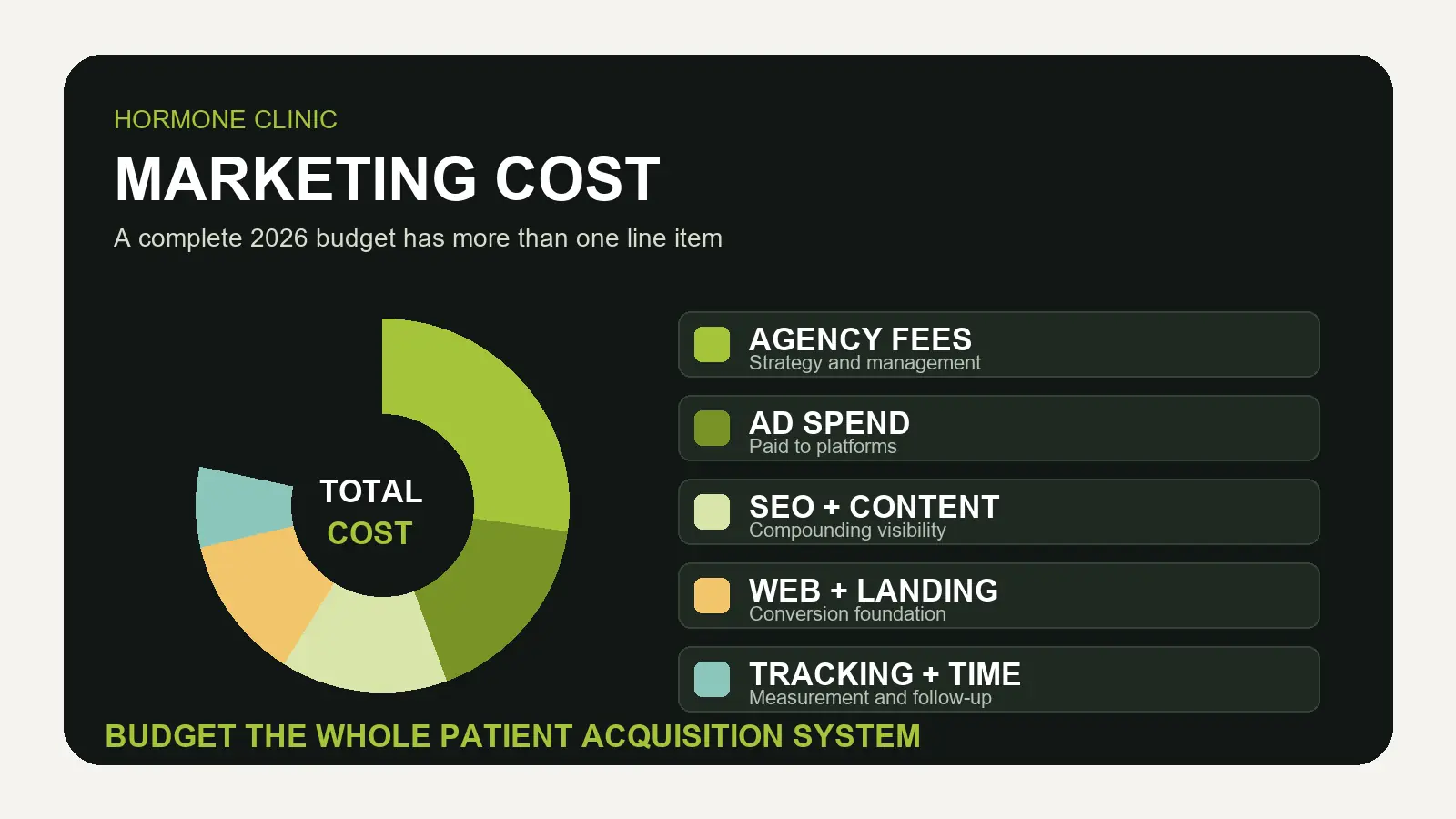
Short answer: a hormone clinic marketing budget can range from a focused single-channel investment to a broader monthly growth system, but the useful number is the total cost of the specific plan you can measure and support. It should include agency fees, ad spend, SEO, landing pages or website work, content, tracking tools and internal staff time. Leaving any of those out creates a budget that looks affordable on paper but fails in practice.
For a concrete reference, WPM's transparent 2026 pricing is $697 per month plus ad spend for Google Ads Management, $597 per month for SEO, $997 per month plus ad spend for the Booked-Out Practice Program, Landing Page Optimization from $300 per month, and a Custom Website from $1,997. These are WPM prices, not industry averages. Another agency, freelancer or in-house team may structure and price the work differently.
Important: ad spend is paid directly to the advertising platform and is separate from management. If management is $697 and the clinic pays Google $1,500, the combined monthly outlay is $2,197, not $697.
The right hormone clinic marketing cost depends on what must be built, how quickly the clinic needs demand, the competitiveness of the local market, and whether the team can answer and qualify enquiries promptly. A solo menopause practitioner with limited capacity should not copy the budget of a multi-provider testosterone clinic opening a second location.
The Seven Costs That Belong in the Budget
A useful budget separates each cost category. This lets an owner see what is recurring, what is paid once, what changes with scale, and what can be handled internally.
1. Agency or specialist fees
Strategy, campaign management, SEO execution, reporting, optimization and coordination. The fee pays for skilled work, not the media itself.
2. Advertising spend
Money paid directly to Google or another platform for clicks and reach. It should stay in an account the clinic owns and can inspect.
3. SEO
Technical improvements, service and location pages, internal linking, Google Business Profile work, content planning and ongoing optimization.
4. Website and landing pages
One-time builds, redesigns or recurring conversion work needed to turn relevant traffic into consultation requests.
5. Creative and content
Copywriting, design, photography, video, patient education and ad assets. Scope varies widely, so it should be itemized rather than hidden.
6. Tracking and software
Analytics, call tracking, forms, booking tools, CRM or lead management, consent tools and integrations that connect enquiries to outcomes.
7. Internal staff time
Reviewing content, answering leads, qualifying prospects, scheduling, following up and recording whether enquiries became patients.
The last category is often ignored. A campaign can generate appropriate consultation enquiries and still fail commercially if calls go unanswered or web forms wait two days for a response. Staff time is not free, even when no vendor invoice appears.
WPM's Transparent 2026 Pricing
The following figures are Wellness Practice Marketing's prices as of 2026. They are provided to make the examples transparent. They are not claims about what the wider market charges.
| WPM service | 2026 price | What to budget separately |
|---|---|---|
| Google Ads Management | $697 per month | Advertising spend paid directly to Google |
| SEO | $597 per month | Large development projects or extensive media production if required |
| Booked-Out Practice Program | $997 per month | Advertising spend paid directly to platforms |
| Landing Page Optimization | From $300 per month | Any agreed media, photography or complex integration costs |
| Custom Website | From $1,997 | Ongoing SEO, advertising and third-party software |
The Booked-Out Practice Program combines advertising, SEO, landing pages, conversion optimization, Google Business Profile work, tracking and newsletter management. The service scope matters when comparing prices. A lower fee for one channel is not directly comparable with a program that includes several.
Before signing, ask any provider to show which account owns the ad data, whether landing pages are included, what counts as content, which tracking events will be configured, how reporting connects to booked consultations, and what happens to the assets if the relationship ends.
Agency Fees and Ad Spend Are Different
Google Ads creates two separate transactions. The clinic pays a management fee for campaign work, and it pays Google for media. Combining them into one vague number makes it difficult to understand where money goes or how to scale.
With WPM Google Ads Management, a clinic choosing $1,500 in monthly ad spend would have this simple budget:
$697 management + $1,500 paid to Google = $2,197 per month
This does not assume any number of leads or patients. It only shows the cash requirement under the stated assumptions.
Ad spend should reflect local search demand, cost per click, geographic reach, clinic capacity and the amount of data needed to make decisions. A budget too small to produce meaningful traffic may create noisy conclusions. A larger budget does not repair weak tracking, unsuitable keywords or a confusing landing page.
For campaign structure and compliance considerations, read our guide to Google Ads for hormone therapy clinics. It explains why consultation-focused messaging, service-specific pages and careful policy review matter in this category.
What You Are Paying for With SEO
SEO is not one task. For a hormone clinic, the work may include technical cleanup, local signals, provider expertise, treatment and consultation pages, educational content, internal links, review strategy and measurement. The balance depends on what the clinic already has.
A clinic may need pages for menopause consultations, testosterone evaluation, BHRT, hormone optimization or relevant locations. Those pages should accurately describe the service and provider without making unsupported outcome claims. They also need clear navigation, useful patient information and a sensible next step.
WPM's SEO service is $597 per month in 2026. A clinic adding Landing Page Optimization from $300 per month would have a combined starting outlay of $897 per month for those two WPM services. This does not mean every clinic needs both at the same time. It is an arithmetic example, not a universal recommendation.
SEO generally requires a longer planning horizon than paid search. It can build compounding visibility, but rankings and traffic are not guaranteed. Owners should look for progress in relevant search visibility, qualified organic enquiries, Google Business Profile actions and actual patient attribution, not just the number of articles published.
Website and Landing Page Costs
A marketing campaign sends people somewhere. If that destination is slow, generic or unclear, paying for more traffic can increase waste. Hormone care is also research-heavy and high trust, so visitors often want to understand the provider, consultation process, suitability, location, fees or financing, and next step before contacting the clinic.
WPM's Custom Website starts at $1,997. If a clinic paired that one-time starting price with WPM SEO at $597 in the first month, the first-month starting outlay for those items would be $2,594, followed by the recurring SEO fee if continued. Final website scope can change with page count and integrations.
Landing page work is narrower. WPM Landing Page Optimization starts at $300 per month and focuses on the pages supporting acquisition. See our landing page optimization service for the conversion elements we review.
Do not judge a page only by visual polish. The budget should cover accurate service copy, provider credibility, compliant language, mobile usability, fast load time, clear calls to action, privacy-conscious forms and event tracking.
Creative, Content, Tracking and Software
Creative and content
Hormone clinics need enough content to answer real patient questions, but volume alone is not a strategy. Budget for content tied to priority consultations and the decisions patients make before booking. This may include service-page copy, educational articles, provider videos, diagrams, email follow-up or ad creative.
Professional photography can strengthen trust, while original diagrams can explain a process without using sensational before-and-after imagery. Every asset should avoid cure claims, guaranteed results and language that suggests a treatment is suitable for everyone.
Tracking and software
Analytics may be free, but implementation and maintenance require time. Call tracking, CRM systems, online booking tools and integrations may carry subscription fees. Before adding software, define the minimum record the team needs: source, campaign, enquiry type, booking status, show status, qualified status and patient outcome.
A form submission, call click or booking-page visit is a tracked action. It is not automatically a booked consultation, a completed visit or a patient. Our article on why conversion tracking matters explains why this distinction changes budget decisions.
Internal staff time
Assign an owner to lead response and data quality. Estimate the weekly time needed to answer enquiries, return missed calls, qualify requests, schedule visits and update the CRM. If a front-desk team spends five hours each week on marketing-generated leads, that labor belongs in the true cost model.
Three Realistic Budget Scenarios
These scenarios use WPM's listed prices and transparent assumptions. They are planning examples, not forecasts, market averages or guarantees.
Scenario 1: Focused paid-search launch
Assumptions: the clinic already has a suitable service page, one priority consultation, reliable intake and basic analytics.
- WPM Google Ads Management: $697 per month
- Google ad spend: $1,500 per month
- Total: $2,197 per month
This structure may suit a clinic that needs near-term visibility and can respond quickly. It excludes new website work, paid call-tracking software and internal staff labor.
Scenario 2: Broader patient acquisition program
Assumptions: the clinic wants coordinated ads, SEO, landing-page work, conversion optimization, Google Business Profile support, tracking and newsletter management.
- WPM Booked-Out Practice Program: $997 per month
- Google ad spend: $2,500 per month
- Total: $3,497 per month
This scenario funds more than campaign management, but software or major website development may still be separate depending on scope. It is appropriate only if the clinic has the capacity and follow-up process to handle additional enquiries.
Scenario 3: Organic foundation and conversion work
Assumptions: the clinic is not ready for paid media and wants to strengthen organic visibility and a priority landing page.
- WPM SEO: $597 per month
- WPM Landing Page Optimization: from $300 per month
- Starting total: $897 per month
The likely tradeoff is speed. Organic work can improve the foundation and build over time, but it should not be sold as immediate demand. The clinic still needs staff time and may need separate creative or software.
Use Clinic Economics to Set the Ceiling
A budget becomes rational when it is connected to contribution margin and capacity. Revenue alone can mislead because treatment delivery has costs.
Build the model with these inputs:
- Consultation value: cash collected for the initial visit, if any.
- Treatment or program value: expected revenue from the care plan under a clearly defined time period.
- Gross margin: revenue left after direct clinical delivery costs, labs, products and relevant variable expenses.
- Lead-to-booking rate: percentage of valid enquiries that schedule.
- Show rate: percentage of booked consultations that attend.
- Patient conversion rate: percentage of attended consultations that become patients.
- Capacity: number of additional patients the clinic can serve without harming care or operations.
- Payback period: how long the clinic can wait to recover acquisition cost from gross contribution.
Expected new patients = valid leads x booking rate x show rate x patient conversion rate
Allowable acquisition cost = expected gross contribution within the chosen payback period minus required operating return
Consider a purely illustrative funnel: 30 valid leads, a 60% booking rate, an 80% show rate and a 45% patient conversion rate. The arithmetic produces 6.48 expected patients. If gross contribution per patient within the selected payback window were $2,500, expected gross contribution would be $16,200.
That is not a performance promise. Every input is an assumption that must be replaced with the clinic's real data. It also does not mean $16,200 is available for marketing. Owners still need to account for overhead, risk, cash timing, capacity and desired profit.
For the $3,497 monthly program example, dividing spend by a hypothetical $2,500 gross contribution per acquired patient gives 1.3988 patients to cover that marketing outlay before other overhead. In practical terms, the clinic would need more than one such patient, and actual acquisition arrives in whole people with variable value and timing.
Track the Journey From Action to Patient
Good reporting has layers. Platform conversions show what happened online. Clinic records show what happened operationally and financially.
| Stage | What to record | Why it matters |
|---|---|---|
| Tracked action | Form, qualified call, booking click | Tests whether campaigns create response |
| Valid lead | Real person, relevant service, reachable | Removes spam and unsuitable enquiries |
| Booked consultation | Appointment date and source | Measures intake effectiveness |
| Attended consultation | Show or no-show | Reveals scheduling and reminder issues |
| New patient | Started appropriate care after clinical evaluation | Connects marketing to acquisition |
| Gross contribution | Collected revenue minus direct delivery costs | Supports payback decisions |
Healthcare privacy deserves careful implementation. Collect only the information needed, use suitable systems and access controls, and get legal or compliance advice for the clinic's jurisdiction and workflows. Marketing reporting should not expose sensitive health information unnecessarily.
Capacity Comes Before Scaling
Marketing cannot solve a full calendar. Before increasing spend, calculate provider availability, consultation slots, follow-up capacity and the service lines the clinic actually wants to grow. If only eight additional consultations can be handled next month, a campaign designed for far more demand may create poor patient experience and wasted follow-up.
Capacity also affects channel choice. A clinic with limited immediate availability may prioritize SEO and conversion work while preparing operations. A clinic with open provider schedules and solid intake may place more weight on high-intent paid search. The hormone clinic marketing service page explains how these channels fit into one acquisition system.
Questions to Ask Before Approving the Budget
- Which services and locations are the priority, and how many new patients can we serve?
- Which costs are one-time, recurring or variable?
- Is ad spend separate, paid directly to the platform and controlled by our clinic?
- Who owns the advertising, analytics, landing pages and creative assets?
- Which actions will be tracked, and how will they be reconciled with booked and attended consultations?
- Who responds to new enquiries, within what timeframe, and where is the outcome recorded?
- How will medical and advertising claims be reviewed for our services and jurisdiction?
- What evidence would justify increasing, holding or reducing spend?
- What is the desired payback period based on gross contribution rather than headline revenue?
A credible provider should be comfortable with these questions. The answer may be that the clinic should fix tracking or intake before buying more traffic.
Budget Mistakes That Make Marketing Look More Expensive
- Counting only the agency fee. This omits media, software, content and staff time.
- Calling every conversion a patient. Platform actions must be reconciled with clinic outcomes.
- Scaling before the landing page works. More clicks amplify existing conversion problems.
- Spreading a small budget across too many services. A focused campaign is usually easier to learn from.
- Ignoring follow-up. Delayed responses reduce the value of otherwise qualified enquiries.
- Using revenue without margin or timing. Cash collected over many months cannot always support a short payback requirement.
- Publishing aggressive medical claims. Cure language, guaranteed results or unsuitable promises create compliance and trust risks.
- Changing channels before enough evidence exists. Frequent resets make it hard to identify the real constraint.
For a broader comparison across clinic stages, see our functional medicine marketing budget guide.
Frequently Asked Questions
How much does hormone clinic marketing cost in 2026?
The total depends on channels, ad spend, clinic capacity and internal workload. WPM's transparent 2026 pricing starts at $697 per month plus ad spend for Google Ads Management, $597 per month for SEO, $997 per month plus ad spend for the Booked-Out Practice Program, $300 per month for Landing Page Optimization, and $1,997 for a Custom Website. These are WPM prices, not industry averages.
Is ad spend included in an agency management fee?
No. Ad spend is normally paid directly to Google or another platform and is separate from management. Under the example above, $697 in management plus $1,500 paid to Google equals $2,197 per month.
Should a hormone clinic invest in SEO or Google Ads first?
Google Ads can create visibility sooner when the clinic has a suitable page and tracking. SEO is intended to build visibility over time. The right order depends on urgency, website quality, demand and capacity.
What costs are commonly missed?
Landing-page work, content and creative, call tracking or CRM software, maintenance, lead follow-up and staff time are frequently absent from initial estimates.
How should a clinic judge affordability?
Use consultation value, treatment or program value, gross margin, booking rate, show rate, patient conversion rate, capacity and payback period. Do not use clicks alone.
Can a small clinic start with one channel?
Yes. A conversion-ready foundation and one measurable acquisition channel can be more useful than launching several underfunded channels at once.
Does a higher budget guarantee more patients?
No. Results depend on demand, competition, offer clarity, compliance, page quality, follow-up and capacity. No budget or agency fee guarantees patient volume.
Build the Budget From the Patient Journey Backward
The best answer to "How much should a hormone clinic spend on marketing?" is not a percentage copied from another business. It is a plan that starts with capacity and clinic economics, funds the complete path from discovery to follow-up, and separates tracked actions from actual patients.
Write down every cost, state every assumption and decide what evidence will trigger the next change. If you want an outside review, book a discovery call with Salem. We will look at your current channels, tracking, capacity and priorities before recommending a scope.