

Growing a wellness practice is rarely about finding one perfect marketing channel. Many clinics begin with referrals, repeat patients, and community relationships, but eventually growth becomes inconsistent. Some months appointments are full. Other months consultation requests slow down without an obvious reason.
The difference between unpredictable growth and sustainable growth is having a patient pipeline rather than relying on chance.
Today's patients research providers before they ever schedule an appointment. They compare Google reviews, browse clinic websites, read educational articles, and often search multiple providers before deciding who feels most trustworthy. That means successful wellness practice growth depends on visibility, trust, conversion, and retention working together.
Whether you run a functional medicine clinic, naturopathic practice, hormone therapy clinic, longevity center, IV therapy clinic, or another cash-pay wellness practice, the goal is the same: consistently attract qualified consultations while building long-term patient relationships. This guide walks through ten strategies that fit together into one repeatable growth framework.
Why Sustainable Growth Requires More Than Referrals
Referrals remain valuable, but they shouldn't be the foundation of your entire growth strategy. A referral-only practice has very little control over how many new patients arrive each month. Existing patients may refer friends, healthcare professionals may recommend your clinic, and word-of-mouth may work well for a while — but none of these channels are predictable or easily scalable.
Cash-pay wellness clinics face another challenge: patients typically spend days or weeks researching providers before booking. They want evidence that your clinic is credible, experienced, and aligned with their health goals. A stronger patient pipeline combines multiple channels instead of depending on one source.
The modern wellness patient journey
| Stage | What the patient does |
|---|---|
| Search | Googles a symptom or "wellness clinic near me" and scans the local map results. |
| Compare | Reads reviews, ratings and photos of two or three nearby clinics. |
| Research | Visits websites, reads service pages and educational articles, checks practitioner bios. |
| Book | Requests a consultation from the clinic that feels most credible and easiest to book. |
| Return | Stays engaged through follow-up, email and ongoing care — and refers others. |
Every strategy in this article strengthens one or more parts of that pipeline.
1Define Your Ideal Patient Before You Market
Many clinics try to market every service to everyone. That usually creates generic messaging that doesn't resonate with anyone. Instead, define exactly who your clinic wants to attract. Think about your primary services, geographic service area, the age groups or lifestyles you commonly serve, whether you're focused on cash-pay patients, and the problems patients actually search for online.
For example, a hormone therapy clinic may target adults searching for hormone optimization consultations within a specific city, while a functional medicine clinic may focus on digestive health, thyroid support, or autoimmune care.
Create service-specific messaging
Instead of describing your clinic broadly, create messaging around patient search intent. This makes your website, Local SEO pages, and Google Ads much more relevant to what patients are actually searching.
2Invest in Local SEO to Increase Visibility
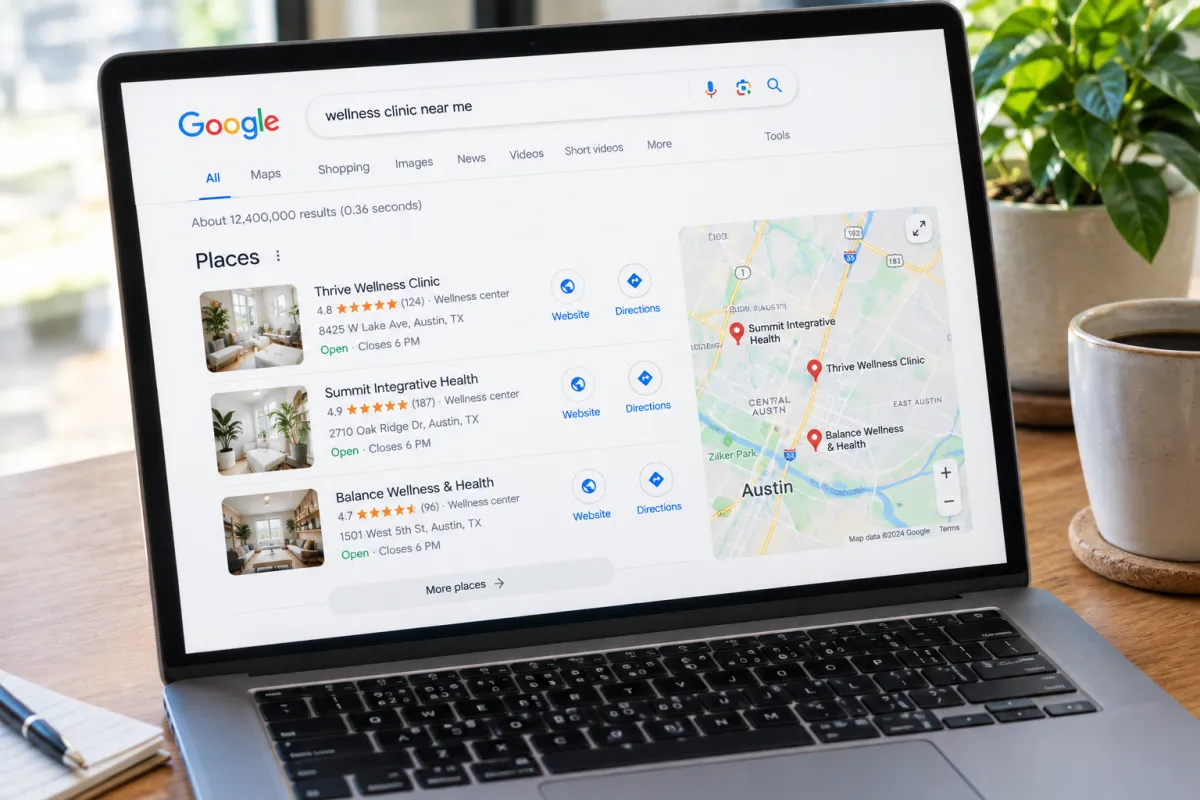
Local SEO is one of the highest-priority growth strategies because many patients begin with searches like "wellness clinic near me," "functional medicine doctor in Austin," or "hormone therapy clinic Chicago." If your clinic doesn't appear prominently in those results, you're missing highly motivated patients.
Optimize your Google Business Profile
A complete profile helps patients discover and evaluate your clinic before visiting your website. Include accurate categories, updated hours, an appointment booking link, service descriptions, clinic and provider photos, and regular updates. If your listing isn't surfacing at all, start with our guide on why your clinic isn't showing up on Google Maps.
Create location-focused pages
If your clinic serves multiple cities or neighborhoods, build dedicated location pages rather than listing every city on one page — each with the services available, local landmarks served, directions, FAQs and an embedded map.
Maintain local consistency
Keep your clinic's name, address, and phone number consistent across your Google Business Profile, website, healthcare directories, local listings and social profiles. Consistency helps search engines understand your clinic's location and improves visibility over time.
3Build a Website That Converts Visitors Into Consultations
Traffic alone doesn't grow a clinic. Your website must convert visitors into consultation requests by answering three questions quickly: What services do you offer? Why should someone trust your clinic? How do they book?
Essential website elements
| Element | Why it matters |
|---|---|
| Clear consultation CTA on every page | Visitors never have to hunt for the next step. |
| Short, mobile-friendly booking forms | Most wellness searches happen on phones. |
| Practitioner bios with real photos | Patients book people, not services. |
| Testimonials and reviews | Third-party trust reduces booking hesitation. |
| FAQs on every service page | Answers objections before they become drop-offs. |
Service pages matter
Create dedicated pages for major services — gut health, hormone health, weight management, women's health, men's health, thyroid wellness, autoimmune support — instead of placing everything on one page. Each should explain who the consultation is for, what patients can expect at the first visit, and how to schedule. Our landing page optimization service covers what high-converting pages look like.
4Use Google Ads to Capture High-Intent Patients
Google Ads works differently from SEO. Instead of waiting for rankings to improve, it places your clinic in front of people actively searching for services — especially useful for cash-pay consultations like weight management, hormone therapy, functional medicine, IV therapy and nutritional counseling. The focus should remain on consultation bookings rather than making health claims in advertisements.
Search campaigns first
Search campaigns usually provide the clearest intent. Good structure means one service per campaign, relevant keywords, matching landing pages and local geographic targeting — the full framework is in our guide to PPC advertising for wellness practices.
Don't send ads to your homepage
Every campaign should direct visitors to a dedicated landing page for that specific service. An ad for hormone consultations should land on a hormone consultation page — not a homepage listing six unrelated services.
Install conversion tracking before spending more
Track consultation forms, phone calls, appointment requests and online bookings. Without tracking, it's impossible to know which campaigns generate consultations.
5Publish Educational Content That Builds Trust
Educational content is a long-term growth asset because it helps patients discover your clinic before they're ready to schedule. Instead of promotional articles, answer the questions patients already search online: What is functional medicine? How do I prepare for a hormone consultation? What are the signs I may benefit from nutritional counseling?
Content like this supports both SEO and patient confidence without feeling promotional — our guide to content marketing for wellness clinics covers the full method, from choosing topics to repurposing each article into video, email and Google Business Profile updates.
6Use Email Marketing to Nurture Leads and Retain Patients
Not every visitor books immediately. Email marketing keeps your clinic connected with people still researching their options.
A simple nurture sequence
- Welcome email after downloading a guide.
- Educational article.
- Provider introduction.
- Frequently asked questions.
- Invitation to schedule a consultation.
The goal is education and trust — not constant promotion.
Email also supports retention
Established patients appreciate helpful communication too: seasonal wellness newsletters, appointment reminders, follow-up educational resources and program updates all help maintain relationships between visits.
7Build a Reputation That Converts More Patients
Reviews influence both Local SEO and booking decisions — many prospective patients read them before ever visiting your website.
Make review collection part of your workflow
Ask satisfied patients after meaningful interactions rather than waiting for reviews to happen naturally. Follow-up emails, SMS requests, QR codes at reception and appointment follow-up messages all work — keep requests simple and convenient, as covered in our guide on getting more Google reviews.
Respond professionally to every review
Positive reviews deserve acknowledgment. Negative reviews deserve calm, respectful responses without discussing private healthcare information publicly. Responding consistently demonstrates professionalism to future patients — our reputation management guide includes privacy-safe response templates for both.
Reviews strengthen multiple marketing channels
Reviews appear on Google Maps, Google Search, your website, landing pages and service pages. That makes reputation management part of patient acquisition — not just customer service.
8Track Every Consultation Request and Marketing Channel
Growth improves when you measure what generates consultations.
What wellness clinics should track
| Metric | What it tells you |
|---|---|
| Consultation form submissions | Whether your website converts visitors into requests. |
| Phone calls from website and profile | How many patients prefer to call — and from where. |
| Online bookings | Whether your scheduling path works, especially on mobile. |
| Google Business Profile interactions | How often local searchers engage before your website. |
| Lead source per consultation | Which channels produce qualified patients, not just traffic. |
Know where consultations come from
Tag lead sources whenever possible — Google Ads, organic search, Google Business Profile, referral, email, direct traffic — so you can prioritize the channels producing qualified requests. Then review the data monthly, looking for trends rather than isolated fluctuations. Our lead generation guide covers tracking setup in depth.
9Increase Patient Lifetime Value With Retention Marketing

Growth isn't only about acquiring patients. Retaining patients often creates a healthier long-term practice.
Build ongoing relationships
Retention marketing includes follow-up educational emails, wellness memberships, seasonal resources, preventive care reminders, and educational workshops or webinars — communications that keep patients engaged without feeling promotional.
Encourage referrals naturally
Satisfied patients become referral sources when they've had a positive overall experience. Rather than constantly requesting referrals, create an experience worth recommending: clear communication, helpful resources, a smooth booking process and consistent follow-up.
A patient pipeline doesn't end after booking — it continues through long-term engagement and future care opportunities.
10Review Your Marketing Every Month and Optimize
Successful wellness practices treat marketing as an ongoing system instead of a one-time project. A monthly review covers consultation volume by source, ad performance, review activity, top-performing content and website conversion rates.
Optimize gradually: small improvements each month produce more sustainable results than constantly rebuilding campaigns or redesigning your website.
Marketing Channel Priority Matrix for Wellness Practices
Not every clinic should invest equally in every channel from day one.
| Channel | Priority | When to invest |
|---|---|---|
| Google Business Profile | Essential | Immediately — free and highest local impact. |
| Website & service pages | Essential | Before any paid advertising. |
| Local SEO & reviews | High | From month one, continuously. |
| Google Ads | High | Once landing pages and tracking are ready. |
| Educational content | Medium | Ongoing — compounds over 6–12 months. |
| Email marketing | Medium | Once traffic and lead capture exist. |
This framework helps clinics focus resources where they have the greatest impact on visibility and consultation generation.
A 90-Day Wellness Practice Growth Plan
A structured rollout is easier than implementing every strategy at once.
| Phase | Focus |
|---|---|
| Days 1–30 | Complete your Google Business Profile, fix listing consistency, start a review request routine, and define your ideal patient and core services. |
| Days 31–60 | Build or improve dedicated service pages, simplify the booking path, set up conversion tracking, and publish your first educational articles. |
| Days 61–90 | Launch a focused Google Ads test for one priority service, activate an email welcome sequence, and run your first monthly marketing review. |
By the end of 90 days, your clinic should have stronger visibility, clearer measurement, and a more organized patient acquisition process — the same sequence we walk through in our practice growth playbook.
Wellness Practice Growth Checklist
Before investing more time or budget into marketing, make sure these fundamentals are in place.
Visibility: Google Business Profile complete and accurate; primary services have dedicated pages; local keywords appear naturally across your website; clinic information consistent across directories.
Conversion: every important page includes a consultation CTA; booking works well on mobile; testimonials and provider bios are easy to find; landing pages match Google Ads campaigns.
Trust: Google reviews requested consistently and answered professionally; clinic photos updated regularly; FAQs address common patient concerns.
Retention: email welcome sequence active; follow-up communications scheduled; educational newsletters provide ongoing value; referrals happen naturally through a positive experience.
Measurement: consultation forms, phone calls and appointment requests tracked; monthly reports review traffic, leads and consultations.
Frequently Asked Questions
What is the best strategy for growing a wellness practice?
The best wellness practice growth strategy combines Local SEO, a well-optimized website, Google Business Profile optimization, educational content, reviews, email marketing, and conversion tracking into one patient acquisition system rather than relying on referrals alone.
How do wellness clinics attract more patients?
Wellness clinics attract more patients by increasing visibility in local search, creating service-specific landing pages, publishing educational content, generating Google reviews, and making it easy for visitors to book consultations.
Does Local SEO help wellness practices grow?
Yes. Local SEO helps wellness practices appear in Google Maps and local search results when nearby patients search for services such as functional medicine, hormone therapy, naturopathic care, or wellness consultations.
Should wellness practices invest in Google Ads?
Google Ads can be valuable for clinics that already have optimized landing pages and conversion tracking. It works best for high-intent searches where patients are actively looking for consultations.
How important are Google reviews for wellness clinics?
Google reviews build trust with prospective patients and strengthen your Google Business Profile. A consistent flow of authentic reviews can improve how patients evaluate your clinic during their research process.
What's the difference between lead generation and practice growth?
Lead generation focuses on creating consultation requests. Practice growth includes lead generation plus website conversion optimization, patient retention, reputation management, referral development, and ongoing marketing measurement.
How do wellness clinics retain patients?
Retention comes from clear follow-up communication, educational resources, appointment reminders, wellness programs, and a positive overall patient experience that encourages long-term relationships.
How do I measure whether my marketing is working?
Track consultation requests, phone calls, appointment bookings, organic website traffic, Google Business Profile interactions, email signups, and the marketing source associated with each new consultation.
Build a Stronger Patient Pipeline, Not Just More Traffic
The most successful wellness practices don't depend on one marketing tactic. They build systems that consistently move prospective patients from discovery to consultation and from consultation to long-term care.
A sustainable patient pipeline starts with being visible through Local SEO and Google Business Profile, continues with a website designed to convert visitors into consultations, and grows stronger through educational content, Google Ads, reviews, email marketing, and conversion tracking.
If your clinic is already attracting visitors but consultation requests aren't growing, the next opportunity usually isn't more traffic — it's improving the journey between search and booking.