

When we built two new Google Ads campaigns for a physician-led integrative medicine practice in California, we did not group every local search into the same ad group.
Instead, we separated geographic intent into distinct categories: generic service searches, "near me" searches, Palo Alto, Portola Valley, Menlo Park, Los Altos, and Bay Area — used across two different service campaigns, perimenopause and hormone health, and preventive and metabolic health.
The reason was not simply account organization. We wanted to be able to see whether people searching by city, by "near me," by regional terms, or without any location language behaved differently.
The Geographic Structure We Used
The account was built around a repeatable framework. For each major service theme, we created geographic variants. In the perimenopause campaign, that included:
- Generic intent — Perimenopause, Hormone, Hormone imbalance.
- Near-me intent — Perimenopause near me, Hormone near me, Hormone imbalance near me.
- City intent — Perimenopause Palo Alto, Perimenopause Portola Valley, Perimenopause Menlo Park, Perimenopause Los Altos (and the same pattern for hormone and hormone-imbalance themes).
- Regional intent — Perimenopause Bay Area, Hormone Bay Area, Hormone imbalance Bay Area.
The preventive and metabolic campaign followed the same architecture using metabolic health, preventive health, near me, Palo Alto, Portola Valley, Menlo Park, Los Altos, and Bay Area — giving us a consistent geographic framework across both campaigns.
Why We Did Not Treat All Local Searches the Same
At first glance, these searches might look equivalent: "perimenopause doctor," "perimenopause doctor near me," "perimenopause doctor Palo Alto," "perimenopause doctor Bay Area." They all involve the same service. But they express different levels of geographic intent.
A generic service search may come from someone still exploring options. A "near me" search adds clear local intent. A city-specific search may indicate someone who already knows where they want to receive care. A regional search like "Bay Area" may show broader location flexibility. We wanted to measure those differences instead of assuming they all behaved the same.
Generic Searches
Generic searches contain the service but no explicit location — "perimenopause doctor," "hormone specialist," "metabolic health doctor." These searches can still be highly valuable; Google already knows the searcher's location and can serve local ads even if the person does not type a city. But from an analysis perspective, generic searches are different from explicitly local searches. They deserve to be measured separately.
"Near Me" Searches
"Near me" terms are often some of the clearest local-intent searches — "perimenopause specialist near me," "hormone doctor near me," "metabolic health doctor near me." The user is not simply researching a topic; they are explicitly looking for a provider within a practical distance. That does not automatically mean they will convert better, but it is a different type of intent. By isolating these searches, we can eventually compare CTR, CPC, conversion rate, cost per conversion, and booked consultations against generic and city-specific searches.
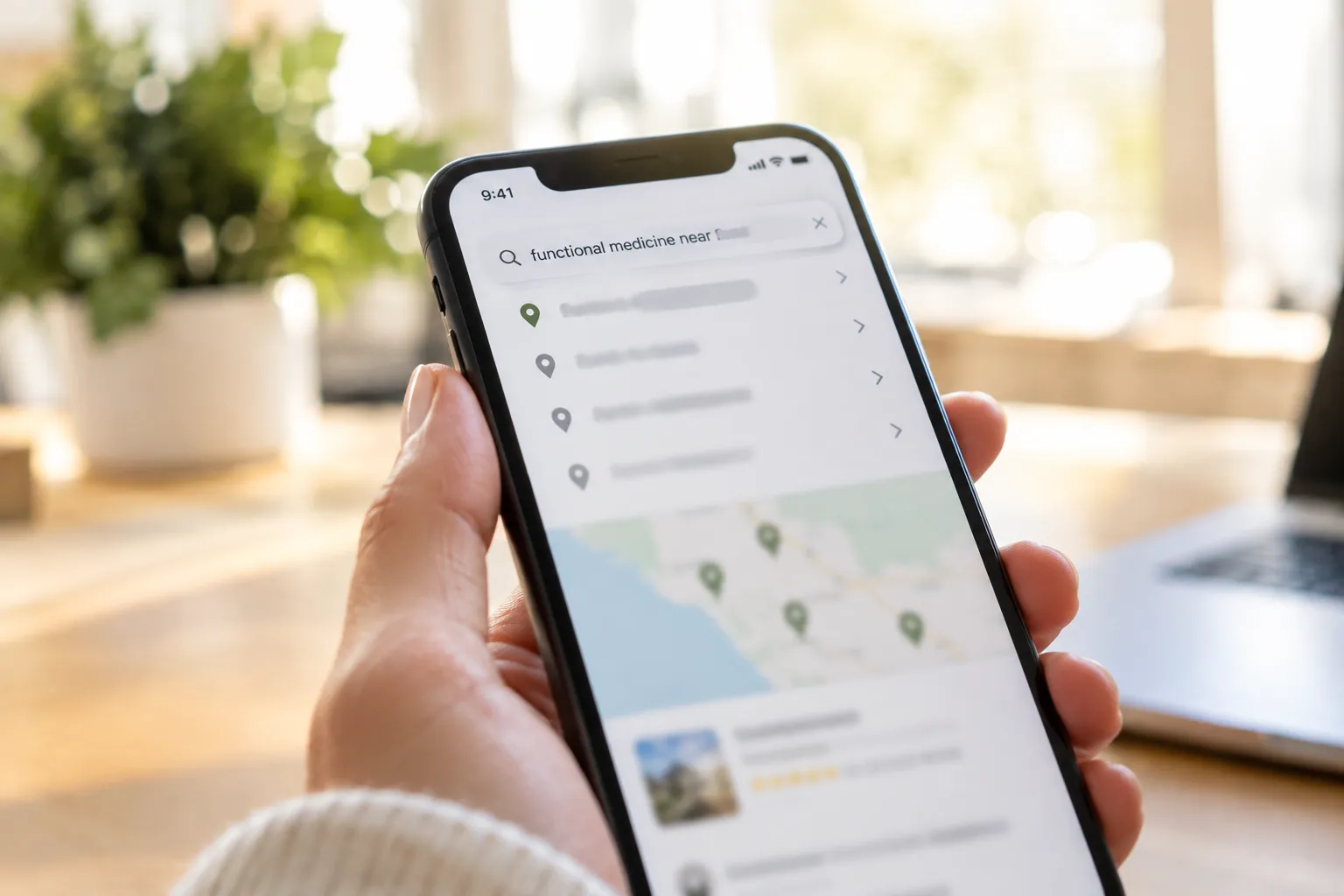
A "near me" search carries explicit local intent — and surfaces the map pack alongside it.
City-Specific Searches
The campaigns also separated several local markets individually: Palo Alto, Portola Valley, Menlo Park, and Los Altos. The clinic serves patients from across these areas, but the economics may not be identical. Over time we may find that Palo Alto generates more search volume, Portola Valley produces fewer clicks but higher-value enquiries, Menlo Park has lower CPCs, or Los Altos generates stronger booking intent. At launch, we do not know — the structure is designed so we can find out.
Why city segmentation matters for premium healthcare
This becomes particularly relevant for integrative and functional medicine practices. Many of these clinics have higher consultation fees, longer patient decision cycles, larger treatment values, and patients willing to travel farther for care. That means local behavior may not follow the same patterns as a lower-ticket local service. A patient searching in Palo Alto may be willing to drive to Portola Valley. Someone searching "Bay Area" may be comparing physicians across several cities. Someone searching "near me" may prioritize convenience more heavily. We do not want to assume those patients are interchangeable.

Higher-value, longer-cycle consultations are exactly why we don't treat every local search the same.
Why We Included "Bay Area" Separately
"Bay Area" is broader than a city search. Someone searching "hormone doctor Bay Area" may be willing to travel significantly farther than someone searching "hormone doctor Palo Alto." That creates a different geographic signal, so the regional terms were separated rather than grouped into city traffic — giving us the ability to compare broader regional demand against tighter local intent.
The Structure Also Helps With Ad Messaging
Geographic segmentation is not only useful for reporting. It also makes ad messaging easier to align. A person searching for "perimenopause doctor Palo Alto" can be shown messaging that feels more locally relevant than someone searching a generic term. The same principle applies to landing pages and extensions. The closer the ad experience matches the searcher's language, the easier it becomes to create a coherent path from search to ad to landing page to booking.
It Helps Us Control Search-Term Quality
Geographic structure also makes search-term auditing easier. If a city-specific ad group begins attracting searches from outside the intended context, we can identify it quickly. If "near me" terms produce better commercial intent than generic terms, we can see that. If a regional term like "Bay Area" generates expensive but weak traffic, that becomes visible too. Without segmentation, those differences are buried inside one larger data set.
This Structure Was Repeated Across Both Service Campaigns
One of the most useful things about the account is that the same geographic framework was applied across two different services. That means we will eventually be able to compare not only location vs. location, but also service vs. service within the same location type — for example, Perimenopause Palo Alto vs. metabolic health Palo Alto, Perimenopause near me vs. metabolic health near me, or Hormone Bay Area vs. preventive health Bay Area. That creates a much more useful dataset over time.
The Match-Type Layer Added Another Dimension
The original account structure also included phrase/exact and broad-match versions of many of these geographic ad groups, creating combinations such as service + geography + match type — for example, Perimenopause Palo Alto Phrase/Exact, Perimenopause Palo Alto Broad, Hormone Near Me Phrase/Exact, Hormone Near Me Broad, Metabolic Health Bay Area Phrase/Exact, Metabolic Health Bay Area Broad.
After launch, the phrase/exact groups were paused and the broad counterparts were enabled. That means future analysis can compare geographic intent within the current broad-match structure while still preserving the first phase as a baseline — the same match-type shift covered in our campaign structure case study.
Why We Prefer This to One Large Local Ad Group
The simpler alternative would have been something like one ad group named "Perimenopause" with keywords for near me, Palo Alto, Portola Valley, Menlo Park, Los Altos, Bay Area, and generic searches all mixed together. That would be easier to manage. It would also make it harder to answer which market generates the strongest demand, which location produces the best CTR, where CPCs are highest, whether "near me" searches convert better than city searches, whether regional traffic is commercially useful, or whether budget should be shifted geographically. The structure we used was designed to answer those questions.
What We Expect to Learn
The account is still too new to make performance claims by location. But as data accumulates, we will be watching for several patterns:
| Question | What we're watching for |
|---|---|
| Search volume by geography | Which markets actually generate meaningful demand? |
| CPC differences | Are certain cities significantly more competitive? |
| Conversion rate | Does explicit city intent outperform generic local searches? |
| "Near me" performance | Does convenience-focused intent produce more consultations? |
| Regional performance | Can broader Bay Area searches generate qualified patients efficiently? |
| Service-location combinations | Does one service perform particularly well in a specific city? |
What This Means for Other Healthcare Practices
A local healthcare Google Ads campaign does not have to treat geography as one setting buried inside the campaign. Geography can also be part of search intent. There is a meaningful difference between someone located in Palo Alto and someone explicitly searching "Palo Alto." The first is a targeting condition. The second is a signal in the search itself. We want to measure both. For practices serving multiple nearby cities, that distinction can become commercially useful.
The Main Takeaway
For these two integrative medicine campaigns, we separated geographic intent into generic service searches, near-me searches, Palo Alto, Portola Valley, Menlo Park, Los Altos, and Bay Area — then repeated that structure across the main service themes.
The objective was not to make the account look sophisticated. It was to make the data easier to interpret. As the campaigns accumulate clicks and conversions, we will be able to see whether different geographic intents produce different acquisition economics. That is the value of the structure — it turns geography from a targeting setting into something we can actually measure.
Wellness Practice Marketing specializes in Google Ads, SEO, Local SEO, and conversion-focused websites for functional and integrative medicine practices. We structure campaigns around real patient intent, including service line, search language, geography, and landing-page relevance, so clinics can see where their marketing budget is actually working. If you want us to build or audit the Google Ads structure for your clinic, learn more about our Google Ads management for functional and integrative medicine practices.